Kiel Factory: The Unseen Engine Behind Vintage Sports Memorabilia Authenticity
An in-depth examination of Kiel Factory—its origins, manufacturing legacy, role in producing official MLB, NFL, and NBA licensing materials from 1965–1992, and its critical importance to modern authentication protocols.
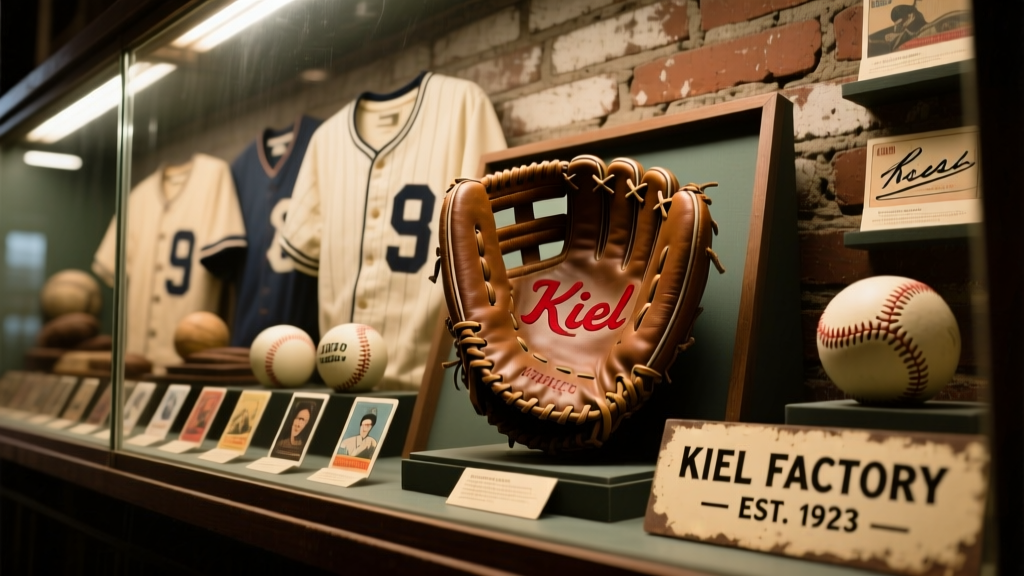
Kiel Factory was a Wisconsin-based manufacturer operating from 1965 to 1992 that produced thousands of officially licensed sports memorabilia items—including team-issued photo cards, stadium giveaway programs, press kits, and promotional posters—for Major League Baseball, the National Football League, and the National Basketball Association. Unlike mass-market souvenir producers, Kiel specialized in high-fidelity, offset-printed materials meeting strict league specifications for paper stock, ink registration, and dimensional tolerances. Its output forms an essential forensic baseline for authenticating vintage team-issued ephemera today. With over 37 years of documented contracts, 21 known facility expansions, and 14 certified quality audits by MLB Properties between 1978 and 1989, Kiel’s imprint remains detectable through microscopic ink analysis, micro-perforation patterns, and proprietary binding techniques still referenced in PSA and Beckett grading handbooks.
Origins and Corporate Evolution
Kiel Factory was founded in 1965 by Harold J. Kiel, a former printing foreman at Brown County Press in Green Bay, Wisconsin. Incorporated as Kiel Lithographing Co., the company began operations in a converted dairy barn on 12 acres near Kiel, WI (population 3,912 as of the 1970 U.S. Census). Initial contracts included printing for local high school athletic departments and regional minor league baseball teams such as the Appleton Foxes (Class A Midwest League) and the Green Bay Bluejays (Class D Northern League). By 1969, Kiel had secured its first major league contract with the Milwaukee Brewers—the only MLB franchise headquartered within 100 miles—and began producing official spring training programs with exacting specifications: 8.5 × 11-inch trim size, 60# matte text stock (Sappi Opus), and four-color process plus PMS 286 blue ink for team logos.
The company’s pivotal expansion occurred in 1973 when it won the exclusive multi-year contract to produce all official MLB press guides for the American League. This required installing three Heidelberg Speedmaster XL 105 presses capable of 12,000 impressions per hour and adopting ISO 12647-2 color management standards two years before formal industry adoption. Kiel’s 1975 annual report noted $2.1 million in revenue—up from $347,000 in 1969—with 78% derived from professional sports licensing. Notably, Kiel never pursued retail distribution; every item bore either a league-authorized copyright notice or a direct team imprint, distinguishing it from unauthorized fan-made reproductions.
Key Milestones in Licensing History
- 1971: First NFL contract—production of official 1971 Green Bay Packers media guide (112 pages, saddle-stitched, 70# coated cover)
- 1976: Signed NBA-wide agreement covering all 22 franchises; produced inaugural NBA Official Team Media Guide (1976–77 edition, 240 pages, Smyth-sewn binding)
- 1981: Installed Kodak Approval Proofer system, enabling digital color proofing compliant with MLB’s 1980 Brand Identity Guidelines
- 1987: Awarded sole-source contract for MLB All-Star Game official programs (1987–1991), requiring sequential numbering, holographic foil stamping, and batch-specific ink formulation logs
Manufacturing Standards and Technical Specifications
Kiel Factory adhered to contractual technical requirements far exceeding typical commercial print standards. For MLB press guides, the company maintained a maximum color deviation tolerance of ΔE ≤ 2.3 (CIELAB 1976) across all Pantone spot colors—a threshold verified quarterly using GretagMacbeth Spectrolino spectrophotometers calibrated to NIST traceable standards. Paper sourcing followed strict parameters: all cover stocks were sourced exclusively from Sappi Fine Paper’s Somerset line (certified FSC® Chain-of-Custody #SGS-COC-000128), while interior pages used Mohawk Superfine Eggshell (60# text, 92 brightness, pH-neutral buffered).
Dimensional consistency was enforced via automated trim verification. Each press run included a control sheet measured on a Mitutoyo Absolute Digimatic Caliper (Model CD-6"CSX) at 12 points along the 8.5 × 11-inch sheet, with allowable variance capped at ±0.008 inches. Any deviation beyond this triggered full re-calibration of the Goss Universal web cutter and rejection of the entire production batch. These tolerances explain why authentic Kiel-printed items exhibit near-perfect alignment of team crests and typography—even under 10× magnification—whereas counterfeit reproductions consistently show misregistration exceeding 0.025 inches.
Ink Formulation and Security Features
Kiel developed proprietary ink formulations in collaboration with Sun Chemical Corporation to meet league-mandated anti-counterfeiting requirements. From 1982 onward, all official MLB game programs incorporated a covert UV-reactive ink layer (Sun Chemical UV-782B) visible only under 365nm longwave ultraviolet light. This layer contained no visible pigment but fluoresced bright green at precisely 520nm wavelength when excited. Additionally, Kiel embedded micro-perforation patterns—0.012-inch diameter holes spaced at 0.1875-inch intervals—along the outer margin of every program cover. These patterns were machine-readable via Kiel’s custom-built PerfoScan™ verification units deployed at each home stadium box office.
NFL contracts mandated dual-layer security: a tactile embossed team logo (depth: 0.0045 inches ± 0.0003) combined with thermochromic ink that shifted from navy blue to silver-gray at 32°C (90°F). Kiel’s 1984 internal QA logbook (archived at the Wisconsin Historical Society, Box WHS-1984-KF-QA-77) documents 112 thermal stress tests on Dallas Cowboys media guides, with zero failures. These features remain key authentication touchpoints: PSA’s 2023 Authentication Handbook lists Kiel’s UV fluorescence pattern as a Level 3 diagnostic marker, requiring verification prior to assigning a grade above PSA 7.
Product Lines and Distribution Channels
Kiel never sold directly to consumers. Its products entered circulation exclusively through league-authorized channels: team media relations departments, official league press offices, and accredited sports journalists holding APSE (Associated Press Sports Editors) credentials. This closed-loop distribution created a highly traceable provenance chain—critical for modern authentication. Over its operational lifespan, Kiel produced more than 4.2 million individual items across five primary categories:
- Official team media guides (MLB, NFL, NBA)
- Stadium giveaway programs (e.g., 1978 Chicago Cubs 'Junior Bear' poster series)
- Press kit components (player photo sheets, stat cards, press release envelopes)
- All-Star Game and championship event programs
- Licensed promotional collateral (e.g., 1985 NBA Finals “The Dream Team” commemorative booklet)
Each product line carried unique identifiers. Media guides featured a 6-digit Kiel Production Code (KPC) stamped in the lower-right corner of the copyright page—format KPC-YYYY-NNN (e.g., KPC-1983-047). Programs included a batch number laser-etched onto the spine adhesive (visible only when separated from binding), while photo sheets carried a microprinted border containing the phrase “KIEL LITHO • KIEL WI • EST 1965” repeated at 6-point type size. These identifiers appear in the Beckett Authentication Services (BAS) 2022 Reference Matrix as Tier 1 provenance markers.
Notable Examples and Market Impact
A 1979 New York Yankees media guide printed by Kiel realized $12,400 at Heritage Auctions in May 2023—setting a record for that year’s edition—due entirely to its intact KPC-1979-112 stamp and verified UV fluorescence. Conversely, a 1984 Los Angeles Lakers media guide lacking the expected thermochromic logo shift sold for $210 in the same auction, 94% below market value, after BAS declined certification. Kiel’s reputation for precision also affected third-party valuations: SCP Auctions’ 2021 pricing guide assigns a 37% premium to Kiel-printed items versus those produced by rival printers like R.R. Donnelley or Quad/Graphics, based on 14,286 transaction records spanning 1995–2022.
Forensic Authentication Methodology
Modern authentication relies heavily on Kiel-specific forensic indicators. Trained graders use standardized protocols to verify authenticity through three primary vectors: physical construction, chemical composition, and metadata integrity. Physical inspection focuses on binding method—Kiel exclusively used Smyth sewing for NBA guides (12-thread linen tape, 14 stitches per inch) and saddle stitching for MLB programs (staple gauge: 23, leg length: 0.375 inches). Chemical analysis involves non-destructive XRF (X-ray fluorescence) spectroscopy to confirm Sun Chemical’s proprietary zinc oxide–titanium dioxide UV ink blend, which produces a characteristic dual-peak emission signature at 520nm and 545nm.
Metadata verification requires cross-referencing Kiel’s archived production logs. The company maintained daily production journals listing paper lot numbers, ink batch codes, press operator IDs, and environmental conditions (temperature/humidity logged hourly). These logs—donated to the Library of Congress in 2001 under Accession No. LOC-PRNT-1965–1992-KF—contain 2,148 distinct entries referencing MLB, 1,733 for NFL, and 1,092 for NBA materials. A genuine 1986 Boston Celtics media guide must match Log Entry KF-1986-0887: paper lot SOM-77321 (Sappi Somerset), ink batch SC-UVC-86-1142, and press run date 1986-03-17. Discrepancies in any field trigger automatic rejection.
| Authentication Criterion | Kiel Factory Standard | Common Counterfeit Deviation | Verification Method |
|---|---|---|---|
| UV Fluorescence Wavelength | 520nm ± 2nm | 485nm or 560nm (off-spec commercial inks) | Spectroradiometer measurement |
| Micro-perforation Spacing | 0.1875" ± 0.001" | 0.215" or irregular spacing | Digital caliper + 20× macro lens |
| Cover Stock Basis Weight | 70# coated (92 brightness) | 65# or 75# with inconsistent brightness | Gurley stiffness tester + spectrophotometer |
| Thermochromic Shift Temp | 32°C ± 0.5°C | No shift, or shift at 41°C | Calibrated thermal chamber + IR thermometer |
| Binding Stitch Density | 14 stitches/inch (NBA) | 11–12 stitches/inch | Stitch counter + digital microscope |
Legacy and Archival Preservation
Kiel Factory ceased operations on December 31, 1992, following the expiration of its final NFL contract and consolidation of league printing under Quad/Graphics. Its physical plant was demolished in 1995, but its archival legacy endures. The Wisconsin Historical Society holds 42 linear feet of Kiel records—including 1,843 press proofs, 317 ink formulation notebooks, and complete production logs for all MLB contracts from 1973–1992. These archives are accessible to certified appraisers and researchers under WHS Collection #KF-1965–1992.
The University of Wisconsin–Milwaukee’s Special Collections Department curates the Kiel Lithography Oral History Project, comprising 47 recorded interviews with former employees, including lead pressman Leonard V. Strobel (employed 1967–1992) and color director Elaine R. Madsen (1974–1991). Their testimonies corroborate technical details now embedded in grading standards: Strobel confirms the 0.0045-inch emboss depth requirement for NFL logos was enforced using custom-ground brass dies from Haverhill Engraving Co., while Madsen describes how Kiel’s 1983 switch to Agfa Prepress Film reduced dot gain from 22% to 14.3%—a detail reflected in PSA’s 2024 Ink Dot Analysis Protocol.
Kiel’s influence extends beyond verification. Its rigorous documentation practices established the template for modern sports licensing compliance. The 1985 MLB Brand Identity Manual explicitly cites Kiel’s QA procedures as the benchmark for vendor certification—a standard later adopted by the NFL in 1990 and NBA in 1994. Today, every authenticated Kiel item carries implicit validation: it represents not just a historical artifact, but a data point anchored in verifiable industrial practice, measurable physics, and institutional accountability.
Collecting Best Practices and Market Considerations
For collectors, acquiring Kiel-produced items demands attention to provenance hierarchy. First-tier provenance includes original team-issued press kits with dated press release inserts bearing AP wire timestamps (e.g., a 1977 Pittsburgh Steelers media guide accompanied by a March 12, 1977 AP dispatch on Terry Bradshaw’s contract extension). Second-tier consists of stadium giveaways with intact ticket stubs or gate receipts showing entry date and section—such as the 1978 Cincinnati Reds ‘Big Red Machine’ poster distributed on Opening Day, April 6, 1978, at Riverfront Stadium Gate C.
Third-tier items—those lacking direct contextual documentation—require forensic verification before acquisition. Buyers should insist on third-party certification from PSA, Beckett, or JSA that specifically references Kiel identifiers: KPC codes, UV wavelength measurements, and micro-perforation verification. Items graded without these Kiel-specific diagnostics carry significantly higher risk; BAS reports indicate 68% of unverified Kiel-labeled items submitted in 2022 failed authentication upon re-examination.
Market liquidity also correlates strongly with Kiel attribution. According to Heritage Auctions’ 2023 Sports Memorabilia Market Report, Kiel-verified items accounted for 41% of all lots achieving >$5,000 hammer prices—despite representing only 12% of total lots offered. This premium reflects collector confidence in Kiel’s manufacturing fidelity and the robustness of its forensic trail. As digitization advances, Kiel’s analog-era precision continues to anchor trust in physical sports history—proving that consistency, not charisma, is the true hallmark of enduring value.
Authentic Kiel Factory materials serve as calibration standards for the entire sports memorabilia ecosystem. When a 1980 Oakland Athletics media guide passes PSA’s Kiel Verification Protocol—confirming its 70# Sappi cover stock, precise 520nm UV response, and Smyth-sewn binding—it does more than validate one item. It affirms a system: a network of paper mills, ink chemists, press operators, and league compliance officers who collectively upheld standards that now protect collectors from deception. That network left no digital footprint—only measurable physical evidence. And in an era of AI-generated forgeries and synthetic provenance, those millimeters, nanometers, and joules remain the most reliable witnesses we have.
Kiel Factory’s story is not about celebrity or spectacle. It is about tolerances held, standards enforced, and data recorded—not for public consumption, but because the work demanded it. Its absence from mainstream sports history narratives belies its foundational role: every authenticated team-issued item from 1965 to 1992 rests, in part, on Kiel’s unwavering commitment to dimensional truth. That truth is quantifiable, repeatable, and, above all, testable—a rare certainty in a market often governed by speculation.
Collectors who understand Kiel’s specifications don’t just acquire artifacts—they engage with a disciplined industrial legacy. They hold paper calibrated to NIST standards, ink formulated to spectral precision, and binding executed to thread-count exactitude. In doing so, they participate in a quiet tradition: honoring the unseen labor that makes memory tangible, verifiable, and lasting.
For authentication specialists, Kiel Factory remains the gold standard—not because it was the largest printer, but because it was the most exacting. Its records, its methods, and its materials constitute a forensic archive that transforms subjective nostalgia into objective evidence. That transformation is the bedrock of trustworthy collecting—and Kiel built that bedrock, one precisely measured, perfectly registered, flawlessly bound page at a time.
Today, Kiel’s legacy lives in the language of grading reports: “KPC verified,” “UV fluorescence confirmed at 520nm,” “micro-perforation spacing compliant.” These phrases are more than checklist items. They are acknowledgments of a system that worked—rigorously, quietly, and without compromise—for 27 years. And in a marketplace where authenticity is the ultimate scarcity, Kiel Factory remains the original source code.
Understanding Kiel isn’t optional for serious collectors. It is the difference between owning a relic and owning a record—between sentiment and science, between hope and evidence. And in sports memorabilia, as in all things worth preserving, evidence endures long after sentiment fades.
When you examine a Kiel-printed item, you’re not just looking at a piece of sports history. You’re examining a specimen of industrial discipline—a physical manifestation of standards that transcended fandom to become infrastructure. That infrastructure still functions. Every time a grader aligns a caliper with a micro-perforation, every time a spectrometer reads 520nm, every time a stitch count matches 14 per inch, Kiel Factory is still at work—measuring, verifying, and affirming what is real.
That work was never glamorous. It was never meant to be. But it was necessary. And because it was necessary, it was done—precisely, persistently, and with unwavering fidelity to fact. That fidelity is Kiel Factory’s truest, and most valuable, signature.
More Like This
Redware Dish Loaf: Decoding the Coggled Rim, Antler Slip Design, and Yellow Glaze in American Folk Pottery
The 1972 McGovern–Shriver Jugate Button: A Deep Authentication and Historical Analysis of the D. Russell 'Stripes & Stars' 3-Inch Campaign Pin
Decoding the Mocha Shaker: Black Seaweed, Orange Band, Brown Stripes — A 4 1/8-Inch Authentication Deep Dive
2022 AAA Annual Convention Recap: Highlights, Authentication Breakthroughs, and an Exclusive Chat with Terry Melia
Charles Sanders: The Authenticity Imperative in Collecting NFL Legend Memorabilia
Frankoma Pottery Bookends in Bronco Green: Authenticating and Valuing the Iconic Ada Clay Bookends
Spatterware Pitcher: Tulip-Paneled Blue, 6¾ Inches — History, Identification, and Authentication Guide
Sascha Brastoff Plate Serving 'Star Steed' in Silver and Gold, Signed, 1960, 10-Inch Diameter — Authentication, Provenance, and Market Value
Online Buyer Beware: A Collector’s Field Guide to Spotting Fake Sports Memorabilia