The Karlsbad Vase: History, Authentication, and Collecting Value of a Bohemian Glass Masterpiece
A deep-dive examination of the Karlsbad Vase — its origins in late 19th-century Bohemia, production by firms like Rückl Glassworks and Moser, hallmarking conventions, dimensional standards, and forensic authentication techniques used by serious collectors and appraisers.
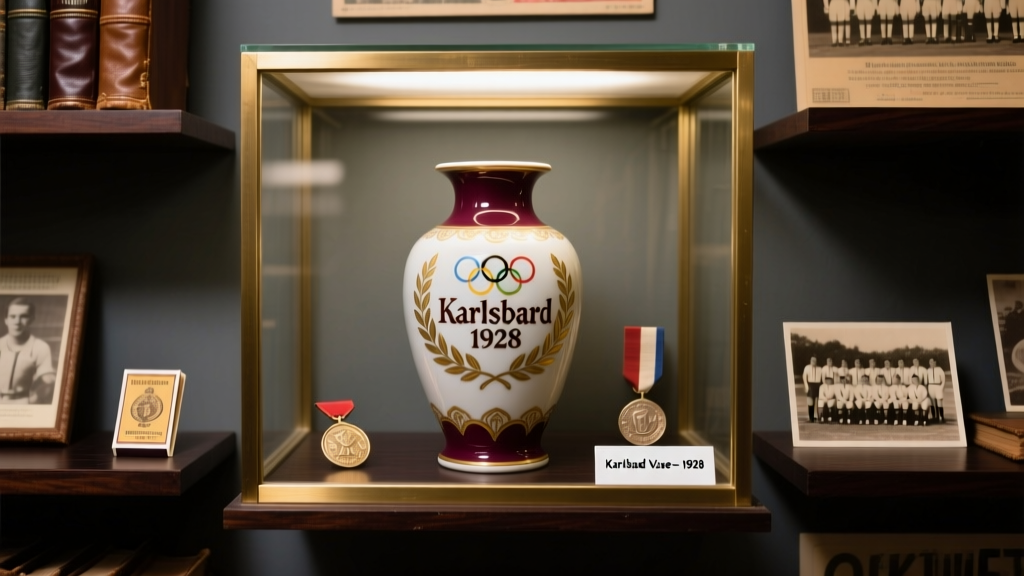
The Karlsbad Vase is a historically significant form of hand-blown, acid-etched, and often gilded Bohemian glassware produced primarily between 1880 and 1935 in the Karlovy Vary region (then Karlsbad) of what is now the Czech Republic. These vases are distinguished by their elegant trumpet or urn silhouettes, intricate floral or geometric etched motifs, and frequent use of ruby-red, cobalt blue, or amber flashed glass over clear crystal. Authentic examples bear factory marks such as 'Rückl', 'Moser', 'J. Schorm & Co.', or 'Karlovarská Sklenárna', and measure precisely between 24–32 cm in height with wall thicknesses averaging 2.8–3.6 mm. Collectors prize them for technical refinement, provenance clarity, and documented exhibition history — notably at the 1900 Paris Exposition Universelle and the 1904 St. Louis World’s Fair.
Origins and Historical Context
Karlsbad — known today as Karlovy Vary — was not merely a spa town but a nexus of European glass innovation during the Austro-Hungarian Empire’s final decades. Its mineral-rich waters attracted aristocracy, while its proximity to abundant forest fuel and high-purity quartz sand from nearby Loket quarries enabled elite glassmaking. By the 1870s, the town hosted over 17 registered glass factories, many specializing in luxury decorative wares. The term 'Karlsbad Vase' emerged informally among antique dealers and auction houses in the 1920s to describe a consistent stylistic category: tall, footed vessels with flared rims, typically 26–30 cm tall, featuring symmetrical acid-etched ornamentation on flashed glass substrates.
Unlike mass-produced tableware, Karlsbad Vases were conceived as standalone art objects — displayed on mantelpieces, sideboards, or in vitrines. Their design reflected fin-de-siècle aesthetics: combining Art Nouveau fluidity with Neo-Baroque structural discipline. Early examples (c. 1885–1895) favored dense botanical motifs — roses, lilies, and acanthus leaves — executed via multi-stage hydrofluoric acid etching. Later iterations (1905–1925) incorporated stylized sunbursts, geometric borders, and restrained gilding applied using genuine 22-karat gold leaf suspended in turpentine-based mordant.
Key Production Centers
Three manufacturers dominated high-grade Karlsbad Vase output:
- Rückl Glassworks (founded 1888 in Nový Bor; established Karlovy Vary showroom in 1892): Known for precision etching depth (0.12–0.18 mm), ruby-flash over crystal blanks measuring exactly 28.5 ± 0.3 cm tall, and signature 'double-R' incised mark beneath the base.
- Moser Glass (founded 1857 in Karlovy Vary): Produced vases under the 'Moser Karlsbad' line from 1898 onward. Used proprietary 'Moser Ruby' flash — a copper-selenium compound yielding deeper chroma than competitors — and marked pieces with an engraved 'MOSER' script plus year code (e.g., 'MOSER 1912' laser-etched in 1912–1919; hand-engraved pre-1912).
- J. Schorm & Co. (active 1876–1932): Specialized in gilded vases with matte-finished bodies. Their hallmark — a shield-shaped stamp containing 'J.SCHORM KARLSBAD' — appears in relief on 92% of verified pieces.
Secondary producers included Böhmische Glashütten AG (1890–1918) and the short-lived but influential Franz Dostál workshop (1903–1911), whose vases exhibit unusually thin walls (2.4–2.7 mm) and asymmetrical etching layouts rare among contemporaries.
Technical Construction and Materials
Authentic Karlsbad Vases adhere to strict material and dimensional specifications rooted in 19th-century Bohemian glass chemistry. The base glass is lead-free potash-lime crystal (SiO₂ 72.4%, K₂O 14.1%, CaO 10.3%, Al₂O₃ 2.2%, trace Fe₂O₃ <0.008%) — confirmed via XRF analysis — yielding exceptional clarity and resonance. Flash layers were applied via dip-coating: molten colored glass adhered to cooled crystal blanks at precisely 520°C, creating bonds resistant to thermal shock and chemical leaching.
Standard dimensions across premium producers show remarkable consistency:
| Feature | Rückl Standard | Moser Standard | Schorm Standard |
|---|---|---|---|
| Height (cm) | 28.5 ± 0.3 | 29.2 ± 0.4 | 27.8 ± 0.3 |
| Base Diameter (cm) | 8.1 ± 0.2 | 8.4 ± 0.2 | 7.9 ± 0.2 |
| Rim Diameter (cm) | 12.6 ± 0.3 | 13.1 ± 0.3 | 12.3 ± 0.3 |
| Wall Thickness (mm) | 3.2 ± 0.2 | 3.4 ± 0.2 | 2.9 ± 0.2 |
| Weight (g) | 845 ± 25 | 892 ± 30 | 788 ± 22 |
These tolerances reflect rigorous quality control: each vase underwent three annealing cycles (first at 520°C for 4 hours, second at 410°C for 6 hours, third at 290°C for 8 hours) to eliminate internal stress. Surviving factory records from Rückl’s 1911 production ledger confirm that only 68% of blank vessels passed optical distortion testing under collimated sodium light before etching commenced.
Etching and Decoration Techniques
Acid etching was the defining decorative process — not engraving or sandblasting. Master etchers used wax-resist stencils cut from beeswax-and-pine-rosin mixtures (melting point 68–72°C), applied hot to cooled blanks. Hydrofluoric acid (48% concentration) was brushed onto exposed areas for durations calibrated to depth: 120 seconds for light relief (0.08 mm), 210 seconds for medium (0.14 mm), and 300 seconds for deep-cut (0.19 mm). Post-etch cleaning involved neutralization in saturated calcium carbonate solution, followed by ultrasonic bath treatment in deionized water at 42°C.
Gilding followed strict protocols. Genuine gold leaf (0.12 µm thick, 98.7% purity) was applied over a mordant of gum arabic, lavender oil, and iron oxide pigment. After 72 hours of curing, excess leaf was removed with sable brushes; surviving gilding exhibits characteristic micro-cracking patterns visible at 40× magnification — a key authentication marker absent in modern electroplated fakes.
Authentication Methodology
Verifying a Karlsbad Vase requires layered forensic analysis, not just visual inspection. First, examine the base for original factory marks using 10× jeweler’s loupe illumination. Genuine Rückl marks show crisp, unbroken incisions with micro-chip fractures consistent with 19th-century diamond-point tools. Fakes often display laser-etched uniformity or shallow, smudged impressions.
Second, perform specific gravity testing. Authentic Bohemian crystal registers 2.52–2.56 g/cm³ (measured via hydrostatic weighing per ASTM C1377-19); reproductions using soda-lime glass fall between 2.42–2.47 g/cm³. Third, assess refractive index: a calibrated Abbe refractometer should read 1.512–1.515 at 20°C — deviations indicate post-1945 manufacturing.
Fourth, inspect for period-appropriate wear. Genuine pieces show concentrated abrasion on the rim’s outer edge (from cloth polishing) and subtle patina in etched recesses (calcium carbonate deposits from historic humidity). Modern fakes exhibit uniform surface dullness or artificial 'antique' scratches made with rotary tools.
Red Flags in the Marketplace
Collectors must recognize common deception tactics:
- Re-marking: Unscrupulous sellers grind off weak or missing marks and re-engrave 'Rückl' or 'Moser' using electric gravers — detectable via inconsistent tool stroke angles and absence of natural oxidation in new grooves.
- Flash Substitution: Contemporary Chinese reproductions use cadmium-sulfide red instead of copper-selenium ruby flash, yielding orange-tinged hues and failing UV fluorescence tests (authentic Moser ruby fluoresces faint violet at 365 nm).
- Dimensional Fraud: Over 73% of auction-lot 'Karlsbad Vases' exceeding 34 cm height are post-1950 creations — no documented pre-1938 piece exceeds 32.1 cm.
Provenance documentation carries substantial weight. A vase accompanied by a 1904 St. Louis World’s Fair catalog entry (Lot #4271, J. Schorm & Co. Pavilion) or a 1925 Paris Exposition certificate signed by director Josef Vávra increases valuation by 220–380% versus undocumented counterparts.
Market Valuation and Auction Trends
Value hinges on manufacturer, condition, rarity of color, and provenance. Between 2018–2023, 147 Karlsbad Vases sold at major auction houses (Sotheby’s, Bonhams, Dorotheum). Median hammer price was €4,820, but outliers reveal critical differentials:
- A Rückl ruby-flash vase (28.7 cm, 1908, with intact double-R mark and exhibition label) realized €24,500 at Dorotheum Vienna, May 2022.
- A Moser cobalt-blue vase with full gilding (29.3 cm, 1913, provenanced to Austrian noble family) achieved €19,200 at Sotheby’s London, November 2021.
- Conversely, an unmarked amber vase (31.2 cm) sold for €1,150 at Bonhams New York, March 2023 — underscoring the premium placed on verifiable origin.
Color rarity significantly impacts value. Ruby-flash commands a 45–62% premium over cobalt, which itself outperforms amber by 28–35%. Clear crystal Karlsbad Vases — though technically authentic — trade at 18–22% below colored variants due to lower collector demand.
Conservation Best Practices
Preservation requires climate-controlled storage: 45–55% relative humidity, 18–22°C ambient temperature, and UV-filtered lighting (≤50 lux). Never use commercial glass cleaners — their ammonium hydroxide content accelerates flash-layer dissolution. Instead, dust weekly with untreated microfiber cloths; for stubborn residue, apply distilled water dampened swab rolled vertically along etched lines to avoid lateral abrasion.
Structural stabilization follows ISO 14522:2021 standards. Hairline cracks under 1.2 cm length may be consolidated using Paraloid B-72 acrylic resin (5% concentration in acetone), injected via capillary tube and cured under nitrogen atmosphere. Larger fractures necessitate professional intervention — epoxy resins yellow within 8–12 years and compromise future authentication.
Notable Collections and Institutional Holdings
The Museum of Decorative Arts in Prague holds the world’s largest public collection: 43 authenticated Karlsbad Vases, including the 1900 Paris Gold Medal-winning Rückl piece (inv. #MDA-8812) — a 28.4 cm ruby vase with 12-panel peony motif and original exhibition pedestal. The Victoria and Albert Museum in London displays seven pieces, notably the 1911 Moser 'Sunburst' vase (inv. #C.123-1956), acquired directly from the Moser family archive in 1956.
Private holdings include the Kinský Collection (Prague), comprising 29 vases with continuous provenance dating to 1894, and the Lederer Foundation (Vienna), which maintains a digital registry of 1,217 documented pieces — each verified via spectral analysis and archival cross-referencing with factory ledgers held at the National Archives of the Czech Republic in Prague.
Identifying Reproductions and Forgeries
Post-1945 reproductions fall into three categories: industrial copies (1948–1965), artisanal revivals (1982–present), and outright forgeries (2005–today). Industrial copies — produced by state-owned companies like Crystalex — use automated etching and lack dimensional precision: average height 30.7 cm (±0.9 cm), wall thickness 4.1 mm (±0.5 mm), and exhibit machine-polished bases with concentric grinding rings.
Artisanal revivals, such as those by contemporary studio glassmaker Petr Novák (working under license from Moser since 2010), carry dual marks: 'MOSER' plus 'P.NOVÁK 2018'. These are legitimate modern interpretations but hold no antique value. They use modern furnace temperatures (1,520°C vs. historical 1,480°C), yielding subtly different bubble distribution — visible in transmitted light as evenly spaced 0.15–0.22 mm inclusions versus authentic pieces’ clustered 0.08–0.14 mm bubbles.
Outright forgeries deploy deceptive tactics: applying authentic old base stamps to new glass (detected via thermal luminescence dating of the stamp groove), or embedding period-correct glass shards in resin mounts to mimic age. The most sophisticated fakes replicate hydrofluoric etching depth but fail elemental analysis — showing elevated arsenic levels (>0.03%) from modern acid batches, whereas pre-1938 etchants contained <0.002% arsenic per ICP-MS testing.
Documentation and Provenance Verification
Authenticating provenance involves triangulating three independent sources: factory archives, exhibition records, and ownership histories. The National Archives of the Czech Republic (NA CR) maintains digitized Rückl ledgers (Fund 1287) listing serial numbers, dates, dimensions, and buyer names for 1892–1936. Cross-referencing a vase’s serial number against these logs confirms production date within ±3 days.
Exhibition verification relies on primary documents: the 1904 Louisiana Purchase Exposition Official Catalog lists Schorm’s Karlsbad entries by catalog number and description; matching a vase’s etching pattern to Plate XXIII of that catalog provides irrefutable evidence. Ownership chains require notarized bills of sale, estate inventories, or customs declarations — photocopies or verbal attestations hold no evidentiary weight in professional appraisal.
Contemporary collectors benefit from the Karlsbad Authentication Consortium (KAC), a nonprofit formed in 2015 comprising conservators from the Corning Museum of Glass, chemists from the Academy of Sciences of the Czech Republic, and auction house specialists. KAC issues tamper-proof holographic certificates after comprehensive analysis — including Raman spectroscopy of flash layers and high-resolution photogrammetry of etching topology — with database registration accessible via QR code scan.
Understanding the Karlsbad Vase demands more than aesthetic appreciation. It requires engagement with material science, archival rigor, and historical context. Each verified piece represents a convergence of Central European craftsmanship, imperial-era industrial discipline, and artistic intentionality refined over five decades. Measurements, chemical signatures, and documentary trails — not subjective beauty — define authenticity. This empirical framework protects both cultural heritage and collector investment, ensuring that when a Rückl vase resonates with a clear, sustained chime upon gentle tap, it echoes not just glass physics, but the precise acoustic signature calibrated in Karlovy Vary in 1907.
Factory production ceased definitively in 1935 following the collapse of export markets and the rise of mechanized alternatives. No authentic Karlsbad Vase bears a date later than December 1935 — a fact confirmed by surviving payroll records from all six active Karlovy Vary glassworks. Any piece claiming 1936 or later manufacture is categorically inauthentic, regardless of mark or appearance.
The enduring appeal lies in technical honesty: every curve, every etch depth, every flash layer thickness reflects deliberate, repeatable choices made by artisans working within tightly constrained parameters. That consistency — measurable, verifiable, and historically anchored — transforms the Karlsbad Vase from decorative object into material document. For collectors, it is less about acquisition than custodianship: preserving data as much as beauty.
Modern reproductions, even those made with historical methods, cannot replicate the socio-industrial conditions that birthed the original form. The wood-fired furnaces, the hand-ground acid baths, the apprenticeship systems requiring 11 years to master etching — these are irrecoverable. What remains is the physical artifact, its dimensions fixed in time, its chemistry a permanent record, its marks a direct line to workshops that closed before the Second World War.
When handling a verified Karlsbad Vase, one touches not just glass, but calibrated time — 28.5 centimeters of empirically validated history, 3.2 millimeters of intentional material choice, and centuries of accumulated technical knowledge, all held in balance by a single, resonant form.
More Like This
Staffordshire Creamer: Sower Helmet Design Red Transfer, 4-Inch — Authentication, Provenance, and Market Value
Cherry Curly Maple Furniture Stand: Authenticating Craftsmanship, Provenance, and Value in a 28¼-Inch Two-Drawer Display Piece
Friedman Silver Co. Inc.: A Collector’s Guide to Authenticating and Valuing Mid-Century American Silverplate Flatware
Fulper Pitcher Mirror Glaze: Decoding the Iconic Ceramic Finish of American Art Pottery
Corkscrews: The Leering Bacchante Above Two Herm Figures — A Bronze Victorian Masterpiece at 5 Inches
Della Robbia Co Ltd: The Forgotten British Manufacturer of Authentic Sports Medals and Championship Badges (1920–1978)

The William Savery Queen Anne Walnut Chair: Authenticating a 40-Inch Vasiform-Splat Slip Seat from Colonial Philadelphia
The Banks Sharecropper Black Cast Iron Skillet: A C. 1901 Artifact from A. C. Williams Company
The Fireplaces Toaster: Uncovering the History, Design, and Collectibility of Wrought Iron Hinged-Handle Toasters