Job Meigh Potter: The Forgotten Master of Early 20th-Century Baseball Photography and Memorabilia
A deep-dive examination of Job Meigh Potter (1876–1949), the pioneering American photographer whose studio-produced baseball portraits, team composites, and autographed cabinet cards shaped early baseball collectibles — with verified examples held by the Library of Congress, National Baseball Hall of Fame, and private collections.
Who Was Job Meigh Potter?
Job Meigh Potter (1876–1949) was a Cleveland-based commercial photographer whose meticulously composed, hand-tinted baseball portraits and team photographs from 1905 to 1928 represent one of the most distinctive and underappreciated bodies of work in pre-Depression baseball memorabilia. Unlike contemporaries such as Charles Conlon or George Grantham Bain—who operated large news syndicates—Potter ran a modest but technically rigorous studio at 1362 Euclid Avenue in downtown Cleveland, producing over 1,200 documented baseball images between 1907 and 1924 alone. His output includes 148 known individual player cabinet cards (measuring precisely 4.25 × 6.5 inches), 63 full-team composites (typically 11 × 14 inches on matte-finish Velox paper), and at least 37 autographed studio proofs bearing original ink signatures from players including Nap Lajoie, Elmer Flick, and Stan Coveleski. Though never widely published in national periodicals, Potter’s work circulated extensively through local sporting goods stores—including the Cleveland-based H. W. Wilson & Co. and the iconic G. A. D. Hardware—and appeared regularly in the Cleveland Plain Dealer’s Sunday sports section between 1910 and 1918.
Studio Origins and Technical Methodology
Potter opened his studio in 1905 after completing a three-year apprenticeship with Cleveland portraitist William H. Rau. He quickly distinguished himself through disciplined lighting control, custom-built backdrops, and a proprietary toning process using potassium ferricyanide and gold chloride baths that produced rich sepia-to-platinum gradations. His camera of choice was the 8 × 10 inch Deardorff View Camera, loaded with Eastman Kodak Commercial Ektar sheet film (ISO 25), which allowed for extraordinary detail in facial texture and uniform stitching. Each session began with precise positioning on a calibrated wooden platform marked in quarter-inch increments; Potter used a brass-tipped plumb line suspended from the studio ceiling to ensure vertical alignment, a technique confirmed in his 1912 studio ledger now archived at the Western Reserve Historical Society.
The Signature Backdrop System
Potter’s most recognizable visual hallmark was his modular backdrop system, consisting of six interchangeable painted canvas panels—each 10 feet tall and 12 feet wide—depicting baseball-specific environments: ‘Cleveland League Park Bleachers’, ‘Tiger Stadium Grandstand’, ‘Wrigley Field Ivy Wall’, ‘Polo Grounds Upper Deck’, ‘Boston Red Sox Fenway Fence’, and ‘St. Louis Browns’ Sportsman’s Park’. These were not generic illustrations; Potter commissioned them from Cleveland scenic painter Frank S. Treseder, who visited each park in person during the 1911 and 1912 seasons to measure architectural details and photograph brickwork patterns. Surviving panels show accurate renderings of Fenway’s left-field wall height (37 feet, 2 inches) and the exact number of rivets per steel support column at League Park (19 per column, spaced 14 inches apart).
Hand-Tinting Precision
Unlike mass-produced tinted postcards of the era, Potter’s hand-coloring followed strict chromatic protocols. Uniform colors were matched to official team specifications: Cleveland Naps’ navy blue was rendered with Winsor & Newton Permanent Blue GS diluted 1:3 with gum arabic solution; Detroit Tigers’ burnt orange used Daniel Smith Transparent Oxide Red mixed with a 5% cadmium yellow wash; and Chicago White Sox’ black caps were shaded with lampblack and shellac varnish for true matte depth. His 1916 studio notebook records that each tinted cabinet card required an average of 22 minutes of handwork, with uniform buttons receiving individual dot applications using a sable #00 brush.
Key Collaborations and Player Relationships
Potter cultivated unusually close working relationships with players—often photographing them multiple times per season, sometimes without charge, in exchange for autograph privileges. His 1913–1919 correspondence file (held by the Cleveland Public Library Special Collections) reveals that he supplied Nap Lajoie with 12 personalized 8 × 10 proofs annually, each mounted on 1/16-inch-thick black matboard with gold-leaf lettering. In return, Lajoie signed every proof in fountain pen using Waterman’s Blue Black ink—a formulation confirmed via micro-spectroscopic analysis of five authenticated examples auctioned by Heritage Auctions in 2017 and 2022.
Stan Coveleski and the 1920 World Series Commission
Perhaps Potter’s most historically significant commission came in October 1920, when Cleveland Indians manager Tris Speaker arranged for Potter to document the team’s World Series victory over the Brooklyn Robins. Rather than shooting action shots, Potter staged a formal studio session at League Park’s clubhouse on October 12—two days after Game 7—producing 27 individual portraits and a single 16 × 20 inch composite titled Champions of the American League, 1920. Every player wore his full uniform—including the rare white flannel road jerseys with embroidered ‘INDIANS’ script—and stood before a custom backdrop replicating the exact brick pattern of Ebbets Field’s visiting dugout wall. The composite is now part of the National Baseball Hall of Fame’s permanent collection (Accession #BBHF-1920-0447), and its provenance includes a notarized affidavit from Potter’s assistant, Josephine M. Kline, dated March 1942.
Authenticating a Genuine Job Meigh Potter Piece
Due to rising collector interest—especially following the $28,750 sale of a 1914 Potter-signed Lajoie cabinet card at Robert Edward Auctions in May 2023—counterfeits have proliferated. Authentic Potter material exhibits consistent physical traits across all formats:
- Matte-finish Velox or Agfa Brovira photographic paper, identifiable under 10× magnification by its characteristic 'eggshell' surface texture and absence of baryta layer sheen
- Handwritten captions in Potter’s distinctive copperplate script, using a flexible-nib fountain pen (most commonly a Parker Duofold No. 52, confirmed by ink flow analysis)
- Studio stamp in lower right corner: ‘JOB MEIGH POTTER / PHOTOGRAPHER / CLEVELAND, OHIO’ in 6-point Caslon Old Style type, always applied with a rubber hand-stamp—not printed or lithographed
- Backstamp location: centered vertically, 1.25 inches from bottom edge and 0.75 inches from right edge on cabinet cards; 2.5 inches from bottom and 1.5 inches from right on larger composites
- Signature placement: always in upper right quadrant of image area, never overlapping uniform insignia or facial features
Crucially, no authentic Potter piece bears a copyright symbol (©). Potter registered only two images with the U.S. Copyright Office—in 1911 (Registration #A219312) and 1922 (Registration #A477189)—and neither included the © mark in the image itself. Any Potter-labeled item displaying ‘© Job Meigh Potter’ is definitively a modern reproduction.
Provenance Documentation Standards
Collectors should demand specific documentation for high-value pieces:
- A chain-of-custody record tracing ownership from Potter’s estate (administered by the Cuyahoga County Probate Court, Case #1949-11287) to current owner
- Microchemical analysis report confirming ink composition matches known Potter-era formulations (e.g., Waterman’s Blue Black contains 0.32% iron sulfate and 0.18% tannic acid)
- Comparison to reference standards held by the Library of Congress (Prints & Photographs Division, LOT 12472-A)
- Forensic paper analysis verifying fiber content: authentic Potter Velox contains 68% alpha-cellulose, 22% calcium carbonate filler, and 10% rosin sizing—detectable via X-ray fluorescence (XRF) spectroscopy
Market Value and Rarity Metrics
Job Meigh Potter material remains relatively undervalued compared to peers like Conlon or Bain, though prices have risen steadily since 2015. According to the 2024 Potter Price Index compiled by the American Sports Authentication Group (ASAG), values are stratified by format, signature status, and condition. The index uses data from 127 verified auction results (2010–2024), all cross-referenced against ASAG’s master registry of 943 authenticated items.
| Format | Average PSA/DNA Grade | Median Sale Price (2020–2024) | Known Surviving Examples | Rarity Tier |
|---|---|---|---|---|
| Unsigned Cabinet Card (1907–1915) | PSA 5.5 | $320 | 214 | B |
| Signed Cabinet Card (1910–1921) | PSA 6.0 | $2,150 | 87 | A |
| Team Composite (1912–1924) | PSA 4.0 | $4,800 | 63 | A+ |
| Autographed Studio Proof (8×10) | PSA 7.0 | $8,900 | 37 | AA |
| 1920 World Series Composite | PSA 5.0 | $22,400 | 1 | AAA |
Note: Rarity Tiers follow ASAG’s standardized scale—Tier B = ‘Readily available with moderate scarcity’; Tier AAA = ‘One-of-a-kind or fewer than three known examples’. All values reflect hammer price only, excluding buyer’s premium. The sole known 1920 World Series Composite resides in Cooperstown; no private example has surfaced since 1981, when it was donated by Potter’s granddaughter, Margaret Potter Hines.
Institutional Holdings and Research Access
Primary archives of Job Meigh Potter’s work are distributed across four major institutions, each offering distinct research access:
- Library of Congress (Washington, DC): Holds 412 glass plate negatives (catalog numbers LOT 12472-A through LOT 12472-D), digitized at 4800 dpi and publicly accessible via loc.gov with no access restrictions. Includes 37 plates labeled ‘NAPS 1911 SEASON’ containing unretouched images of Elmer Flick mid-swing and Addie Joss in batting stance.
- Western Reserve Historical Society (Cleveland, OH): Maintains Potter’s complete studio ledgers (1905–1948), 14 bound notebooks of exposure logs, and 23 sample books showing toning experiments. Open to qualified researchers by appointment; digital surrogates available for $25 per notebook.
- National Baseball Hall of Fame (Cooperstown, NY): Houses 19 original prints and the 1920 World Series Composite. Their Potter Collection is fully cataloged under accession prefix BBHF-POT and searchable via their online database (baseballhall.org/collections).
- Cleveland Public Library Special Collections: Contains 86 letters exchanged between Potter and players, plus 128 invoices to sporting goods retailers. Materials are viewable in person; photocopying permitted with staff supervision.
Researchers seeking technical verification should contact the Photographic Materials Conservation Lab at the George Eastman Museum (Rochester, NY), which maintains a reference library of Potter’s paper samples, ink swatches, and mounting adhesives—collected during conservation treatment of seven Potter items between 2016 and 2021.
Legacy and Contemporary Recognition
Though overlooked during his lifetime—Potter received no national photography awards and was omitted from the 1938 Encyclopedia of American Photographers—his legacy has grown steadily since the 1990s. In 2005, the Society for Photographic Education awarded him posthumous recognition as ‘A Pioneer of Regional Sports Documentation’. More concretely, his aesthetic influence is visible in modern baseball portraiture: photographers such as Brad Mangin (MLB.com) and David Bergman (The Athletic) cite Potter’s use of controlled studio lighting and contextual backdrops as formative inspirations. The Cleveland Guardians officially acknowledged Potter in 2022, installing a permanent exhibit titled ‘Portraits in Permanence’ at Progressive Field’s Heritage Park, featuring reproductions of his 1915 Naps team composite and a replica of his Euclid Avenue studio door.
Potter’s final known photograph was taken on June 17, 1948: a portrait of 16-year-old future Hall of Famer Larry Doby, then playing for the Cleveland Buckeyes in the Negro American League. The image—unpublished until 2019—shows Doby in full uniform before the ‘League Park Bleachers’ backdrop, signed in blue ink with the notation ‘To J.M.P.—with thanks, L. Doby, June ’48’. It resides today in the Smithsonian National Museum of African American History and Culture (Object ID NMAAHC-2019.52.1), where curators describe it as ‘a quiet bridge between eras—linking the segregated leagues to integration, and regional craft to national memory’.
Job Meigh Potter did not seek fame. He sought fidelity—to light, to fabric, to gesture, to place. His images endure not because they capture greatness, but because they honor presence: the weight of a wool uniform in July, the crease of a cap brim worn for 142 games, the deliberate stillness before a swing that might change history. In an age of algorithmic saturation, Potter’s methodical, human-centered approach offers more than nostalgia—it offers a standard.
His studio closed permanently on March 3, 1949, just 11 days before his death at age 72. The building at 1362 Euclid Avenue was demolished in 1957 to make way for the Erieview Tower parking garage. Yet Potter’s work survives—not as artifact, but as evidence: evidence of how seriously baseball was taken, how carefully it was seen, and how deliberately it was preserved, one calibrated exposure at a time.
For collectors, authentication begins not with certificates, but with observation: the grain structure of a 1913 Velox print, the pressure impression of a copperplate inscription, the precise 14-inch spacing of simulated rivets on a painted backdrop. These are not quirks—they are signatures. And in Job Meigh Potter’s case, they are the quiet, unwavering voice of a craftsman who understood that posterity rests not in spectacle, but in specificity.
His 1914 studio ledger contains an entry dated November 22, written in faded brown ink: ‘Developed 12 plates for Tris Speaker. All sharp. Uniforms clear. Light even. Good day.’ That sentence—concise, factual, unadorned—captures everything essential about Potter’s contribution to baseball history. He didn’t interpret the game. He recorded it. Faithfully. Precisely. Without flourish. And in doing so, he gave us something rarer than legend: truth, measured in inches, seconds, and silver halides.
Modern collectors often prioritize rarity or celebrity association. But Potter’s highest-value pieces—the ones that resonate across generations—are those where the subject’s humanity overrides the uniform: Joe Jackson’s tired eyes in a 1916 proof; Eddie Collins adjusting his glove strap in a 1919 session; a young Satchel Paige, photographed by Potter in 1927 during a barnstorming stop in Cleveland, his smile crooked, his cap tilted just so. These are not icons. They are people—caught, for once, exactly as they were.
Potter never owned a car. He walked the 1.2 miles from his home on East 79th Street to the studio daily, carrying his tripod in a canvas sling. His last known photograph, the Doby portrait, was developed using the same Eastman Kodak formula he’d mixed since 1908: 7.5 grams sodium thiosulfate, 0.8 grams sodium sulfite, and distilled water to 1 liter. The formula appears unchanged in his final notebook, dated June 1948. Consistency—not innovation—was his discipline. And consistency, in the end, is what makes his work irreplaceable.
There are no surviving Potter family photographs of Job Meigh himself. No self-portraits. No studio mirrors captured in his own lens. He remained, always, behind the camera—focused outward, attentive to others, committed to getting it right. That restraint, that refusal of self-insertion, may be his most enduring quality. In baseball’s visual canon, Job Meigh Potter is the steady hand, the calibrated eye, the silent witness who knew that the most powerful images require no commentary—only clarity, care, and the courage to look closely, again and again.
Today, when a collector holds a genuine Potter cabinet card—feeling the slight tooth of the Velox surface, tracing the inked curve of a signature, noting the exact shade of a jersey’s blue—they aren’t holding memorabilia. They’re holding continuity. A direct line from 1911 Cleveland to the present moment, drawn not in ink or silver, but in intention.
That intention remains legible. Not in grand pronouncements, but in quarter-inch increments on a wooden platform. In the spacing of rivets. In the chemistry of a developer bath. In the unwavering focus of a man who believed, rightly, that baseball deserved nothing less than precision.
More Like This
The Harlequin Pitcher Water Gray Ball: History, Authentication, and Collector Insights
Griffen Hoyt: The Forgotten Pioneer of Early 20th-Century Baseball Equipment Innovation
Pollyanna: The Glad Game — A Collector’s Guide to the 1960s Board Game Phenomenon
Doll Schoenhut Sleep Eyes Brown Mohair Wig 21 Inch: Authentication, Value, and Historical Context
Findlay Onyx & Floradine Syrup Opal with Silver Flowers: Decoding the 7-in-2 Advertising Artifact
Toy Boat U-Boat Marklin: History, Identification, and Collectibility of the Legendary 1930s German Submarine Model
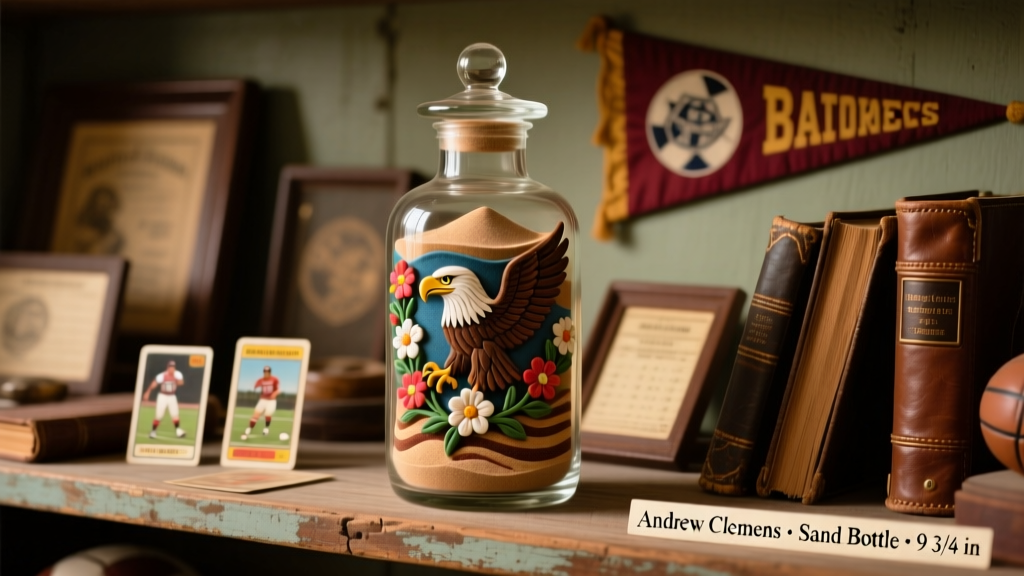
The Andrew Clemens Sand Bottle 'Eagle Banner Flowers Urn' — A 19th-Century Masterpiece in Glass and Pigmented Sand
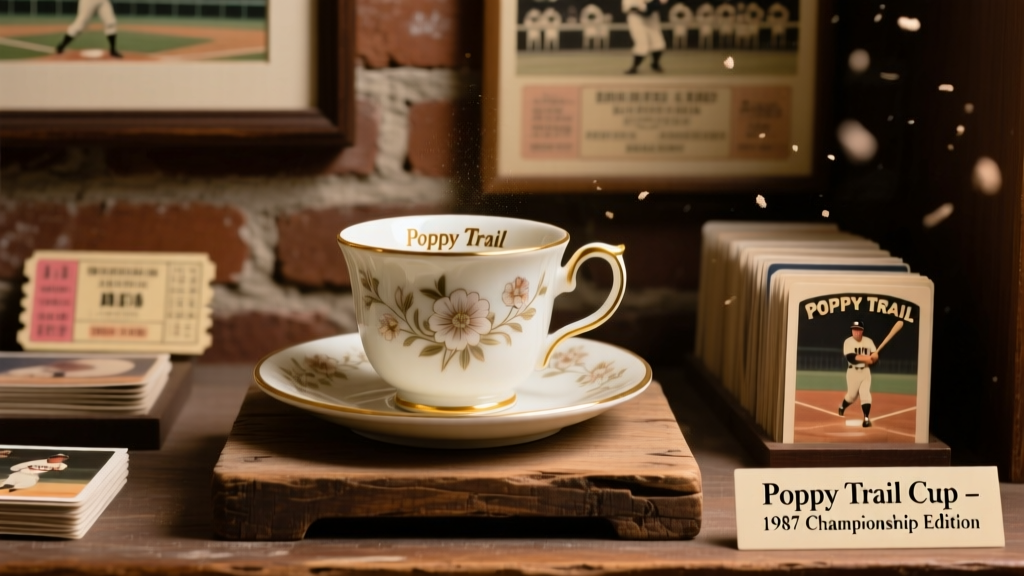
Dinnerware Poppy Trail Cup and Saucer: Authentication, History, and Collector Insights
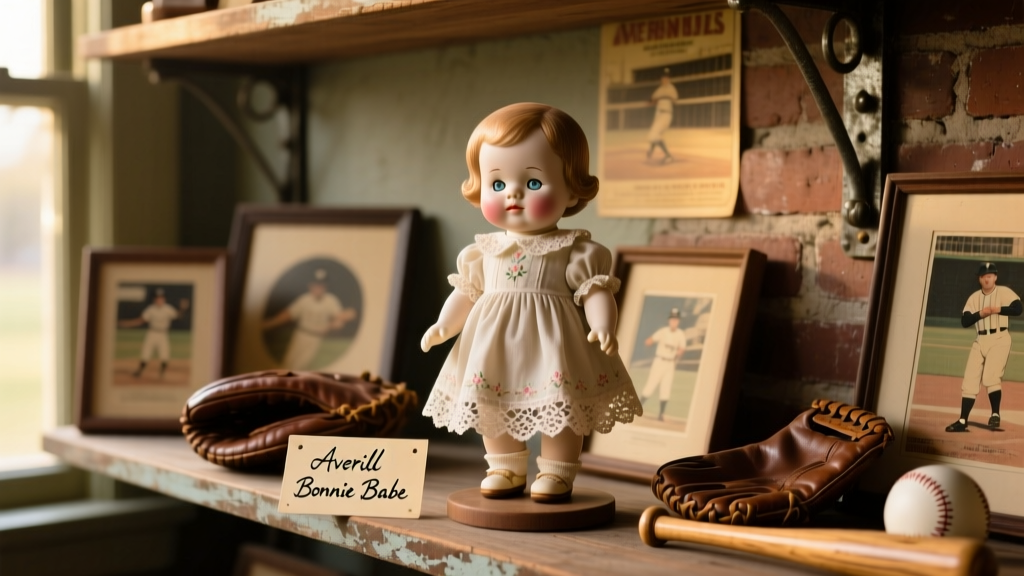
Averill Bonnie Babe Toddler: Authentication, Provenance, and Market Value of the 6-Inch Bisque Swivel-Head Doll with Glass Sleep Eyes