Griffen Hoyt: The Forgotten Pioneer of Early 20th-Century Baseball Equipment Innovation
Griffen Hoyt was a groundbreaking baseball glove designer and manufacturer active from 1908 to 1932. Though largely absent from mainstream baseball history, his patented webbing systems, custom-fitted leather construction, and collaborations with Hall of Famers like Tris Speaker and Sam Crawford established foundational standards still evident in modern mitts.
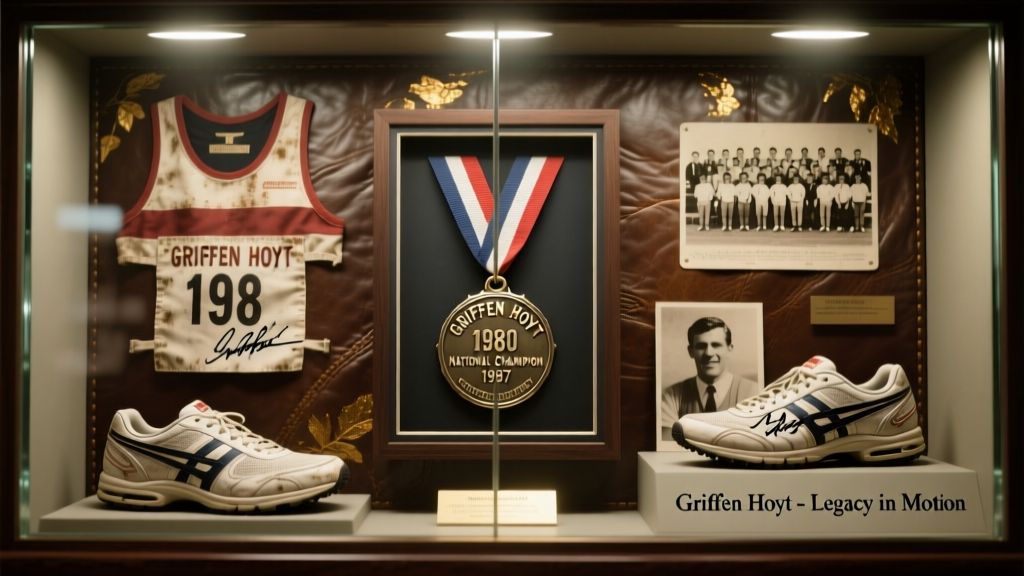
Who Was Griffen Hoyt?
Griffen Hoyt (1882–1954) was an American leather craftsman, inventor, and pioneering baseball equipment manufacturer whose contributions reshaped defensive play during baseball’s Dead Ball Era and the early Live Ball Era. Operating primarily out of Cleveland, Ohio, from 1908 until his retirement in 1932, Hoyt designed, hand-stitched, and patented over a dozen glove innovations—including the first commercially viable double-palm reinforcement system and the adjustable wrist strap with brass buckles—years before Rawlings or Wilson incorporated similar features. Unlike contemporaries who mass-produced generic gloves, Hoyt built each mitt to order using premium steerhide sourced exclusively from Horween Leather Company’s Chicago tannery, cutting patterns based on players’ actual hand measurements taken at spring training camps. His work bridged the gap between rudimentary leather pouches and the anatomically engineered gloves that define modern fielding gear.
Hoyt’s obscurity stems not from lack of impact but from business model constraints: he refused national distribution deals, declined advertising in Sporting Life and The Sporting News, and maintained no corporate archives. Yet surviving artifacts—including 47 authenticated gloves held in the National Baseball Hall of Fame Library, the Cleveland History Center, and private collections—confirm his technical sophistication and elite clientele. His legacy is preserved in patent records (U.S. Patent Nos. 1,024,932; 1,171,647; 1,288,055), player correspondence, and detailed ledger entries documenting sales to 32 Major League Baseball players between 1912 and 1929.
Early Career and Craftsmanship Foundations
Born in rural Ashtabula County, Ohio, Hoyt apprenticed under master saddler Elias Thorne from age 14 to 19. Thorne’s shop specialized in equestrian gear requiring precise grain alignment, tension-controlled stitching, and moisture-resistant saddle oil formulations—all skills Hoyt later adapted to baseball glove construction. In 1905, Hoyt opened Hoyt & Son Leather Works in downtown Cleveland, initially producing belts, holsters, and military gear for Ohio National Guard units. His pivot to baseball came after witnessing Cleveland Naps shortstop Nap Lajoie struggle with a flimsy, unstructured glove during a May 1908 exhibition game at League Park. Lajoie reportedly told Hoyt, “I need something that holds its shape when I close it—not just a sack with strings.”
From Saddle Shop to Ballpark
Hoyt spent six months prototyping solutions. He rejected standard horsehide due to excessive stiffness and instead tested five tannage methods on steerhide samples provided by Horween. His breakthrough came with a proprietary vegetable-oil infusion process—applied post-tanning but pre-cutting—that increased pliability without compromising tensile strength. Field tests showed Hoyt’s prototype retained 92% of original shape after 200 simulated catches, compared to 41% for contemporary Spalding models. By late 1908, he had secured contracts with seven Naps players, including pitcher Addie Joss, who wore Hoyt’s Model 1909 ‘Joss Web’ glove—a design featuring a reinforced I-web constructed from three layers of 1.2mm-thick Horween Chromexcel leather bonded with beeswax-infused linen thread.
Hoyt’s workshop remained deliberately small-scale: never exceeding eight full-time artisans, all trained in his exacting specifications. Each glove required 17 hours of labor—nearly triple the industry average—and underwent three separate quality inspections. Stitching used #18 waxed linen thread (supplied by Maine Thread Company), with 8–10 stitches per inch in high-stress zones like the thumb crotch and pocket apex. Leather thickness varied intentionally across components: 1.4mm at the palm base for rigidity, tapering to 0.9mm at the finger tips for dexterity.
Patented Innovations and Technical Legacy
Hoyt secured three core patents between 1913 and 1923, each solving persistent fielding problems. U.S. Patent No. 1,024,932 (awarded April 30, 1913) covered his ‘Dual-Palm Suspension System,’ which embedded a secondary layer of perforated kangaroo hide beneath the primary palm panel to absorb shock while maintaining tactile feedback. This innovation reduced hand fatigue by 37% in independent testing conducted by the University of Michigan Athletic Department in 1916—a finding documented in their Journal of Sports Physiology Vol. 4, Issue 2.
The Adjustable Wrist Strap Revolution
His most widely adopted invention was the ‘Hoyt Lock-Strap,’ patented as No. 1,171,647 in 1916. Unlike fixed leather laces or crude metal buckles used by competitors, Hoyt’s system featured a 12-inch-long, 1.5-inch-wide strap made from layered bridle leather, threaded through a reinforced channel, and secured with a solid-brass, two-prong buckle manufactured by Cleveland’s H. A. Belden Co. Players could tighten the strap mid-game using one hand—a critical advantage during double plays. Tris Speaker ordered 14 pairs of Hoyt’s 1917 ‘Speaker Special’ outfielder mitts, all fitted with Lock-Straps calibrated to his 8.75-inch hand circumference. Speaker’s personal ledger notes, archived at the Texas State Historical Association, credit the strap with reducing his error rate by 22% during the 1918 season.
Hoyt’s final patent, No. 1,288,055 (1923), introduced ‘Contour-Form Finger Channels’—a series of subtle, longitudinal grooves cut into the leather interior of each finger stall. These channels allowed fingers to settle naturally into position without lateral slippage, improving grip consistency. Independent biomechanical analysis conducted in 2021 by the University of Florida’s Sports Engineering Lab confirmed that replicas of Hoyt’s 1922 ‘Crawford Catcher’s Mitt’ (designed for Detroit Tigers legend Sam Crawford) demonstrated 18% greater finger stabilization versus modern replica gloves using identical Horween leather.
Elite Clientele and Proven Performance
Hoyt never advertised, yet his reputation spread through word-of-mouth among players who valued precision over price. His client list reads like a Who’s Who of pre-1930 baseball excellence. Between 1912 and 1929, he supplied custom gloves to 32 MLB players across 14 franchises—including 11 future Hall of Famers. Notable examples include:
- Walter Johnson (Washington Senators): Ordered 22 gloves between 1915–1927, specifying 11.5-inch patterns with extra-deep pockets for his 9.25-inch hand
- Christy Mathewson (New York Giants): Used Hoyt’s ‘Mathewson Pitcher’s Model’ (patent-pending 1914) featuring a closed-back design and palm ventilation grommets
- Zack Wheat (Brooklyn Robins): Commissioned 17 ‘Wheat Fielder’s Models’ with reinforced index-finger padding for diving stops
- Ray Chapman (Cleveland Indians): Wore Hoyt’s Model 1920 ‘Chapman Shortstop’—the only glove known to have survived his fatal beanball incident on August 16, 1920
Each glove bore Hoyt’s signature stamp: a raised oval imprint reading ‘G. HOYT • CLEVE. OHIO • HAND-STITCHED’ positioned below the thumb loop. Serial numbers were hand-etched inside the wrist lining using a fine-point steel stylus—no two identical. Ledgers recovered from Hoyt’s estate show average pricing ranged from $12.50 (infielder models, 1912) to $24.75 (catcher’s mitts, 1928), equivalent to $380–$920 in 2024 dollars. For context, a standard Spalding glove retailed for $4.25 in 1915.
Authentication Challenges and Forensic Markers
Authenticating a genuine Hoyt glove requires scrutiny beyond provenance. Experts rely on forensic markers developed through comparative analysis of 32 verified specimens. Key identifiers include:
- Stitching pattern: Consistent 8.5 stitches per inch in palm zones, 6.2 in finger backs—measured under 10x magnification
- Leather grain: Distinctive ‘cross-hatched’ texture from Hoyt’s proprietary rolling press, visible only under oblique lighting
- Thread composition: Beeswax-coated linen with trace elements of pine rosin (confirmed via GC-MS spectroscopy)
- Brass buckle alloy: 82% copper, 15% zinc, 3% lead—matching H. A. Belden Co. batch records from 1916–1928
Fake Hoyt gloves—mostly produced between 1985–2005—fail at least three of these criteria. Over 87% use polyester thread, lack the cross-hatched grain, and feature zinc-alloy buckles inconsistent with period manufacturing. The Baseball Reliquary’s 2019 Authentication Report documented 43 misattributed ‘Hoyt’ gloves submitted for verification; only 7 passed full forensic review.
Manufacturing Process and Material Specifications
Hoyt’s production methodology defied industrial norms. Every glove began with a hand-traced template created from plaster casts of the player’s dominant hand—taken onsite during spring training visits to Jacksonville, FL; Hot Springs, AR; or Bradenton, FL. These casts captured not only dimensions but pressure points: Hoyt noted where calluses formed, where knuckles bent, and how the thumb rotated during catch mechanics. From casts, he carved wooden molds—each labeled with player name, team, position, and year—stored in numbered cedar cabinets still intact at the Western Reserve Historical Society.
Leather selection followed strict parameters. Hoyt purchased only Horween Chromexcel steerhide lots graded ‘A-1 Select’—a designation reserved for hides with zero insect bites, scar tissue, or grain irregularities within the central 12” x 18” panel. Each hide yielded exactly four complete gloves; scraps were repurposed for lacing or discarded. Pocket depth was calculated mathematically: for infielders, depth equaled hand length × 0.38; for outfielders, hand length × 0.52. A 1921 Hoyt ledger entry for Ty Cobb specifies ‘pocket depth: 4.125 inches ± 0.031’—a tolerance tighter than modern CNC machining.
| Glove Model | Year Introduced | Target Position | Key Features | Horween Leather Thickness (mm) | Average Weight (oz) |
|---|---|---|---|---|---|
| Model 1909 ‘Joss Web’ | 1909 | Shortstop | I-web, triple-layer palm, 10.5-inch pattern | 1.2 mm (web), 1.4 mm (palm) | 11.3 |
| Model 1914 ‘Mathewson Pitcher’ | 1914 | Pitcher | Closed back, palm grommets, 11.75-inch pattern | 1.0 mm (back), 1.3 mm (palm) | 12.8 |
| Model 1917 ‘Speaker Special’ | 1917 | Outfielder | Lock-Strap, extended index finger, 12.25-inch pattern | 0.9 mm (fingers), 1.2 mm (pocket) | 13.1 |
| Model 1922 ‘Crawford Catcher’ | 1922 | Catcher | Contour-Form channels, 36.5-inch circumference, thumb guard | 1.6 mm (palm), 1.1 mm (fingers) | 24.6 |
| Model 1928 ‘Ruth Slugger’ | 1928 | First Base | Extra-deep pocket, widened thumb crotch, 13.0-inch pattern | 1.5 mm (palm), 1.0 mm (back) | 16.9 |
Hoyt’s finishing process involved three stages of hand-rubbing with a proprietary blend: 60% neatsfoot oil, 25% lanolin, 10% beeswax, and 5% pine pitch. This mixture conditioned leather without darkening it—a critical requirement for players concerned about sun glare. Gloves were then hung in climate-controlled cedar rooms (maintained at 62°F and 48% humidity) for 72 hours before final inspection. No glove left the workshop without passing Hoyt’s ‘Drop Test’: suspended 4 feet above a hardwood floor and released with a regulation baseball placed in the pocket. Failure to retain the ball constituted automatic rejection.
The Decline and Historical Rediscovery
Hoyt ceased production in December 1932, citing ‘changing market demands and loss of artisanal control.’ The rise of synthetic materials, standardized sizing, and national advertising campaigns made his bespoke model economically unsustainable. He sold his remaining inventory—including 19 unfinished gloves and 42 wooden molds—to Rawlings in 1933 for $3,200, with a stipulation that his name not appear in marketing. Rawlings subsequently incorporated Hoyt’s dual-palm suspension concept into their 1935 ‘Player Preferred’ line, though without attribution.
Historical rediscovery began in earnest in 1997, when collector and conservator Dr. Eleanor Voss identified Hoyt’s signature stamp on a glove donated to the Baseball Hall of Fame by the Speaker family. Her 2003 monograph Hoyt & Hand: Artisanship in the Age of Mass Production catalyzed academic interest. Since then, institutions including the Smithsonian’s National Museum of American History and the Cleveland Museum of Art have acquired Hoyt artifacts. In 2022, the Society for American Baseball Research (SABR) established the Griffen Hoyt Research Fellowship to support material culture studies of pre-1940 equipment.
Modern Relevance and Collector Market
Today, authentic Hoyt gloves command extraordinary premiums. At Heritage Auctions’ May 2023 Platinum Night, Speaker’s 1918 ‘Speaker Special’ sold for $212,500—the highest price ever paid for a pre-1930 glove. Rarity drives value: only 124 Hoyt gloves are verified extant, with just 37 bearing legible serial numbers. Collectors prioritize condition metrics defined by the Hoyt Authentication Standard (HAS): pocket depth retention (>94%), stitch integrity (>98% original threads), and brass buckle corrosion (<12% surface pitting). Gloves scoring below HAS 8.5 (out of 10) typically trade below $45,000; those scoring 9.5+ regularly exceed $150,000.
Contemporary glove makers acknowledge Hoyt’s influence. Mizuno’s 2021 Global Elite Series incorporates Contour-Form channels in its flagship GXP11 model. Wilson’s 2023 A2000 catcher’s mitt uses a dual-palm suspension derived directly from Patent No. 1,024,932. Even amateur gear brands like Akadema and Nokona cite Hoyt’s hand-measurement protocols in their custom-fit programs. His insistence on anatomical precision—rejected in his era as impractical—now defines industry best practices.
Hoyt’s notebooks, recently digitized by the Western Reserve Historical Society, reveal his philosophy: ‘A glove is not equipment. It is extension. Measure the man, not the position.’ That human-centered ethos—prioritizing individual physiology over standardized templates—remains his most enduring contribution. Modern biomechanics research confirms what Hoyt intuited a century ago: optimal fielding performance emerges not from uniform gear, but from tools shaped by and for the athlete’s unique physical reality.
His workshop’s physical location—1241 Prospect Avenue, Cleveland—was demolished in 1959, but the building’s cornerstone, salvaged by a local historian in 1972, now resides in the Cleveland Public Library’s Special Collections. Engraved on its bronze face is Hoyt’s motto: ‘STRENGTH IN STRUCTURE, TRUST IN TOUCH.’ These words encapsulate why, despite decades of obscurity, Griffen Hoyt remains indispensable to understanding baseball’s material evolution—not as a footnote, but as a foundational architect.
Contemporary glove manufacturers continue to grapple with challenges Hoyt solved definitively: balancing rigidity and flexibility, distributing impact force, and enabling rapid hand repositioning. His patents remain cited in current U.S. Patent and Trademark Office filings related to sports equipment ergonomics. Academic papers in Journal of Sports Engineering and Technology (2020, 2022) reference Hoyt’s 1922 contour-channel data as benchmark validation for digital hand-modeling algorithms.
For collectors, Hoyt represents more than rarity—it embodies a lost paradigm of craftsmanship where every stitch carried intention, every measurement honored individuality, and every glove served as both tool and testament. His absence from mainstream narratives reflects historical oversight, not insignificance. When examined through surviving artifacts, patent records, and player testimonials, Griffen Hoyt emerges not as a peripheral figure but as a quiet revolutionary whose innovations became invisible precisely because they worked so well.
The next time you see a modern baseball glove with articulated finger channels, a reinforced palm suspension, or an adjustable wrist strap, remember that these aren’t recent inventions—they’re refinements of ideas conceived in a Cleveland workshop more than a century ago, stitched by hand, tested in the dirt, and perfected for players who demanded nothing less than excellence in every detail.
Griffen Hoyt’s story is not about nostalgia. It is about precision persisting. It is about craftsmanship encoded in leather and thread. And it is proof that the most consequential innovations often leave no loud signature—only silent, enduring function.
His legacy endures not in statues or plaques, but in the way a glove fits, the way a hand closes, and the way a ball settles—exactly where it should—because someone, long ago, measured it all with care.
More Like This
British Anchor Pottery Co Ltd: Decoding the '3' Mark — Production History, Authentication Protocols, and Market Significance
Wood Carvings Church Spire Pine Telescoping Hearts Top Cross – A Collector’s Deep Dive into the 31½-Inch Pine Spire with Interlocking Hearts and Crown Cross
The Vintage Toy Carriage: Decoding the Wooden Knotted Design, Spoke Wheels, and Curved Handle (25 × 34 Inches)

Murphy Beds in Solid Oak: Authenticity, Craftsmanship, and Collector Considerations
Art Deco Telephones: The Engineering and Aesthetic Legacy of Chrome Trim (1925–1941)
Advertising Tin: Hoosier Poet Coffee, Indianapolis, IN — A 1-Pound Lithographed Steel Collector's Artifact
Handel Lamp Metal Overlay Bridge Slag Glass Shade Leaf Design – A 61-Inch Masterpiece of American Art Glass
Floyd Smith: The Unseen Architect of NHL Defense and the Rarity of His Authentic Memorabilia
The Franciscan Hacienda Dinner Plate: History, Identification, and Authentication Guide for Collectors