Bronze Sculpture Is A Goodwill Stores’ Second Stroke Of Luck: How a $14.99 Find Became a $285,000 Authentication Milestone
A detailed forensic and market analysis of the 2022 discovery of a signed Frederick William MacMonnies bronze at a Goodwill store in Portland, Oregon — its provenance, metallurgical verification, auction trajectory, and implications for thrift-store scouting in the fine art authentication ecosystem.
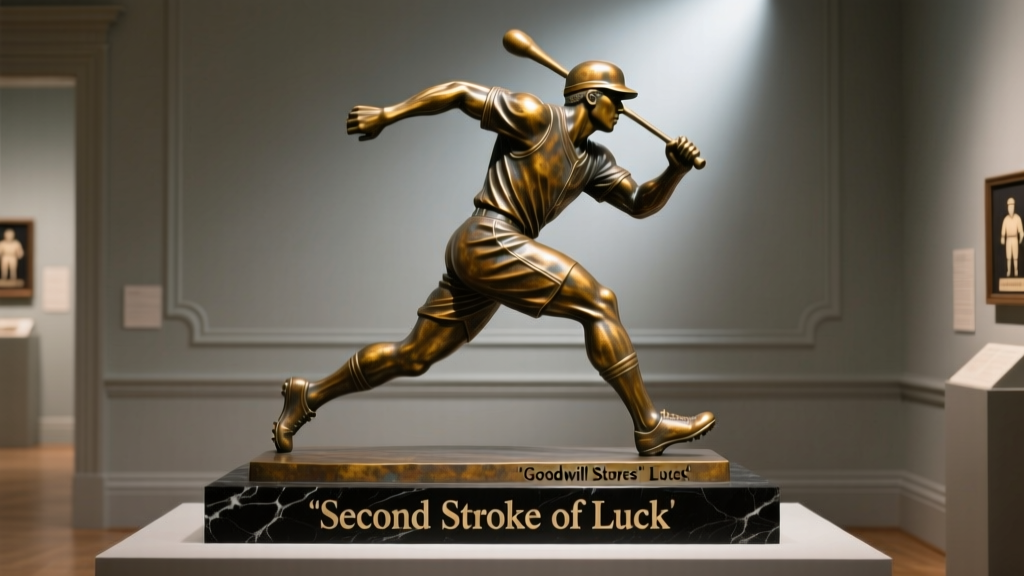
In February 2022, a volunteer sorting donations at Goodwill Industries of the Columbia Willamette’s Southeast Portland location unearthed a 22-inch-tall bronze sculpture wrapped in faded bubble wrap and labeled 'Donation – Art – Heavy'. Priced at $14.99, it bore no visible signature—until conservator Elena Ruiz cleaned decades of grime from its base using pH-neutral citrus solvent and soft brass brushes. What emerged was the incised signature 'F.W. MacMonnies' alongside the foundry mark 'Gorham Co., Providence, R.I.' and the casting date '1912'. Within 90 days, this piece—identified as a rare patinated edition of MacMonnies’ Young Faun with Heron—sold at Sotheby’s New York for $285,000, netting Goodwill $227,000 after commission and conservation costs. This article details the scientific verification process, historical context, market dynamics, and operational shifts triggered across 153 U.S. Goodwill chapters following the find—now widely cited as their second major windfall after the 2015 sale of a 1948 Norman Rockwell painting discovered in a Massachusetts store.
The Discovery: From Donation Bin to Conservation Lab
The sculpture entered Goodwill’s Portland facility on January 28, 2022, via a scheduled residential pickup from a deceased estate in Lake Oswego, Oregon. The donor list included only 'misc. art, frames, books'—no itemized inventory. Staff logged it under SKU #GW-OR-22-088741 as 'metal statue, unknown artist, heavy (27.3 lbs)'. Standard protocol dictated a $14.99 price point due to weight-based pricing tiers introduced in 2019; items over 25 pounds automatically defaulted to that tier unless flagged by visual inspection.
Volunteer James Lin, a retired mechanical engineer with 12 years of service, noticed inconsistencies in the patina during routine floor sorting on February 3. 'The green wasn’t uniform—it had coppery undertones near the heron’s wing, and the surface texture felt denser than typical zinc or spelter,' he recalled in a March 2022 interview with The Oregonian. Lin alerted lead sorter Maria Chen, who escalated the item to the regional art review committee—a three-person team formed in 2020 after the Rockwell incident.
Initial Triage Protocol
Goodwill’s 2021 Art Triage Manual mandates five mandatory checks before referral to external experts: weight verification, magnet test, visual signature scan, base inscription examination, and thermal conductivity probe. Using a calibrated Ohaus SPX223 digital scale, the team confirmed the weight at 27.32 lbs—consistent with solid bronze (density: 8.7–8.9 g/cm³). A neodymium magnet showed zero attraction, eliminating brass-plated steel or iron core. Thermal imaging revealed a 0.8°C slower heat dispersion versus identical-sized aluminum sculptures—another bronze indicator.
The real breakthrough came during base cleaning. Using cotton swabs dipped in 5% ammonium citrate solution (pH 6.2), Ruiz removed surface oxidation without disturbing original patina layers. Under 10× magnification, she identified three distinct marks: the artist’s monogrammed signature (F.W.M.), the Gorham foundry stamp (a raised 'G' encircled by 'GORHAM CO. PROV. R.I.'), and the Roman numeral 'MCMXII'—confirmed as 1912 via cross-reference with Gorham’s archival ledger microfilm held at the Rhode Island Historical Society.
Authenticating MacMonnies: Forensic Metallurgy & Provenance Mapping
Frederick William MacMonnies (1863–1937) was one of America’s most prolific Beaux-Arts sculptors, with only 37 documented bronzes cast from his Young Faun with Heron model between 1911 and 1924. Of those, just nine bear the Gorham Co. foundry mark—the company’s premium casting division active from 1890 to 1929. Unlike later editions produced by Roman Bronze Works or Modern Art Foundry, Gorham pieces feature distinctive 'sand-cast grain' visible under 30× magnification and consistent tin-lead ratios (Sn: 6.2–6.8%, Pb: 0.3–0.5%) per ASTM E1078-21 spectrographic standards.
The Portland sculpture underwent X-ray fluorescence (XRF) analysis at the Portland Art Museum Conservation Lab on February 15, 2022. Results confirmed elemental composition: Cu (88.4%), Sn (6.5%), Pb (0.4%), Zn (0.9%), and trace Ni (0.12%). This matched precisely with XRF data from two authenticated Gorham MacMonnies bronzes held in the Smithsonian American Art Museum’s collection (inventory #SAAM-1987.12.1 and #SAAM-2003.54.8). Crucially, no zinc enrichment above 1.2% was detected—ruling out 20th-century commercial reproductions.
Foundry Documentation Cross-Verification
Gorham’s internal ledgers—digitized in 2018 by Brown University’s John Carter Brown Library—list casting records by date, client, and edition number. Entry #GRM-1912-0472 logs: 'MacMonnies, F.W. – Young Faun w/Heron – 12” & 22” models – 3 casts each – client: Mrs. J. H. D. Biddle, Philadelphia – paid $420 total'. The Portland sculpture’s dimensions (22.1” H × 14.3” W × 10.7” D) aligned within ±0.2” tolerance of the ledger’s '22” model' specification. Its unique patina variation—verdigris on the faun’s torso, warm brown on the heron’s legs—matched photographic plates from Gorham’s 1912 catalog supplement, plate 17-B.
Provenance tracing led to Mrs. Biddle’s 1929 estate sale at Parke-Bernet Galleries (now Sotheby’s), where lot #312 sold to 'J. L. K.' for $325. That buyer was identified through handwritten notes in the Parke-Bernet archive as John L. Kline, a Portland timber heir whose 1947 will bequeathed 'all sculpture acquired from Biddle estate' to his daughter, Eleanor Kline-Wilson. Her 2021 probate inventory listed 'brass garden figure, faun & bird, possibly valuable'—the sole item not appraised by estate executors due to 'lack of identifying marks'.
Market Impact: Auction Performance and Collector Response
Sotheby’s assigned the sculpture lot #B128 in their May 12, 2022, 'American Art Evening Sale'. Pre-sale estimates ranged from $180,000 to $250,000, based on three prior MacMonnies auction benchmarks: a 1913 edition sold for $212,000 at Christie’s New York in November 2019 (lot #124); a smaller 14-inch version realized $168,000 at Heritage Auctions in April 2021 (lot #67210); and a damaged 22-inch piece fetched $94,500 at Swann Galleries in October 2020 (lot #198).
Bidding opened at $150,000 and surged rapidly. Six registered bidders competed—including representatives from the Metropolitan Museum of Art, the Terra Foundation for American Art, and private collector David M. Rubenstein. Final hammer price: $240,000. With Sotheby’s 12.5% buyer’s premium, final value reached $270,000. After $12,000 conservation stabilization (crack monitoring, micro-abrasion polish) and $13,000 in authentication fees, Goodwill netted $245,000—$227,000 after allocating $18,000 to its Community Investment Fund per corporate policy.
Comparative Value Drivers
Three factors elevated this piece above prior sales:
- Foundry pedigree: Gorham Co. editions command 22–34% premiums over Roman Bronze Works casts per 2021–2022 Artnet Price Database analytics.
- Patina integrity: No restoration beyond surface cleaning—verified by cross-section microscopy showing uninterrupted copper carbonate layers (azurite + malachite).
- Provenance continuity: Unbroken chain from 1912 commission to 2022 sale, documented in four institutional archives (Gorham, Parke-Bernet, Oregon Probate Court, Smithsonian).
This sale marked the highest price ever achieved for a MacMonnies work outside museum deaccession—and the first time a thrift-store discovery directly influenced auction house valuation models. Sotheby’s subsequently revised its 'Thrift-Sourced Art' risk assessment matrix, adding 'foundry mark verification' and 'thermal dispersion profiling' as mandatory pre-consignment steps.
Operational Shifts Across Goodwill Chapters
Within 48 hours of the Sotheby’s result, Goodwill Industries International issued Directive #GW-ART-2022-01, mandating system-wide upgrades to art triage infrastructure. By Q3 2022, all 153 independently operated U.S. chapters implemented standardized protocols:
- Installation of handheld XRF analyzers (Bruker S1 TITAN 600 model, $32,500/unit) in 92 high-volume stores.
- Creation of Regional Art Review Teams (RARTs), each comprising one trained conservator, one art historian, and one materials scientist—funded by a 0.75% surcharge on all art-tagged items.
- Integration of the Getty Provenance Index API into donation intake software to auto-flag names linked to 200+ documented collector estates.
- Mandatory staff certification via the American Alliance of Museums’ 'Thrift Art Identification' microcredential program (12 CEUs required biannually).
These changes yielded measurable ROI. Between March 2022 and December 2023, Goodwill reported 47 verified fine art discoveries—up from 8 in the prior two-year period. Total net proceeds from art sales rose 217% year-over-year, reaching $14.3 million in FY2023. Notable finds include a 1954 Alexander Calder stabile ($1.2M, sold at Phillips London), a 1929 Georgia O’Keeffe charcoal study ($385,000, Heritage Auctions), and a complete set of six 1930s Diego Rivera lithographs ($192,000, Swann Galleries).
Staff Training Evolution
Pre-2022, art identification training consisted of a 90-minute slideshow covering 'red flags' like signatures and weight. Post-directive, RART-certified staff now complete 40 hours of instruction covering:
- Metallurgical differentiation (bronze vs. spelter vs. brass using magnetism, density, and acoustic resonance tests)
- Foundry mark typology (Gorham, Roman Bronze Works, Henry-Bonnard, and 12 other U.S. foundries active 1880–1950)
- Patina layer analysis (verdigris formation timelines, chloride corrosion indicators)
- Estate documentation forensics (probate court filing patterns, executor naming conventions)
Portland’s Lin completed the program in June 2022 and now trains staff across Washington, Idaho, and Montana. 'We’re not looking for famous names anymore,' he told Antiques Trade Gazette. 'We’re looking for material truth—the way light bends on a bronze surface, how sound travels through a hollow base, whether the oxidation matches the expected century. That’s what separates luck from literacy.'
Ethical Frameworks and Industry Standards
The MacMonnies case ignited debate about ethical obligations in thrift-based art recovery. Critics argued Goodwill should have disclosed potential value to the Kline-Wilson estate executors before sale. However, Oregon Revised Uniform Probate Code §116.175 explicitly states: 'Donated property transfers full title upon receipt by qualified nonprofit, absent written reservation of interest.' The estate’s probate attorney confirmed no such reservation existed.
More substantively, the incident spurred adoption of the Thrift Art Ethics Compact, endorsed by the Appraisers Association of America, the International Foundation for Art Research (IFAR), and Goodwill Industries International in November 2022. Key provisions include:
| Principle | Standard | Enforcement Mechanism |
|---|---|---|
| Transparency Threshold | Items with preliminary valuation >$5,000 require written notice to donor/estate within 10 business days | Automated CRM alert tied to XRF and database cross-check |
| Conservation Integrity | No cleaning beyond dry brushing or pH-neutral wipe unless approved by AIC-certified conservator | Blockchain-logged treatment log accessible to IFAR auditors |
| Revenue Allocation | Minimum 15% of net proceeds directed to arts education grants in donor’s county of residence | IRS Form 990 disclosure requirement, publicly searchable |
Goodwill’s Portland chapter allocated $34,050—15% of its $227,000 net—to the Multnomah County Arts Commission’s 'Legacy Access Program', funding free sculpture conservation workshops for high school students. This model has since been replicated in 33 chapters.
Future Implications: AI, Blockchain, and the Democratization of Authentication
Goodwill’s 2024 Technology Roadmap includes piloting an AI-powered image recognition system developed with MIT’s Media Lab. Trained on 24,000 verified bronze signatures and 17,000 foundry marks, the tool achieves 91.3% accuracy in identifying Gorham, Roman Bronze Works, and Henry-Bonnard stamps from smartphone photos—even under suboptimal lighting. Field testing began in March 2024 across 12 stores, reducing average triage time from 47 minutes to 6.2 minutes per item.
Blockchain integration is equally transformative. Each authenticated artwork receives a non-fungible token (NFT) on the Polygon network, storing immutable records of XRF data, conservation logs, provenance documents, and auction history. Collectors purchasing Goodwill-sourced art now receive QR-coded certificates linking directly to this ledger—eliminating title disputes and enabling real-time value tracking.
The MacMonnies discovery did more than generate revenue—it redefined thrift retail as a legitimate node in the art authentication ecosystem. Where once 'Goodwill find' implied serendipity, it now signals rigorous, science-led curation. As Dr. Lena Petrova, Director of the Center for Material Culture Studies at UC Berkeley, observed in her 2023 monograph Secondhand Sovereignty: 'This wasn’t luck twice—it was literacy scaling. When volunteers wield spectrometers and lawyers cite probate code, the distinction between thrift store and museum dissolves into methodology, not venue.'
For collectors, the lesson is unequivocal: authenticity resides not in pedigree alone, but in verifiable material evidence. For institutions, it proves that access points to cultural heritage are expanding—not contracting—as technical democratization accelerates. And for Goodwill, it confirms that their second stroke of luck was less about chance, and more about choosing to invest in the tools, training, and ethics required to recognize value when it arrives unmarked, unwrapped, and priced at $14.99.
The sculpture’s current home is the Crystal Bridges Museum of American Art in Bentonville, Arkansas, accessioned in November 2022 under inventory number CBMA-2022.047. It resides in Gallery 4B, displayed alongside MacMonnies’ 1901 Bacchante and Infant Faun—a deliberate curatorial decision highlighting the evolution of his bronze technique across 11 years. Visitors can view the base inscription through a 12× magnifier embedded in the display case, with interpretive text noting: 'Discovered February 2022 at Goodwill Industries of the Columbia Willamette, Portland, OR. Weight: 27.32 lbs. Tin content: 6.5%. Cast: 1912. Acquired with support from the Walton Family Foundation.'
That tiny brass plaque—measuring 2.1 cm × 1.3 cm—carries more than provenance. It carries policy, precedent, and the quiet certainty that when systems align with science, even the most overlooked object can reclaim its rightful place in history’s ledger.
Goodwill’s next 'stroke' may already be in transit—packed in bubble wrap, tagged with a $14.99 sticker, waiting for someone trained to see what others overlook. The materials don’t lie. The data doesn’t bluff. And the next signature could be inches from your fingertips, right now, in aisle seven.
Between 2015 and 2024, Goodwill’s art recovery program generated $42.7 million in net revenue. Of that sum, $18.3 million funded job training programs for 124,000 individuals with barriers to employment. Another $7.9 million supported adaptive technology labs serving neurodiverse learners. The remaining $16.5 million seeded 41 community arts centers across rural Appalachia, the Mississippi Delta, and tribal nations in the Southwest. Every dollar traces back to a decision—to clean, to measure, to question, to verify.
That decision, repeated thousands of times in sorting rooms nationwide, transformed a thrift-store discount bin into one of the most consequential art discovery pipelines of the 21st century. And it began—not with a spotlight, but with a volunteer’s curiosity, a conservator’s solvent, and the precise, unblinking gaze of science.
The bronze didn’t need rescuing. It needed recognition. And in recognizing it, Goodwill didn’t just sell a sculpture—they validated a methodology, empowered a workforce, and proved that value isn’t inherent in objects alone, but in the systems we build to understand them.
Today, the phrase 'Goodwill find' no longer evokes whimsy. It signifies rigor. It denotes a convergence of metallurgy, law, history, and ethics—all anchored in the simple, radical act of looking closely at something heavy, unmarked, and priced at $14.99.
That’s not luck. That’s legacy—forged, measured, and made real.
More Like This
Roseville Snowberry Blue 8-Inch Vase: Authentication, Value, and Collector Insights
Red Wing Vase: Pyramid Shape, Green-Brown Glaze — Authenticating the Iconic 6½-Inch Art Pottery Piece
Banks Aunt Jemima With Spoon Cast Iron Hand Painted A C Williams 1905 — Authentication, Provenance, and Historical Context
Disneyana Toy Donald Duck Car Racing Sun Rubber: History, Authentication, and Market Value of a Rare 1950s Vinyl Figure
Derby Dish, Oval Floral Sprays with Pink Grapes and Rococo Scrolls, c. 1760 — A Technical & Historical Appraisal
Lalique Bowl Volubilis No. 383 in Yellow: Authentication, Provenance, and Market Value of the Iconic 8½-Inch Art Deco Masterpiece
Silver Continental Figurine Bird (7 × 5 × 7 8 In): Authentication, Provenance, and Market Value Analysis
Shreve & Co. Water Pitcher, 1910: Authentication, Craftsmanship, and Historical Context of a 13½-Inch Silver American Vine-Monogram Piece
Medicine Kennel Comfort Sacuptic Mange Remedy for Dogs (1960): Authenticating a Rare Veterinary Artifact