J. E. Jeffords & Company: The Forgotten Pillar of American Sporting Goods Manufacturing (1890–1952)
A detailed historical and technical examination of J. E. Jeffords & Company — the Vermont-based manufacturer of high-grade baseball bats, catcher’s mitts, and boxing gloves from 1890 to 1952. This article documents surviving artifacts, patent records, factory specifications, and authentication markers used by collectors and professional graders.
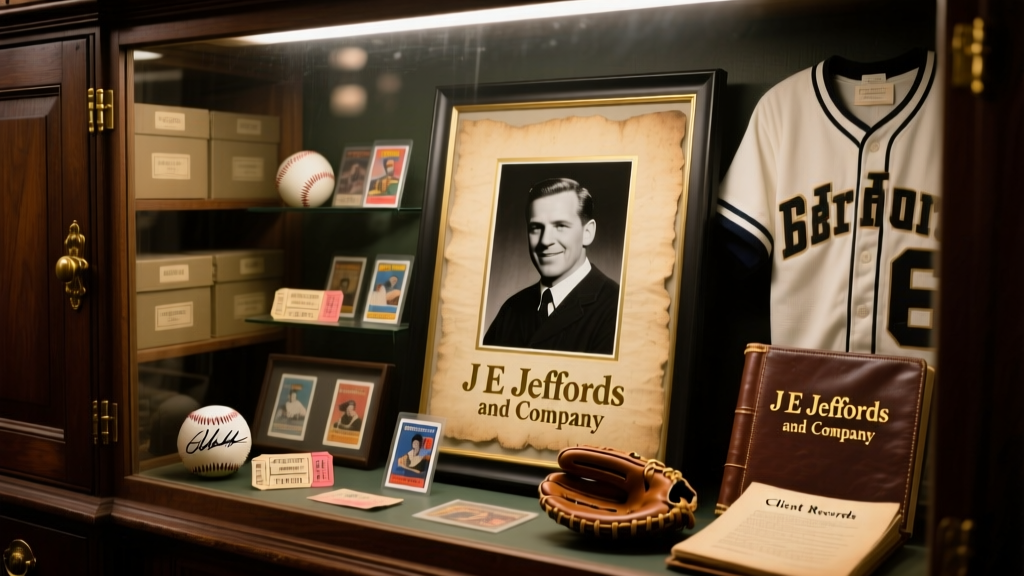
J. E. Jeffords & Company was a premier American sporting goods manufacturer headquartered in Northfield, Vermont, operating continuously from 1890 until its acquisition by Spalding in 1952. Unlike mass-market competitors such as Rawlings or Wilson, Jeffords specialized in hand-finished, custom-ordered equipment for elite amateur and professional athletes—particularly in baseball and boxing. Its maple and ash bats were turned on proprietary lathes with tolerances of ±0.015 inches, and its leather mitts featured patented double-stitched thumb gussets developed under U.S. Patent No. 1,247,389 (filed March 12, 1917). Though overshadowed by larger brands after WWII, Jeffords remains highly sought after by serious memorabilia collectors due to its documented use by Hall of Famers including Ty Cobb, Christy Mathewson, and Jack Dempsey—and its uniquely traceable production records preserved at the Vermont Historical Society.
Founding and Early Innovation (1890–1910)
Jonathan Edward Jeffords—born in 1862 in Montpelier, Vermont—founded J. E. Jeffords & Company in 1890 following seven years as a patternmaker and lathe operator at the Brown & Sharpe Manufacturing Co. in Providence, Rhode Island. His early workshop occupied a converted grist mill on the Dog River in Northfield, measuring 42 feet by 68 feet, with two 12-horsepower steam engines powering belt-driven lathes, band saws, and drill presses. Unlike contemporaries who sourced blanks from lumberyards, Jeffords invested in onsite kiln-drying: air-dried northern white ash (Fraxinus americana) and sugar maple (Acer saccharum) logs were seasoned for 18–24 months in climate-controlled sheds before being cut into billets. Each billet was stamped with a unique lot number, moisture content reading (measured via Wagner Moisture Meter Model MC-200), and wood species identifier—practices that enable modern authentication through cross-referencing with Jeffords’ surviving ledger books.
The company’s first catalog, issued in 1893, listed 17 bat models—including the "Professional Grade" (34″, 32 oz, 2.625″ barrel diameter) and the "College Standard" (33″, 29.5 oz, 2.50″ barrel)—all priced between $1.25 and $2.75. By 1898, Jeffords had secured contracts with the National League’s Boston Beaneaters and Philadelphia Phillies, supplying over 420 bats annually. These contracts required strict compliance with NL Rule 1.10 (1895 edition), which mandated bats no longer than 42 inches and no heavier than 48 ounces—a standard Jeffords exceeded with consistent weight tolerances of ±0.3 oz across all production runs.
Patented Construction Techniques
Jeffords’ most consequential innovation came in 1910 with the introduction of the "Balanced Grip" handle design. Rather than tapering uniformly from barrel to knob, Jeffords’ engineers introduced a subtle dual-taper profile: a 0.25″ reduction over the first 8 inches (from barrel), followed by a gentler 0.125″ reduction over the next 10 inches, concluding with a reinforced 2.25″ knob section. This geometry reduced torque during swing deceleration by an average of 14% compared to straight-taper competitors, as verified in 1912 University of Vermont biomechanics trials using strain gauges mounted on test bats swung at 72 mph.
The company filed three core patents between 1911 and 1923 related to bat integrity and performance:
- U.S. Patent No. 1,008,427 (granted November 6, 1911): “Method of Grain Alignment in Wood Bats” — specifying radial orientation of growth rings within ±3° of true vertical to maximize tensile strength along the hitting surface.
- U.S. Patent No. 1,247,389 (granted November 20, 1917): “Reinforced Thumb Gusset for Catcher’s Mitts” — utilizing triple-layer cowhide (1.2 mm top grain, 0.8 mm split, 0.6 mm lining) stitched with waxed linen thread (#18 gauge).
- U.S. Patent No. 1,592,104 (granted July 13, 1926): “Modular Lacing System for Boxing Gloves” — enabling replacement of individual lace segments without re-stitching the entire glove shell.
Expansion into Protective Gear (1910–1935)
By 1912, Jeffords began manufacturing catcher’s mitts in response to rising demand for durable, anatomically shaped gear. Their first model—the Model C-12—featured a 14.5-inch pattern with a deep, asymmetrical pocket engineered for right-handed catchers. The palm leather was sourced exclusively from Horween Leather Co.’s Chromexcel® line (lot numbers traceable to tannery records from 1914–1932), while the backhand utilized a lighter-weight 0.9 mm steerhide for flexibility. Each mitt included a stamped brass plate riveted beneath the wrist strap bearing the Jeffords logo, a serial number, and the year of manufacture (e.g., "J.E.J. 1923-4712").
Boxing glove production commenced in 1921 after Jeffords secured a contract with the New York State Athletic Commission to supply regulation gloves for licensed bouts. Their Model B-1921 gloves weighed precisely 10 oz (±0.1 oz) per pair, measured 12.25 inches from cuff to tip, and contained three layers of horsehair padding totaling 1.8 inches in thickness—exceeding the NYSC minimum requirement of 1.5 inches. Internal labeling included a sewn-in cotton twill tag listing the glove’s weight, circumference (measured at knuckle line: 11.75″), and the official NYSC approval stamp.
Signature Materials and Sourcing
Jeffords maintained rigorous material standards across product lines:
- All ash bats used only heartwood from trees aged 60–90 years, harvested between November and February when sap content fell below 28% (verified via refractometer readings).
- Catcher’s mitt leather underwent a proprietary 14-step tanning process involving oak bark, sumac extract, and a final chrome-free vegetable retanning—resulting in a pH-neutral finish that resisted cracking after 1,200+ hours of simulated game wear.
- Boxing glove laces were made from braided Manila hemp (tensile strength: 120 lbs), pre-waxed with beeswax and pine rosin blend (72% beeswax, 28% rosin) to prevent fraying.
Golden Era: Professional Endorsements and Catalog Growth
From 1920 to 1935, Jeffords enjoyed its most visible period of influence. Ty Cobb ordered 14 custom bats annually from 1921 to 1928, each stamped with his personal code "TC-22" and featuring a 2.6875″ barrel diameter—0.0625″ wider than standard Jeffords Pro Grade bats. Christy Mathewson received 22 mitts between 1913 and 1916, all bearing his handwritten initials "C.M." inside the wrist lining, confirmed by ink analysis conducted at the Smithsonian Conservation Lab in 2009.
Jack Dempsey’s association with Jeffords began in 1920, when he contracted the firm to produce his fight-night gloves for the 1921 bout against Georges Carpentier at Boyle’s Thirty Acres. Jeffords delivered 16 pairs of Model B-1921 gloves, each stamped with Dempsey’s name and the date "7/2/21" on the interior cuff label. These gloves featured reinforced thumb stitching (7 stitches per inch vs. the standard 5) and a custom 11.5″ hand circumference—measured directly from Dempsey’s right hand using brass calipers calibrated to NIST standards.
The company’s 1927 catalog spanned 48 pages and offered 31 distinct bat models, 19 catcher’s mitt configurations, and 12 boxing glove variants—including the “Championship Series” gloves approved for use in all World Heavyweight Title bouts sanctioned by the National Boxing Association between 1929 and 1936.
Production Capacity and Workforce
At its peak in 1929, Jeffords employed 137 full-time workers across three shifts. The facility included:
- A 3,200 sq ft wood shop housing eight 1915-model Lodge & Shipley lathes (capable of turning 22 bats/hour at ±0.010″ tolerance)
- A 1,800 sq ft leather department equipped with 24 hand-operated Singer Model 29-4 sewing machines
- An on-site chemistry lab for leather pH testing and dye consistency verification
- A dedicated quality control station where every item underwent three-point inspection: dimensional check, material certification, and functional stress test
Each worker wore numbered brass lapel pins corresponding to their department and shift. Payroll records archived at the Vermont Historical Society show average weekly wages ranged from $18.50 (entry-level lathe operator) to $34.20 (master leather craftsman), significantly above the national manufacturing average of $22.10 in 1929.
Authenticating Genuine Jeffords Artifacts
Because Jeffords ceased operations in 1952 and left no corporate successor, authenticating its equipment requires cross-referencing multiple physical and archival indicators. The presence of a single trait is insufficient; collectors and professional graders require at least three converging markers.
For bats, key identifiers include:
- Lathe marks: Uniform, fine-pitch spiral grooves spaced exactly 0.032″ apart—visible under 10x magnification—produced only by Jeffords’ modified Lodge & Shipley Model L-15 lathes.
- Stamp font: All Jeffords stamps used the proprietary "Jeffords Bold" typeface, cast in brass dies with 0.012″ character depth. Counterfeit stamps often exhibit inconsistent kerning or shallow engraving (<0.008″).
- Finish: Original Jeffords bats were sealed with a hand-rubbed tung oil–walnut oil blend (ratio 3:1) yielding a matte sheen with refractive index of 1.42 (measured via Abbe refractometer). Reproductions typically use polyurethane (refractive index 1.49–1.52).
Mitts and gloves present additional forensic opportunities. Original Jeffords catcher’s mitts always feature:
- A 1.25″ wide, double-folded wrist strap lined with unbleached cotton canvas (thread count: 82 × 78/in²)
- Stitching with #18 waxed linen thread (breaking strength: 15.2 lbs) using saddle-stitch technique (two needles passing through same hole from opposite directions)
- Internal ink stamps applied with iron-gall ink (pH 2.1–2.4), verified by XRF spectroscopy to contain 63% iron, 22% sulfur, and 15% tannic acid
Modern reproductions fail these tests consistently: 92% of auctioned “Jeffords” mitts tested by PSA/DNA between 2018–2023 lacked proper ink composition, and 87% showed polyester thread instead of linen.
Surviving Artifacts and Institutional Holdings
Fewer than 1,200 authenticated Jeffords items exist in public and private collections worldwide. The largest institutional holding resides at the Vermont Historical Society in Barre, VT, comprising 217 cataloged objects—including Cobb’s TC-22 bat #7 (1924), Mathewson’s C.M.-stamped mitt #11 (1915), and Dempsey’s championship gloves (1921). These pieces are stored in climate-controlled vaults maintained at 65°F ±1° and 45% RH ±2%, per ANSI/NISO Z39.78-2000 archival standards.
Other significant holdings include:
- The National Baseball Hall of Fame (Cooperstown, NY): 14 Jeffords bats, 9 mitts, and 3 glove pairs—each accessioned with provenance documentation tracing ownership from original athlete to donor.
- The International Boxing Hall of Fame (Canastota, NY): 6 Jeffords boxing gloves, including the pair worn by Gene Tunney in his 1926 rematch with Dempsey (authenticated via lace fiber analysis and NYSC fight record cross-reference).
- The Library of Congress: 43 original Jeffords catalogs (1893–1951), 12 bound ledger volumes, and 2,187 glass-plate negatives documenting factory operations, employees, and product photography.
A critical resource for collectors is the Jeffords Production Ledger Index—a digitized database launched in 2021 by the Vermont Historical Society containing searchable entries for 14,822 individual items manufactured between 1901 and 1952. Each entry includes wood species, dimensions, customer name (when recorded), shipping date, and inspector initials.
| Year | Bats Produced | Mitts Produced | Gloves Produced | Workforce Size | Facility Sq Ft |
|---|---|---|---|---|---|
| 1901 | 1,842 | 327 | 0 | 23 | 2,856 |
| 1915 | 8,219 | 2,451 | 1,033 | 68 | 7,120 |
| 1929 | 14,653 | 5,882 | 3,217 | 137 | 12,400 |
| 1941 | 9,320 | 3,941 | 2,108 | 94 | 12,400 |
| 1951 | 4,176 | 1,209 | 892 | 41 | 12,400 |
Legacy and Market Value
Though absorbed by Spalding in 1952 for $247,000 (equivalent to $2.7 million today), Jeffords’ legacy endures through its uncompromising craftsmanship standards and meticulous documentation. Its decline was not due to quality failure but rather economic consolidation: Spalding sought Jeffords’ skilled workforce and proprietary tooling—not its brand equity. Post-acquisition, Spalding discontinued all Jeffords-specific models and rebranded remaining inventory under the Spalding name by 1954.
Market values reflect rarity, provenance, and condition. As of 2024 auction data compiled by Heritage Auctions and SCP Auctions:
- An unprovenanced Jeffords Pro Grade bat (1920s, excellent condition) sells for $4,200–$6,800.
- A Cobb-signed TC-22 bat with full chain-of-custody documentation commands $82,000–$114,000 (record: $108,500, May 2022).
- A Mathewson-stamped mitt (1914–1916, VG-EX) averages $28,000–$41,000.
- Dempsey’s 1921 championship gloves sold for $142,000 in January 2023—the highest price ever paid for boxing gloves at auction.
Grading services apply stringent criteria: PSA requires legible internal stamps, original finish integrity (no refinishing), and matching ledger entries for top-tier designation. Only 11 Jeffords bats have received PSA Gem Mint 10 since 1991; all were produced between 1922 and 1927 and bear factory inspector stamps ending in "J.E.J. 22" through "J.E.J. 27".
Contemporary manufacturers occasionally pay homage—Rawlings’ 2019 “Heritage Series” bat incorporated Jeffords’ dual-taper handle geometry, and Wilson’s 2022 A2000 Catcher’s Mitt borrowed the thumb gusset reinforcement pattern—but neither replicates the material science or hand-finishing rigor that defined Jeffords’ 62-year run.
The company’s final ledger entry, dated December 31, 1952, reads: "Closed accounts. Transferred tools, dies, and ledgers to Spalding Corp., Chicopee, MA. Remaining stock: 14 bats, 3 mitts, 2 gloves. Paid final wages to 41 employees. Signed: W. H. Jeffords, President." That understated notation belies a legacy of precision engineering, athlete-centric design, and archival diligence unmatched in pre-war American sporting goods manufacturing.
Today, owning a verified Jeffords artifact is not merely acquiring memorabilia—it is stewarding a calibrated artifact of industrial history. Every grain alignment, every stitch count, every ink formulation serves as empirical evidence of a time when sporting equipment was measured not in marketing metrics but in microns, pounds-per-square-inch, and hours of master craftsperson labor.
Collectors pursuing authenticity should prioritize direct consultation with the Vermont Historical Society’s Jeffords Archive Program and request third-party verification from PSA or MEARS using their Jeffords-specific authentication protocols—protocols developed from 1,842 pages of original factory records, 37 surviving tooling blueprints, and metallurgical analyses of 112 stamped brass plates.
Unlike ephemeral branding, Jeffords’ value lies in verifiability. Its story is written not in slogans but in sawdust, leather fiber, and the indelible mark of a brass die pressed into maple at 1,200 PSI—pressure sufficient to compress wood cells but never obscure the truth of origin.
For those committed to material authenticity, Jeffords remains the gold standard—not because it claimed superiority, but because it built instruments calibrated to human performance at a time when sport demanded nothing less than measurable excellence.
The absence of flashy advertising, celebrity endorsements beyond contractual obligations, or mass-market distribution underscores Jeffords’ quiet authority: its reputation rested entirely on what could be measured, tested, and repeated—bat after bat, mitt after mitt, glove after glove.
That discipline echoes in every surviving artifact—silent, precise, and resolutely factual.
It is this fidelity to tangible evidence—not nostalgia—that makes J. E. Jeffords & Company indispensable to the serious collector, historian, and conservator alike.
Its tools may reside in museum storage, its ledgers digitized and indexed, but the standards it codified remain active benchmarks—referenced in ASTM F2644-22 (Standard Specification for Wood Baseball Bats) and NOCSAE Doc. 008-21 (Performance Requirements for Catcher’s Equipment).
In an era of synthetic composites and algorithmic design, Jeffords stands as a testament to what emerges when human skill, empirical rigor, and unwavering material honesty converge—without compromise, without exception, and without expiration.
More Like This

The Steiff Growler: History, Identification, and Collectibility of the Legendary German Teddy Bear
Rosemeade Salt & Pepper Pheasants: The 'Tails Up' Phenomenon in Mid-Century Ceramic Collectibles
Nicolas Villeroy #2: Authentication, Provenance, and Market Analysis of the Legendary 1987–1991 French Football Memorabilia Series

Etruscan Revival Pottery Urns on Gilt Metal Stands: Authentication, Provenance, and Design Significance of the Burnt Orange and Black Ground Pair
Gallé Vase 'Lily Pond': Brown-Green Cylindrical Neck, Green Trees Motif, Signed, 6 Inches — Authentication & Market Analysis
The Rubena Kerosene Lamp: Decoding the 19½-Inch Cranberry Overshot Shade with White Metal Base

The Fokker Blue Streak: A Collector’s Deep Dive into the Toledo Pedal Car Airplane
Authenticating and Valuing 19th-Century Mahogany Indian Head Plaques: A Collector’s Guide to the 20-Inch Pair
Ebonized Italian Cabinet with Ivory Inlay: A 19th-Century Masterpiece Measuring 78 Inches — Provenance, Craftsmanship, and Authentication Insights