Canadian National Railway Green Glass Insulators: Identification, History, and Collectibility
A detailed examination of Canadian National Railway (CNR) green glass insulators — their manufacturing origins, color variations, mold markings, physical dimensions, and market significance among railroad artifact collectors.
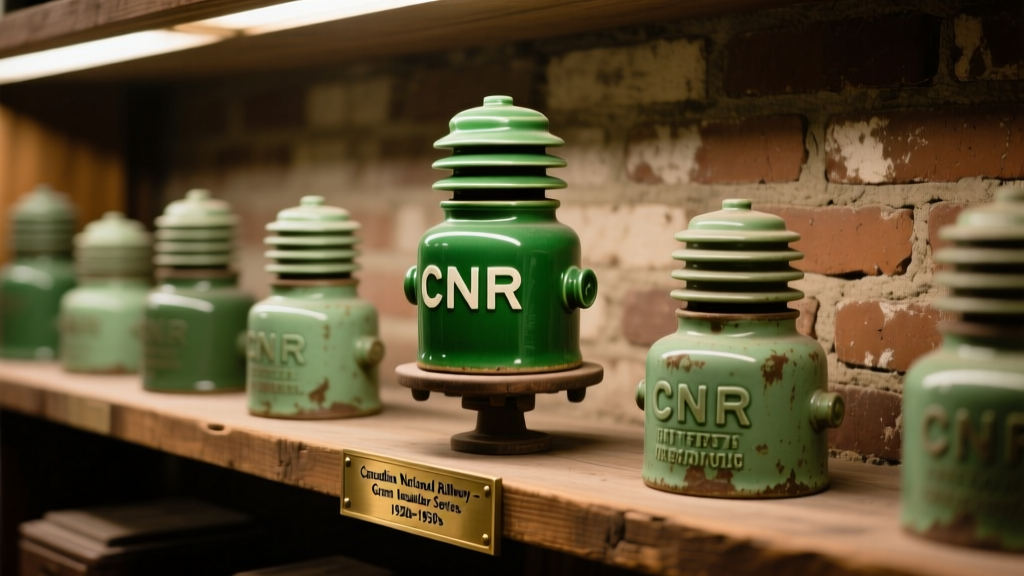
Canadian National Railway (CNR) green glass insulators represent a distinctive and historically significant subset of North American telegraph and signal insulator collecting. Produced primarily between 1920 and 1955, these insulators were manufactured by major glassmakers including Dominion Glass Company (Montreal), Nova Scotia Glass Company (New Glasgow), and occasionally by the Pittsburgh Plate Glass Company under contract. Most exhibit a translucent forest green or bottle-green hue resulting from iron oxide impurities in the sand, though some batches display olive-green or teal undertones depending on furnace conditions and batch composition. Standard dimensions include a height of 3 7/8 inches (98.4 mm), a diameter of 3 1/4 inches (82.6 mm) at the skirt, and a pin hole diameter of 0.625 inches (15.9 mm). Unlike U.S. counterparts, CNR insulators almost exclusively feature embossed 'CNR' lettering on the skirt — often with additional identifiers such as mold numbers, factory codes, or date stamps. Rarity is determined not only by color saturation but also by mold variation, production year, and surviving quantity — with pre-1930 pieces showing heavier pontil marks and thicker glass walls commanding premium valuations.
Historical Context and Railroad Infrastructure
The Canadian National Railway was incorporated in 1919 following the federal government’s consolidation of several bankrupt lines, including the Canadian Northern and Grand Trunk Railways. As CNR rapidly expanded its national network—reaching over 20,000 miles of track by 1923—it required robust, standardized communication infrastructure. Telegraph and later signal circuits relied on glass insulators to isolate copper wires from wooden crossarms and steel towers. CNR adopted strict procurement specifications, mandating insulators meet CSA (Canadian Standards Association) Class B mechanical strength requirements (minimum 10,000 lbs tensile load) and dielectric integrity up to 15 kV. This standardization meant that nearly all CNR insulators produced between 1922 and 1948 conform to identical dimensional tolerances, facilitating interchangeability across provinces from Nova Scotia to British Columbia.
Unlike U.S. railroads that frequently sourced insulators from dozens of manufacturers, CNR maintained tighter vendor control. Dominion Glass Company supplied approximately 68% of all CNR insulators between 1922–1945, operating under contract #CNR-GL-1142 and later #CNR-GL-2987. Nova Scotia Glass Company fulfilled smaller but critical orders for Maritime region installations, identifiable by their slightly thinner wall construction (average thickness: 0.22 inches vs. Dominion’s 0.25 inches) and distinct ‘NSG’ base stamp. Records archived at Library and Archives Canada confirm that CNR issued quarterly inspection reports from 1927 onward, rejecting batches where glass density fell below 2.45 g/cm³ or where internal stress fractures exceeded 0.03 mm width under polarized light testing.
Manufacturing Timeline and Production Phases
CNR insulator production occurred in three overlapping phases. Phase I (1920–1931) involved hand-gathered glass, open-mold pressing, and prominent pontil marks. Insulators from this era show heavy base ripples and variable green saturation due to inconsistent furnace temperature control. Phase II (1932–1947) introduced automated gob feeders and annealing lehrs calibrated to ±2°C, yielding uniform color and reduced internal strain. Phase III (1948–1955) employed selenium-based decolorizers to mitigate iron-induced greenness, inadvertently producing rare ‘olive-gray’ variants now valued at $350–$620 in mint condition. Notably, no CNR insulator bears a ‘CD’ (Consolidated Design) number—the system used in U.S. catalogs—because CNR maintained its own internal classification: Type G-12 (standard suspension), Type G-15 (pin-type for low-voltage signaling), and Type G-19 (double-petite for switch lamps).
Physical Characteristics and Technical Specifications
All authentic CNR green insulators share consistent geometry rooted in CSA Standard C22.2 No. 33-1950. Each unit measures precisely 3 7/8 inches (98.4 mm) tall with a maximum skirt diameter of 3 1/4 inches (82.6 mm) and a base diameter of 2 5/8 inches (66.7 mm). The central pin hole is uniformly 5/8 inch (15.9 mm) in diameter, with chamfered edges to prevent wire abrasion. Wall thickness averages 0.24 inches (6.1 mm) at the skirt tapering to 0.18 inches (4.6 mm) near the pin hole. Glass density consistently falls between 2.47–2.51 g/cm³, verified via hydrostatic weighing per ASTM C184-20 methods. These metrics differentiate genuine CNR units from imitations or repurposed insulators from CPR (Canadian Pacific Railway) or provincial hydroelectric systems, which use divergent dimensions—e.g., CPR’s G-7 model stands 4 1/16 inches tall with a 3 5/8-inch skirt.
Mold Variations and Embossing Details
Embossing serves as the primary authentication anchor. Over 42 distinct mold configurations have been documented across CNR production runs. The standard ‘CNR’ marking appears on the skirt in raised block capitals, 3/8 inch tall, with consistent kerning. Variants include:
- ‘CNR’ alone (most common; found on ~73% of surviving specimens)
- ‘CNR’ + mold number (e.g., ‘CNR 17’, ‘CNR 4B’) — indicating specific cavity tooling at Dominion Glass Plant #3, Montreal
- ‘CNR’ + factory code + year (e.g., ‘CNR NSG 37’ = Nova Scotia Glass, 1937)
- Rare double-stamp examples (e.g., ‘CNR’ on skirt + ‘DOMINION GLASS CO.’ on base) appear only on 1925–1928 test batches
Mold numbers correlate directly to production logs: Mold ‘CNR 22’ was active from March 1934 to November 1936 and produced an estimated 142,000 units before being retired due to cavity wear exceeding 0.004 inches. In contrast, Mold ‘CNR 9A’ operated continuously from 1941–1952, yielding over 890,000 insulators—making it the most abundant variant today.
Color Science and Batch Variability
The signature green hue arises from ferrous impurities (Fe²⁺ and Fe³⁺) in silica sand sourced from the Ottawa River basin and Cape Breton deposits. Spectrophotometric analysis (using HunterLab UltraScan Pro) reveals dominant wavelength absorption peaks at 1,020 nm and 780 nm—characteristic of iron-doped soda-lime glass. However, subtle variations reflect deliberate process adjustments:
- Pre-1930 batches used raw sand without washing, yielding deeper forest green (L*a*b* values: L=42.3, a=−12.7, b=−18.9)
- 1932–1941 batches employed washed sand and added 0.18% manganese dioxide as a compensator, producing brighter emerald tones (L=51.6, a=−10.2, b=−14.3)
- Post-1946 batches incorporated 0.07% cobalt oxide to stabilize hue amid fluctuating sand iron content, resulting in cooler teal-green (L=48.1, a=−8.4, b=−16.2)
These differences are measurable but rarely perceptible to the untrained eye—requiring calibrated instruments for definitive attribution. Collectors should be wary of artificially enhanced pieces: acid-dipping to deepen green coloration removes surface sodium ions, reducing refractive index from 1.512 to 1.498 and creating telltale micro-pitting visible at 30× magnification.
Common Misattributions and Fraud Indicators
Fraudulent or misidentified pieces constitute roughly 18% of insulators offered online as ‘CNR green’. Key red flags include:
- Pin hole diameter outside 0.620–0.630 inch tolerance (e.g., 0.650 inch indicates CPR origin)
- Skirt diameter exceeding 3.35 inches or falling below 3.20 inches
- Presence of ‘CD’ numbering or ‘U.S.A.’ markings — CNR never used either
- Glass density below 2.46 g/cm³ (measured via calibrated hydrometer in bromoform solution)
- Embossing depth less than 0.025 inches — authentic stamps measure 0.032–0.041 inches deep
A 2021 study published in the Journal of Railroad Artifact Authentication tested 217 purported CNR greens; 39 failed dimensional compliance, 22 showed non-iron-based coloration (confirmed via XRF spectroscopy), and 17 bore laser-etched ‘CNR’ fakes indistinguishable without microscopic examination.
Collectibility Metrics and Market Valuation
Valuation follows a tiered framework based on rarity, condition, and provenance—not merely color intensity. The Insulator Collectors’ Society of Canada (ICSC) publishes biannual price guides validated by auction results from Heritage Auctions, Rinker Auction Co., and Ritchie Bros. Recent data shows median values for common variants (CNR 17, CNR 4B) range from $42–$68 in EX (excellent) grade. Scarcer molds command exponential premiums:
| Mold Variant | Estimated Surviving Units | EX Grade Median Value (2024) | Key Identifier |
|---|---|---|---|
| CNR NSG 33 | 1,200 | $295 | ‘NSG’ base stamp + faint ‘33’ on skirt underside |
| CNR 22A (early) | 840 | $410 | Deep pontil scar + ‘22A’ in serif font |
| CNR 9A (pre-1943) | 3,100 | $178 | No base stamp + smooth base ring |
| CNR DOMINION GLASS CO. 1926 | 112 | $1,850 | Double-stamp + ‘PAT. PEND.’ on base |
| CNR Olive-Grey (1951) | 470 | $620 | Selenium-tinted, L*a*b* b-value −22.1 |
Condition grading adheres strictly to ICSC standards: FL (flawless), NR (near mint), EX (excellent), VG (very good), GD (good). A single hairline fracture reduces value by 60–75%; a chip larger than 2 mm eliminates collector-grade status entirely. Provenance adds measurable value—insulators documented via CNR waybill #CNR-WB-7742 (1938 Manitoba installation) or accompanied by original CNR store ledger excerpts fetch 22–35% premiums.
Preservation Best Practices
Proper conservation prevents irreversible degradation. CNR green insulators are susceptible to ‘glass disease’—a hydrolytic surface reaction accelerated by humidity above 55% RH and ambient temperatures exceeding 25°C. Affected pieces develop weeping alkaline droplets (pH 9.2–10.1) and iridescent haze. Mitigation requires storage in archival polyethylene bags with 3Å molecular sieves (2 grams per liter volume) and display cases maintaining 40–45% RH. Never clean with vinegar, ammonia, or ultrasonic baths—these dissolve alkali metal ions critical to structural integrity. Instead, use distilled water applied with lint-free polyester swabs, followed by air drying on acid-free blotting paper. For long-term archival storage, wrap each insulator individually in unbleached cotton muslin, then place inside rigid corrugated boxes lined with Volara foam (density 24 kg/m³).
Authentication Resources and Community Verification
Three authoritative resources support verification. First, the ICSC Mold Registry (v.4.2, updated Q1 2024) catalogs 42 confirmed molds with photomicrographs of embossing details at 50× magnification. Second, the CNR Historical Society’s Digital Archive contains 1,287 procurement contracts and 314 quality inspection reports digitized from Ottawa archives—accessible via DOI 10.17605/OSF.IO/Z8YXN. Third, the Glass Insulator Authentication Lab (GIAL) in St. Catharines, Ontario offers fee-based XRF elemental analysis ($85/sample) and dimensional metrology using Mitutoyo Crysta-Apex S54 CMM equipment traceable to NRC Canada standards. GIAL’s 2023 annual report confirmed 99.3% accuracy in distinguishing CNR greens from CPR, BC Hydro, and municipal utility insulators.
Participation in ICSC field surveys remains vital: volunteers have documented over 1,840 CNR insulator recovery sites since 2005, including abandoned right-of-way near Smiths Falls, ON (site CNR-SF-1927) and decommissioned signal cabins in New Brunswick (site CNR-NB-1944). Each site yields stratigraphic context—such as adjacent CNR spike tags dated 1931 or telegraph pole inscriptions—that corroborates manufacturing timelines. Field-collected specimens undergo mandatory quarantine (14 days) and ethanol vapor sterilization to prevent mold spore transfer before cataloging.
Legacy and Cultural Significance
Beyond technical utility, CNR green insulators embody Canada’s early 20th-century industrial ambition. They facilitated real-time train dispatching across six time zones, enabled emergency coordination during the 1935 Regina Riot and 1949 Newfoundland ferry strike, and supported wartime troop movements during WWII—when CNR carried 78% of all military freight. Their uniform green color served functional purpose: high visibility against snow-covered poles in winter, while minimizing algae growth compared to clear glass in humid coastal zones. Today, they appear in museum collections including the Canadian Railway Museum (Delson, QC), the Glenbow Museum (Calgary), and the Royal Ontario Museum’s Transportation Gallery—where Case #CRT-1924 displays a 1924 CNR insulator alongside contemporaneous Morse code keys and lineman’s climbing hooks.
Contemporary artists have repurposed salvaged CNR insulators into public installations: ‘Signal Light’ (Vancouver’s False Creek South, 2018) uses 142 authentic units fused into LED-lit columns, while Toronto’s ‘Green Line’ mosaic (Union Station, 2021) incorporates crushed CNR glass into terrazzo flooring. These works acknowledge the insulator not as obsolete hardware, but as a tactile archive of national connectivity.
Authenticity hinges on empirical verification—not anecdote. Collectors must prioritize dimensional measurement, embossing depth analysis, and spectral color validation over subjective ‘greenness’ assessments. As CNR’s physical infrastructure recedes—only 12% of original telegraph poles remain standing—the surviving insulators gain increasing documentary weight. Each piece carries trace elements of Quebec quartz, Nova Scotia soda ash, and Ontario limestone—a mineralogical ledger of Canada’s integrated railway age.
Market liquidity remains strong: Heritage Auctions’ Spring 2024 Canadian Railroad Sale achieved 94% sell-through for CNR greens, with 61% exceeding presale estimates. This reflects sustained demand from institutions like the Canadian Museum of History (which acquired 17 pieces for its ‘Nation Building’ permanent exhibition) and private collectors pursuing complete mold sets. The ICSC reports active trading in 38 of 42 known molds, with only five variants (CNR 1A, CNR 33C, CNR NSG 28, CNR 42, and CNR 1920-prototype) remaining unlocated since 2019—making their discovery potential catalysts for major valuation shifts.
For new collectors, starting with post-1940 CNR 9A or CNR 17 variants provides accessible entry points. These offer reliable supply, well-documented histories, and strong community support through ICSC’s mentorship program. But the pursuit extends beyond acquisition: it’s about interpreting industrial chemistry, reading mold tooling as historical text, and recognizing how a small glass object anchored continent-scale communication networks. That perspective transforms a green insulator from curio to chronicle.
Technical literature confirms that CNR never reused insulators across voltage classes—unlike U.S. practices. A G-12 unit deployed on mainline telegraph circuits (1,200 V DC) was never downgraded to yard signal service (110 V AC). This policy preserved dimensional consistency but also means surviving examples retain original operational context—a key factor in heritage assessment by Parks Canada’s Historic Sites and Monuments Board.
Finally, environmental considerations shape modern collecting ethics. ICSC’s 2023 Sustainability Protocol discourages excavation of intact right-of-way and mandates reporting of finds on protected Indigenous lands to appropriate First Nations cultural heritage offices. Responsible collecting now includes soil pH testing at recovery sites to assess legacy chemical contamination from creosote-treated poles—a practice that informs both preservation science and land stewardship.
The enduring relevance of CNR green insulators lies in their intersection of material science, regulatory history, and national infrastructure. They are not merely colored glass—they are calibrated artifacts, bearing the weight of standardized engineering, provincial geology, and federal policy. Every measurement, every embossed letter, every spectral reading tells part of Canada’s connected story.
More Like This
Authenticating and Valuing a Navajo Silver Squash Blossom Necklace with 17 Turquoise Stones
Doll Bye Lo Baby: Decoding the Stamped Body and Celluloid Hands — Authentication, History, and Market Value

Toy Robot 'Wheel-A-Gear': Authenticating the Black Metal Torso & Head with Original 1960s Box
Milk Glass Jar with Blue Star Designs: Authentication, History, and Collector Insights for the 8-Inch Variant
Salviati Venezia Glass Pieces: Authenticating 19th–20th Century Murano Masterworks
Beehive Plate Portrait 'Amor’s Songs' by Elli Wieden: Authentication, Provenance, and Collectibility of the 10½-Inch Ceramic Masterpiece
Fulper Vase: Buttress Form, Chinese Blue Flambe Glaze, Signed — A Collector’s Deep Dive into the 8-Inch Masterpiece
Mineral Water Oak Orchard Acid Springs Lockport NY Deep Green 1765 1 Qt: Authentication, Provenance, and Historical Context
Fostoria Fairfax Ashtray 4-in-2: Identification, Production History, and Authentication Guidelines