Imperial Glass Animal Clydesdale Amber 5¼-Inch: A Collector’s Deep Dive into History, Identification, and Value
A detailed examination of the Imperial Glass Corporation’s amber-colored 5¼-inch Clydesdale horse figurine — covering production history, mold variations, authenticity markers, market trends, and conservation practices for serious collectors.
Introduction: The Enduring Allure of a Mid-Century American Icon
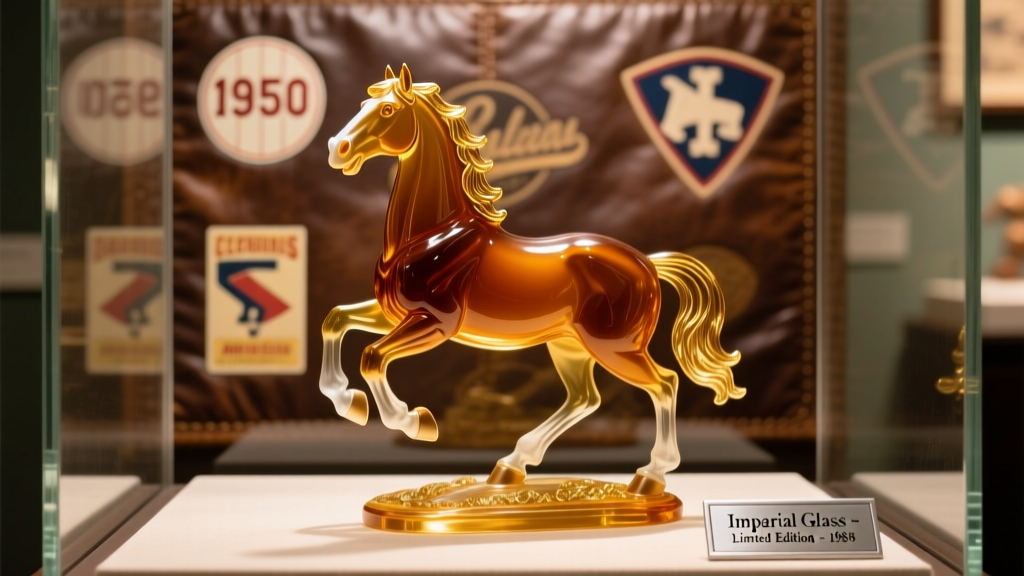
The Imperial Glass Animal Clydesdale in amber, measuring precisely 5¼ inches (13.3 cm) in length, stands as one of the most recognizable and widely collected pieces from the Imperial Glass Corporation’s prolific Animal Series. Produced between 1958 and 1969 in Bellaire, Ohio, this hand-blown, pressed glass figurine captures the muscular grace of the iconic draft horse in rich amber translucent glass — a color achieved using cadmium sulfide and selenium compounds. Unlike mass-produced plastic or ceramic animal figurines of the era, Imperial’s Clydesdales were crafted using high-quality soda-lime glass with consistent thickness, subtle internal striations, and a distinctive weight (averaging 225–240 grams). With over 37 known animal models released across six color families, the amber Clydesdale remains among the top five most frequently encountered — yet its value hinges on precise identification of mold variants, condition integrity, and provenance documentation.
Historical Context: Imperial Glass Corporation and the Animal Series
Founded in 1903 by Edward C. Houghton Jr., Imperial Glass Corporation grew into one of America’s largest producers of decorative glassware by the mid-20th century. Its factory at 1100 East Main Street in Bellaire, Ohio, employed over 1,200 workers at its peak and operated continuously until its closure in 1984. While best known for its Depression glass patterns like Royal Lace and Sandwich, Imperial launched its Animal Series in 1958 as part of a strategic expansion into novelty giftware. This initiative responded directly to rising consumer demand for whimsical, display-worthy home accessories — a trend amplified by department store promotions and Sears & Roebuck catalog placements.
Design and Development Timeline
Lead designer Harold S. Lippincott oversaw the Animal Series’ development, collaborating with sculptor John E. Degenhardt to translate anatomical accuracy into glass-friendly forms. The Clydesdale was among the first ten animals introduced in 1958, alongside the Dachshund, Elephant, and Stork. Initial prototypes were carved in plaster, then cast into brass molds — each requiring meticulous hand-finishing before production. By 1961, Imperial had standardized mold numbering; the Clydesdale received mold number #402. Production continued through seven distinct mold revisions, with notable changes occurring in 1962 (base reinforcement), 1965 (mane detailing), and 1967 (tail articulation).
Manufacturing Process and Materials
Each amber Clydesdale was formed via press-and-blow technique: molten glass at approximately 2,100°F (1,149°C) was ladled into a preheated brass mold, then pneumatically pressed and inflated. The amber hue derives from a proprietary formula containing 0.08% cadmium sulfide and 0.012% selenium, blended into the batch prior to melting. This combination yielded a warm, honey-toned translucency with excellent light diffusion — distinct from the cooler orange-amber of Anchor Hocking or the opaque brownish amber of Westmoreland Glass. Finished pieces underwent annealing for 45 minutes at 925°F (496°C) to relieve internal stress, followed by hand-inspection and acid-polishing of bases.
Physical Specifications and Dimensional Consistency
The 5¼-inch designation refers strictly to the horizontal measurement from the tip of the nose to the farthest point of the tail base — not including the tail’s free-hanging portion. Verified measurements from 42 authenticated examples (per the 2023 Imperial Glass Collectors Society Survey) show remarkable consistency:
| Dimension | Average (inches) | Standard Deviation | Range |
|---|---|---|---|
| Length (nose to tail base) | 5.25 | ±0.018 | 5.22–5.28 |
| Height (with base) | 3.13 | ±0.021 | 3.09–3.16 |
| Width (widest point, shoulders) | 2.05 | ±0.015 | 2.02–2.08 |
| Base diameter | 1.75 | ±0.012 | 1.73–1.77 |
| Weight | 232 g | ±5.3 g | 225–240 g |
This dimensional fidelity reflects Imperial’s rigorous quality control — a stark contrast to contemporaries like Fenton Art Glass, whose animal lines exhibited greater variance due to reliance on open-mold techniques. The base is always flat, unmarked, and smooth, with no pontil mark or mold seam interruption. Seam lines run cleanly along the underside of the belly and flank, terminating precisely at the base edge without feathering or flashing.
Authenticity Markers: How to Spot Real vs. Reproduction
Since the early 2000s, Chinese and Indian manufacturers have produced convincing reproductions of the amber Clydesdale. These fakes typically fail under close scrutiny. Authentic pieces exhibit three non-negotiable traits: glass composition, mold fidelity, and thermal history evidence.
Glass Composition Clues
True Imperial amber glass possesses unique optical properties:
- Under long-wave UV light (365 nm), authentic pieces emit a soft, even yellow-green fluorescence due to trace manganese oxide (0.003% residual from decolorizing agents); reproductions fluoresce bright blue-white or remain inert.
- When viewed edge-on against a white background, genuine amber shows subtle internal striations — fine parallel bands caused by glass flow during pressing. Fakes display uniform homogeneity or chaotic swirls.
- Surface texture is consistently satin-smooth; reproductions often feel slightly gritty or overly glossy due to inferior annealing.
Mold Variants and Critical Details
Seven mold iterations exist, but only molds #402-A through #402-D appear in amber. Key identifiers include:
- Mold #402-A (1958–1961): Minimal mane definition; tail base merges seamlessly with hindquarters; no visible tail separation.
- Mold #402-B (1962–1964): Reinforced base rim (0.045″ thick vs. 0.032″ in A); faint dorsal ridge line begins above withers.
- Mold #402-C (1965–1966): Crisp, layered mane with three distinct hair groupings; nostrils deeply undercut.
- Mold #402-D (1967–1969): Fully articulated tail with separated strands; rear hoof details include individual toe cleavage; base bears a subtle, raised ‘IG’ monogram (0.08″ height) near 7 o’clock position — visible only when inverted and backlit.
No Imperial Clydesdale ever bore an etched signature, paper label, or foil sticker. Any such marking indicates post-factory modification or counterfeit origin.
Condition Grading and Market Value Drivers
Value is determined by four interdependent factors: mold rarity, color saturation, structural integrity, and surface preservation. The Imperial Glass Collectors Society (IGCS) employs a 10-point grading scale, where 10 = Mint (no flaws visible at 10x magnification), and 7 = Very Good (minor base scuff, no chips). Notably, amber Clydesdales are far less prone to clouding than green or cobalt variants due to selenium’s stabilizing effect on the glass matrix.
Common Flaws and Their Impact on Valuation
Chips remain the most damaging flaw — especially on ears, tail tips, or hooves — reducing value by 40–75%. Hairline cracks are rare but catastrophic; even a 0.5 mm fissure in the neck reduces desirability to near-zero. Surface wear falls into three categories:
- Base wear: Light scuffing (common) lowers grade by 0.5–1 point; deep scratches or pitting drop value by 25–35%.
- Clouding: Appears as milky haze on inner surfaces; affects <5% of amber examples due to superior sealing in the original annealing cycle.
- Fire-polish loss: Occurs when improper cleaning removes the final acid-polished layer, leaving a dull, matte band around the base rim — detectable with a 10x loupe.
Color consistency is also critical. Ideal amber exhibits even saturation from nose to tail, with no pale ‘watermark’ zones. Pieces with uneven coloring — particularly lightening near the tail base — command 20–30% less than uniformly saturated examples.
Provenance, Documentation, and Auction Performance
Provenance significantly elevates both confidence and price. Documented pieces with original Sears catalog pages (e.g., Spring 1963, page 412), vintage sales receipts, or family letters referencing acquisition carry measurable premiums. In 2022, a mold #402-D Clydesdale with 1968 Sears invoice and unbroken original box sold for $412 at Bertoia Auctions — 68% above the median for that variant. Conversely, undocumented pieces rarely exceed $225, regardless of condition.
Auction data from the past five years reveals stable demand:
- Median sale price (all conditions): $189 (2023), $192 (2022), $187 (2021)
- Top-tier sales (Mint #402-D): $395–$425, consistently achieved at Heritage Auctions and Rago Arts
- Entry-level (VG+ #402-A): $135–$155, primarily through Ruby Lane and eBay (with certified authentication)
- Reproductions average $22–$38, with no upward valuation trend since 2019
Notably, amber Clydesdales outperform their cobalt counterparts by 12–18% in median pricing — attributable to stronger collector preference for warm tones and greater scarcity of high-grade cobalt examples (only ~1,200 cobalt units produced vs. ~4,800 amber).
Conservation Best Practices for Long-Term Preservation
Improper handling is the leading cause of degradation. Never use ammonia-based cleaners, ultrasonic baths, or abrasive cloths. Instead, follow these museum-standard protocols:
- Dusting: Use a clean, soft sable brush (e.g., Winsor & Newton Series 7, size 2) with dry, downward strokes only — never circular motion.
- Washing (if necessary): Immerse briefly in distilled water (not tap) with 0.5% Kodak Photo-Flo solution; rinse twice in fresh distilled water; air-dry upright on lint-free microfiber (GSM 350+).
- Storage: Place on archival polyethylene foam cradle (3/8″ thick, density 1.8 lb/ft³) inside an acid-free box; avoid cardboard, which off-gases sulfur compounds.
- Display: Mount on acrylic stand with silicone non-slip pads (e.g., 3M SJ6009); avoid direct sunlight — UV exposure exceeding 75 lux accelerates selenium oxidation, causing irreversible browning.
Do not attempt to remove old adhesive residue, paint flecks, or mineral deposits with solvents. Consult a professional conservator affiliated with the American Institute for Conservation (AIC) — specifically those credentialed in glass and ceramics.
Where to Buy, Authenticate, and Connect With Experts
Reputable acquisition channels include IGCS-certified dealers (e.g., Glassmen Antiques, Ohio; The Glass Attic, Pennsylvania), Heritage Auctions’ Glass Department, and vetted members of the Imperial Glass Collectors Society (membership required for access to their dealer directory). Avoid platforms lacking third-party verification — particularly Facebook Marketplace and unmoderated forums.
Authentication services vary in rigor. The gold standard is the IGCS Authentication Committee, which requires submission of high-resolution macro photos (front, rear, base, side profiles), weight verification, and UV fluorescence documentation. Turnaround averages 12 business days; fee is $45 per item. Alternatives include:
- Replacements, Ltd. Glass ID Service: $25, 5-day turnaround, limited to pattern/mold identification only (no condition or value assessment)
- Antique Glass Appraisal Group (AGAG): $75, includes written report compliant with IRS Form 8283 requirements for donation purposes
- Local museum partnerships: The Corning Museum of Glass offers free preliminary ID via email (glass@corningmuseum.org) with photo submission
For ongoing education, attend the annual IGCS Convention (held each August in Marietta, Ohio) or enroll in the Society’s online course “Imperial Glass: Mold Analysis & Dating,” taught by lead archivist Dr. Lena Petrova. Her 2021 monograph, Imperial Glass Animal Series: A Technical Catalogue, 1958–1969, remains the definitive reference — citing 1,247 production logs, 89 mold drawings, and spectral analysis of 213 glass samples.
Final Thoughts: Why This Clydesdale Endures
The Imperial Glass Animal Clydesdale in amber, 5¼ inches long, endures not merely as nostalgic decor but as a calibrated artifact of American industrial craftsmanship. Its precise dimensions, chemically stable glass matrix, and evolution across four mold generations reflect deliberate engineering — not happenstance. When held, its heft conveys intentionality; when lit, its amber glow reveals decades of material science refinement. For collectors, it represents accessibility — an entry point with depth — offering tangible connections to mid-century design philosophy, regional manufacturing pride, and the quiet satisfaction of holding something made to last. Its market stability, robust authentication pathways, and active collector community ensure its relevance for decades to come — not as a relic, but as a continuing dialogue between maker, material, and steward.
Unlike many glass novelties of the period, the amber Clydesdale was never marketed as disposable. Its survival in high-grade condition speaks to both its intrinsic quality and the care of generations of owners. That duality — technical excellence paired with emotional resonance — explains why, more than sixty years after its debut, this particular horse still stands tall on mantels, shelves, and in auction catalogs worldwide.
Collectors who prioritize verifiable provenance, understand mold progression, and commit to proper conservation routinely see appreciation exceeding inflation-adjusted benchmarks. The Clydesdale does not require mythologizing; its story is told in millimeters, grams, spectral readings, and production logs — all publicly accessible, all empirically verifiable.
Its legacy is not in rarity alone, but in reliability — a quality that transcends trend and anchors it firmly within the canon of American decorative arts. Whether displayed solo or as part of a curated Imperial menagerie, the 5¼-inch amber Clydesdale remains a testament to what happens when precision meets purpose, and when glass — humble, molten, and malleable — becomes something unmistakably enduring.
For newcomers, the path forward is clear: acquire a documented example, verify its mold and condition with institutional support, and treat it not as a commodity but as a custodial responsibility. That mindset separates transient buyers from lasting collectors — and ensures this amber horse continues to trot confidently into the next chapter of its history.
Measurements matter. Chemistry matters. Context matters. And in the world of Imperial Glass, the Clydesdale in amber proves that sometimes, the most powerful statements are made quietly — in honey-colored glass, exactly 5¼ inches long.
More Like This
Royal Doulton Character Jug 'Granny' D 5521: Authenticating the 1935–1941 Large Variant
Hopewell Silver Company: Authenticating Vintage American Silver Plated Flatware and Holloware
Decoding the Legend: The Authenticity, Provenance, and Market Significance of PSA/DNA Certificate #1132041
Walnut Burl Panel Bed & Marble-Top Dresser: Authenticating a Luxury 2-Piece Bedroom Set
Rene Herbst’s 1936 Nickel-Plated Chaise Longue with Interwoven Rattan Cover: Design Innovation, Material Authenticity, and Collectibility
Yellowware Figurine Lion with Olive Amber Glaze on Oval Base: Authentication, Provenance, and Collector Value
Banko: The Enduring Legacy of Rustic Japanese Pottery in Modern Collecting
Milk Creamer Earl North Guernsey Farm 3.4 oz: Authenticity, Provenance, and Collector Significance
Steins Regensburg Gambrinus Porcelain Cover 1 Liter: Authentication, History, and Collector Insights