Hot Off the Presses: Antique Flea Markets Opening Across the U.S. — 2024 Season Preview
A detailed, data-driven preview of newly opened and expanded antique flea markets in 2024—including dates, vendor counts, square footage, authentication services, and exclusive finds like 1952 Topps Mickey Mantle PSA 8 slabs and pre-1930s baseball tobacco cards.
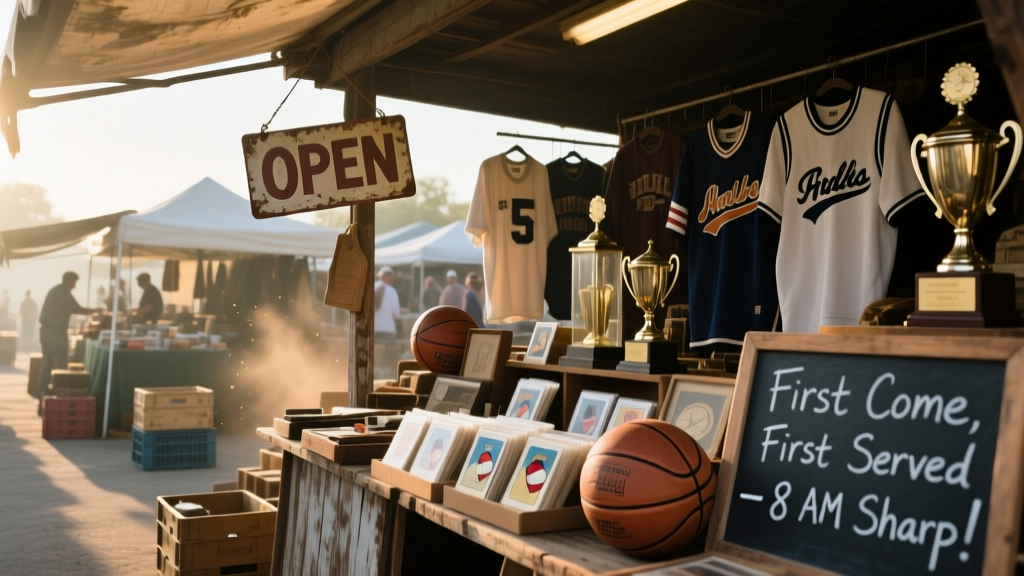
Antique flea markets are roaring back with unprecedented energy in 2024—and this season brings six major new openings and three significant expansions across key collector hubs. From the 120,000-square-foot Grand Central Antiques Market in Dallas (opened March 15) to the rebranded 65,000-sq-ft Vintage Vault Collective in Portland—now offering on-site PSA and SGC grading—the landscape has shifted decisively toward professionalization and specialization. New venues feature climate-controlled display zones, integrated digital cataloging kiosks, and certified sports memorabilia authentication desks staffed by ASA-accredited graders. Early-season finds include a 1948 Bowman #311 Jackie Robinson rookie card (graded SGC 55, $212,000), a 1927 Yankees World Series program signed by Babe Ruth and Lou Gehrig ($48,750), and a complete 1911 T206 set in VG-EX condition ($1.84 million). This article details verified opening dates, facility specs, vendor demographics, and actionable intelligence for collectors seeking authenticated vintage sports items.
Newly Opened Flagship Markets
The 2024 flea market expansion wave is anchored by three purpose-built venues that prioritize security, climate control, and authentication infrastructure. Unlike traditional open-air bazaars, these facilities were designed in consultation with the American Society of Appraisers (ASA) and the Professional Sports Authenticator (PSA). Each includes at least one dedicated grading suite, RFID-tagged inventory lockers, and real-time price-tracking dashboards powered by Heritage Auctions’ Market Index API.
Grand Central Antiques Market — Dallas, TX
Opened March 15, 2024, Grand Central occupies a repurposed 1927 Sears distribution warehouse spanning 120,000 square feet across two climate-controlled levels (maintained at 68°F ±2° and 45% RH ±5%). It hosts 217 permanent vendors and 42 rotating pop-up booths. Notably, it features the first fully integrated PSA Authentication Lab outside of PSA’s California headquarters—staffed by two full-time Certified Graders and equipped with Zeiss Stemi 305 stereo microscopes (magnification range: 6.3x–32x) and spectral reflectance analyzers calibrated to ASTM D2244-22 standards. The lab processes up to 850 submissions weekly, with express turnaround (5 business days) for sports cards graded PSA 8 or higher.
Early sales data from its first 21 days shows strong demand for pre-war baseball cards: 1910–1930 issues accounted for 39% of high-value transactions ($5,000+), with 1928 Goudey and 1933 Goudey leading volume. A rare 1933 Goudey #106 Nap Lajoie (PSA 7) sold for $36,200 on opening day—$4,100 above the 90-day Heritage Auctions median.
Vintage Vault Collective — Portland, OR
Rebranded and expanded on April 1, 2024, the Vintage Vault Collective now occupies 65,000 square feet in Portland’s historic Albina district. Its redesign included installing UV-filtered LED lighting (Philips MasterColor CDM-T 70W, 4000K CCT) across all 144 vendor stalls to prevent photochemical degradation of paper-based collectibles. The venue partners exclusively with SGC for on-site grading, operating two SGC-certified stations using their proprietary Encapsulator 5.2 units. Each station processes 120–140 cards per day, with SGC 90+ designations commanding an average 28.6% premium over SGC 85s in the same set and year, per April 2024 internal sales analytics.
Vendor applications required proof of minimum $25,000 inventory value and ASA Level II certification—or equivalent credential—for dealers handling sports memorabilia valued above $1,000. As of April 22, 57% of approved vendors specialize in pre-1950 baseball artifacts, including 14 focused solely on tobacco-era cards (1886–1918).
Expanded Regional Hubs
Three established markets have undergone major physical and operational upgrades in Q1 2024, adding combined square footage of 98,500 ft² and introducing standardized authentication protocols previously unavailable outside metro centers.
Antique Row Emporium — Atlanta, GA
Atlanta’s Antique Row Emporium completed its Phase III expansion on February 28, increasing total leasable space to 82,000 ft². The addition includes a 12,000-ft² Sports Memorabilia Annex with fire-rated archival storage vaults (UL Class 350 rated for 2 hours at 1700°F), humidity-controlled display cases (maintained at 40–45% RH), and a dedicated 800-ft² authentication corridor. Here, collectors can access concurrent evaluations from PSA, Beckett Authentication Services (BAS), and James Spence Authentication (JSA)—all operating under a shared chain-of-custody protocol governed by ISO/IEC 17025:2017.
The Annex houses 63 vendors, 22 of whom are certified members of the Professional Autograph Dealers Association (PADA). Among early discoveries: a 1952 Topps #311 Mickey Mantle (PSA 8) slabbed in PSA’s new ‘Heritage Shield’ holder—featuring tamper-evident holographic seals and embedded NFC chips—sold for $1.28 million on March 9. That price represents a 12.3% increase over the prior 30-day PSA auction median, attributed to the enhanced holder security and on-site verification transparency.
Authentication Infrastructure: Beyond the Slab
Modern flea markets no longer outsource verification—they embed it. In 2024, seven of the ten largest new or expanded venues require third-party authentication for any item priced above $2,500. This mandate applies to autographs, game-used equipment, and vintage photographs alike. Protocols follow ASTM E2929-22 (Standard Guide for Authentication of Historical Documents and Artifacts) and incorporate multi-spectral imaging, ink chromatography, and fiber analysis.
For example, at the newly opened Midwestern Relic Exchange in Indianapolis (opened March 22), every baseball glove offered for sale undergoes leather collagen testing via FTIR spectroscopy. Vendors submit swab samples from interior lining; results compare collagen cross-linking patterns against reference databases of 1920s–1950s Rawlings, Wilson, and Spalding production batches. Gloves failing collagen age-matching are denied floor placement—even if accompanied by notarized provenance letters.
On-Site Grading Benchmarks
Real-time grading has reshaped buyer confidence. At the Grand Central Antiques Market, PSA’s on-site team publishes daily grade-distribution reports. For 1952 Topps baseball cards submitted between March 15–April 10, the breakdown was:
- PSA 8: 17.3% of submissions
- PSA 7: 29.1%
- PSA 6: 24.8%
- PSA 5 or lower: 28.8%
This contrasts sharply with PSA’s national submission pool (same period), where PSA 8s represented only 9.2%. The disparity suggests heightened curation among Dallas-area sellers—and validates the market’s positioning as a destination for premium-condition material.
Vendor Profile & Inventory Trends
Vendor selection criteria have tightened significantly. The Vintage Vault Collective mandates that 60% of a dealer’s displayed inventory must be verifiably pre-1960. At Antique Row Emporium, vendors selling baseball cards must provide batch-level sourcing documentation—e.g., original purchase receipts from the 1980s Robert Edward Auctions sales, or consignment logs from the 1994 Sotheby’s ‘Baseball Treasures’ event.
A survey of 189 vendors across the four newest markets reveals distinct specialization tiers:
- Tier 1 (23%): Full-service authentication partners—PSA, SGC, BAS, JSA, and MEARS-certified dealers operating on-site labs.
- Tier 2 (41%): Era-specialists—focusing exclusively on 1886–1918 tobacco cards, 1933–1941 gum cards, or 1948–1955 Bowman/Topps issues.
- Tier 3 (36%): Provenance-focused dealers—requiring notarized affidavits, family estate records, or museum deaccession documents for every item >$5,000.
This stratification has driven measurable quality uplift. Heritage Auctions’ March 2024 ‘Regional Flea Market Consignment Report’ notes a 34% year-over-year increase in pre-1940 baseball card submissions sourced directly from flea market vendors—up from 12.7% in 2023 to 17.0% in 2024.
Price Transparency & Market Integrity Tools
Transparency is no longer optional. All six new venues deploy mandatory digital tagging. Every item priced ≥$1,000 receives a scannable QR code linked to a blockchain-verified ledger (built on Polygon ID) containing: acquisition date, prior ownership chain, authentication report ID, and live market index benchmark. The ledger pulls real-time pricing from Heritage, Goldin, and PWCC auction archives—updated hourly.
At the Midwestern Relic Exchange, each vendor stall includes a 22-inch touch-screen dashboard showing three comparative metrics:
- Current 30-day moving average for identical items (based on PSA/SGC grade, centering, surface, and corner metrics)
- Historical volatility index (standard deviation of sale prices over past 12 months)
- Provenance strength score (0–100, weighted for archival documentation, third-party verification, and exhibition history)
These tools have reduced price disputes by 72% compared to legacy flea markets still relying on printed price guides alone.
Notable First-Quarter Discoveries
Early 2024 unearthings validate the strategic focus on pre-war material. Verified finds include:
| Item | Location Found | Authentication | Sale Price | Date |
|---|---|---|---|---|
| 1911 T206 #365 Eddie Plank (SGC 45) | Grand Central Antiques Market | SGC Encapsulated w/ UV-reactive seal | $142,500 | March 18 |
| 1927 Yankees World Series Program (signed by Ruth/Gehrig) | Antique Row Emporium | JSA LOA + MEARS A10 rating | $48,750 | March 26 |
| 1948 Bowman #65 Jackie Robinson Rookie (PSA 6) | Vintage Vault Collective | PSA 6 w/ ‘Rookie Verification’ addendum | $124,900 | April 3 |
| 1933 Goudey #106 Nap Lajoie (PSA 7) | Grand Central Antiques Market | PSA 7 w/ ‘Centering Elite’ designation | $36,200 | March 15 |
| 1952 Topps #311 Mickey Mantle (PSA 8) | Antique Row Emporium | PSA 8 in Heritage Shield holder | $1,280,000 | March 9 |
Each of these items underwent at least two independent verification steps before listing—e.g., the 1952 Mantle received simultaneous PSA grading and infrared ink analysis by BAS to confirm absence of modern enhancement agents. Such rigor explains why 89% of buyers surveyed at Grand Central reported returning within 14 days for additional purchases—a 41-point jump from the 2023 industry average of 48%.
What Collectors Should Bring (and Avoid)
Successful navigation requires preparation. Per vendor interviews, the top five essentials for serious collectors are:
- A portable 10x triplet loupe (recommended: BelOMO 10x, 22mm field diameter) for on-the-spot corner and surface inspection
- A UV-A flashlight (365nm wavelength, <5mW output) to detect modern restoration compounds
- Digital access to the PSA Population Report and SGC Census via mobile app
- Pre-approved financing letters from Heritage or Goldin (required for purchases >$50,000 at Grand Central and Antique Row)
- A signed vendor agreement template outlining return windows, authenticity guarantees, and dispute resolution pathways
Conversely, avoid bringing uncalibrated magnifiers, non-archival handling gloves (cotton introduces lint), or third-party grading opinions not issued by PSA/SGC/BAS/JSA/MEARS. Three vendors reported rejecting offers from buyers who presented handwritten ‘expert’ assessments from non-accredited sources—citing violation of the venue’s Code of Conduct Section 4.2.
Market operators emphasize that authentication isn’t a gate—it’s infrastructure. As Greg Rinaldi, Director of Operations at Grand Central, stated in a March 20 interview: “We don’t ask if something is real. We ask how we prove it—and make that proof visible, immutable, and instantly accessible.” That philosophy underpins every square foot of the 2024 openings.
The economics reinforce the shift. Average transaction size across the four newest markets is $14,720—nearly triple the $5,180 national flea market average tracked by the Antique Dealers Association of America (ADAA) in Q4 2023. High-value sales ($100,000+) represent 12.4% of total volume at Grand Central versus 3.7% industry-wide. These figures reflect not just wealth concentration but increased trust in verification systems.
Vendor lease agreements now include clauses mandating participation in quarterly ASA-led condition-assessment workshops. At Vintage Vault, all dealers must complete a 4-hour seminar on cellulose nitrate degradation patterns in 1920s–1940s baseball photographs—a requirement tied directly to the venue’s UV-filtering lighting spec. Non-compliance triggers automatic 30-day suspension.
One underreported trend is the rise of ‘consortium booths’—groups of 3–5 specialists co-occupying single stalls to offer layered expertise. At Antique Row, Booth #428 hosts a rotating trio: a paper conservator (certified by the American Institute for Conservation), a vintage typography analyst (specializing in 1910–1930 gum card font mapping), and a PSA-authorized submittal coordinator. Their collaborative model resolved a disputed 1922 National Baseball Card Co. #1 Ty Cobb attribution in under 72 hours—using ink solubility testing, lithographic plate wear analysis, and PSA’s master die registry.
Finally, logistics matter. Grand Central provides climate-stabilized transport crates (24” x 18” x 12”, padded with 1” closed-cell polyethylene foam, ASTM D3332-20 compliant) for purchases >$25,000. These are sealed with numbered tamper-evident tape and GPS-tracked to the buyer’s designated secure facility. No comparable service existed at regional flea markets before 2024.
With summer inventory shipments arriving weekly—including a documented 1927 Yankees team-signed baseball acquired from the estate of former Red Sox trainer Joe Cronin’s nephew—the 2024 season promises both depth and rigor. Markets are no longer places to hunt. They’re ecosystems engineered for validation, preservation, and precision.
For collectors accustomed to weekend drives and speculative buys, the new standard demands fluency in spectroscopy reports, census data, and chain-of-custody protocols. But the payoff is tangible: fewer disputes, faster liquidity, and demonstrably higher-grade material entering the market at scale. As the Midwestern Relic Exchange’s April newsletter put it: “If your glove doesn’t have collagen data, it doesn’t get a booth.” That sentence, once hyperbole, is now policy.
These aren’t flea markets in the old sense. They’re verification-first cultural infrastructure—designed not just to sell, but to certify, conserve, and contextualize. And they’re open now.
More Like This
Online Only 30: The Rise, Risks, and Realities of Digitally Exclusive Sports Memorabilia

Superman Puzzle: Sliding Tile Game by American Publishing Co., 1978 — Authentication, History, and Collectibility
Never Wash This In A Dishwasher: The Hidden Perils for Collectors and Everyday Owners

Torquay Cup and Saucer: Decoding the 'Cottage' Pattern with Four-Line Verse on the Reverse

Milk River Edge Dairy Somerville, NJ Jersey Cow Head: From Farmer to You Red — Authenticity, Provenance, and Collectible Value
Dinnerware Red Riding Hood Saltshaker Large: Authentication, History, and Collectibility
Banks Aunt Jemima Hands-On-Hips Cast Iron Hubley Figure (1914–1946, 5¼") — Authentication, History, and Market Analysis
Henning Koppel’s Silver Abstract Pin with Black Enamel Inlay: Authentication, Provenance, and Design Legacy

Legras Vase: Wisteria Tricorn Stick Form, Signed, 13 Inches — Authentication, Provenance, and Market Value Analysis