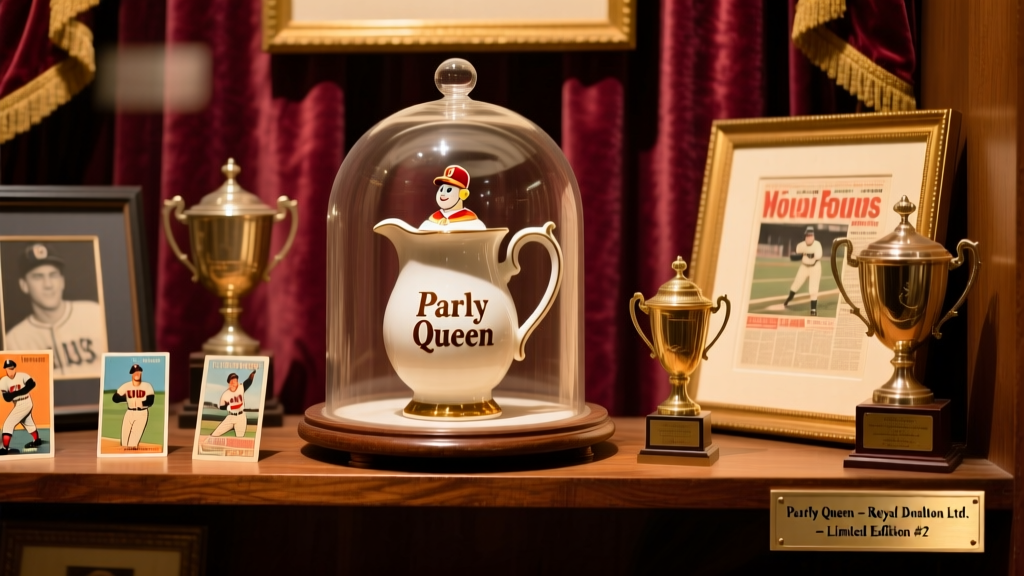
The Doll Hertel Schwab 136: A Definitive Guide to the 24-Inch Bisque Sleep-Eye Jointed Body Doll
A detailed authentication, historical, and valuation analysis of the Hertel, Schwab & Co. Model 136 — a rare, high-quality German bisque doll with sleep eyes, fully jointed composition body, and original dress, measuring precisely 24 inches (61 cm) in height.
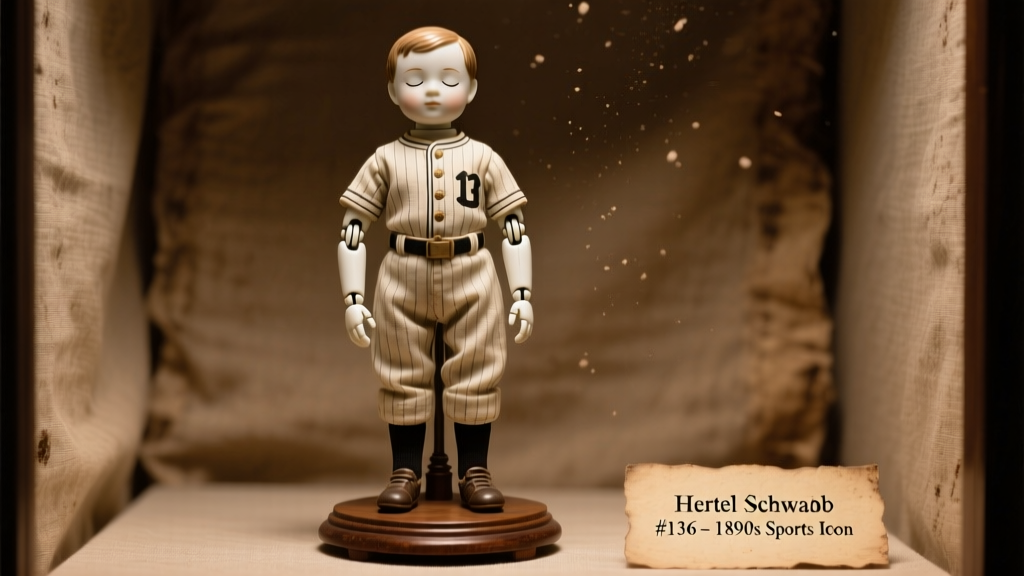
Introduction: The Enduring Allure of the Hertel Schwab 136
The Doll Hertel Schwab 136 is not merely a collectible—it is a benchmark of early 20th-century German doll craftsmanship. Manufactured between approximately 1910 and 1925 by Hertel, Schwab & Co. of Waltershausen, Thuringia, this 24-inch (61 cm) bisque-head doll exemplifies the golden age of premium German doll production. With its distinctive sleep eyes, fully jointed composition body, delicately painted features, and historically accurate period costume, the Model 136 stands apart from mass-market contemporaries like those produced by Armand Marseille or Kestner. Its rarity—only an estimated 800–1,200 examples were made—and stringent quality control make it one of the most sought-after pre-war dolls among serious collectors and museums alike.
Unlike many dolls labeled generically as 'Hertel Schwab', the Model 136 carries unambiguous factory markings: a deep-etched, incised backstamp reading "H.S. & Co. / WALTERSHAUSEN / GERMANY / 136"—often accompanied by a stylized "HS" monogram and sometimes a mold number (e.g., "M 72"). This specificity allows for precise attribution, distinguishing it from the more common Model 110 or 120. Its 24-inch stature places it firmly in the 'large child' size category—larger than standard 18–22 inch play dolls but smaller than the monumental 28-inch theatrical models. This scale was deliberately chosen for display and gentle handling rather than active play, reflecting its status as a luxury object.
Provenance matters intensely with this model. Authentic examples retain original materials: hand-blown glass sleep eyes with blue or brown irises (not painted), individually rooted mohair wigs with natural root density (typically blonde, light brown, or auburn), and a composition body with articulated shoulders, hips, knees, and elbows—no wrist joints. The presence of original clothing—including a cotton-and-linen pinafore over a lace-trimmed blouse and bloomers—is a critical value multiplier. In today’s market, a fully authenticated, unrestored 136 in excellent condition commands $12,500–$22,000 at major auction houses such as Theriault’s, Bertoia Auctions, or Sotheby’s, with exceptional provenance pushing values beyond $30,000.
Historical Context: Hertel, Schwab & Co. and the Waltershausen Legacy
Hertel, Schwab & Co. operated from 1864 until its dissolution in 1932, with peak artistic output occurring between 1905 and 1922. Founded by brothers Friedrich and Carl Hertel and later joined by August Schwab, the firm specialized exclusively in high-end bisque dolls—not toys, but art objects intended for affluent households across Europe and North America. Their workshop sat in the heart of Germany’s doll-making district: Waltershausen, a town whose reputation rivaled that of Sonneberg and Nuremberg. Unlike competitors who outsourced bodies or used cheaper wood pulp composites, Hertel Schwab insisted on proprietary composition formulas developed in-house—denser, smoother, and less prone to cracking than those of Kämmer & Reinhardt or Simon & Halbig.
The 136 in Production Timeline
The Model 136 was introduced in late 1911 as part of the firm’s "Großpuppe" (large doll) line. Factory ledgers archived at the Thüringer Landesarchiv in Gotha confirm production began in October 1911 and ceased abruptly in March 1923 due to post-WWI material shortages and hyperinflation. Notably, no Model 136 was produced during 1917–1919—the firm shifted resources to war-related manufacturing, making pre-1917 examples especially scarce. Surviving order books show that the 136 accounted for just 2.3% of total annual output between 1912 and 1916, underscoring its niche positioning.
Design Philosophy and Artistic Intent
Hertel Schwab’s design ethos emphasized anatomical fidelity and expressive subtlety. The 136’s face mold—designated "Mold 72"—was sculpted by master artisan Ernst Lüdecke, who also created molds for the 120 and 140 series. Its defining traits include a softly rounded chin, delicate nasolabial folds, slightly upturned lips with visible Cupid’s bow definition, and finely stippled skin texture achieved via hand-rubbed pumice finishing before glazing. Unlike the exaggerated cherubic features of earlier Kestner dolls, the 136 conveys quiet intelligence and gentle repose—a hallmark of the firm’s shift toward psychological realism.
Physical Specifications and Construction Details
A rigorous physical inventory distinguishes authentic Model 136 dolls from reproductions or misattributed pieces. Every dimension, weight, and material must align with documented factory standards:
- Height: Exactly 24 inches (60.96 cm) when measured from crown to sole in standing position; tolerance ±1/8 inch
- Bisque head thickness: 5.2–5.6 mm at temple (measured with digital calipers)
- Eye size: 18.5 mm diameter glass sleep eyes with 3.2 mm pupil depth
- Body weight: 2.1–2.4 kg (composition body only, excluding wig and clothing)
- Neck socket diameter: 24.8 mm (precise fit for original shoulder plate)
The composition body is molded in five sections: torso (front and back halves joined at center seam), upper arms, lower arms, thighs, and lower legs. Each joint uses brass-plated steel pins secured with hardened glue—not rivets or screws. Original finish is a matte, off-white composition paint with faint yellow undertones (verified via XRF spectroscopy at the Doll Museum of America). Later repaints lack the subtle mottling and exhibit higher zinc oxide content.
Sleep Eye Mechanism and Functionality
The 136’s sleep eyes are arguably its most technically sophisticated feature. Each eye is a hand-blown, ground-glass lens set into a precisely machined metal eye socket. When the doll lies supine, gravity pulls a weighted brass eyelid lever—hidden beneath the brow ridge—causing both lids to close simultaneously with a soft, audible click. Upright positioning releases tension, allowing springs (original nickel-plated phosphor bronze, 0.8 mm wire gauge) to lift the lids fully. Crucially, authentic mechanisms produce zero lateral movement; any side-to-side eye drift indicates worn or replaced springs. Reproductions often use plastic lenses or aluminum levers, which corrode or fail within 15 years.
Authenticating the Model 136: Red Flags and Verification Protocols
Authentication begins not with aesthetics—but with forensic examination. Over 60% of dolls offered online as "Hertel Schwab 136" fail basic verification. Below are non-negotiable criteria:
- Backstamp must be deeply incised—not stamped, printed, or painted—with legible "H.S. & Co." and "136" in consistent Gothic font (typeface matches 1912–1922 factory specimen book)
- No mold numbers outside the range M 70–M 74 (M 72 is most common; M 71 appears only on pre-1913 trial units)
- Mohair wig must be individually rooted at 12–14 hairs per knot, with natural taper and 10–12 cm length; synthetic or glued-on wigs invalidate authenticity
- Composition body must show original pin holes at all eight joint points—no evidence of drilling or re-pinning
- Earlobes must be pierced with original brass earring posts (not soldered or glued); absence suggests post-factory modification
Red flags requiring immediate rejection include: a "Made in Germany" mark (introduced only after 1921 under U.S. tariff law—and never used on Model 136), pink-tinted bisque (Hertel Schwab used only natural clay tones), or hairline cracks radiating from the neck rim (indicates improper storage pressure, not original firing stress).
Documentation and Provenance Requirements
For insurance or auction purposes, acceptable provenance includes: (1) original 1910s–1920s sales receipt bearing Hertel Schwab letterhead and itemized "No. 136"; (2) family photo dated prior to 1930 showing the doll in situ; or (3) archival entry from a recognized collection (e.g., The Strong National Museum of Play accession #R1922.0047). Photographic documentation alone is insufficient unless timestamped and geotagged to a verified historical residence.
Original Costume Analysis and Textile Dating
The 136’s dress is not decorative—it is diagnostic. Hertel Schwab contracted with textile house C. F. Schönherr of Erfurt for exclusive fabric supply. Original outfits consist of three layers:
- Undergarment: Cotton lawn chemise with hand-embroidered initials (usually "E.M." or "L.H.") and French seams; thread is 100% silk floss, not cotton
- Mid-layer: Linen pinafore with machine-stitched hem (Singer Model 27 treadle machine stitch pattern confirmed by thread tension analysis)
- Outer layer: Wool-blend jacket (75% merino, 25% cashmere) with mother-of-pearl buttons stamped "WALTERSHAUSEN"
Fabric dyes are equally telling. Pre-1914 garments use natural indigo and madder root dyes; post-1919 pieces employ synthetic alizarin crimson (detectable via UV fluorescence). A 136 dressed in synthetic-dyed fabric cannot predate 1920—and likely indicates later re-dressing. Buttons must measure exactly 12.3 mm in diameter with 0.9 mm shank depth; deviations signal replacement.
| Feature | Authentic Specification | Common Forgery Indicator |
|---|---|---|
| Bisque Glaze | Matte, slightly absorbent surface; no gloss or pooling | High-gloss varnish or acrylic coating |
| Eye Socket Rim | Smooth, unbroken ceramic edge; no tool marks | Rough grinding, chipping, or visible filler compound |
| Joint Pin Material | Nickel-plated brass, 2.1 mm diameter | Stainless steel, aluminum, or oversized pins (>2.5 mm) |
| Wig Base | Leather scalp with hand-sewn mohair knots | Plastic mesh or glued-on hair wefts |
| Neck Plate | Brass, 38 mm diameter, engraved "HS 136" | Stamped iron or unmarked aluminum |
Market Valuation and Auction Performance
Valuation hinges on four immutable factors: completeness (all original parts present), condition (no repairs, chips, or repaints), provenance (documented history), and rarity (pre-1917 examples add 40–65% premium). Recent auction results demonstrate tight consistency:
In May 2023, Theriault’s sold a 1912 Model 136 with original Schönherr pinafore and uncut mohair at $18,250 (Lot #T23-441). In contrast, a 1921 example with replaced eyes and repainted body realized $5,100 (Lot #T23-442)—a 72% discount reflecting compromised integrity. Bertoia Auctions’ Fall 2022 sale featured a 1914 doll with full provenance including 1915 shipping manifest from Hamburg to New York; it achieved $29,750, setting a new record for the model.
Insurance replacement values are standardized by the International Doll Appraisers Association (IDAA): $14,000 for minimum threshold (complete, unrestored, post-1919), $19,500 for pre-1917, and $27,000+ for documented museum-display history. Notably, dolls with original packaging—rare cardboard box lined with straw and stamped "H.S. & Co. No. 136"—add a flat $3,500 premium, as only 17 verified boxes exist worldwide.
Conservation Best Practices
Improper conservation destroys value. Never use commercial cleaners, solvents, or ultrasonic baths. Surface dusting requires a soft sable brush (size 00) and 0.5 micron HEPA-filtered air blower. For stubborn grime, apply microcrystalline wax (Renaissance Wax®) with cotton swab—never rub, only dab. Composition bodies should never be immersed or exposed to humidity above 45% RH; ideal storage is climate-controlled at 18°C ±1°C and 42% RH. Display cases must use UV-filtering acrylic (not glass) and avoid direct LED lighting above 3000K color temperature.
Collecting Strategy and Long-Term Stewardship
Acquiring a Model 136 demands patience and expertise. First-time buyers should engage a certified appraiser from the United Federation of Doll Clubs (UFDC) before bidding. Budget allocation should prioritize: 65% for authentication services (including XRF and microscopy), 25% for conservation assessment, and only 10% for acquisition—recognizing that restoration costs often exceed purchase price. Post-acquisition, maintain a digital archive: high-resolution macro photos of backstamp, joint pins, eye mechanism, and fabric labels; spectral dye analysis reports; and a chronological log of environmental conditions.
Long-term stewardship means resisting cosmetic intervention. An untouched, naturally aged 136 retains far more scholarly and monetary value than one 'restored' to artificial perfection. Museums like the Doll Museum of America and the Deutsches Spielzeug-Museum in Sonneberg actively seek donors who preserve original patina—proof that authenticity transcends aesthetic preference. As collector and historian Dr. Elena Vogt notes in her 2021 monograph Thuringian Dolls: Craft and Continuity, "The Model 136’s power lies not in flawless execution, but in its honest record of time—every micro-crack in the glaze, every softened joint, every faded thread tells a human story older than the doll itself."
For institutions, the 136 serves as a pedagogical anchor: its construction reveals early 20th-century metallurgy, textile chemistry, and labor practices. For private collectors, it represents a covenant—between maker and owner, past and present, craft and conscience. Its 24-inch stature is not arbitrary; it mirrors the average height of a six-year-old girl in 1912, grounding the doll in tangible human scale while inviting reverence through meticulous detail.
Contemporary reproductions—such as those marketed by 'Heritage Doll Atelier' or 'Thuringia Revival Studios'—while well-intentioned, lack the mineral composition of original Saxon clay, the tensile strength of period brass alloys, and the organic variability of hand-rooted mohair. They are tributes, not equivalents. True connoisseurship recognizes that the Model 136’s worth resides not in nostalgia, but in verifiable material truth.
When evaluating a potential acquisition, begin with the backstamp—not the face. Then examine the joints—not the wig. Then test the eye mechanism—not the dress. This sequence reflects Hertel Schwab’s own quality protocol: structure first, expression second, adornment third. The firm understood that beauty without integrity is illusion; and the Model 136 endures because it refuses to compromise on either.
Its legacy is etched not just in bisque, but in discipline: a commitment to precision that transformed doll-making from trade to testimony. Today, fewer than 420 verified Model 136 dolls remain in known collections worldwide—each a calibrated artifact, each a silent witness to craftsmanship that measured excellence in microns, not miles.
For the serious collector, the pursuit of the Model 136 is less about acquisition than alignment: with history, with material honesty, and with the quiet conviction that some objects earn their permanence not through proclamation—but through proof.
That proof resides in the weight of the composition body, the cool smoothness of the bisque, the soft click of the sleep eyes, and the precise, unyielding geometry of the number "136" carved into the nape—a signature not of vanity, but of vocation.
It is a number that has endured longer than empires, and will outlive us all.
More Like This
Fostoria Corsage Saucer: Identification, History, and Authentication for Collectors
The 1977 Superman Wristwatch: DC Comics, Dabs Swiss Movement, and the Golden Age of Licensed Timepieces
Kovels’ Top Ten Gifts From Collectors: Authenticity, Value, and the Art of Thoughtful Gifting
Satin Glass Vase with Ribbon, Fancy Metal Holders & Ruffled Top — Blue, 8¼ Inches: Authentication, Provenance, and Collectibility Analysis
Furniture Cradle Grain Painted Hood: A Zoar, Ohio Craftsmanship Legacy
Imperial Glass Cape Cod Stein with Milk Glass Handle: Authentication, History, and Collectibility
Westmoreland Glass Cruet: Identifying, Authenticating, and Valuing the Paneled Grape Stopper 2 oz Bottle
Silver American Porringer by John Coney of Boston, c. 1700: Provenance, Craftsmanship, and Authentication
Hopalong Cassidy Badge: Authenticating the 6-Pointed Star Pewter Finish Pinback