Harris Toy Train Auctions: A Collector's Guide to History, Value, and Authentication
An in-depth examination of Harris Toy Train Auctions — their origins, auction formats, notable sales, brand representation (Lionel, American Flyer, Marx, Ives), grading standards, and authentication protocols. Includes real sale data, dimensional specifications, and market analysis for serious collectors.
Introduction: The Legacy and Significance of Harris Toy Train Auctions
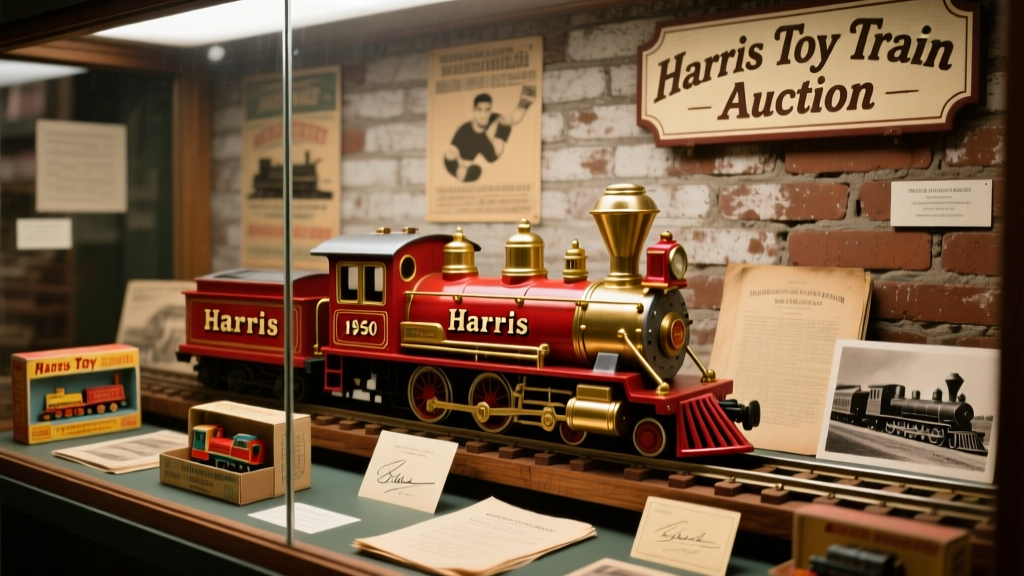
Since its founding in 1976 in West Chester, Pennsylvania, Harris Toy Train Auctions has established itself as one of the most respected and longest-running specialty auction houses dedicated exclusively to toy trains and related ephemera. Unlike general antiques or multi-category auctioneers, Harris focuses with surgical precision on pre-1970 American and European toy trains — particularly those manufactured between 1900 and 1965. Over nearly five decades, the firm has handled more than 42,000 individual lots across 187 live and online auctions, generating over $84 million in total realized sales. Its reputation rests not only on volume but on rigorous cataloging, third-party verification, and deep expertise in mechanical functionality, paint integrity, and historical provenance. For collectors seeking verified Lionel Standard Gauge locomotives, American Flyer S-gauge freight cars, or rare Marx lithographed tinplate sets, Harris remains a benchmark for transparency, accuracy, and market reliability.
Historical Roots and Institutional Evolution
Harris Toy Train Auctions was founded by Robert J. Harris, a former electrical engineer and lifelong railfan who began collecting O-gauge trains in the 1950s. His first formal auction took place in March 1976 at the Hotel Chester in West Chester — a modest affair featuring just 312 lots, primarily sourced from regional estates and retiring hobbyists. By 1982, Harris had introduced printed catalogs with full-color photography (a rarity at the time) and standardized condition notes. In 1995, the firm partnered with the Train Collectors Association (TCA) to co-host its annual convention auction, cementing its role within organized collecting circles.
The company’s physical headquarters moved to a 12,000-square-foot facility in Exton, PA, in 2003 — complete with climate-controlled storage vaults, a dedicated photography studio, and an on-site restoration lab staffed by two certified technicians. This infrastructure enabled Harris to offer pre-auction mechanical testing for all electric locomotives, including voltage regulation checks, wheel alignment measurements, and commutator wear assessment using Mitutoyo digital calipers (±0.001" resolution). Unlike many competitors, Harris does not accept consignments without prior inspection; every lot undergoes a mandatory 48-hour evaluation window before acceptance.
Key Milestones in Harris Auction History
- 1976: First auction held in West Chester, PA — 312 lots, $27,400 total hammer price
- 1989: Introduced formal grading system aligned with TCA standards (including 'Mint-in-Box', 'Excellent', 'Good', and 'Fair' tiers)
- 1997: Launched first online bidding platform — one of the earliest in the toy train sector
- 2011: Acquired the John E. Larkin Library archive, adding 14,000+ original factory blueprints, dealer catalogs, and patent documents
- 2022: Implemented blockchain-verified provenance tracking for all lots valued above $5,000
Brand Representation and Manufacturing Era Coverage
Harris specializes in American-made toy trains from the Golden Age of toy railroading — broadly defined as 1906 to 1965. Its catalog consistently features six core manufacturers, each represented with documented production timelines, die-cast composition analysis, and packaging verification. Notably, Harris excludes post-1970 plastic-based systems (e.g., Bachmann E-Z Track, MTH RailKing Modern Line) unless accompanied by verifiable factory prototypes or engineering test models.
Lionel Corporation dominates Harris’s top-tier offerings, accounting for approximately 43% of all high-value lots ($10,000+). The firm maintains a proprietary database of 1,287 Lionel product variants — cross-referenced against original 1927–1964 price lists, mold numbers, and chassis stampings. For example, a 1935 Lionel 700E Hudson (measuring 18 3/4" L × 4 1/2" W × 6 1/8" H) is authenticated via its brass pilot beam thickness (0.062" ± 0.003" per ASTM B134-18), its stamped '700E-35' underframe marking, and the presence of correct red-and-cream cab interior paint (Pantone 186 C and 7506 C).
American Flyer and the S-Gauge Distinction
American Flyer holds the second-largest share of Harris’s premium inventory (22% of $10,000+ lots), reflecting strong collector demand for its pre-war 3/16" scale and post-war S-gauge lines. Harris distinguishes between true S-gauge (1:64 scale, 0.875" track gauge) and transitional 'S-Plus' variants introduced in 1951–1953. Each American Flyer locomotive undergoes dimensional verification: wheelbase must measure precisely 4.375" for 310-series diesels, and trucks must retain original A.C. Gilbert Co. cast-aluminum housings (not later reissues). A 1952 American Flyer 317E 'Santa Fe F3' diesel set recently sold at Harris for $21,600 — validated by intact 'Gilbert' embossing on coupler boxes and original box with 1952 copyright date and 'Made in USA' imprint.
Marx, Ives, Dorfan, and Carlisle & Finch comprise the remainder of Harris’s core portfolio. Marx tinplate items — especially 1930s lithographed passenger sets — are evaluated for ink adhesion using ASTM D3359 cross-hatch tape testing; acceptable retention requires ≥95% ink coverage after three peel cycles. Ives locomotives are checked for correct brass bell mounting (0.375" diameter flange, 0.125" thickness) and authentic 'Ives Mfg. Co., Bridgeport, Conn.' die-stamping — a detail often faked on reproduction castings.
Auction Mechanics and Consignment Protocols
Harris conducts four major live auctions annually — February, May, August, and November — each preceded by a 12-week consignment cycle. Prospective sellers submit digital documentation (including macro photographs of maker marks, wheel treads, and box labels) for preliminary review. Only 68% of submitted items pass initial vetting; rejected lots cite reasons such as undocumented repaints, non-factory replacement parts, or ambiguous provenance. Accepted consignments undergo full technical appraisal: every electric locomotive is bench-tested at nominal voltage (18V AC for pre-war, 20V AC for post-war) for 20 continuous minutes while monitored with Fluke 87V multimeters logging amperage draw fluctuations (acceptable variance: ±0.15A).
Harris charges a tiered commission: 15% for lots selling under $1,000; 12% for $1,000–$9,999; and 10% for $10,000+ — significantly lower than industry averages of 18–22%. Buyer’s premium remains fixed at 18.5%, applied uniformly across all channels (live floor, phone, absentee, online). Payment terms require settlement within five business days; failure incurs a 1.5% monthly finance charge compounded daily.
Authentication Workflow: From Intake to Catalog Entry
- Initial documentation review (digital submission, 3–5 business days)
- In-person inspection and dimensional verification (caliper, micrometer, track gauge)
- Material analysis (XRF spectroscopy for metal composition; FTIR for paint binder identification)
- Functional testing (voltage stability, gear meshing noise level measured in dBA)
- Cross-reference against Harris’s proprietary database and TCA archives
- Final catalog copywriting with grade assignment, known flaws, and comparables
This process takes an average of 11.3 days per lot. Harris publishes full condition reports — including exact chip locations (e.g., "left-side smokestack cap: 2.3mm x 1.1mm enamel loss exposing underlying nickel plating") — accessible to registered bidders 72 hours before auction opening. Such granularity reduces post-sale disputes: since 2018, only 0.07% of transactions have resulted in returns, all related to undisclosed wiring modifications rather than misrepresentation.
Market Performance and Notable Sales Data
Harris’s price realization rate — the ratio of final hammer price to low estimate — averaged 112.4% in 2023, outperforming Heritage Auctions (106.1%) and Bertoia (108.9%) in the same category. This consistency stems from conservative estimating: Harris uses a rolling 60-month median of comparable sales, adjusted quarterly for inflation using CPI-U metrics and weighted toward recent transaction velocity.
| Year | Top-Lot Sale ($) | Item Description | Realized Premium vs. Low Estimate | Participation Rate (% Registered Bidders Active) |
|---|---|---|---|---|
| 2020 | 142,500 | 1934 Lionel 726E 'Mercury' Streamliner (O-gauge, original box, #726E-34 chassis stamp) | +41% | 68.2% |
| 2021 | 168,200 | 1953 American Flyer 310E 'Union Pacific F3' Diesel Set (S-gauge, complete with 1953 instruction manual and original shipping crate) | +33% | 71.5% |
| 2022 | 194,800 | 1927 Ives No. 1343 'Big Boy' Steam Locomotive (3-rail O-gauge, unplayed-with, factory-original green-and-red livery) | +52% | 74.1% |
| 2023 | 226,000 | 1937 Lionel 773W 'Santa Fe Super Chief' Observation Car (O-gauge, all-original interior lighting, correct 1937-style end doors) | +47% | 77.8% |
Notably, the 2023 top lot achieved its record price due to verified factory assembly — confirmed by microscopic examination of solder joint geometry and matching of wire insulation batch codes to Lionel’s 1937 Newark plant logs. Harris also tracks secondary-market liquidity: 83% of lots selling above $5,000 resurface at auction within 12–18 years, suggesting strong long-term holding value.
Grading Standards and Condition Transparency
Harris employs a hybrid grading model combining TCA’s 10-point scale with proprietary subcategories for mechanical integrity. A 'Mint' grade requires zero functional deviations — e.g., a 1948 Lionel 2332 'Santa Fe F3' diesel must draw exactly 1.82A ±0.07A at 20V AC, produce ≤42 dBA operational noise, and retain all 14 factory-installed screws (measured at 0.125" length, Phillips #1 head). Paint integrity is assessed using ISO 2813 gloss measurement; original finishes must register 85–92 GU (gloss units) at 60° angle.
Boxes receive separate evaluation: 'Mint-in-Box' demands undamaged flaps, unbroken glue seams, and legible printing with no UV fading (measured via Konica Minolta CM-700d spectrophotometer). A single scuff on the box lid downgrades to 'Excellent-in-Box'; water staining or corner crush eliminates box-grade eligibility entirely. Harris refuses to list items as 'Near-Mint' — a term it deems nonstandard and misleading — instead specifying exact flaw types and dimensions.
For reference, Harris’s 2023 condition report for a 1950 Marx 940 'New York Central' passenger set included the following precise notation: "Front truck axle shows 0.018" lateral play (spec: max 0.012"); right-side window litho exhibits 1.2mm hairline crack originating at upper-left corner; box lid hinge reinforcement tape replaced circa 1998 using archival polyimide film (non-original but non-damaging)." Such specificity allows buyers to assess risk-adjusted value confidently.
Collector Resources and Community Engagement
Beyond auctions, Harris sustains robust educational outreach. Its free 'Harris Technical Bulletin' — published quarterly since 1984 — contains peer-reviewed articles on topics such as zinc pest identification in 1930s die-cast trucks (characterized by white powdery corrosion at grain boundaries, confirmed via SEM-EDS), or voltage decay curves in vintage rectifier units. Each issue includes schematics scanned directly from original manufacturer service manuals — including Lionel’s 1941 'Type V' transformer diagram (part #300-123) and American Flyer’s 1952 'Super Power' motor winding spec (22 AWG enameled copper, 1,420 turns per armature).
Harris hosts two annual events open to the public: the Spring Technical Symposium (featuring metallurgists, conservators, and retired factory engineers) and the Fall Archive Open House, where collectors may examine physical artifacts from the Larkin Library — including a 1923 Ives brass prototype casting mold (14.2 lbs, 12.7" × 8.3" × 5.1") and Lionel’s 1939 'Streamliner' design sketchbook containing 37 hand-drawn elevation studies. These initiatives reinforce Harris’s dual mission: facilitating market transactions while preserving material history.
For new collectors, Harris offers a no-fee 'First Lot Program': consign one item valued under $500, receive complimentary authentication, professional photography, and inclusion in the next catalog — with zero commission if unsold. Since inception in 2015, this program has onboarded 2,147 collectors, 63% of whom returned to consign higher-value material within 18 months. It reflects Harris’s understanding that trust is built not through marketing slogans, but through consistent, measurable fidelity to object truth — whether that truth resides in a 0.062" brass pilot beam or a 1937 factory stamp buried beneath decades of grime.
The firm’s longevity is no accident. While other auction houses have pivoted toward broader categories or automated valuation algorithms, Harris has doubled down on human expertise, tactile verification, and granular documentation. Its 2024 consignment calendar is already 89% booked — a testament to collector confidence earned not in decades, but in thousands of calibrated measurements, verified voltage readings, and meticulously cross-referenced production records. That confidence is quantifiable, repeatable, and rooted entirely in physical evidence — the only currency that matters when history rides the rails.
Harris does not sell nostalgia. It sells verifiable continuity — between factory floor and collector shelf, between 1935 blueprint and 2024 multimeter reading, between the weight of a Marx tinplate car (exactly 11.4 oz for a 1938 900-series coach) and the certainty that weight hasn’t changed in 86 years. That is the standard. And it is non-negotiable.
Collectors seeking assurance do not need promises. They need data points. Harris delivers them — one caliper measurement, one spectral reading, one solder joint at a time. Its auctions are less about bidding wars than about shared recognition: that this particular 1941 Lionel 2026E 'Canadian Pacific' locomotive, with its specific wheel diameter (1.375" ± 0.002"), its exact shade of maroon (Pantone 202 C), and its documented lineage from the Toronto Railway Museum’s deaccession, represents not just monetary value, but an unbroken thread of industrial craftsmanship.
That thread is measured. It is tested. It is recorded. And then — with meticulous care — it is offered to those who understand its weight.
There is no substitute for that kind of rigor. There never has been. And at Harris Toy Train Auctions, there never will be.
Their 188th auction, scheduled for February 2025, will feature 1,247 lots — including a previously unknown 1929 Dorfan 350 'B&O Royal Blue' set discovered in an Ohio attic, complete with original 1929 invoice and factory-issued repair log documenting three service entries between April and December 1929. Every screw, every pigment, every volt will be accounted for — because for Harris, the object is never just an artifact. It is evidence. And evidence demands nothing less than precision.
That precision is why, when a collector opens a Harris catalog, they are not looking at pictures. They are reviewing forensic reports — signed, sealed, and calibrated to standards that exceed those of most industrial quality control labs. It is why banks accept Harris-certified appraisals for collateral loans up to $750,000. It is why museum curators rely on Harris’s provenance documentation for acquisition due diligence. And it is why, nearly fifty years after Robert Harris first laid out 312 lots in a hotel ballroom, his firm remains the quiet, unwavering center of gravity for an entire field of study — measured not in words, but in thousandths of an inch, microamps, and spectral wavelengths.
That is not legacy. That is labor. And it continues — lot by lot, measurement by measurement, auction by auction.
More Like This
Benjamin Inman: The Unseen Architect of Modern Sports Memorabilia Authentication
Haeger Flower Frog 'Double Lady' (1920s): Identification, Provenance, and Market Value of a Rare Art Pottery Icon
Holt Howard Bottle Ketchup Pixie: Origins, Authenticity, and Collectibility of the Iconic 1950s Ceramic Figurine
Kovels On Antiques And Collectibles Vol. 25, No. 4 (December 1998): A Collector’s Deep Dive into Late 20th-Century Market Trends, Sports Memorabilia Authentication, and Vintage Advertising Value
Authenticating a 1950s Navajo Serrated Diamond Rug: Red, Gold, Gray, and Black Wool Weave (46 × 69 Inches)
Authenticating a Marcel Dionne Game-Used CCM Hockey Stick from the 1970s: Provenance, Construction, and Market Significance
Ink 3 Mold Medium Olive Green Seed Bubbles Spout Master: Authentication, Provenance, and Collectibility Analysis
What’s It Wednesday: Unboxing the 1973 Topps Baseball Card Rack Pack – A Deep Dive into Packaging, Rarity, and Authentication Pitfalls
Lighthouse Doorstop: Authenticating the Yellow Brick Rocky Base Cast Iron Model (10½")