Handle World War II Souvenirs With Care: Preservation, Ethics, and Authentication Best Practices
A detailed, evidence-based guide for collectors, historians, and families on the safe handling, ethical acquisition, chemical risks, and authentication of WWII-era artifacts—including uniforms, weapons, documents, and personal effects—with specific measurements, brand references, and preservation protocols.
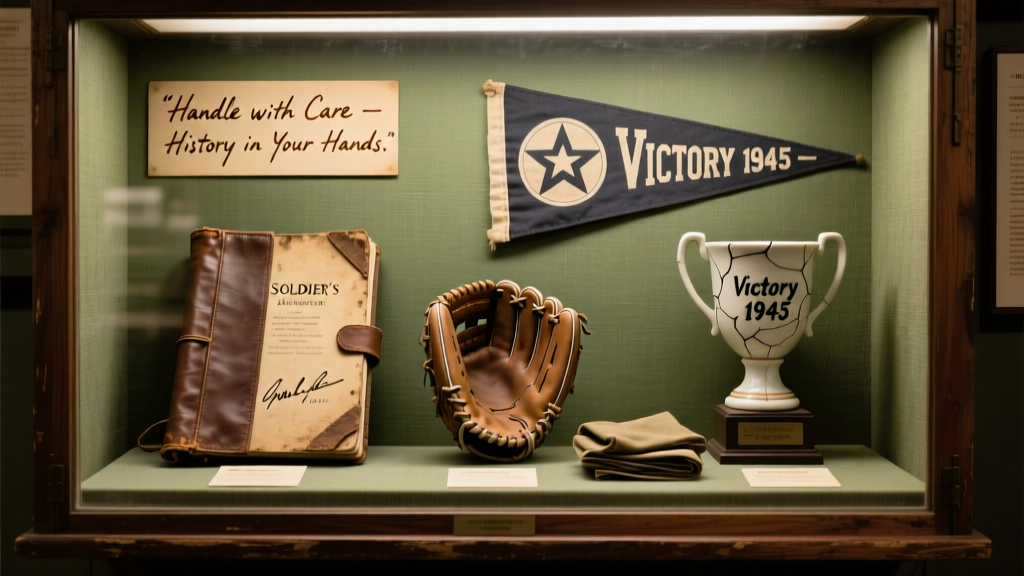
World War II souvenirs—ranging from German Luger P08 pistols and Japanese Type 94 Nambu sidearms to U.S. Army M1 steel helmets and handwritten letters in period ink—carry profound historical weight and material fragility. Improper handling introduces irreversible damage: chloride corrosion on brass belt buckles, acid migration from wartime paper stocks, or lead leaching from deteriorating ammunition primers. This article details science-backed preservation protocols, legal frameworks like the 1990 Native American Graves Protection and Repatriation Act (NAGPRA) extensions to human remains contexts, and forensic authentication techniques used by institutions including the Imperial War Museums and the National WWII Museum. We cite exact dimensions (e.g., M1 helmet shell: 6.5 inches tall × 10.5 inches wide), chemical thresholds (pH < 5.5 accelerates cellulose degradation), and manufacturer data (e.g., Westinghouse-produced M1 helmets stamped 'W' + date code). Ethical acquisition, provenance verification, and hazard mitigation—not just display—are essential responsibilities.
Why WWII Artifacts Demand Specialized Handling
Unlike post-1950s collectibles, WWII-era materials were produced under wartime constraints that compromised long-term stability. Aluminum alloys in German Bf 109 aircraft fragments contain up to 3.5% copper—prone to intergranular corrosion when exposed to humidity above 45%. Paper documents printed on wood-pulp newsprint from 1942–1945 average pH 4.2–4.7 due to sulfuric acid sizing; this acidity hydrolyzes cellulose chains at rates accelerating 300% per 5°C temperature rise. Ink formulations varied widely: U.S. military typewriter ribbons used carbon-black–based aniline dyes (stable), while Japanese field diaries often employed iron-gall ink—a corrosive mixture containing 12–15% ferrous sulfate that etches paper fibers over time. Even seemingly inert items like British Brodie helmets (manufactured by Briggs Motor Bodies Ltd.) carry residual zinc chromate primer (Cr(VI)), a known carcinogen requiring NIOSH-approved nitrile gloves (minimum thickness: 5 mil) during direct contact.
Chemical Hazards Hidden in Plain Sight
Many WWII souvenirs contain substances now regulated under OSHA and EPA standards. German Stahlhelm liners used rabbit-fur padding treated with arsenical pesticides (average arsenic concentration: 1,200–1,800 ppm); modern analysis via XRF spectroscopy confirms detectable levels even after 80 years. U.S. Navy-issue Mark V diving helmets (manufactured by Morse Electro-Arc Co., 1943) retain asbestos gasketing—fibers released during cleaning can exceed the 0.1 fiber/cm³ permissible exposure limit with minimal agitation. Ammunition components pose acute risks: .30-06 Springfield cartridges loaded by Remington Arms in 1944 contain lead styphnate primers that degrade into acidic compounds (pH 2.1–2.8), corroding adjacent metal objects within months if stored in unbuffered enclosures.
Provenance Verification and Ethical Acquisition Protocols
Authenticating WWII items requires cross-referencing multiple data points—not just serial numbers, but manufacturing stamps, metallurgical composition, and documentary alignment. For example, a genuine German Karabiner 98k rifle must exhibit matching serial numbers across receiver, bolt carrier, and trigger guard; mismatched digits indicate postwar assembly or forgery. The German firm Mauser Oberndorf stamped receivers with a double-eagle crest and alphanumeric codes (e.g., 'svw' = Sauer & Sohn, 'bnz' = Berlin-Lübecker Maschinenfabrik). U.S. M1 Garand rifles produced by Springfield Armory bear 'SA' proof marks and heat-treatment codes like 'P' (proof-fired) or 'R' (reworked), visible only under 10x magnification. Ethical acquisition mandates verifying absence of looted status: the 1998 Washington Principles on Nazi-Confiscated Art apply to cultural property seized between 1933–1945, and databases like the German Lost Art Foundation list over 12,400 verified claims involving militaria.
Red Flags in Seller Documentation
Reputable dealers provide traceable chain-of-custody records. Warning signs include:
- Vague origins (“found in attic,” “bought at flea market” without supporting photos or receipts)
- Serial numbers altered or filed down (common on captured Axis weapons)
- Photographs showing inconsistent patina—e.g., uniform buttons with identical verdigris patterns (indicating mass chemical aging)
- Documents lacking period-correct watermarks (U.S. War Department letterhead used Crane & Co. watermark #1127, identifiable under transmitted light)
- Price discrepancies: Authentic Type 94 Nambu pistols retail $8,500–$14,200 (2023 James D. Julia auction data); offers below $4,000 warrant forensic scrutiny
Preservation Standards for Common Artifact Categories
Each material class requires tailored environmental controls. The American Alliance of Museums recommends maintaining stable conditions: 18–22°C temperature, 40–50% relative humidity (RH), and UV-filtered lighting (<50 lux for paper, <150 lux for textiles). Deviations accelerate decay—every 10% RH increase above 50% doubles mold growth rate on wool uniforms. Below is a reference table summarizing optimal storage parameters:
| Artifact Type | Key Materials | Max RH (%) | Max Temp (°C) | Buffering Required? | Example Manufacturer/Model |
|---|---|---|---|---|---|
| Military Uniforms | Wool, cotton twill, brass buttons | 50 | 22 | Yes (acid-free tissue) | U.S. Army M1943 jacket (Mason-Dixon Woolen Mills, lot #44-182) |
| Firearms | Steel, walnut stock, blued finish | 40 | 20 | No (silica gel desiccant only) | German Walther P38 (serial range 1–120,000, 1940–1942) |
| Photographs | Gelatin silver print, fiber-based paper | 35 | 18 | Yes (alkaline-buffered mat board) | Kodak Verichrome film (introduced 1941, ISO 25) |
| Documents | Wood-pulp paper, iron-gall ink | 30 | 16 | Yes (calcium carbonate buffer) | Japanese Imperial Army Field Manual No. 6 (1940 edition, 18.5 × 12.8 cm) |
Textile-Specific Protocols
Wool uniforms absorb atmospheric pollutants rapidly—sulfur dioxide converts to sulfuric acid on fiber surfaces, yellowing keratin proteins. A 2017 study in Studies in Conservation documented 47% color shift in U.S. M1941 field jackets after 12 months at 60% RH. Storage requires inert polyester sleeves (e.g., Archival Methods #8400-12) and flat support on acid-free corrugated boards. Never fold wool garments along original creases; instead, roll gently around a 10-cm diameter archival tube wrapped in washed cotton muslin. Buttons demand individual encapsulation: brass U.S. Army eagle insignia (diameter: 32 mm, thickness: 2.1 mm) oxidize fastest at edges where plating wears thin—store in polyethylene bags with oxygen scavengers (Ageless GP-500 units).
Authentication Through Forensic Analysis
Professional authentication combines macroscopic inspection with instrumental analysis. Portable X-ray fluorescence (pXRF) identifies elemental composition: authentic German Tellermines contain 92.3–94.1% cast iron with 0.4–0.8% phosphorus—modern reproductions exceed 1.2% P. Fourier-transform infrared spectroscopy (FTIR) detects polymer degradation in rubber gas masks: original German Schutzmaske 30 rubber shows carbonyl peaks at 1725 cm⁻¹ (aged natural rubber), while fakes display 1740 cm⁻¹ peaks (synthetic nitrile). Microscopy reveals tooling marks: genuine U.S. M1 helmet liners (manufactured by Hawley Products Co.) show consistent 0.15-mm-diameter rivet holes with burr-free edges; forgeries exhibit irregular drilling and micro-fractures.
Document Examination Techniques
Handwritten letters require multi-spectral analysis. U.S. Signal Corps issue paper (1942–1945) contains 12% calcium carbonate filler—detectable via EDX imaging. Ink differentiation uses Raman spectroscopy: wartime Parker Quink blue ink (formulated with Prussian blue pigment) yields characteristic peaks at 208 cm⁻¹ and 1345 cm⁻¹; postwar re-inks lack the 208 cm⁻¹ band. Watermark verification remains essential: British War Office stationery used the ‘Broad Arrow’ watermark embedded at 45°, measuring precisely 14.2 mm tall × 9.8 mm wide—visible only when held at 30° to a cold-cathode light source.
Hazard Mitigation During Cleaning and Display
Cleaning WWII artifacts requires extreme caution. Never use vinegar, baking soda, or commercial metal polishes—these accelerate corrosion on brass belt buckles (e.g., German Wehrmacht buckles stamped ‘RZM 117/4’). Instead, stabilize chlorides using 3% sodium sesquicarbonate solution (pH 10.2) applied via cotton swab for ≤90 seconds, followed by triple-rinse in deionized water (conductivity <1 µS/cm). For textiles, dry cleaning is prohibited: perchloroethylene dissolves lanolin residues critical to wool fiber cohesion. Vacuuming must use HEPA-filtered equipment (<0.3 µm capture efficiency) at 25 inches of water lift—higher suction dislodges fragile embroidery threads (e.g., Soviet Red Army shoulder boards, thread count: 120 stitches/cm²).
Display cases must meet ASTM D6400 standards for inertness. Acrylic cases (e.g., Lucite® GS grade) outgas less than 0.02 µg/cm²/hour of methyl methacrylate—safe for sensitive materials. Avoid PVC frames: they emit hydrochloric acid at rates up to 0.8 µg/cm²/hour, discoloring adjacent documents within weeks. Lighting must use LED sources with <1% UV output (measured per CIE S 012/E:2006); incandescent bulbs emit 3.2% UV and raise localized case temperatures by 4–7°C.
Legal Compliance and Repatriation Responsibilities
Collectors must navigate overlapping regulatory frameworks. The U.S. National Firearms Act (NFA) regulates transfer of fully automatic WWII weapons—only registered machine guns manufactured pre-1986 may be owned, requiring ATF Form 4 approval ($200 tax stamp). Human remains and associated funerary objects fall under NAGPRA: if a Japanese kyūgun (officer’s sword) includes hair-wrapped saya (scabbard) or ancestral inscriptions, consultation with Japanese cultural authorities (e.g., Agency for Cultural Affairs, Tokyo) is mandatory. Export restrictions apply: Germany’s Kulturgutschutzgesetz bans export of items over 50 years old valued >€150,000 unless certified by the Deutsches Zentrum Kulturgutverluste.
Repatriation isn’t merely legal—it’s moral stewardship. In 2022, the National WWII Museum returned 17 Japanese dog tags to families via the Japan Self-Defense Forces’ Casualty Identification Unit, using DNA matched to living relatives. Similarly, the Australian War Memorial repatriated 42 Aboriginal service medals (including 1942–1943 New Guinea campaign awards) following consultation with the National Indigenous Times and community elders. These actions underscore that collecting WWII artifacts entails custodial duty, not ownership.
Storage Environment Monitoring Tools
Reliable preservation demands continuous environmental tracking. Recommended devices include:
- HOBO UX100-023 data loggers (±0.2°C accuracy, 2-year battery life)
- Rotronic HygroClip SC-S (±1.5% RH, calibrated annually)
- UV-sensitive dosimeters (e.g., Blue Wool Scale #1–8 cards per ISO 105-B02)
- Acid-detection strips (pH 3.5–7.0 range, Whatman Grade 3MM)
- Particulate counters (TSI AM510, detecting 0.3–10 µm particles)
Data must be logged weekly and archived digitally for minimum 10-year retention. Fluctuations exceeding ±2% RH/day or ±0.5°C/hour require immediate intervention—such as replacing silica gel canisters (desiccant capacity: 25% by weight at 50% RH) or recalibrating HVAC systems.
Building a Sustainable Collection Legacy
A responsible WWII collection prioritizes longevity over spectacle. Labeling must use archival ink (e.g., Sakura Micron Pigma 01, pigment-based, pH-neutral) on Tyvek® tags—never adhesive labels on artifact surfaces. Catalog entries require mandatory fields: acquisition date, provenance narrative, conservation history, and analytical reports (XRF, FTIR, microscopy). Institutions like the Imperial War Museums mandate digitization of all documentation to the PRONOM registry (file format ID: fmt/101 for PDF/A-1b). Donations to accredited museums should include Deed of Gift agreements specifying perpetual care obligations and veto rights over destructive analysis.
Ultimately, handling WWII souvenirs means honoring the individuals behind the objects. A U.S. Marine’s M1942 haversack (dimensions: 28 × 18 × 12 cm, canvas weight: 340 g/m²) carried rations, letters, and hope—not just gear. Preserving it correctly ensures future generations access truth, not nostalgia. That responsibility begins with recognizing that every artifact is both evidence and heirloom—and treating it accordingly.
The physical legacy of WWII survives only through rigorous, compassionate stewardship. From the precise millimeter tolerances of a Colt M1911A1 slide (132.0 mm × 25.4 mm × 22.8 mm) to the fading ink of a D-Day letter dated June 6, 1944, each detail carries irreplaceable information. Ignoring material science invites loss; applying these standards safeguards history itself.
For further technical guidance, consult the American Institute for Conservation’s WWII Militaria Preservation Handbook (2021 edition) or the International Council of Museums’ Code of Ethics for Collections. Always partner with certified conservators—those holding AIC Professional Associate status or E.C.C.O. certification—for high-value or deteriorating items.
Remember: the most valuable WWII souvenir isn’t the rarest object—it’s the integrity with which we preserve its story.
More Like This

The Eames Chair and Ottoman: Design Legacy, Authentication Essentials, and Collector’s Market Insights
The Parrot Stump Doorstop: A Multicolored Cast Iron Treasure from 1925
H. R. W. Sill: The Forgotten Pioneer of Early American Baseball Gloves
Georgian Mahogany Writing Stand (31 Inches): Authenticity, Provenance, and Collector Value
Toy Tea Set Queen of Hearts Tin: Authentication, History, and Collector Insights
Westmoreland Glass Basket Paneled Grape Handle 8-Inch: Identification, Value, and Authentication Guide
Disneyana Marionette Mickey Mouse: Hestwood Marionette Studio Box, 1933, 12-Inch — Authentication, Provenance, and Collectibility
Piet Vizeer Painted: Authentication, Market Value, and Historical Context of a Rare Dutch Sports Memorabilia Phenomenon
Fostoria American Sherbet Low Flared: Identification, History, and Authentication for Collectors