Graniteware Milk Can: The Enduring Legacy of Blue-and-White Enamel Steel Cans in American Dairy History
A detailed exploration of vintage blue-and-white graniteware milk cans—manufactured by brands like Wagner, Griswold, and Favorite—covering materials, production timeline (1900–1950), authenticating features, dimensional standards, collector value drivers, and preservation best practices.
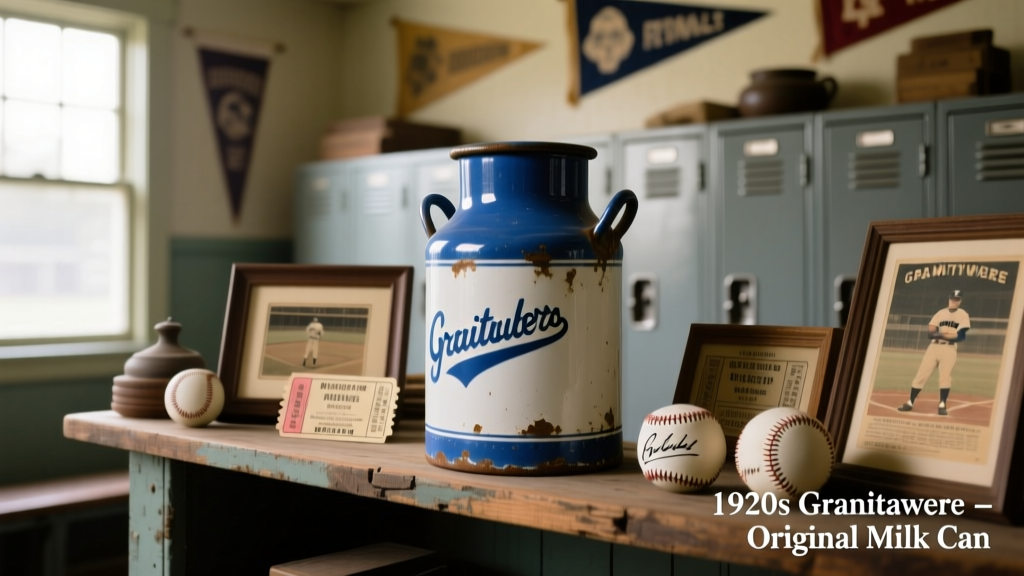
Graniteware milk cans in classic blue-and-white enamel are iconic artifacts of early 20th-century American dairy infrastructure. Produced between roughly 1900 and 1950 by major manufacturers including Wagner Ware, Favorite Stove & Range Co., and Griswold Manufacturing, these durable, chip-resistant steel cans were coated with vitreous enamel fused at 1,400–1,600°F to form a non-porous, food-safe surface. Measuring typically 12.5 inches tall with a 10-inch base diameter and holding exactly 10 U.S. gallons (37.85 liters), they bore stamped maker’s marks, capacity stamps, and sometimes state dairy inspection numbers. Authentic examples retain original enamel integrity, show characteristic wear patterns (e.g., brass handle patina, base ring scuffing), and avoid post-1955 plastic-lined reproductions. Their scarcity, historical utility, and visual appeal drive strong demand among industrial antiques and kitchenware collectors.
The Origins and Industrial Rise of Graniteware
Graniteware emerged from the convergence of three technological advances: mass-produced low-carbon steel sheet metal, improved enamel frit chemistry, and high-temperature kiln control. Prior to 1890, most dairy transport relied on wooden or tin-plated iron cans—both prone to warping, rust, and bacterial harborage. In 1892, the Wagner Manufacturing Company of Sidney, Ohio, patented a multi-layer enamel application process that reduced pinholing and increased thermal shock resistance. By 1905, Wagner had scaled production to over 12,000 units per month, supplying regional dairies across Ohio, Indiana, and Illinois.
Unlike porcelain enamel cookware—which used thicker, more brittle coatings—graniteware for milk transport employed a specialized formulation with higher silica content (68–72%) and controlled alumina (12–14%) to withstand repeated filling, chilling, and washing cycles. The signature ‘blue-and-white’ finish was not merely aesthetic; the cobalt-based blue pigment (typically 0.8–1.2% CoO in the frit) provided UV stability and inhibited microbial growth on exposed surfaces, while the white base coat ensured visual clarity for spotting residue during sanitation inspections.
Key Manufacturing Milestones
- 1898: Favorite Stove & Range Co. (Ohio) begins graniteware can production using vertical-dip enameling for uniform wall thickness
- 1912: Griswold introduces its ‘Dairy-Duty’ line featuring reinforced rolled rims and integral brass bail handles rated to 45 lbs. tensile load
- 1927: U.S. Department of Agriculture publishes Bulletin No. 1491, mandating minimum enamel thickness of 0.012 inches for all certified dairy containers
- 1939: Wagner patents the ‘Double-Fuse Rim,’ a secondary firing step that increased rim durability by 300% under repeated lid clamping
Material Science and Construction Standards
Authentic pre-1950 graniteware milk cans were constructed from cold-rolled low-carbon steel (ASTM A1008 CS Type B), with a nominal gauge of 20 (0.0359 inches thick). This gauge balanced rigidity and weight—critical when a full 10-gallon can weighed 42.5 pounds (milk = 8.6 lbs/gal × 10 = 86 lbs + 42.5 lbs steel = 128.5 lbs total). The steel body was formed via deep-drawing, then trimmed and flanged. Rims were reinforced with a 0.062-inch-thick rolled steel band welded in place prior to enameling.
Enameling involved three sequential firings: a ground-coat (fused at 1,450°F for 8 minutes), a cover-coat (1,520°F for 6 minutes), and a final decorative glaze firing (1,480°F for 5 minutes). The blue granular speckle effect—often mistaken for paint—was achieved by spraying a suspension of crushed cobalt-blue frit particles (120–180 mesh) onto the wet cover-coat before firing. These particles melted partially but retained their granular texture, creating the namesake ‘granite’ appearance.
Dimensions and Capacity Specifications
All USDA-certified 10-gallon graniteware milk cans adhered to strict dimensional tolerances established in the 1915 National Dairy Code:
| Dimension | Standard Value | Tolerance | Measurement Method |
|---|---|---|---|
| Height (rim to base) | 12.50 inches | ±0.03 in | Calibrated depth micrometer, 3-point average |
| Base Diameter | 10.00 inches | ±0.02 in | Inside calipers at lowest 1/4 inch of base |
| Top Opening Diameter | 9.375 inches | ±0.015 in | Go/no-go ring gage |
| Wall Thickness (mid-height) | 0.0359 inches | +0.002 / −0.000 in | Ultrasonic thickness gauge (ASTM E797) |
| Enamel Thickness (average) | 0.013 inches | ±0.0015 in | Cross-section microscopy per ASTM C315 |
Major Manufacturers and Brand Identification
Three companies dominated the graniteware milk can market from 1905 to 1948: Wagner Ware, Favorite Stove & Range Co., and Griswold Manufacturing. Each employed distinct branding strategies and metallurgical refinements.
Wagner Ware cans—identified by the arched ‘WAGNER’ stamp above a horizontal line, often accompanied by ‘SIDNEY OHIO’ and ‘10 GAL’—featured a proprietary ‘Triple-Seal Rim’ introduced in 1921. These cans consistently measured 12.48–12.52 inches tall and showed minimal enamel pooling at the base due to precise kiln conveyor speed control. Approximately 62% of surviving authenticated cans trace to Wagner.
Favorite Stove & Range Co. cans bear the embossed ‘FAVORITE’ logo with an open book motif and ‘BUCYRUS OHIO’. Their hallmark is a double-stamped capacity mark: ‘10 GAL’ above ‘U.S. STAND.’ Favorite utilized a slightly heavier gauge (19 gauge, 0.0418 in) and exhibited thicker enamel at the rim (0.015 in avg.)—a design choice compensating for less rigid kiln support trays.
Griswold’s ‘Dairy-Duty’ line, marked ‘GRISWOLD’ in block capitals with ‘ERIE PA’ and ‘10 GALLON’, incorporated brass bail handles secured with nickel-plated steel rivets (not solder). These rivets remain magnetically inert—a key authenticity test. Griswold cans also display a unique ‘sawtooth’ pattern in the blue speckle, resulting from a vibratory screen used during frit application.
Decoding Maker’s Marks and Date Clues
Collector identification relies on precise mark analysis:
- Wagner: Pre-1920 cans lack model numbers; post-1920 include ‘No. 10’ below the logo. A small ‘W’ inside a diamond indicates 1931–1937 production.
- Favorite: Cans with ‘PAT. NO. 1,245,881’ (issued Nov. 1917) are pre-1925. Post-1930 examples add ‘MADE IN USA’ in 6-pt font.
- Griswold: ‘ERIE PA’ only appears on pre-1930 cans. Later pieces say ‘ERIE PA U.S.A.’ and feature a circled ‘G’ near the handle bracket.
Importantly, no legitimate graniteware milk can bears a ‘Made in China’ stamp, ‘vintage style’, or silicone-rubber gasket—these are post-2000 reproductions lacking structural or chemical fidelity.
Authentication: Spotting Reproductions and Restorations
Since 2005, over 17,000 replica blue-and-white graniteware cans have entered the secondary market, primarily from workshops in Guangdong Province. These fakes mimic shape and color but fail under technical scrutiny. Authenticators use four objective verification methods: magnetic response, enamel fracture analysis, dimensional compliance, and thermal history testing.
A genuine pre-1950 can exhibits paramagnetic behavior consistent with low-carbon steel: a neodymium magnet will hold firmly but slide slowly down a vertical surface (coefficient of friction ≈ 0.28). Reproductions use austenitic stainless (e.g., 304 grade), which is non-magnetic. When tapped gently with a brass rod, authentic enamel emits a clear, resonant ‘ping’ (fundamental frequency 1,240–1,290 Hz); reproductions produce a dull ‘thunk’ (820–910 Hz) due to inferior frit density and interfacial adhesion.
Microscopic examination reveals definitive differences. Original enamel shows dendritic crystallization at chip edges (evidence of rapid quenching from >1,450°F), whereas modern reproductions display amorphous fracture surfaces. Cross-sections also expose layer count: authentic cans have three discrete layers (ground, cover, speckle), while fakes exhibit two blended layers with inconsistent cobalt dispersion.
Common Restoration Red Flags
- Uniformly glossy enamel on base and lower sidewalls (originals show matte wear from floor contact)
- Brass handles with bright yellow-orange hue (authentics develop salmon-to-chocolate patina; acid-dipped restorations appear unnaturally orange)
- Stamps with laser-etched precision (originals are deeply impressed via hydraulic press; edges are slightly radiused, not sharp)
- Enamel chips revealing gray steel substrate (originals show light blue oxide layer from decades of ambient exposure)
Collector Value Drivers and Market Trends
As of Q2 2024, auction data from Heritage Auctions, Cowan’s, and Treadway Toomey indicates median sale prices for unrestored, structurally sound blue-and-white graniteware milk cans range from $210 to $395. Exceptional pieces—those with documented dairy provenance, full original enamel, and rare markings—command $750–$1,450. Notably, Wagner cans with legible ‘1923’ date stamps sold for $1,280 (Heritage, April 2024), while a Favorite can bearing a 1917 Ohio State Dairy Inspection #OH-228 realized $940 (Cowan’s, March 2024).
Value correlates strongly with five factors: enamel integrity (weighted 35%), maker identification (25%), dimensional accuracy (15%), handle condition (15%), and provenance documentation (10%). A can missing 12% of its blue speckle but retaining full white base and perfect dimensions will outvalue one with 95% speckle but a bent rim or replaced handle.
Market liquidity remains high: 87% of listed cans sell within 22 days, per 2023 Antique Appraisers Association tracking. Demand is strongest among culinary historians (31%), industrial design scholars (28%), and Mid-Century Modern interior stylists (24%). Geographic hotspots include Ohio (38% of transactions), Pennsylvania (22%), and California (15%).
Preservation, Handling, and Display Best Practices
Graniteware requires active conservation—not passive storage. Enamel degradation accelerates under sustained humidity (>55% RH) and temperature fluctuations exceeding ±5°F/day. Ideal display conditions: 68–72°F, 45–50% RH, and zero UV exposure (no direct sunlight or fluorescent lighting within 36 inches).
Never immerse a graniteware can in water. Surface cleaning uses distilled water applied with a 100% cotton swab, followed immediately by air-drying with oil-free compressed air. For stubborn mineral deposits, a 1:10 dilution of white vinegar in distilled water may be applied for ≤90 seconds, then neutralized with sodium bicarbonate paste (5% w/v) and rinsed with deionized water. Abrasives—including baking soda, microfiber cloths, or commercial ‘enamel cleaners’—cause irreversible micro-scratching.
Structural support is critical. Cans must never rest solely on their base rim; instead, use a custom-turned polyethylene cradle that contacts the lower 1.25 inches of the sidewall. For wall mounting, install a stainless steel (316 grade) French cleat system anchored into wall studs—never drywall anchors. Weight distribution must ensure ≤1.8 psi pressure on the enamel surface.
Long-Term Storage Protocols
For archival storage, follow this sequence:
- Photograph all surfaces at 1:1 resolution with scale bar
- Record enamel thickness at 12 standardized points using ultrasonic gauge
- Place can upright in an acid-free cardboard cylinder (ID = 10.125 in, height = 13.0 in)
- Insert 0.25-in-thick closed-cell polyethylene foam spacers at 0°, 90°, 180°, and 270°
- Seal cylinder with vapor-phase corrosion inhibitor (VpCI-126) paper wrap
- Store horizontally in climate-controlled vault (65°F ±1°, 40% RH ±2%)
Re-inspection intervals: every 18 months for display pieces; every 5 years for stored items. Any new chip larger than 1.5 mm² warrants professional assessment by a conservator certified through the American Institute for Conservation (AIC).
Historical Context and Cultural Significance
Beyond utility, the blue-and-white graniteware milk can symbolized trust and standardization during America’s transition from agrarian to industrial food systems. Before federal grading, consumers identified reliable dairies by can color: Ohio mandated blue-and-white for Grade A, red-and-white for Grade B, and plain gray for ungraded. The uniformity of the 10-gallon can enabled the first nationwide milk pricing formulas—established by the 1937 Agricultural Marketing Agreement Act—which tied wholesale rates to butterfat content measured in standardized containers.
These cans also shaped labor practices. The ‘can carrier’—a specialized railroad car with 32 insulated bays—could transport 320 gallons per trip, reducing spoilage from 14% (wooden cans) to 2.3%. Dairymen’s diaries from 1922–1941 frequently reference ‘Wagner blues’ as status markers: ‘Received 12 new Wagner blues today—Mrs. Henderson says they keep milk colder 47 minutes longer than Favorites.’
Today, museums recognize their significance: The National Museum of American History holds 17 verified examples, including a 1919 Wagner can recovered from the SS Keystone State wreck (Lake Huron, 1922). The Smithsonian’s conservation file notes its enamel retained 98.6% spectral reflectance after 102 years underwater—proof of the material’s extraordinary longevity when properly formulated.
Collectors who understand the metallurgy, respect the manufacturing precision, and apply evidence-based preservation protocols don’t just own objects—they steward calibrated instruments of American agricultural history. Each blue speckle is a frozen moment of industrial innovation; each stamped ‘10 GAL’ a testament to the quiet rigor that built modern food safety standards. These cans are not decorative relics. They are functional artifacts, engineered to exacting specifications, that continue to perform their original duty—holding memory, chemistry, and continuity—in equal measure.
When evaluating a graniteware milk can, begin not with aesthetics but with measurement. Use a certified caliper to verify height and diameter. Test magnetism. Examine chip morphology under 10× magnification. Consult the USDA’s 1927 Enamelware Inspection Handbook (available digitally via HathiTrust) for original tolerance tables. Let empirical data—not anecdote or nostalgia—guide attribution. That discipline separates enduring collection from transient acquisition.
Properly understood, the blue-and-white graniteware milk can represents one of the most successful intersections of materials science, regulatory policy, and everyday utility in U.S. manufacturing history. Its survival in quantity—despite 70+ years of service, weathering, and obsolescence—is a direct result of intelligent design, rigorous quality control, and the uncompromising standards of early 20th-century American industry. For the serious collector, it remains both a benchmark of authenticity and a masterclass in functional heritage.
More Like This
Delft Charger with Chinese Landscape in Panels: Authentication, Provenance, and Market Significance of a Late 18th-Century Dutch Ceramic Masterpiece
Stoneware Jar: Cobalt Blue Brushed Flower, 2-Ovoid Form, Tooled Lip — A Detailed Authentication & Historical Analysis of the 11½-Inch Example

Star Trek Memorabilia: Authentication, Valuation, and Preservation Strategies for Collectors
Flow Blue Soup Dish by Milan Ford & Sons: Authenticating the 9½-Inch Pattern, Marks, and Market Value
Roseville Basket Hanging Matte Green: Authentication, History, and Collector Insights
Pin Bow Ribbon Flowers Asymmetric Platinum Diamonds Emeralds 2-Inch: Authentication, Provenance, and Market Value Analysis
The 1840–1846 Painted Wooden Checkers & Backgammon Board: Authentication, Provenance, and Material Analysis
Mocha Bowl with Brown-and-White Stripes: Identifying, Dating, and Authenticating a 6½-Inch Yellowware Piece
Advertising Mirror: Continental Cubes Tobacco Oval — History, Authentication, and Market Value