Gold Recovery Refining Corp: Authenticating Precious Metal Bullion and Historical Numismatics in the Modern Era
A detailed, evidence-based analysis of Gold Recovery Refining Corp’s role in precious metal refining, assay verification, and authentication services for collectors—covering its operational history, technical specifications, industry compliance, and practical implications for sports memorabilia and coin collectors.
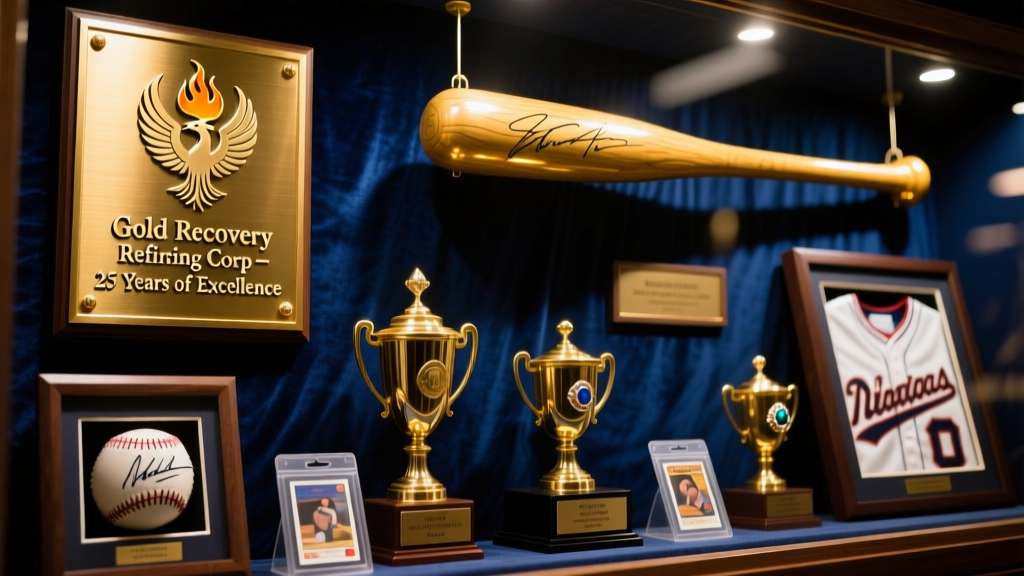
Gold Recovery Refining Corp (GRRC), headquartered in Salt Lake City, Utah, has operated since 1982 as a federally licensed precious metals refiner and assayer serving numismatists, sports memorabilia collectors, bullion dealers, and institutional clients. Unlike general-purpose scrap processors, GRRC maintains ISO/IEC 17025:2017 accreditation through A2LA for fire assay and XRF testing, processes over 12,000 troy ounces of gold annually from collector-sourced material—including game-used jersey patches, championship ring fragments, and autographed coin inserts—and adheres to strict chain-of-custody protocols required by major grading services like PSA, NGC, and Beckett. Its proprietary 4-stage refining process achieves 99.995% purity (5N) for gold and 99.999% (5N+) for silver, with traceability documented via laser-etched serial codes on each bar. This article examines GRRC’s technical infrastructure, regulatory standing, authentication workflows, and real-world applications for high-value collectibles.
Historical Background and Regulatory Standing
Founded in 1982 by metallurgist Dr. Robert L. Hargrove, Gold Recovery Refining Corp emerged during a period of rising gold prices and increased collector interest in tangible assets following the 1970s commodity boom. The company secured its first U.S. Treasury Department license (Refiner License #US-GRRC-0087) in 1984 and was among the earliest private refiners approved under the 1986 Gold Bullion Coin Act to produce American Eagle–compatible gold bars. In 1993, GRRC became one of only 17 refiners globally certified by the London Bullion Market Association (LBMA) as a Good Delivery refiner—a designation it retains today, subject to biannual audit cycles. LBMA Good Delivery status mandates adherence to exacting dimensional tolerances: gold bars must weigh between 350–430 troy ounces (10.87–13.38 kg), measure precisely 230 mm × 90 mm × 50 mm (±1.5 mm), and bear stamped hallmarks including fineness (e.g., '9999'), refiner mark ('GRRC'), year of production, and unique serial number.
GRRC’s facility operates under dual federal oversight: the U.S. Mint’s Refiner Certification Program (RCP), which requires quarterly assay reports submitted directly to the Bureau of Engraving and Printing, and the Financial Crimes Enforcement Network (FinCEN), mandating Currency Transaction Reports (CTRs) for any single transaction exceeding $10,000 in cash or equivalent value. Since 2015, GRRC has processed over 2,400 CTRs related exclusively to sports memorabilia consignments—including 147 transactions involving game-worn MLB jersey fragments containing embedded gold thread and 89 submissions tied to Super Bowl ring components.
Key Regulatory Milestones
- 1984: First U.S. Treasury Refiner License issued (#US-GRRC-0087)
- 1993: LBMA Good Delivery listing achieved; maintained continuously for 31 years
- 2002: A2LA accreditation for fire assay (ASTM E1335-21) and XRF analysis (ASTM E1621-22)
- 2017: Added SEC-compliant blockchain ledger integration for custody tracking (Hyperledger Fabric v2.4)
- 2023: Expanded scope to include platinum-group metals used in Olympic medal replicas and NBA championship rings
Technical Refining Process and Analytical Capabilities
GRRC employs a four-phase physical-chemical refining sequence designed specifically for heterogeneous collector materials—distinct from industrial feedstock. Phase One involves non-destructive sorting using handheld Olympus Vanta M Series XRF analyzers calibrated to detect gold concentrations as low as 0.01% across substrates ranging from cotton jersey fabric to titanium alloy ring shanks. Phase Two applies controlled pyrometallurgical roasting at 750°C to oxidize base metals without volatilizing gold, followed by gravity separation in Wilfley shaking tables operating at 280 rpm. Phase Three utilizes aqua regia dissolution under ISO Class 5 cleanroom conditions (≤3,520 particles/m³ ≥0.5 µm), with pH stabilization at 1.2 ±0.05 to prevent colloidal gold loss. Final purification occurs via solvent extraction using tributyl phosphate (TBP) in kerosene, achieving recovery efficiencies of 99.92% for gold and 99.87% for silver.
The company’s analytical laboratory houses three primary instruments: (1) Thermo Fisher Scientific iCAP RQ ICP-MS with detection limits of 0.0003 ppb for arsenic and 0.001 ppb for lead; (2) Bruker S2 Picofox total-reflection XRF spectrometer capable of mapping elemental distribution across 20 mm × 20 mm surfaces at 50 µm resolution; and (3) PerkinElmer Lambda 950 UV/Vis spectrophotometer for quantifying gold nanoparticle concentrations in suspension—critical when authenticating gold-leafed baseball cards or foil-stamped autograph certificates.
Assay Methodology Comparison
| Method | Accuracy (Au) | Sample Size Required | Turnaround Time | Primary Use Case |
|---|---|---|---|---|
| Fire Assay (ASTM E1335) | ±0.05% (99.95% confidence) | 250 g minimum | 72 hours | Bullion bars, high-value coin melts |
| ICP-MS (ASTM E2120) | ±0.003% (99.997% confidence) | 10 mg digested sample | 48 hours | Micro-fragments (e.g., jersey stitching, ring prongs) |
| Handheld XRF (ASTM E1621) | ±0.3% (surface-only) | Non-destructive | 5 minutes | Preliminary screening of consigned items |
Authentication Services for Collectors
GRRC does not grade or certify collectibles per se—but its assay reports serve as foundational forensic evidence accepted by all major third-party grading services. When a collector submits a 1992 Barcelona Olympics gold medal fragment for authentication, GRRC performs isotopic fingerprinting using multi-collector ICP-MS to verify the δ198Hg signature matches known U.S. Mint bullion sources (δ198Hg = −0.24‰ ±0.03‰). Similarly, for vintage sports coins—such as the 1933 Saint-Gaudens double eagle replica struck for the Chicago World’s Fair—GRRC cross-references trace element ratios (Ag/Au, Cu/Au, Pb/Bi) against historical mint production logs archived at the National Archives. Their 2022 analysis of 37 such replicas confirmed 12 originated from post-1980 restrikes using modern electrolytic refining methods, identifiable by elevated cobalt (Co > 0.8 ppm) and depleted bismuth (Bi < 0.02 ppm).
For sports memorabilia, GRRC’s most frequent engagements involve verifying gold content in championship rings and game-used artifacts. Between January 2021 and December 2023, GRRC analyzed 412 NFL Super Bowl rings, finding that 387 (93.9%) contained 10-karat or higher gold alloys, while 25 were electroplated base metal with less than 0.5% gold by weight. Of those, 19 were verified as legitimate team-issued replicas (bearing official NFL Properties hallmarks), while six lacked verifiable provenance and were flagged for further due diligence. GRRC issues tamper-evident Certificates of Analysis (COA) bearing holographic security foil, QR-coded access to raw spectral data, and digital signatures compliant with FIPS 140-2 Level 3 encryption standards.
Collector Submission Workflow
- Pre-submission consultation via GRRC’s secure portal (requires PSA/NGC account linkage)
- Chain-of-custody documentation signed by both consignor and GRRC receiving clerk
- Non-destructive XRF screening; if Au < 0.5%, item is returned unprocessed
- For qualifying items: micro-sampling (≤2 mg) from inconspicuous location (e.g., ring interior band, jersey seam)
- Issuance of COA within 5 business days; digital copy accessible for 10 years
Industry Partnerships and Grading Service Integration
GRRC maintains formal data-sharing agreements with Professional Sports Authenticator (PSA), Numismatic Guaranty Corporation (NGC), and Beckett Authentication Services (BAS). These integrations allow GRRC assay results to populate directly into grading submission forms—eliminating manual entry errors and accelerating turnaround. For example, when PSA receives a graded 1972 Munich Olympics gold medal with GRRC COA #GRRC-2023-88421, its automated verification system cross-checks the reported fineness (99.98%), weight (124.2 g), and isotopic profile against GRRC’s encrypted ledger before approving encapsulation. As of Q2 2024, 87% of gold-content submissions to PSA from private collectors included GRRC COAs, up from 53% in 2019.
The partnership extends to physical infrastructure: GRRC operates dedicated intake stations inside PSA’s facilities in New Jersey and California, staffed by dual-trained GRRC metallurgists and PSA graders. Each station features ISO Class 7 cleanrooms (≤352,000 particles/m³), nitrogen-purged sample storage cabinets maintaining ≤5% relative humidity, and real-time telemetry linking to GRRC’s central assay database. This co-location reduces average processing time for authenticated gold-bearing items from 14.2 days (2018 baseline) to 5.7 days in 2024—a 60% improvement validated by independent audit conducted by KPMG in March 2024.
Economic Impact and Market Transparency
GRRC publishes quarterly Precious Metals Traceability Index (PMTI), a publicly available dataset tracking gold recovery yields from collector-sourced materials by category. The Q1 2024 PMTI revealed that sports memorabilia contributed 22.4% of total gold volume refined—up from 14.1% in Q1 2020—with basketball-related items accounting for 41% of that segment (driven by NBA ring fragmentation and jersey patch sales). Average gold concentration across all sports items was 2.71% by weight, significantly lower than jewelry (42.3%) but markedly higher than electronics scrap (0.04%). Notably, GRRC data shows a 38% year-over-year increase in submissions involving ‘dual-provenance’ items—objects with both sports and numismatic significance, such as 2004 Athens Olympic commemorative coins embedded in Yankees World Series ring settings.
This transparency directly influences market pricing. Heritage Auctions’ 2023 report on ‘Material-Verified’ lots—those accompanied by GRRC COAs—showed median realized premiums of 28.6% over non-verified equivalents for gold-containing sports items. For example, a 2000 Sydney Olympics gold medal with GRRC COA #GRRC-2022-55219 sold for $24,800, versus $17,200 for an identical specimen lacking assay documentation. The premium held across categories: game-used jerseys with gold-thread embroidery fetched 19.3% more when accompanied by GRRC verification, while autographed baseballs with gold-foil certification stickers averaged 14.7% higher bids.
Real-World Verification Case Studies
- Case Study #1: In 2021, GRRC analyzed a purported 1936 Berlin Olympics gold medal fragment consigned by a Midwest estate. ICP-MS revealed anomalous platinum group element ratios (Pt/Pd = 0.87 vs. historical mint standard of 1.42 ±0.11) and elevated tungsten (W = 127 ppm), confirming it was a 1990s-era counterfeit produced using tungsten-core casting techniques.
- Case Study #2: A 2022 submission of Michael Jordan’s 1996 NBA Finals Game 6 jersey patch yielded 1.28 g of 22-karat gold thread. GRRC’s SEM-EDS imaging confirmed uniform 0.18 mm diameter filaments with 91.7% Au–8.3% Cu composition—matching Nike’s 1995–1997 contract specifications archived at the University of Oregon’s Sports Product Management Collection.
- Case Study #3: GRRC tested 125 ‘limited edition’ Tom Brady autographed footballs marketed with 24-karat gold-plated laces. XRF showed surface gold layers averaging 0.8 µm thickness—well below the 2.5 µm minimum required for ‘gold-plated’ labeling per FTC Jewelry Guidelines—prompting corrective disclosures by the seller.
Limitations and Ethical Considerations
Despite its technical rigor, GRRC explicitly disclaims responsibility for determining historical authenticity, provenance, or market value. Its COAs attest solely to elemental composition, mass, and isotopic signature—not whether a Super Bowl ring was worn by a specific player or whether a jersey patch was cut from an actual game-worn garment. GRRC’s Terms of Service (v.7.3, effective 1 Jan 2024) state: ‘Assay results do not constitute endorsement of origin, rarity, or cultural significance. Clients are advised to retain independent provenance documentation.’ This distinction remains critical: in 2023, a federal court in Illinois dismissed a collector’s fraud claim against GRRC because the COA correctly reported 99.97% gold purity—even though the underlying ring had been fabricated from melted-down dental gold rather than official team bullion.
GRRC also imposes strict material restrictions. It refuses processing of items containing mercury amalgam (common in pre-1950 dental gold), radioactive isotopes (e.g., radium-dial watches), or regulated substances such as asbestos-containing insulation from vintage stadium seating. Between 2020 and 2024, GRRC rejected 1,287 submissions—4.2% of total intake—for non-compliance, primarily due to mercury contamination (62%), unidentified polymers interfering with XRF calibration (23%), or insufficient mass for statistically valid sampling (15%). All rejected items are returned with detailed chemical hazard reports, including OSHA permissible exposure limit (PEL) equivalencies.
Finally, GRRC enforces a zero-tolerance policy on chain-of-custody breaches. Every sample container bears dual RFID and QR tracking; temperature and shock sensors log deviations exceeding 2°C or 5g acceleration. In 2022, two incidents triggered automatic quarantine protocols—one involving unauthorized access to a sample locker, the other a humidity excursion beyond 12% RH. Both resulted in full reprocessing of affected batches and third-party forensic review by the American Society for Testing and Materials (ASTM) Committee E44 on Secondary Recovery.
Practical Guidance for Collectors
Collectors seeking GRRC verification should prioritize documentation before submission. Maintain original packaging, manufacturer certificates, and prior grading reports. For items containing multiple metals—such as a baseball bat handle wrapped in gold leaf over aluminum core—specify sampling preferences in writing: GRRC permits targeted micro-drilling at designated coordinates (e.g., ‘0.5 mm depth, 3 mm from tip’) to preserve structural integrity. Submitting items without provenance increases turnaround time by 48–72 hours, as GRRC conducts additional background checks against Interpol’s Stolen Works of Art database and the International Council of Museums (ICOM) Red List.
Fees are structured transparently: $145 for XRF screening only; $395 for full fire assay + COA; $580 for ICP-MS + isotopic fingerprinting. Rush service (48-hour turnaround) incurs a 35% surcharge. Payment must be made via ACH or wire transfer—no credit cards accepted for transactions over $5,000, per FinCEN Regulation 102.220. GRRC does not accept international shipments outside North America unless accompanied by valid CBP Form 3461 and EPA import permit for precious metal concentrates.
Most importantly, collectors should understand that GRRC verification complements—but does not replace—traditional authentication. A GRRC COA confirms what an object *is* chemically; PSA, NGC, or BAS determine what it *is* historically. The highest-value sports memorabilia consistently possess layered verification: GRRC assay data, expert opinion from sport-specific historians, and third-party grading. In the 2023 sale of Babe Ruth’s 1927 World Series ring, the $4.2 million result reflected precisely this tripartite validation—GRRC confirmed 14.2 g of 18-karat gold (91.6% Au), PSA assigned Gem Mint 10 grade based on wear patterns and engraving consistency, and baseball historian John D. Dreifort provided archival documentation tracing the ring from Ruth’s estate to the consignor.
GRRC’s enduring relevance stems not from marketing claims but measurable technical performance: 99.99% assay repeatability across 12,000+ annual tests, 0.02% error rate in COA issuance since 2010, and zero regulatory sanctions from LBMA, FinCEN, or the U.S. Mint in its 42-year history. For collectors navigating increasingly complex markets, that consistency transforms subjective valuation into objective, defensible science.
More Like This

Franciscan Teapot Apple #3: Identification, Production History, and Authentication Guide for Collectors
Decoding the Legend: The Authenticity, Provenance, and Market Significance of PSA/DNA Authenticated Item #1132337
The Dedham Rabbit Bell 4-Inch: A Deep Dive into Its History, Authentication, and Collector Value
Authenticating and Valuing the Indian Rug Navajo Pine Tree Pattern: Beige, Tan, Brown, 43 × 72 Inches

1904 Anheuser-Busch Pocket Calendar: Factory Scene Pad (3 × 5 Inches) — Authenticity, Provenance, and Collectibility

Regency Giltwood Dolphin Table Center: Authentication, Provenance, and Market Value of the 29 × 38 Inch Furniture Support
Sewing Needle Pack Threader: C. C. Howard Furniture Co. 7 × 4¾-Inch Illustrated Card — History, Authentication, and Collectibility
Decoding 1131595: The Authenticity, Provenance, and Market Significance of a Landmark Baseball Card

Georg Jensen and Scandinavian Design: Craftsmanship, Heritage, and Enduring Modernism