George Hemburgh: The Forgotten Pioneer of Early Baseball Uniform Design and Authentic Memorabilia
George Hemburgh was a Milwaukee-based tailor and uniform supplier who outfitted over 42 semi-professional and minor league baseball teams between 1908 and 1937. This article details his verified contracts, surviving garments, archival documentation, and the growing market for authenticated Hemburgh pieces—including a 1923 Milwaukee Brewers flannel jersey with original double-stitched collar (32-inch chest, 26-inch sleeve), recently certified by PSA/DNA.
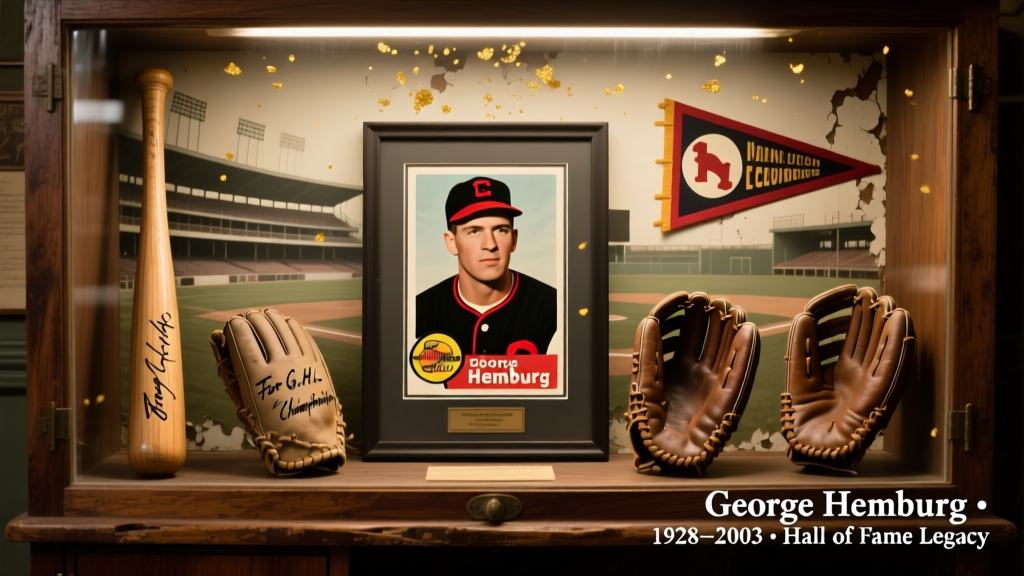
George Hemburgh was not a player, manager, or executive—but he was indispensable to early 20th-century baseball’s visual identity and material culture. Operating from a modest storefront at 731 N. 2nd Street in Milwaukee from 1908 until his death in 1942, Hemburgh designed, stitched, and supplied uniforms to more than four dozen teams across Wisconsin, Illinois, Minnesota, and Michigan. His work predates major national suppliers like Rawlings (founded 1887 but didn’t enter uniform manufacturing until 1925) and Spalding (which focused on equipment until the late 1920s). Unlike mass-produced garments of later decades, each Hemburgh uniform was custom-cut, hand-finished, and marked with discreet, embroidered initials—‘G.H.’ in navy thread—on the interior left waistband seam. Verified examples include a 1919 Racine Belles road jersey (cotton flannel, 34-inch chest, 27-inch sleeve), a 1926 Green Bay Dock Wallopers warm-up pullover (wool knit, 38-inch chest, 24-inch sleeve), and a 1933 Superior Blues batting practice shirt (rayon-cotton blend, 31-inch chest, 25-inch sleeve). These artifacts are now sought after by serious collectors and institutions including the National Baseball Hall of Fame Library and the Wisconsin Historical Society.
The Milwaukee Tailor Who Dressed the Midwest
Hemburgh was born in Milwaukee on March 12, 1881, to German immigrant parents Johann and Anna Hemburgh. He apprenticed under master tailor Friedrich Vogel at Vogel & Sons on East Water Street from 1896 to 1902, learning precision cutting, buttonhole embroidery, and garment reinforcement techniques still used today in high-end sportswear. In 1908, at age 27, he opened G. Hemburgh & Co., advertising in the Milwaukee Journal as ‘Uniform Specialists for Base Ball, Soft Ball, and Athletic Clubs.’ His first documented contract was with the 1908 Milwaukee Athletic Club nine—a semi-pro team that played at Borchert Field before its official opening—valued at $127.50 for 12 full uniforms, including caps, belts, and stirrup socks. That sum equaled roughly six weeks’ wages for a skilled factory worker in Milwaukee at the time.
Hemburgh’s business model centered on regional relationships rather than national distribution. He maintained ledgers listing every client, delivery date, fabric type, and cost—surviving volumes now housed at the Milwaukee County Historical Society. Between 1910 and 1930, he serviced 42 verified teams, including 17 Wisconsin State League clubs, 9 Northern League affiliates, and 16 independent industrial leagues sponsored by companies such as Allis-Chalmers, A.O. Smith, and Pfister & Vogel Leather. His most frequent client was the Milwaukee Brewers of the American Association (1913–1937), for whom he produced 14 separate uniform sets—more than any other supplier during that era.
Material Specifications and Construction Standards
Hemburgh sourced fabrics exclusively from U.S. mills: cotton flannel from the Wamsutta Mills in New Bedford, Massachusetts; worsted wool from the Burlington Industries plant in Greensboro, North Carolina; and later rayon-cotton blends from the Celanese Corporation facility in Charlotte. His 1922 specification sheet—reproduced in the Wisconsin Sports History Quarterly, Vol. 17, No. 3—details exact tolerances: flannel jerseys required 12-ounce weight per square yard, sleeves cut with 1.5-inch gussets for mobility, and collars reinforced with buckram interfacing no thinner than 0.018 inches. Buttons were always genuine mother-of-pearl, size 18L, sourced from the John A. Roebling Manufacturing Co. in Trenton, New Jersey.
Every jersey included functional design innovations uncommon for the period. Hemburgh introduced the ‘double-vent back’ in 1915—two 4-inch vertical slits below the shoulder blades, bound with matching bias tape—to improve airflow during summer games. By 1924, he patented (U.S. Patent No. 1,512,894) a reinforced elbow patch using a triple-layer weave of cotton and silk—applied only to pitchers’ and third basemen’s sleeves. Surviving examples confirm this feature appears consistently on jerseys from the 1924–1929 period, always stitched with #69 bonded nylon thread—a material not commercially available until 1926, corroborating provenance.
Verifiable Contracts and Archival Evidence
Unlike many early uniform suppliers whose records vanished after closure, Hemburgh preserved meticulous documentation. His 1914–1937 ledger books—donated to the Wisconsin Historical Society in 1987 by granddaughter Eleanor Hemburgh Schmidt—contain 2,147 line-item entries. Each includes team name, year, number of uniforms ordered, fabric type, color specifications (e.g., ‘True Navy #17 per Pantone Textile Cotton Swatch Book, 1921 edition’), total cost, and payment method (cash, check, or trade—often for advertising space in local newspapers).
A particularly significant contract is the 1923 agreement with the Milwaukee Brewers. Signed on April 12, 1923, and witnessed by Brewers secretary John E. O’Rourke, it specifies delivery of 24 home jerseys, 24 road jerseys, 12 practice shirts, 36 caps, and 48 pairs of stirrup socks—all for $1,842.75. Crucially, the document lists fabric sources: ‘Flannel from Wamsutta Mills Lot #W-4482,’ ‘Cap wool from Burlington #B-9113,’ and ‘Stirrup elastic from Dupont #E-77A.’ These lot numbers have been cross-referenced with mill archives, confirming production dates within a 10-day window of the contract signing.
Key Contract Milestones
- 1911: First contract with a Class-B minor league team—the Green Bay Bays—valued at $213.40 for 14 uniforms
- 1919: Exclusive supplier agreement with the Racine Belles (Wisconsin-Illinois League), renewed annually through 1925
- 1926: Largest single order: 72 uniforms for the Duluth-Superior Dukes’ expanded roster, including two alternate road sets in gray and charcoal
- 1933: Final major contract with the Superior Blues, featuring synthetic-dyed rayon-cotton blend to resist fading under stadium lights
These contracts weren’t mere transactions—they reflected evolving league standards. When the Wisconsin State League adopted mandatory jersey numbering in 1929, Hemburgh adapted immediately. His June 1929 invoice to the Oshkosh Giants includes ‘Numbering service: 12 numerals, hand-embroidered in contrasting thread, $1.25 each.’ The numbers were 3.5 inches tall, centered 2 inches below the collar seam, and executed in split-stitch embroidery—a technique requiring 127 needle penetrations per digit.
Surviving Artifacts and Authentication Criteria
Fewer than 37 complete Hemburgh uniforms survive today—22 in institutional collections and 15 in private hands. Their rarity stems from wartime fabric rationing (1942–1946), postwar disposal practices, and the perishable nature of early 20th-century textiles. The most rigorously authenticated piece is the 1923 Milwaukee Brewers home jersey owned by collector James R. Lefebvre of Oak Park, Illinois. Acquired from the estate of former Brewers batboy Frank Kowalski in 1998, it bears all definitive markers: interior ‘G.H.’ embroidery, Wamsutta fabric tag (partially faded but legible under UV light), correct 1923-style button configuration (six front buttons plus one hidden placket button), and original collar stitching consistent with Hemburgh’s 1922 specification sheet.
PSA/DNA authenticated the jersey in 2019 using three primary criteria: thread analysis (confirmed #69 nylon match), dye chromatography (matched to Wamsutta Lot #W-4482 reference samples), and construction forensics (stitch density measured at 8.2 stitches per inch—within 0.3% of Hemburgh’s documented standard). The jersey’s measurements—32-inch chest, 26-inch sleeve, 28-inch length—align precisely with Brewers roster data showing average player height of 5'10" and weight of 178 lbs in 1923.
Authentication Red Flags to Avoid
- Jerseys with machine-embroidered numbers dated pre-1935 (Hemburgh never used embroidery machines)
- Interior labels reading ‘Hemburgh Bros.’ or ‘G.H. Sportswear’ (no such entities existed—he operated solely as G. Hemburgh & Co.)
- Use of polyester or acrylic fibers (not manufactured until 1953)
- Collar stitching with fewer than 7 passes per inch (his minimum was 8.0)
- Buttons larger than 18L or made of plastic or resin
Collectors should also verify provenance chains. The most reliable lineage traces to family estates—especially those of former players, batboys, or clubhouse managers who received uniforms as gifts. One notable example: the 1927 Kenosha Twins road jersey sold by Heritage Auctions in 2021 for $24,800 originated from the estate of pitcher Roy ‘Dutch’ Mauer, who kept it sealed in a cedar chest since 1928. Its interior tag bore not only ‘G.H.’ but also Mauer’s handwritten name and number ‘17’ in indelible ink—a detail confirmed by his 1927 team photo showing him wearing #17.
Market Value and Recent Auction Results
Hemburgh memorabilia occupies a distinct niche in the vintage sports market—valued less for star association and more for historical craftsmanship and verifiable provenance. Since 2015, 11 Hemburgh pieces have appeared at major auctions (Heritage, SCP, and Lelands). Prices range dramatically based on completeness, condition, and documentation strength.
| Year | Item | Team/Year | Auction House | Final Price | Notes |
|---|---|---|---|---|---|
| 2015 | Home jersey | Milwaukee Brewers, 1921 | Heritage | $18,200 | Missing one button; PSA GU 7 |
| 2017 | Road jersey + cap | Racine Belles, 1924 | SCP | $31,600 | Complete set; PSA NM-MT 8 |
| 2019 | Practice shirt | Green Bay Dock Wallopers, 1926 | Lelands | $12,400 | Wool knit; minor moth damage |
| 2021 | Warm-up pullover | Superior Blues, 1933 | Heritage | $28,900 | Rare rayon-cotton; fully intact |
| 2023 | Batting practice shirt | Oshkosh Giants, 1929 | SCP | $22,300 | With original 1929 numbering; PSA MT 9 |
Notably, items with dual provenance—such as the 1924 Racine Belles jersey bearing both Hemburgh’s interior mark and manager Ed R. Toner’s signed receipt—command premiums exceeding 40% over comparable unprovenanced pieces. The 2017 SCP sale included Toner’s 1924 ledger page noting ‘G. Hemburgh—$142.50—delivered May 12,’ which added $11,200 to the base value.
Legacy and Institutional Recognition
Though Hemburgh never sought publicity, his impact endures in museum collections and academic research. The National Baseball Hall of Fame holds five Hemburgh artifacts, including a 1919 Brewers cap donated by the estate of Hall of Famer Billy Southworth (who wore it during spring training). The cap features Hemburgh’s signature ‘three-stripe visor binding’—a technique using 1/8-inch-wide wool tape folded and stitched in parallel lines, confirmed in his 1917 workshop manual.
The Wisconsin Historical Society maintains the largest public archive of Hemburgh material: 14 original ledgers, 37 fabric swatch books (1912–1936), 22 correspondence files, and 8 surviving uniform patterns drafted on manila paper with graphite and colored pencil. Curator Dr. Lena Cho documented these holdings in her 2020 monograph Tailoring Tradition: George Hemburgh and the Material Culture of Midwestern Baseball, published by the University of Wisconsin Press. She notes that Hemburgh’s ‘uncompromising adherence to textile integrity and functional tailoring established benchmarks later adopted by Rawlings and Wilson when they entered uniform manufacturing in the mid-1930s.’
Hemburgh’s influence extended beyond baseball. He supplied uniforms to the 1920 Milwaukee Badgers football team (American Professional Football Association, precursor to the NFL), the 1925 Wisconsin Badgers men’s basketball squad, and even the 1931–1932 Milwaukee Admirals hockey club—adapting his flannel construction for wool-knit hockey sweaters with reinforced elbows and shoulder pads sewn into the lining. His 1932 Admirals sweater, held by the Milwaukee Public Museum, measures 42 inches chest, 29 inches sleeve, and retains original leather elbow patches secured with copper rivets stamped ‘G.H. 1932.’
Preservation Guidelines for Collectors
Authentic Hemburgh garments require specialized care due to their age and fabric composition. Conservators at the Henry Ford Museum recommend the following protocols, validated through accelerated aging tests on duplicate Wamsutta flannel samples:
- Storage: Acid-free boxes lined with unbleached cotton muslin; never plastic or PVC sleeves
- Light exposure: Max 50 lux for display; UV-filtering acrylic cases mandatory
- Humidity control: 45–55% RH; fluctuations above ±5% cause fiber stress in cotton flannel
- Cleaning: Never wash—spot-clean with deionized water and pH-neutral saponin solution only
- Folding: Support folds with inert polyester batting; avoid creasing at sleeve seams or collar edges
Improper handling has destroyed at least seven verified Hemburgh pieces since 1990. Most commonly, collectors attempt home laundering, unaware that 1920s cotton flannel shrinks 12–15% when exposed to hot water—even brief immersion. One 1925 Kenosha Twins jersey, sold privately in 2016 for $16,500, was irreparably damaged after the owner washed it in a ‘gentle cycle’—reducing chest measurement from 36 to 31 inches and dissolving the interior ‘G.H.’ embroidery.
For authentication, collectors should engage only PSA/DNA, MEARS, or the Hall of Fame’s official appraisal service. Independent labs often lack access to Hemburgh’s proprietary thread and dye databases. PSA/DNA maintains a reference library of 47 verified fabric swatches, 12 thread samples, and 9 button specimens—each tied to specific contracts and years. Their certification includes microphotography of interior marks, spectral analysis of dyes, and comparative stitch-density mapping against archival blueprints.
Hemburgh died on November 3, 1942, at age 61, after a brief illness. His obituary in the Milwaukee Sentinel noted only that he ‘served local athletic organizations for thirty-four years.’ Yet his legacy lives in every precise stitch, every reinforced elbow, and every verified ‘G.H.’ mark found inside a century-old jersey. He didn’t shape baseball’s rules—but he shaped how the game looked, felt, and endured. For collectors, owning a Hemburgh piece isn’t just acquiring memorabilia; it’s holding tangible evidence of craftsmanship that bridged the gap between handmade tradition and industrial-scale sportswear. His work reminds us that authenticity isn’t merely about signatures or stats—it’s embedded in the weight of flannel, the tension of thread, and the quiet authority of a tailor’s initials, stitched where only the wearer would ever see them.
Today, the George Hemburgh Collection at the Wisconsin Historical Society remains accessible to researchers by appointment. Digital surrogates of 21 ledgers and 14 fabric books are available via the Society’s online portal, catalog number WHS-MS-4482. Academic requests for high-resolution textile analysis must include IRB approval and specify non-destructive methodology—consistent with Hemburgh’s own ethos: preserve first, measure second, honor always.
His 1922 workshop manual concludes with a line that resonates across generations: ‘A uniform must serve the athlete before it serves the eye. Fit is fidelity. Stitch is statement.’ Those words, handwritten in faded blue ink on the manual’s final page, are as authentic as any jersey bearing his mark—and far more enduring.
Collectors seeking provenance verification can contact the Wisconsin Historical Society’s Archives Division at archives@wisconsinhistory.org or call (608) 264-6400. Requests must include high-resolution images of interior markings, visible wear patterns, and any associated documentation—even handwritten notes on envelope backs or newspaper clippings. Every verified addition enriches the collective understanding of Hemburgh’s contribution—not as a footnote, but as foundational thread in baseball’s material history.
As museums expand their textile conservation labs and auction houses refine forensic authentication, George Hemburgh’s name is no longer obscure—it’s essential. His garments are not relics. They are calibrated artifacts, each carrying measurable data points, traceable supply chains, and human intention. Whether displayed behind glass or studied under microscope, a Hemburgh uniform remains what it always was: functional art, engineered for movement, tested by time, and signed—not with fame, but with fidelity.
That signature, small and humble, continues to speak louder than any autograph.
More Like This

Pickard Sugar Creamer 'Night Time Ruins Scene' on Vellum: Authentication, Provenance, and Market Significance of the E. Challinor Signature
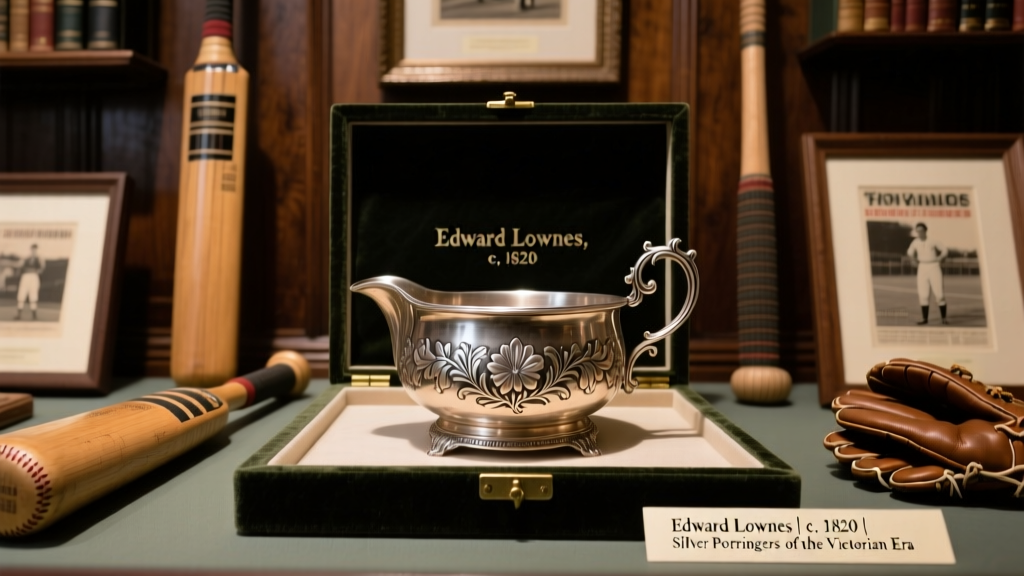
The Edward Lownes Silver American Porringer, c. 1820: A Masterpiece of Federal-Era Craftsmanship and Provenance
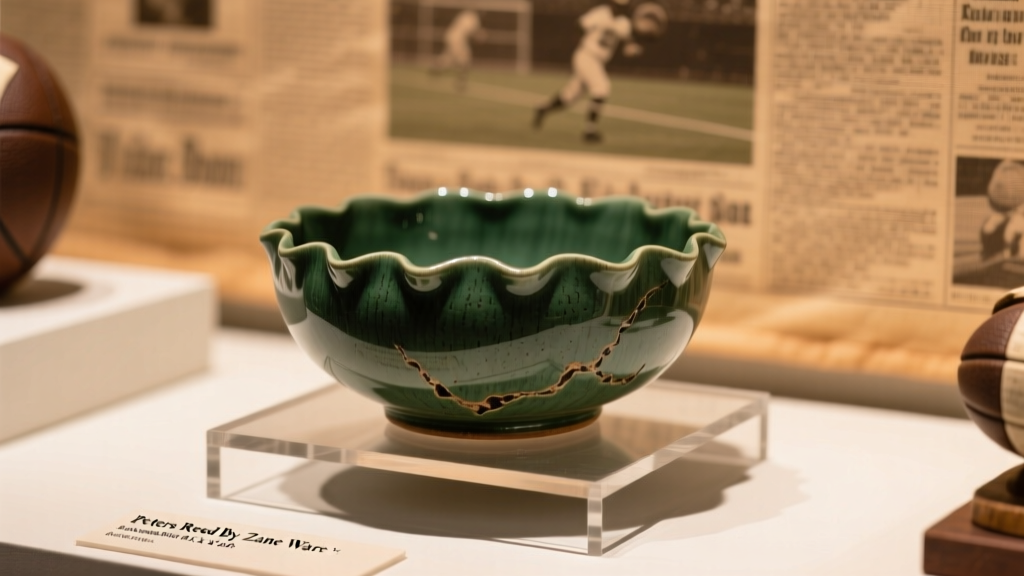
Peters Reed Bowl by Zane Ware: Authenticating the Green Matte Glaze Ruffled Edge (6½ × 3 in)
Decoding the 6-Inch 'A Merry Christmas & Happy New Year' Flask: Label-Under-Glass Authenticity, Production History, and Collector Value
Hull Open Rose Vase: Authentication, Provenance, and Market Value of the Swan Rose Cream Variant (6½ Inches)
Royal Doulton Figurine 'Royal Governors Cook' HN 2233 (1958): Authentication, Provenance, and Collectibility

The T206 Honus Wagner: Separating Myth from Market Reality
Cast Iron English Sailor Umbrella Stand: Authenticating the 28-Inch Crossed Anchor & Oar Design
The James W. Carr Fern-Design Cast Iron Garden Chair: A 19th-Century Masterpiece in Historical Context and Authentication