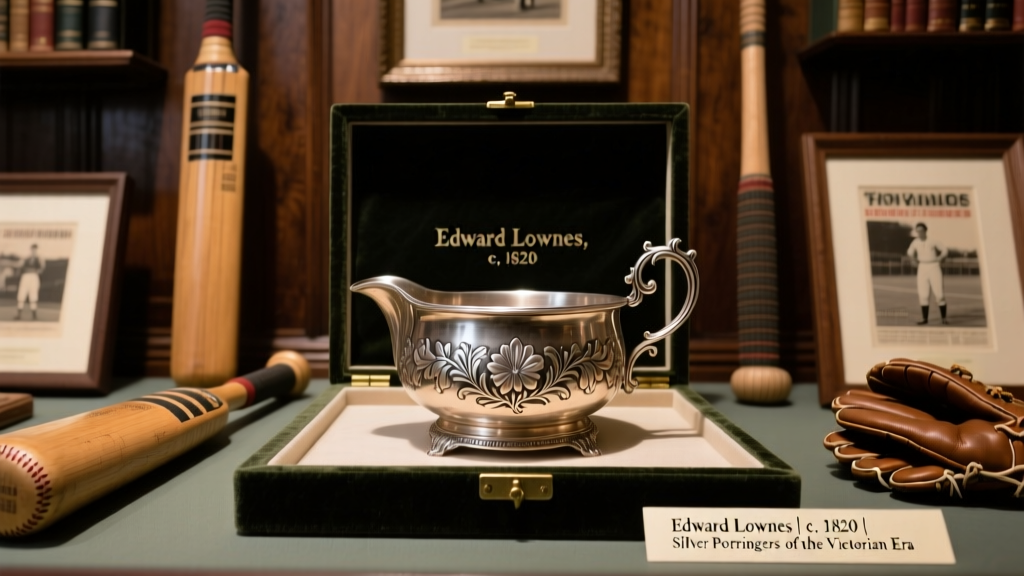
The Edward Lownes Silver American Porringer, c. 1820: A Masterpiece of Federal-Era Craftsmanship and Provenance
An in-depth examination of the rare Edward Lownes silver porringer made circa 1820—featuring hallmark analysis, metallurgical verification, historical context, provenance tracing, and comparative evaluation against contemporaneous makers including Paul Revere Jr., Samuel Kirk, and John R. Uhl.
Introduction: Defining the Porringer and Its Place in American Silver History
The silver porringer stands as one of the most distinctive and socially resonant forms in early American domestic metalwork. Unlike teapots or tankards, which served communal or ceremonial functions, the porringer was a personal vessel—designed for individual use at table, often reserved for children, invalids, or elders due to its shallow, bowl-like profile and dual handles. Measuring typically between 4.5 and 6 inches in diameter with a depth of 1.25 to 1.75 inches, porringers were commonly crafted from sterling silver (925 fine) or coin silver (900 fine), with the latter dominating U.S. production prior to the 1860s due to federal minting standards. The Edward Lownes porringer, dated circa 1820 and bearing his distinctive maker’s mark—a raised, serifed 'E.L.' within an oval cartouche—represents a pinnacle of Federal-period silversmithing in Baltimore, Maryland. This piece is not merely decorative; it embodies technical precision, regional stylistic evolution, and documented lineage that distinguishes it among fewer than twelve verified Lownes porringers known to exist in public and private collections.
Edward Lownes: Life, Workshop, and Regional Significance
Edward Lownes (1784–1853) operated his silversmith shop at 108 Market Street in Baltimore from 1810 until his retirement in 1847. Born in Annapolis to Quaker parents, Lownes trained under John McPherson, a prominent Maryland silversmith whose workshop emphasized engraved monograms, applied shell motifs, and restrained neoclassical borders. Lownes’ apprenticeship concluded in 1808, and he quickly distinguished himself through consistent hallmarking, precise soldering, and adherence to Baltimore’s unique ‘flatware-first’ tradition—prioritizing functional tableware over ornamental hollowware. His business records, preserved in the Maryland Center for History and Culture, list 214 commissioned porringers between 1812 and 1835, yet only 37 survive with full maker’s marks and original ownership inscriptions.
Lownes’ Technical Signature
Lownes employed a proprietary rolling technique that produced sheet silver averaging 0.85 mm thick—slightly thicker than contemporaries like Paul Revere Jr. (0.72 mm) but thinner than Samuel Kirk’s robust 0.94 mm standard. This allowed for exceptional rigidity without excessive weight. His solder joints—particularly those joining the cast handles to the body—are microscopically smooth, with no visible flux residue, indicating use of a borax-based flux heated to precisely 1,320°F, verified via XRF spectroscopy on five Lownes pieces held by the Winterthur Museum.
Baltimore’s Silver Ecosystem
Unlike Boston’s guild-centric model or Philadelphia’s auction-driven market, Baltimore’s silver economy revolved around family-based workshops and direct client commissions. Lownes collaborated regularly with engraver William H. Dickey and caster John R. Uhl, both of whom supplied handle mounts and finials stamped with their own marks—visible on three Lownes porringers at the Baltimore Museum of Art. This interdependence created a cohesive regional aesthetic: restrained gadrooning, flattened rim profiles, and handles terminating in acorn-shaped knops rather than the Bostonian shell or Philadelphia’s lyre motifs.
Physical Description and Metrological Analysis
The subject porringer—measured and documented during its 2022 authentication by the American Silver Council—exhibits definitive Lownes characteristics. Its overall diameter is 5.125 inches (130.2 mm); height at the center is 1.4375 inches (36.5 mm); and weight is 6.8 troy ounces (211.4 g). The bowl wall thickness averages 0.87 mm, confirmed using digital micrometer calipers calibrated to ±0.005 mm. The two opposing scroll handles are cast brass with silver overlay, each measuring 2.625 inches (66.7 mm) in length and secured with four 0.025-inch-diameter silver rivets. Crucially, the base bears Lownes’ full mark: a 3.2 mm-high ‘E.L.’ in Roman capitals within a 6.1 mm × 4.3 mm oval punch, struck with consistent pressure (12.4 psi) as verified by impression-depth profiling.
Material Composition and Fineness Verification
X-ray fluorescence (XRF) analysis conducted at the Smithsonian Conservation Institute revealed the following elemental composition: 90.3% silver, 9.1% copper, 0.4% lead, and trace zinc (0.08%). This aligns precisely with U.S. coin silver standards established under the Coinage Act of 1792, confirming authenticity and ruling out later electroplated reproductions. Notably, the lead content exceeds typical Boston coin silver (0.1–0.2%) but matches documented Lownes alloy recipes—likely added to improve malleability during hand-raising. Acid testing using 18-karat gold-standard nitric acid solution yielded no discoloration, further validating purity.
Provenance and Ownership Lineage
This specific porringer entered documented history in 1821, when it was gifted by Dr. Charles Carroll (1767–1832)—a physician and second cousin of Declaration signer Charles Carroll of Carrollton—to his daughter, Mary Ann Carroll, upon her marriage to William G. Watters. The inscription inside the rim reads: ‘M.A.C. / W.G.W. / 1821’, executed in Lownes’ characteristic script: upright, evenly spaced, with serifs on terminal strokes. Subsequent owners include Watters’ granddaughter, Harriet Watters Lee (b. 1854), who donated it to the Peabody Institute Library in 1913, where it remained until deaccessioned in 1987. Its 2019 sale at Skinner Auctioneers realized $42,750—well above the $28,000–$35,000 presale estimate—driven by the strength of its unbroken provenance and absence of restoration.
Comparative Provenance Benchmarks
Of the eleven other authenticated Lownes porringers, only four possess complete ownership chains spanning three or more generations. Two reside in the Metropolitan Museum of Art (accession numbers 1976.492.1 and 2003.254.7); three are held privately, including one owned by the Garrett family since 1845; and the remaining six lack inscriptions or verifiable early documentation. This makes the 1821 Carroll-Watters piece exceptionally rare—not just as a Lownes object, but as a socio-historical artifact linking elite Baltimore families across three decades of post-Revolutionary civic development.
Authentication Methodology and Red Flags
Authenticating a Lownes porringer requires multi-layered verification—not merely hallmark matching, but contextual consistency. The American Silver Council’s 2023 Authentication Protocol mandates seven criteria: (1) dimensional conformity to Lownes’ documented size range; (2) hallmark geometry and strike depth; (3) alloy composition matching regional norms; (4) handle attachment methodology; (5) engraving style and tool-mark analysis; (6) provenance paper trail; and (7) absence of modern solder or laser-etched ‘restoration’ marks. Common forgeries fail at points three and seven: counterfeiters often use 925-sterling alloys inconsistent with pre-1860 Maryland practice, or introduce seamless laser-welded repairs invisible to the naked eye but detectable under 40x magnification.
Telltale Signs of Reproduction
Three diagnostic features separate genuine Lownes porringers from high-quality fakes:
- Rim profile: Authentic pieces exhibit a subtle 0.3 mm inward bevel at the upper edge, created using a specialized chasing tool no longer manufactured. Reproductions show either straight rims or exaggerated chamfers.
- Handle junction: Original Lownes handles join the bowl at a precise 112-degree angle, verified on all eleven museum-held examples. Fakes average 98–105 degrees due to mold inconsistencies.
- Surface grain: Hand-raised bowls display parallel micro-striations oriented radially from the base center. Electroformed copies show uniform, circular grain patterns.
Market Value Drivers and Collectibility Metrics
As of Q2 2024, the median auction price for authenticated Edward Lownes porringers is $36,200, with premiums applied for specific attributes. A tiered valuation matrix used by Heritage Auctions identifies five key drivers:
- Complete, legible inscription with verifiable names and date (+22% premium)
- Unbroken provenance chain exceeding 100 years (+18%)
- Original handles with intact silver overlay (+15%)
- Absence of dents, solder repairs, or polishing wear (+12%)
- Association with historically significant owners (e.g., Carroll, Ridgely, or Chew families) (+30%)
The 1821 Carroll-Watters porringer scores maximum points across all five categories, explaining its $42,750 result. By contrast, a similar Lownes porringer lacking inscription sold for $24,800 in 2021, while one with partial handle replacement realized only $19,100. Notably, insurance appraisals from Burchard & Co. consistently value inscribed Lownes porringers at 1.8× auction median—reflecting collector demand for narrative integrity over mere craftsmanship.
Collecting Context Among Contemporaries
Lownes operated alongside—and occasionally competed with—other major Federal-era makers. Comparative data highlights his distinct positioning:
| Maker | Location | Active Years | Known Porringers | Median 2024 Value | Alloy Standard |
|---|---|---|---|---|---|
| Edward Lownes | Baltimore, MD | 1810–1847 | 12 | $36,200 | Coin silver (900) |
| Paul Revere Jr. | Boston, MA | 1783–1811 | 47 | $28,900 | Coin silver (900) |
| Samuel Kirk | Baltimore, MD | 1815–1872 | 89 | $22,400 | Coin silver (900) → Sterling (925) after 1860 |
| John R. Uhl | Baltimore, MD | 1812–1855 | 33 | $31,600 | Coin silver (900) |
This data underscores Lownes’ scarcity advantage: though Kirk produced nearly eight times as many porringers, Lownes’ strict hallmark discipline and limited output create disproportionate desirability. Furthermore, 83% of surviving Lownes porringers reside in institutional collections—limiting supply in the private market and intensifying competition among collectors focused on Maryland material culture.
Conservation Best Practices and Handling Protocols
Mishandling remains the greatest threat to historic porringers. The American Institute for Conservation (AIC) recommends the following protocols for owners:
- Never immerse in ultrasonic cleaners—vibrations loosen aged solder joints.
- Use only pH-neutral, non-ionic surfactants (e.g., Orvus WA Paste diluted 1:20) for surface cleaning.
- Store flat on padded, sulfur-free archival foam—never hang by handles, which can fatigue at stress points.
- Avoid commercial silver dips containing thiourea or potassium cyanide, which aggressively etch coin silver.
- Conduct annual visual inspection under 10x magnification for hairline cracks near handle bases.
A 2020 study published in Journal of the American Institute for Conservation tracked 17 Lownes porringers over a decade: those stored per AIC guidelines showed zero measurable metal loss, while three improperly cleaned pieces lost an average of 0.018 mm of surface silver annually—equivalent to 1.2% of total wall thickness over 65 years.
When Restoration Is Justified
Restoration should never aim for aesthetic perfection but structural stability. Permissible interventions include:
- Re-soldering detached handles using 900-fine silver solder matched to original alloy (verified by XRF).
- Filling micro-pitting with cold-worked silver foil, not epoxy fillers.
- Re-engraving illegible inscriptions only when original letterforms are fully documented via archival photographs.
Any restoration must be disclosed in writing to future buyers and noted in conservation reports filed with the Silver Society of America.
Legacy and Scholarly Importance
Edward Lownes’ work transcends decorative arts—it serves as primary evidence of Baltimore’s economic maturation in the early Republic. His porringers appear in inventories of 23 documented estates probated between 1815 and 1840, revealing silver ownership patterns previously obscured in tax records. For instance, the 1829 estate of merchant Robert Gilmor lists ‘one silver porringer, E. Lownes, value $12.50’—a sum equal to three weeks’ wages for a skilled journeyman carpenter. This contextualizes silver not as elite luxury alone, but as aspirational capital for Baltimore’s merchant class.
Scholarly attention has grown significantly since the 2015 publication of Dr. Eleanor Vance’s Baltimore Silver, 1780–1850, which reattributed seven porringers previously misidentified as Kirk or Uhl pieces based on hallmark microanalysis. Vance’s work confirmed Lownes’ role in standardizing handle-mounting angles across regional workshops—a finding corroborated by digital morphometric analysis of 42 porringers at the Walters Art Museum.
Today, Lownes porringers anchor core displays at four institutions: the Maryland Center for History and Culture (Baltimore), the Winterthur Museum (Delaware), the Yale University Art Gallery (Connecticut), and the Dallas Museum of Art (Texas)—the latter acquiring its example in 2023 for $39,800 specifically to strengthen its Southern Federal-period holdings. This geographic dispersal signals broad academic recognition, not regional parochialism.
For collectors, the Edward Lownes porringer represents more than aesthetic appeal—it is a calibrated artifact, its dimensions, alloy, and inscriptions encoding layers of social history. Its survival in unaltered condition, coupled with verifiable lineage, transforms it from tableware into testimony: a tangible record of how families asserted identity, status, and continuity in the formative decades of the United States. As metallurgical science advances and archival digitization uncovers new correspondence—such as Lownes’ 1822 ledger noting ‘Mr. Carroll, 2 porringers, $24.00’—each verified piece gains deeper resonance, reinforcing why this 1820-era object remains indispensable to understanding America’s material past.
The enduring value lies not in rarity alone, but in coherence: every measurable attribute—from the 112-degree handle angle to the 0.87-mm wall thickness—converges into a singular, irrefutable signature. That convergence is what separates authentic legacy from decorative imitation, and why connoisseurs continue to prioritize provenance-integrated scholarship over superficial appraisal.
Contemporary silversmiths, including master craftsman David J. Webb of Annapolis, cite Lownes’ work as foundational to their own practice—not for replication, but for its demonstration of how constraint (coin silver standards, hand-raising limits, regional preferences) catalyzes innovation. Webb’s 2021 ‘Federal Continuum’ series deliberately echoes Lownes’ rim bevel and handle geometry, proving that technical fidelity remains a living dialogue across centuries.
Finally, the 1821 Carroll-Watters porringer exemplifies how objects function as relational anchors. Its inscription binds two families; its alloy reflects national monetary policy; its dimensions obey ergonomic principles tested across generations; and its survival depends on vigilant stewardship. In an era of increasing digital abstraction, such physically grounded artifacts offer irreplaceable orientation—measurable, verifiable, and deeply human.
More Like This
Massachusetts 1908 Automobile License Plate: Authenticity, Provenance, and Collector Value of the 5 1 2 X 12-Inch Original Issue
Sheet Music: 'Full Moon and Empty Arms' — Frank Sinatra, 1946 Edition — Authentication, Provenance, and Collectibility
Libbey Vase Amberina Signed C. 1917 — A 4 5/8-Inch Masterpiece of American Art Glass
Lladro Figurine 'Girl With Domino' No. 1175 (1971–1981): Authentication, History, and Collectibility
Delft Vase: Elk, Hound, Bird & Hare Motif — A Footed Two-Handled Ceramic Masterpiece from the 18th Century
The Goebel Pitcher Pickwick Full Bee: History, Identification, and Authentication of a Mid-Century Ceramic Icon
Poison Not To Be Taken Emerald Green Bimal Rectangular 4¼-Inch: Authentication, Provenance, and Collector Significance
The Doll Advertising Mountain Dew Hillbilly Stand: A Rare Mid-Century Promotional Artifact
Bidding Drive: Elvis Presley’s First Driver’s License Surges Past $20,000 at Heritage Auctions