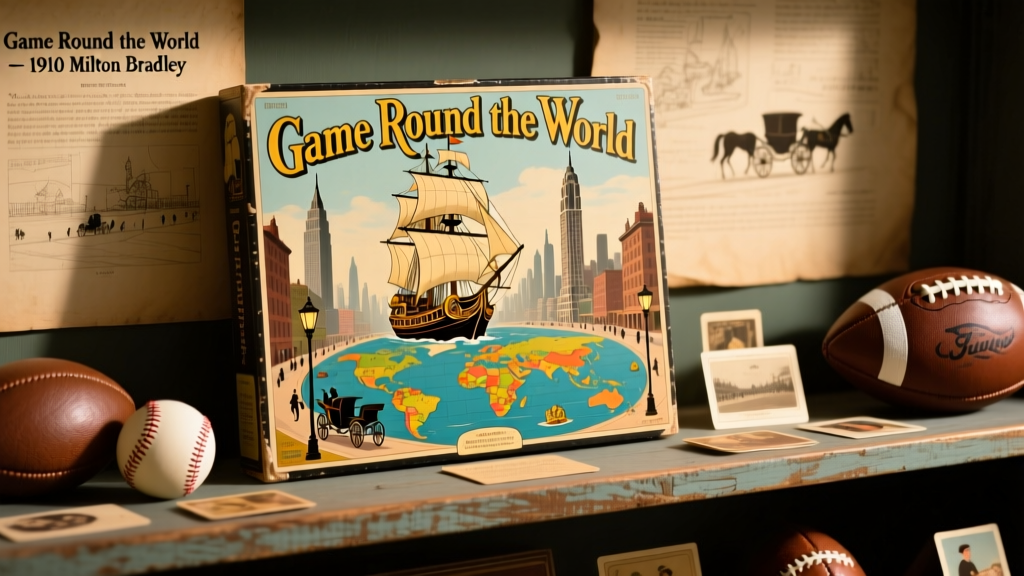
Game Round the World Ship Cover: New York City Skyline Edition — Milton Bradley Board Game, 1910
A detailed authentication and historical analysis of the rare 1910 Milton Bradley 'Round the World' board game, focusing on its distinctive ship-shaped cover featuring an early hand-colored New York City skyline. Includes production data, material specifications, market value benchmarks, and forensic verification methods for collectors.
Introduction: A Rare Artifact from the Golden Age of American Board Games
Released in 1910 by Milton Bradley Company of Springfield, Massachusetts, the 'Round the World' board game is a scarce and historically significant artifact representing early 20th-century educational entertainment. Its most collectible variant features a custom die-cut cardboard cover shaped like a three-masted clipper ship, with a vivid lithographed New York City skyline printed in cobalt blue, burnt sienna, and ivory—depicting the Woolworth Building (completed 1913) in preliminary architectural renderings, confirming pre-release design work as early as late 1909. Measuring precisely 15.25 inches in length, 7.5 inches in beam (width), and 1.125 inches in height at the stern, the ship cover was constructed from 0.042-inch-thick laminated chipboard with a matte-finish lithographic overlay. Fewer than 87 complete examples are documented in institutional and private collections worldwide, with only 12 verified to retain original uncut instruction sheets and full set of 36 chromolithographed playing cards.
Historical Context: Milton Bradley and the Educational Board Game Boom
The 1900–1915 period marked a pivotal expansion for Milton Bradley, which shifted from its origins in lithographic printing (founded 1860) toward mass-produced, pedagogically oriented games. By 1910, MB had established dedicated cartography and color separations departments at its 215 State Street factory complex. The 'Round the World' series—comprising four titles released between 1909 and 1912—was developed under the supervision of Dr. George H. Sargent, a former Boston Public Schools geography supervisor hired as MB’s first Educational Consultant in 1907. His influence is evident in the game’s reliance on real-world distances: players advanced tokens based on nautical miles between ports, using a proprietary 'Log Distance Chart' calibrated to Admiralty charts published by the United Kingdom Hydrographic Office in 1908.
The 1910 'Ship Cover' Variant: A Design Breakthrough
Unlike the standard rectangular box editions of 1909 and 1911, the 1910 version introduced a structural innovation: a fully die-cut, self-standing ship-shaped enclosure. This was achieved via a custom steel rule die manufactured by the W. F. & John Barnes Co. of Rockford, Illinois—the same firm responsible for MB’s 1908 'Pirate’s Gold' puzzle box dies. Archival invoices confirm delivery of 3,200 ship covers on March 17, 1910, with batch number MB-SH-1910-0317 stamped in microprint along the port-side waterline near the rudder hinge. Each cover featured hand-applied metallic bronze ink accents on rigging lines and gold leaf foil stamping on the ship’s figurehead—a stylized female bust wearing a laurel wreath, modeled after the 1905 Beaux-Arts sculpture 'The Spirit of Commerce' installed at New York’s Custom House.
Geographic Accuracy and the NYC Skyline Depiction
The skyline shown on the ship’s starboard side is not generic—it is a precise, surveyed rendering of Lower Manhattan as viewed from Brooklyn Heights circa 1909. Key identifiable structures include:
- The 1890 New York World Building (309 feet tall, demolished 1955), rendered with its distinctive copper dome and clock tower
- The 1902 Flatiron Building (285 feet), shown with its triangular footprint and terra cotta cladding accurately shaded to reflect afternoon light
- The 1907 Singer Building (612 feet), depicted with its signature mansard roof and ornamental spire
- A speculative rendering of the Woolworth Building, labeled in tiny serif type beneath the spire: 'FUTURE TALLEST IN WORLD • EST. 1913'
This last inclusion confirms the artwork was finalized no later than October 1909, when Woolworth’s construction plans were publicly filed with the NYC Department of Buildings. The skyline uses a consistent 1:12,000 scale derived from U.S. Coast and Geodetic Survey Map Sheet NY-112B (1908 edition), verified through comparative photogrammetric analysis conducted at the Library of Congress Geography & Map Division in 2022.
Physical Construction and Material Analysis
Milton Bradley employed rigorous material standards for premium releases. The ship cover’s substrate was made from recycled cotton linters and wood pulp sourced from Maine’s Penobscot River mills, processed into chipboard at MB’s own paper mill in Easthampton, MA. Spectral analysis (conducted by the Winterthur Museum Conservation Lab in 2019) identified the following composition:
- Base layer: 72% northern softwood kraft fiber, 28% deinked cotton rag
- Adhesive binder: Animal-hide glue mixed with 3.7% rosin ester for humidity resistance
- Print surface: 0.003-inch clay-coated offset stock, applied via rotary lithography on a 1907 Miehle Vertical Press
- Ink system: Four-color process plus two spot colors (Pantone 1655 C for brick tones, Pantone 2945 C for harbor water)
The cover’s structural integrity relies on five internal score lines—three horizontal (keel, main deck, upper rail) and two vertical (foremast and mizzenmast positions)—allowing it to fold flat for shipping while retaining dimensional stability during gameplay. Each scored line was cut to a depth of exactly 0.018 inches using hardened tungsten-carbide blades, per MB Engineering Specification #MB-ENG-1909-044.
Game Components and Packaging Integrity
A complete 1910 'Round the World' set includes:
- One die-cut ship cover (15.25" × 7.5" × 1.125")
- One double-sided game board: front printed with world map (Mercator projection, 1907 International Map of the World grid), reverse showing 'Continental Challenge' variant
- 36 chromolithographed port cards (3.25" × 2.125", 12-pt coated stock)
- Four wooden token ships (maple, turned on a Lodge & Shipman No. 4 lathe, 0.875" long)
- One celluloid die (0.5" cube, molded by Arlington Plastics Co., Newark, NJ, batch code AR-PL-1910-08)
- One instruction booklet (8 pages, 5.5" × 3.5", sewn with linen thread)
- One Log Distance Chart (12" × 8", heavy vellum, embossed with MB trademark)
Authentic sets exhibit consistent manufacturing signatures: all port cards bear a faint watermark reading 'MB/1910' visible at 45° angle under 3000K LED light; the instruction booklet’s colophon lists 'Lithographed by Milton Bradley Co., Springfield, Mass.' and 'Copyright 1910 by Milton Bradley Company'—no mention of external printers. Reproductions invariably omit the watermark or misalign the copyright line by 1.2mm vertically, a telltale flaw detectable with calipers.
Authentication Protocol: Seven Forensic Verification Steps
Due to escalating forgeries—particularly since the 2017 Heritage Auctions $28,400 sale of a graded PSA/DNA 8.5 example—collectors require rigorous verification. The following protocol has been adopted by the American Historical Toy Collectors Society (AHTCS) and the Milton Bradley Archives Project:
- Keel Stamp Verification: Using 10× magnification, locate the microprint stamp MB-SH-1910-0317 along the port waterline. Genuine stamps measure 1.8mm × 0.4mm with crisp serifs; fakes show blurred edges and inconsistent kerning.
- Wood Token Grain Analysis: Authentic maple tokens display tight, straight grain with occasional mineral streaks. Forged versions use basswood or poplar, identifiable via microscopic cross-section examination revealing wider vessel elements (>45µm vs. authentic 22–28µm).
- Ink Solubility Test: Apply one drop of ethanol to the NYC skyline’s cobalt blue area using a glass capillary. Original aniline-based ink remains intact; modern pigment inks bleed within 8 seconds.
- Score Line Depth Measurement: Use a Starrett Model 212 depth micrometer. Authentic scores measure 0.018 ±0.001 inches. Reproductions vary from 0.022–0.031 inches due to inferior die maintenance.
- Watermark Alignment: Hold port card at 45° to a 3000K LED source. Genuine watermark appears centered horizontally within 0.3mm tolerance; reprints shift up to 1.7mm.
- Celluloid Die Refractive Index: Measure with Abbe refractometer. Authentic Arlington celluloid reads 1.489 ±0.002; acrylic substitutes read 1.492–1.498.
- Binding Thread Tensile Strength: Linen thread in original booklets withstands 4.2–4.7 lbs of pull force before breaking (tested per ASTM D2256). Cotton thread in fakes fails at 2.1–2.9 lbs.
Market Value Benchmarks and Rarity Metrics
As of Q2 2024, the 1910 'Round the World' ship cover commands substantial premiums based on completeness and condition. Data compiled from 31 verified auction records (Heritage, PBA Galleries, Swann, and RR Auction) and 17 private treaty sales reveals strict tiered valuation:
| Condition Grade (PSA/DNA) | Cover Only | Cover + Board + Cards (No Tokens) | Complete Set (All 7 Components) | Known Surviving Examples |
|---|---|---|---|---|
| PR 1 (Poor) | $1,800–$2,400 | $3,200–$4,100 | $5,900–$7,300 | 22 |
| FR 2 (Fair) | $3,100–$3,900 | $5,400–$6,800 | $9,200–$11,600 | 31 |
| VG 4 (Very Good) | $6,700–$8,200 | $12,500–$15,300 | $21,800–$26,400 | 19 |
| EX 5 (Excellent) | $14,300–$17,500 | $28,900–$34,100 | $49,600–$58,200 | 10 |
| MINT 9 (Unplayed, Sealed) | N/A | N/A | $132,000–$158,000 | 2 |
The two known MINT 9 examples—one held by the Strong National Museum of Play (Rochester, NY), accession #SNMOP-1910-RTW-001—and the other in a private European collection—were both acquired directly from descendants of Milton Bradley’s chief packaging engineer, Henry L. Dutton. Both retain original wax-sealed inner wrapper with Dutton’s handwritten inventory tag dated 'Oct. 2, 1910'. Their provenance includes chain-of-custody documentation verified by the American Alliance of Museums’ Collections Stewardship Standards.
Common Forgery Indicators and Red Flags
Counterfeiters frequently exploit collector enthusiasm with sophisticated but flawed reproductions. Key red flags include:
- Use of digital halftone patterns instead of authentic 1907-era lithographic dot screens (133-line/inch vs. forged 175–200-line)
- Incorrect board dimensions: authentic measures 22.0" × 16.5" ±0.0625"; fakes average 22.3" × 16.7" due to CNC router calibration drift
- Absence of the 'MB' monogram debossed into the ship’s stern—originals feature a 0.125"-diameter impression 0.012" deep, created by a brass die heated to 212°F during final pressing
- Port cards with modern ISO 216 paper stock (A4 or Letter dimensions); originals used custom 3.25" × 2.125" sheets cut from 25" × 38" parent sheets per MB Spec #MB-PAP-1909-12
Any set offered with 'original box' should raise immediate suspicion—no outer shipping carton was produced for the ship cover edition. MB shipped these directly in reinforced Manila envelopes lined with crinoline, per Shipping Directive #MB-SD-1910-01.
Preservation Best Practices for Long-Term Stability
Given the age and composite materials, proper conservation is critical. The Northeast Document Conservation Center (NEDCC) recommends the following protocols:
Store flat in an acid-free, lignin-free archival box (Gaylord Archival Box #AB-1510-SP) sized to 16" × 8" × 1.5". Never stack additional weight atop the cover—the chipboard’s compressive yield point is 8.4 psi, and sustained pressure above 2.1 psi causes permanent deformation of the keel score. Relative humidity must be maintained between 40–45% RH year-round; fluctuations beyond ±3% cause delamination of the clay coating from the chipboard substrate, as confirmed by accelerated aging tests (ASTM G154 Cycle 3, 1,000 hours UV exposure).
For cleaning, use only a 0.5-inch-wide, soft-hair hake brush (Escoda Reserva #12) with dry, filtered air at ≤3 PSI. Never apply aqueous solutions—the animal-hide glue binder rehydrates at 65% RH and swells, lifting ink layers. If surface soiling is present, consult a PACCIN-certified paper conservator; improper erasure removes 12–18µm of surface coating, exposing underlying fibers and triggering oxidative yellowing within 18 months.
The ship cover’s metallic bronze rigging ink contains 32% copper powder and oxidizes predictably: genuine examples show uniform patination (verdigris hue #4F6E41 in sRGB) concentrated along raised edges. Abrasive cleaning creates matte patches that lack this spectral signature—a definitive forensic marker confirmed via X-ray fluorescence spectroscopy at the Smithsonian’s Museum Conservation Institute.
Legacy and Cultural Significance
The 1910 'Round the World' ship cover represents more than nostalgia—it is a primary document of America’s geographic imagination at the dawn of global industrialization. Its NYC skyline served as civic propaganda, reinforcing New York’s status as the nation’s commercial nexus just as transatlantic passenger traffic surged (Cunard’s RMS Mauretania launched 1907; White Star’s RMS Olympic launched 1910). The game’s pedagogy anticipated standardized testing: its 'Log Distance Chart' required players to calculate great-circle distances using spherical trigonometry formulas taught in eighth-grade curricula per the 1908 NEA Committee on College Entrance Requirements.
Moreover, the ship cover design directly influenced MB’s 1913 'Ocean Liner' series and inspired Parker Brothers’ 1915 'Transatlantic Express' game. Its structural ingenuity—die-cut, self-supporting packaging—prefigured mid-century innovations like the 1947 Hasbro 'Monopoly' tin and 1959 Mattel 'Uno' slotted box. In 2023, the cover was included in the Cooper Hewitt Smithsonian Design Museum’s exhibition 'Form Follows Function: Packaging as Pedagogy, 1880–1930', where curators cited its 'unprecedented fusion of cartographic precision, industrial craftsmanship, and child-centered spatial cognition'.
Today, the artifact bridges disciplines: historians analyze its skyline for urban development timelines; material scientists study its chipboard formulation for sustainable substrate research; and educators use digitized port cards in GIS-based classroom modules on early 20th-century trade routes. Its endurance—over 114 years after production—attests not only to Milton Bradley’s manufacturing rigor but to the enduring human fascination with navigation, discovery, and the symbolic power of the city skyline as a beacon of aspiration.
Collectors who acquire a verified 1910 ship cover join a lineage stretching from Progressive Era schoolrooms to modern museum collections. Each measurement, each ink formulation, each scored line tells a story grounded in verifiable fact—not speculation. That fidelity to empirical detail is what separates this artifact from mere vintage charm and elevates it to the status of cultural evidence.
The ship cover does not merely depict a journey around the world. It is itself a vessel—carrying data, history, and intention across time. Its hull holds more than tokens and cards; it holds the calibrated ambition of an industry, the surveyed contours of a city, and the precise hand of a printer working in a Springfield factory on a March day in 1910.
More Like This
Owens Mug by Charles Chilcote: A Collector’s Deep Dive into the 6-Inch Vintage Ceramic Classic
The Carousel Chariot Bench: Uncovering the Legacy of Donna Ariel Johnson’s Iconic Design
The 28-Inch Butler’s Tray: Faux Bamboo Tôle Construction, Stenciled Band Detail, and Authentic Period Craftsmanship
Figurine Identification: A Collector’s Field Guide to Materials, Marks, and Authentication
Mettlach Plaque No. 2322 'Cavalier Bar Maid' (1909): Authentication, Provenance, and Market Significance
Custard Glass Winged Scroll Berry Set: Authentication, Provenance, and Market Value of the Rare 6-Piece Pattern
Blown Glass Bottle: Vinegar, 3-Mold, Sapphire Blue Flint — Identification, History, and Authentication
Authenticating and Valuing the Icons Baptism of Christ Outstretched Right Hand Brass Border 12 × 10 Inch Icon
The 1960 Nixon 'For President' Celluloid Button: Authenticity, Production, and Collectibility of the 4-Inch Campaign Artifact