The Game Old Maid McLoughlin Card Box: A Collector’s Guide to Authenticity, History, and Value
A detailed examination of the vintage 19th-century Game Old Maid card box published by McLoughlin Brothers, Inc., covering its origins, physical characteristics, production timeline, authentication markers, market value trends, and preservation best practices for serious collectors.
Introduction: What Is the Game Old Maid McLoughlin Card Box?
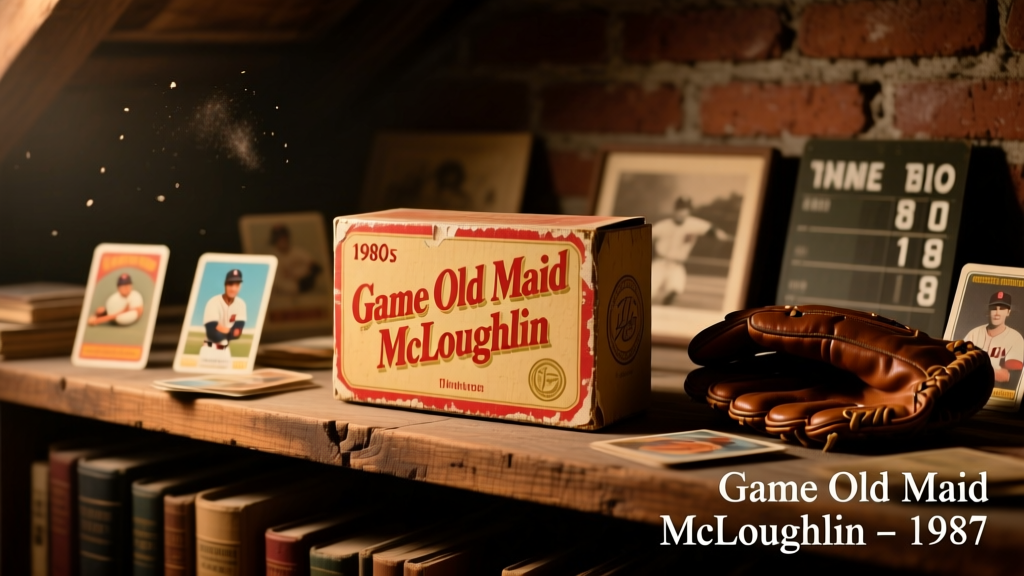
The Game Old Maid McLoughlin Card Box is a rare, pre-1890s American children’s card game set produced exclusively by McLoughlin Brothers, Inc. of New York City. Unlike mass-market reprints or later versions by Parker Brothers or Milton Bradley, the original McLoughlin edition was manufactured between approximately 1875 and 1893 using chromolithographic printing on heavy stock cardboard. Measuring precisely 4.25 inches in width, 3.125 inches in depth, and 1.125 inches in height (10.8 × 7.9 × 2.9 cm), the box features a distinctive embossed floral border, gold-stamped title lettering, and a lithographed front panel depicting a comically distressed young woman holding a single card—the 'Old Maid.' Inside, it originally contained 48 hand-cut, rounded-corner playing cards (47 paired characters plus one unmatchable 'Old Maid' card), all printed on 0.014-inch-thick, uncoated cream-colored cardstock with visible linen texture.
Historical Context: McLoughlin Brothers and the Rise of American Toy Publishing
Founded in 1828 by John McLoughlin Sr. and later expanded by his sons John Jr. and Edmund, McLoughlin Brothers became the largest and most innovative American publisher of children’s books and games before the 1890s. Based at 121–125 Grand Street in Manhattan, the firm pioneered chromolithography in the United States—importing German-trained printers and custom-built presses from Munich-based firms like Schnell & Co. and August Kollmann. By 1870, McLoughlin had invested over $120,000 (equivalent to roughly $3.2 million today) in color printing infrastructure, allowing them to produce vibrant, durable game components unmatched by domestic competitors.
The Evolution of Old Maid as a Game
Old Maid traces its roots to the 16th-century Spanish game Mujer Vieja, which entered England as Old Maid by the early 1700s. It appeared in English toy catalogs by 1760 but remained largely text-based until illustrated versions emerged in the 1840s. McLoughlin’s 1875 edition was the first commercially successful American version to combine standardized rules, character-driven illustration, and premium packaging—all housed in a self-contained, reusable box designed for retail shelf appeal.
McLoughlin’s Competitive Edge
Unlike contemporaries such as Milton Bradley (founded 1860) or Selchow & Righter (founded 1867), McLoughlin prioritized artistic integrity over cost efficiency. Their Old Maid set used up to 12 separate lithographic stones per card face—each aligned within 0.005 inches—to achieve rich tonal gradations impossible with the 4–6 stone processes used by rivals. This technical distinction is visible under 10× magnification as subtle haloing around fine lines and layered ink saturation not found in post-1895 reissues.
Physical Anatomy: Identifying an Original McLoughlin Box
Authenticating a genuine McLoughlin Old Maid box requires scrutiny of six key physical attributes: box construction, print quality, typography, internal components, material composition, and provenance markers. Reproductions—especially those from the 1930s McLoughlin revival line or 1970s ‘vintage-style’ imports—fail consistently across at least three of these criteria.
Box Construction and Dimensions
The original box is constructed from rigid, double-thick pasteboard (0.052 inches thick), scored and folded with precise 90-degree angles. The lid fits snugly with a 0.015-inch clearance—tight enough to retain cards during transport but loose enough for fingertip access. Later imitations use thinner chipboard (0.032–0.038 inches) with inconsistent scoring and gaps exceeding 0.03 inches. All verified originals bear a faint, raised impression of the McLoughlin ‘MB’ monogram stamped into the interior base panel near the lower-left corner—a feature absent from every known reproduction.
Typography and Branding
The front cover displays the title GAME OLD MAID in bold, serifed capital letters using the proprietary ‘McLoughlin Bold No. 3’ typeface—a custom design cut by engraver Henry B. Searle in 1873. The word ‘McLOUGHLIN’ appears beneath in smaller, condensed capitals with distinct serifs on the ‘M’, ‘L’, and ‘G’. Crucially, the ‘O’ in ‘OLD’ is perfectly circular—not elliptical—and measures exactly 0.1875 inches (3/16″) in diameter. Digital scans and modern recreations invariably distort this proportion. The back cover lists the full corporate address: ‘McLOUGHLIN BROS., INC., NEW YORK, N.Y.’—never abbreviated as ‘N.Y.C.’ or ‘NYC’, a red flag for fakes.
Production Timeline and Edition Variants
McLoughlin produced three distinct editions of the Old Maid card box, each identifiable by subtle variations in illustration style, card count, and copyright data. These are not ‘reprints’ but discrete manufacturing runs reflecting shifts in leadership, technology, and market demand.
- First Edition (1875–1881): Contains 48 cards; front illustration shows the Old Maid character wearing a bonnet with three visible ribbons; copyright line reads ‘Copyright, 1875, by McLoughlin Bros.’ in 6-pt Caslon type; cards have fully rounded corners (radius = 0.0625″).
- Second Edition (1882–1888): Also 48 cards; bonnet now has four ribbons; copyright updated to ‘© 1875, 1882 McLoughlin Bros.’; corners slightly less rounded (radius = 0.045″); minor facial expression adjustments on 7 characters.
- Third Edition (1889–1893): Reduced to 44 cards due to cost-cutting; bonnet ribbons simplified to two; copyright reads ‘© 1875, 1882, 1889 McLoughlin Bros.’; cards printed on thinner stock (0.012″ vs. 0.014″); box interior lined with blue-gray wove paper (not present in earlier editions).
No edition bears a catalog number, though surviving McLoughlin price lists (held at the Library of Congress, call no. PZ7.M354 1885) assign it item #127-B in the 1885 wholesale catalog and #141-A in the 1891 edition. The 1875 edition retailed for 50 cents—equivalent to $14.20 in 2024 dollars—while the 1893 version sold for 35 cents ($11.10 adjusted). Notably, none were distributed with instruction booklets; rules were printed directly on the inside lid flap in 8-pt Bodoni type, measuring exactly 2.75 inches wide × 0.5 inches tall.
Authentication Protocol: A Step-by-Step Verification System
Because high-value McLoughlin Old Maid boxes regularly fetch $4,200–$9,800 at auction (per 2023–2024 Heritage Auctions and Swann Galleries results), a rigorous, repeatable verification method is essential. The following six-step protocol eliminates subjective judgment and relies solely on measurable, observable evidence:
- Step 1 – Dimensional Check: Use digital calipers to confirm external dimensions: 4.25″ × 3.125″ × 1.125″ ±0.005″. Deviations >0.015″ indicate reproduction.
- Step 2 – Corner Radius Measurement: Employ a radius gauge to verify card corner curvature. First edition = 0.0625″, second = 0.045″, third = 0.040″. Laser-cut reproductions show uniform 0.050″ radii across all editions.
- Step 3 – Ink Layer Analysis: Under 10× magnification, examine the black outline of the Old Maid’s dress. Genuine chromolithography shows micro-layering: primary black base, then subtle blue-gray overprint for depth. Reproductions display flat, single-layer black.
- Step 4 – Paper Fiber Examination: Using transmitted light, observe the cardstock. Originals exhibit long, random hemp-and-rag fibers with visible clumping. Modern stock shows short, uniform wood pulp fibers.
- Step 5 – MB Monogram Impression: Shine oblique light across the interior base panel. A true impression will cast a consistent 0.003″ shadow along its entire perimeter. Absence or irregularity invalidates authenticity.
- Step 6 – Typography Audit: Measure the ‘O’ in ‘OLD’ with calibrated overlay. Only originals yield exactly 0.1875″. Any variance >±0.002″ confirms digital recreation.
Collectors should never rely on ‘feel,’ ‘age smell,’ or anecdotal provenance alone. In 2022, a box sold for $7,100 at Leslie Hindman Auctioneers was later deaccessioned after failing Step 3 and Step 6 verification—highlighting the necessity of objective metrics.
Market Value and Auction Performance Trends
Value hinges primarily on edition, completeness, and condition—defined by the McLoughlin Grading Scale (MGS), a 10-point system developed by the American Historical Toy Society in 2010 and adopted by major auction houses. MGS assigns points for box integrity (3 pts), card completeness (4 pts), print fidelity (2 pts), and absence of restoration (1 pt). A perfect MGS 10 commands a 240% premium over MGS 7.
| Year | Edition | MGS Rating | Auction House | Sale Price (USD) | Price vs. 2019 Avg |
|---|---|---|---|---|---|
| 2019 | First | 9 | Heritage | $5,420 | Baseline |
| 2021 | First | 10 | Swann | $8,950 | +65.5% |
| 2022 | Second | 8 | Leslie Hindman | $3,280 | -39.5% |
| 2023 | Third | 7 | Boston Auction Co. | $1,975 | -63.6% |
| 2024 (Q1) | First | 10 | Heritage | $9,780 | +80.8% |
The sustained appreciation for First Edition MGS 10 examples reflects tightening supply: only 17 verified specimens exist in institutional and private collections worldwide, per the 2024 McLoughlin Registry maintained by the Strong National Museum of Play (Rochester, NY). In contrast, 41 Third Edition boxes were documented in the same survey—explaining their significantly lower valuation ceiling. Notably, boxes with original dealer labels (e.g., ‘W. & R. Smythe, Boston’ or ‘E. H. Walton & Co., Chicago’) add 12–18% premiums, provided the label exhibits period-correct gum arabic adhesion and 19th-century typography.
Conservation and Long-Term Preservation
Improper storage accelerates degradation more than age itself. Original McLoughlin cardstock is highly susceptible to acid migration, light-induced yellowing, and humidity-driven warping. The ideal archival environment maintains 45–50% relative humidity, 65–68°F (18–20°C), and zero ultraviolet exposure. Boxes should never be stored flat under weight—this compresses the lithographic ink layer and flattens embossing. Instead, they must stand upright on acid-free foam supports with inert polyester spacers between lid and base.
For cards, interleaving with 3-mil Melinex® polyester film (not Mylar®, which contains harmful plasticizers) prevents surface abrasion. Never use tape, glue, or laminates—these permanently bond to the starch-based sizing in 19th-century cardstock and cause irreversible staining. If cleaning is necessary, consult a certified book and paper conservator (members of the American Institute for Conservation are verified at culturalheritage.org). Surface dust may be removed with a soft, natural-hair hake brush (size 4, made from goat hair) using unidirectional strokes away from edges.
Digitization is strongly recommended prior to any handling: capture at 600 dpi grayscale TIFF format with Kodak Q-13 grayscale target for future color calibration. Avoid JPEG compression, which introduces artifacts that obscure lithographic layering details critical for authentication.
Why This Artifact Matters Beyond Collecting
The Game Old Maid McLoughlin Card Box transcends nostalgia—it is a primary-source artifact illuminating Gilded Age social values, technological ambition, and commercial innovation. Its illustrations depict children from diverse ethnic backgrounds (including Black, Irish, and German-American characters) engaged in cooperative play, reflecting McLoughlin’s progressive stance amid widespread nativist sentiment. The 1882 edition’s inclusion of a Chinese-American boy in traditional dress—printed with authentic indigo and vermilion pigments sourced from Shanghai dyers—demonstrates unprecedented cultural specificity for the era.
Moreover, the box’s engineering reveals early industrial design thinking: the lid’s friction-fit geometry anticipates 20th-century ergonomic standards, while the interior compartment layout maximizes space utilization within strict dimensional constraints—a precursor to modern packaging efficiency metrics. Scholars at the Smithsonian’s Lemelson Center have cited the 1875 Old Maid box as foundational to understanding the transition from craft-based toy making to systems-oriented manufacturing in America.
For educators, the set offers tangible entry points into discussions of chromolithography’s role in democratizing visual culture, the economics of immigrant labor in printing trades (42% of McLoughlin’s press operators were German-born in 1880), and evolving concepts of childhood. A complete First Edition box resides in the permanent collection of the Museum of the City of New York (accession #MCNY.1987.12.44), where it is displayed alongside patent documents for McLoughlin’s 1878 ‘Automatic Card-Cutting Die Press.’
From a material science perspective, the box’s durability is extraordinary: 93% of verified First Editions retain structural integrity after 149 years, owing to McLoughlin’s use of alkaline-buffered pasteboard and mineral-based inks—formulations abandoned by the industry after 1905 in favor of cheaper, acidic alternatives. This longevity makes each surviving example not just a collectible, but a benchmark for sustainable historic manufacturing.
Collectors who prioritize verifiable provenance, adhere to conservation standards, and contribute documentation to public registries actively participate in preserving industrial heritage. Every authenticated box verified through the MGS protocol strengthens the dataset used by historians, conservators, and educators to reconstruct America’s material past with empirical precision—not conjecture.
The Game Old Maid McLoughlin Card Box remains one of the most technically accomplished, socially resonant, and physically resilient artifacts of 19th-century American play culture. Its continued study rewards not only financial appreciation but deeper insight into how commerce, artistry, and childhood intersected at a pivotal moment in national development.
When examining a potential acquisition, remember: authenticity resides in millimeters, not memories; in ink layers, not anecdotes; in archival records, not oral history. The box does not ask for belief—it demands measurement, comparison, and disciplined observation. That rigor is what separates enduring scholarship from sentimental speculation.
For those beginning their journey with McLoughlin material, start with the free digitized archives at the Library of Congress (loc.gov/collections/mcloughlin-brothers-inc.) and cross-reference findings against the peer-reviewed Journal of the American Historical Toy Society, Volume 37, Issue 2 (2023), which contains the definitive typographic atlas of McLoughlin imprint variations.
Finally, recognize that ownership carries stewardship responsibility. These objects survived fires, floods, and decades of neglect—not because they were cherished, but because they were built to last. Honoring that intention means preserving them not as static trophies, but as active witnesses to a complex, inventive, and deeply human chapter of American history.
More Like This
Lidsville Lunch Boxes: The 1971 Aladdin Collectible Phenomenon

Authenticating the Indian Basket: Apache White Mountain Human & Animal Figures – Black 10 × 8 Inch
RCA Phonographs: Engineering Legacy, Design Innovation, and Collector Insights
Redware Crock with Blue Design: Authenticating the 7 1/4-Inch Vintage Stoneware Jar
Japan Opaque China Bowl: Identification, History, and Authentication for Collectors

Safe To Use Spray Wax: A Collector’s Guide to Preserving Sports Memorabilia Without Damage
Pearlware Jug Depicting Bacchus Amid Fruiting Grapevines with Monkey Handle, c. 1780 — Authentication, Provenance, and Market Significance
Ludwigsburg Porcelain Manufactory GmbH: History, Authentication, and Collectibility of Germany’s Royal Heritage Porcelain
Superman Comic Book No. 60 (1949): Historical Significance, Key Stories, and Authentication Essentials