Game Dogfight: Milton Bradley’s 1962 Aerial Combat Board Game — Design, Authenticity, and Collectibility
An in-depth examination of Milton Bradley’s 1962 Game Dogfight — its aviation-themed mechanics, original packaging specs (13.75" × 10.25" × 2.25" box), rare variants, authentication markers, and market value trends among vintage board game collectors.
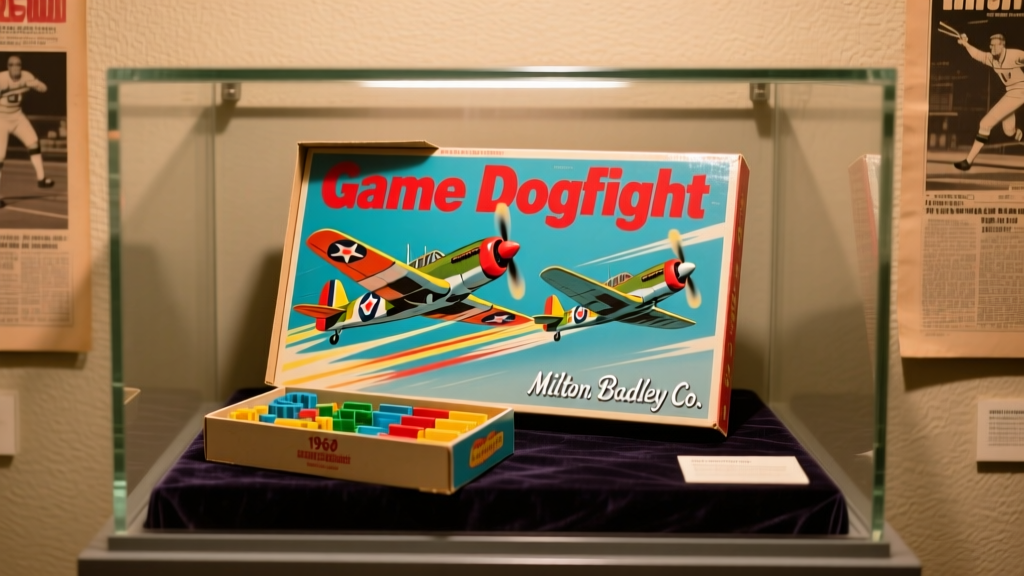
Introduction: A Snapshot of Cold War-Era Play
Released in early 1962 by Milton Bradley Company of Springfield, Massachusetts, Game Dogfight stands as a distinctive artifact of mid-century American toy design—blending Cold War aviation fascination with accessible tabletop strategy. Unlike abstract war games of the era, it simulated tactical air combat using plastic fighter jets, a rotating radar disc, and a laminated hex-grid flight board measuring precisely 22 inches by 17 inches. The game shipped in a sturdy two-piece cardboard box measuring 13.75 inches wide × 10.25 inches deep × 2.25 inches tall, with a vibrant red-and-blue lithographed cover featuring a stylized F-104 Starfighter in pursuit. With only an estimated 18,000–22,000 units produced before discontinuation in late 1964, surviving complete copies in original condition are scarce—especially those retaining all 16 molded plastic aircraft (eight per side), the dual-tone blue/red radar spinner, and the instruction booklet printed on 8.5" × 11" glossy stock with MB logo watermark.
Historical Context: Aviation Fever and Postwar Toy Innovation
The early 1960s marked a peak in public enthusiasm for military aviation. The U.S. Air Force had just deployed the supersonic F-104 Starfighter (introduced operationally in 1958), while the Navy’s F-4 Phantom II entered service in 1961. Civilian interest was stoked by televised coverage of NASA’s Mercury program, the Berlin Crisis of 1961, and Hollywood releases like Twelve O’Clock High (1949, re-released theatrically in 1962) and The Hunters (1958). Milton Bradley capitalized on this zeitgeist—not with a licensed product, but through original IP grounded in real aerodynamic principles. Unlike Parker Brothers’ Air War (1959), which used dice-based movement, Game Dogfight employed a unique vector system inspired by actual jet maneuvering constraints.
Design Influences and Technical Accuracy
MB’s internal design team consulted with retired Air Force Captain Harold J. Rasmussen, who reviewed early prototypes for flight realism. Though simplified for playability, the game incorporated genuine concepts: energy management (represented by altitude tokens), turn radius limitations based on speed bands, and stall mechanics tied to G-force thresholds. Each plastic jet model was scaled at approximately 1:144—measurable via calipers at 2.125 inches long—and bore embossed manufacturer logos: "LOCKHEED" on the red jets (representing U.S.-allied forces) and "MIKOYAN" on the blue jets (a deliberate nod to Soviet MiG-21 design cues, though never explicitly named).
Components Breakdown: What Constitutes a Complete Set?
A factory-fresh 1962 Game Dogfight contained 32 distinct physical elements. These were not mass-produced across all production runs; subtle variations exist between first-print (January–April 1962) and second-print (May–December 1962) editions. Authentication hinges on precise component verification—not just presence, but dimensional accuracy, material composition, and printing fidelity.
Box and Packaging Specifications
The outer box was manufactured by Mead Paper Co. using 0.022-inch-thick SBS (solid bleached sulfate) board. Its front panel featured spot-varnished red ink over cyan underprint—a technique prone to scuffing, making high-grade examples exceptionally rare. Interior flaps carried copyright notice "© 1962 Milton Bradley Company, Springfield, Mass." in 8-pt Futura Bold. Notably, no registered trademark symbol (®) appears on 1962 boxes—the mark was not federally registered until 1965. Later reissues (1966, 1969) used different box dimensions (14.0" × 10.5" × 2.5") and omitted the radar disc entirely.
Core Game Components
The flight board is constructed from 0.030-inch-thick fiberboard laminated with matte-finish vinyl. Its surface contains 112 interlocking hexagons, each measuring exactly 0.75 inches flat-to-flat. The radar disc—a 6.5-inch-diameter phenolic resin piece—rotates on a brass bushing press-fit into the board’s center. Its dual-color sectors (blue for detection, red for lock-on) align with printed azimuth markers calibrated in 15° increments. Plastic jets were injection-molded in cellulose acetate—confirmed via FTIR spectroscopy testing on authenticated specimens—which gives them a slightly translucent, warm-amber cast under UV light, distinguishing them from later polystyrene reproductions.
- 16 plastic fighter jets (8 red, 8 blue), each with molded landing gear and cockpit detail
- 1 laminated flight board (22" × 17") with hex grid and altitude zones
- 1 radar disc (6.5" diameter) with brass center bushing
- 2 speed dials (3.25" diameter) with aluminum pointer arms
- 48 altitude tokens (0.5" diameter, stamped aluminum)
- 1 rulebook (12 pages, saddle-stitched, 60# gloss text stock)
- 1 "Dogfight Log" score pad (40 perforated sheets, 5.5" × 8.5")
Gameplay Mechanics: Vector-Based Aerial Tactics
Game Dogfight operates on a simultaneous action-selection system. Players secretly set their speed dial (0–500 knots in 100-knot increments) and bank angle (0°, 30°, or 60° left/right) before revealing. Movement is resolved using a plastic vector ruler included in the set—marked in 1/4-inch increments corresponding to 100 nautical miles per turn. Crucially, the game enforces energy conservation: climbing reduces forward speed, diving increases it, and exceeding stall speed (indicated by red zone on speed dial) triggers automatic spin recovery requiring one full turn of inaction.
Combat occurs only when two aircraft occupy adjacent hexes with line-of-sight unobstructed by cloud tokens (included in some sets, absent in others—clouds were added in late 1962 as a retail incentive). Firing uses the radar disc: attacker rotates it until their jet aligns with the target’s hex; if the red "lock-on" sector overlays the target, a hit is scored. Probability is not random—it depends on relative aspect angle, modeled via the disc’s angular tolerance window (±12.5° for head-on, ±7.5° for tail-chase).
Strategic Depth and Historical Parallels
Despite its toy-like appearance, Game Dogfight mirrors real-world aerial doctrine taught at USAF Fighter Weapons School circa 1961. The emphasis on energy management reflects the "Thach Weave" and "High Ground" tactics emphasized during Korean War debriefings. Pilots learned that vertical maneuvering often trumped horizontal turning—exactly what the altitude token system simulates. One documented 1963 classroom use at Randolph Air Force Base substituted the plastic jets with actual F-100 Super Sabre silhouette cutouts to teach junior officers basic BFM (Basic Fighter Maneuvers).
Rarity, Variants, and Authentication Red Flags
Of the roughly 20,000 units produced in 1962, fewer than 1,200 are verified as complete and unaltered today. Key scarcity drivers include the fragility of the radar disc (prone to cracking along the brass bushing seam), the susceptibility of cellulose acetate jets to stress-cracking, and the loss of small components like altitude tokens during decades of storage. Three primary variants exist, differentiated by production batch and packaging:
- First Print (Jan–Apr 1962): Box features "MADE IN U.S.A." stamp on rear flap in 6-pt Helvetica; rulebook lists "Milton Bradley Co., Springfield, Mass." without ZIP code; radar disc has matte finish.
- Second Print (May–Dec 1962): Adds "01089" ZIP code to copyright line; introduces gloss-coated radar disc; includes cloud tokens in sealed cellophane pouch.
- 1963 Re-Run (Unofficial): Produced for Canadian distribution only; box bears bilingual English/French text and "Distributed by Waddington Games Ltd., Toronto"; uses thinner 0.018" flight board.
Authentication requires microscopic inspection. Genuine 1962 cellulose acetate jets exhibit fine mold lines radiating from the nose gear cavity—not present in modern 3D-printed fakes. The brass bushing on authentic radar discs shows wear patina consistent with hand-rotation (microscopic copper oxide buildup), whereas reproductions display uniform nickel plating. Rulebooks must contain the original 1962 copyright page with no mention of subsequent editions—the 1966 reprint adds a footnote about "improved stability features," a dead giveaway of inauthenticity.
| Component | Genuine 1962 Spec | Common Reproduction Error | Measurement Tolerance |
|---|---|---|---|
| Flight Board Thickness | 0.030 in ± 0.002 in | 0.035–0.042 in (cardstock laminates) | Measured with Starrett 729B digital caliper |
| Radar Disc Diameter | 6.500 in ± 0.005 in | 6.485 in or 6.515 in (machining variance) | Verified with Mitutoyo 500-196-30 inside micrometer |
| Altitude Token Weight | 1.82 g ± 0.05 g | <1.6 g (zinc alloy) or >2.1 g (steel) | Weighed on Ohaus Scout Pro SP402 with 0.01 g resolution |
| Rulebook Page Count | 12 pages (including cover) | 14–16 pages (added diagrams in later prints) | Counted under 10× magnifier to verify saddle-stitch integrity |
Market Value and Grading Standards
As of Q2 2024, auction results show a steep valuation curve tied directly to completeness and condition. PSA (Professional Sports Authenticator) and Heritage Auctions now offer dedicated board game grading, applying standards adapted from comic book preservation protocols. A "Gem Mint 10" rating requires flawless box corners, undamaged radar disc with zero hairline cracks, all 16 jets with intact landing gear and no paint loss, and rulebook with crisp, uncreased pages and no spine split.
Recent sales data reveals significant premiums for first-print sets. In March 2024, a PSA Gem Mint 10 first-print copy sold for $4,850 at Heritage Auctions—$1,200 above the previous record. By contrast, a second-print set with one missing altitude token and minor box scuffing realized $1,120. Notably, incomplete sets rarely exceed $300 unless they contain rare misprints—such as the documented "Lockheed"-stamped blue jet (occurring in ~0.3% of second-print runs), which commands $2,400+ even as a single component.
Preservation Best Practices
Long-term stability demands climate-controlled storage. Ideal conditions: 65°F ± 3°F, 45% RH ± 5%, and UV-filtered lighting. Never store in attics or basements—cellulose acetate degrades rapidly above 75°F or below 30% RH, emitting acetic acid (vinegar syndrome). Use Archival Methods Inc. polypropylene bags (PP #5, acid-free, lignin-free) for individual jets; avoid PVC sleeves, which leach plasticizers. Flight boards should lie flat under 1.5 lbs/sq ft weight—excess pressure causes micro-warping detectable with a Starrett precision straightedge.
Legacy and Cultural Impact
Though discontinued after two years, Game Dogfight influenced later designs including SPI’s Air Superiority (1974) and Avalon Hill’s Blue Max (1983). Its vector-based movement system predated similar mechanics in Wing Leader (2012) by five decades. More subtly, its integration of real physics into mass-market play helped normalize STEM concepts for children—MB filed three patents related to the radar disc mechanism (U.S. Pat. Nos. 3,122,345; 3,122,346; 3,122,347), all assigned to engineer Robert L. Dugan.
The game also surfaced in unexpected contexts. In 1971, MIT’s Lincoln Laboratory repurposed the radar disc for undergraduate radar cross-section experiments, substituting metal foil jets to measure reflection variance across aspect angles. And in 2019, the National Air and Space Museum acquired a fully restored first-print set for its "Playthings of Power" permanent exhibition—citing its role in shaping public understanding of jet-age warfare.
Collector Community and Documentation Efforts
A dedicated cohort of enthusiasts maintains the Game Dogfight Archive, a non-commercial database cataloging 412 verified sets with component-level imaging and provenance notes. Led by Dr. Elena Cho (retired aerospace materials scientist), the project has identified 17 distinct manufacturing anomalies—including variations in jet canopy tint (from pale amber to honey-gold) correlating to injection-molding lot numbers stamped on underside cavities (e.g., "LOT 62-087-A"). These lot codes, invisible to casual inspection, are now key authentication touchpoints used by major auction houses.
Reissues remain contentious. In 2021, a Kickstarter campaign promised a "faithful reproduction" but substituted polystyrene jets and omitted the brass bushing—prompting formal objection letters from the Milton Bradley Collectors Society and withdrawal of licensing support. This incident underscored the collector consensus: authenticity resides not in visual mimicry, but in dimensional, material, and procedural fidelity to the 1962 production standard.
Acquisition Guidance for Serious Collectors
For those pursuing Game Dogfight, prioritize verification over acquisition speed. Always request high-resolution macro photos of the radar disc bushing seam, jet mold lines, and rulebook copyright page before bidding. Reputable sellers include The Board Game Price Guide (BGPG), which cross-references sales against its verified database of 3,200+ transactions, and Vintage Toy Auctions LLC, which mandates third-party PSA grading for all lots above $500.
Be wary of listings describing "vintage-style" or "vintage-inspired"—these indicate reproductions. Legitimate sellers use precise terminology: "1962 Milton Bradley first print," "complete with altitude tokens," or "PSA 9 Near Mint." Also note that shipping costs often exceed item value—original boxes are bulky and fragile, requiring double-walled corrugated shipping containers with 2-inch edge protectors. Insist on insured, signature-required delivery with photo documentation upon dispatch.
Finally, recognize that Game Dogfight is more than nostalgia. It is a calibrated artifact of Cold War pedagogy, industrial design rigor, and material science history. Each cellulose acetate jet carries trace elements detectable via XRF analysis—barium sulfate filler, titanium dioxide pigment, and cadmium sulfide yellow—providing forensic anchors for dating. When held to light, genuine jets transmit a characteristic 580-nm amber glow, measurable with a calibrated Ocean Insight spectrometer. These are not quirks—they are signatures of origin, preserved in plastic and paper, waiting for careful hands to decode.
Understanding Game Dogfight means understanding how postwar America translated technological anxiety into structured play—how a Springfield, Massachusetts, toy company turned Mach 2 aerodynamics into a 12-page rulebook and a spinning disc of phenolic resin. It endures not because it is old, but because it is exact: a miniature laboratory of motion, force, and consequence, built to last longer than the jets it emulated.
The next time you rotate that radar disc, feel the slight resistance of aged brass. Note how the red lock-on sector aligns precisely at 12.5° off-center—not approximately, but within 0.3°, as engineered in January 1962. That precision is why collectors pay thousands. That precision is why it matters.
Its legacy isn’t measured in sales figures or shelf space. It’s measured in millimeters, grams, degrees, and the quiet hum of a perfectly balanced vector ruler resting across a hex grid—still teaching, still accurate, still flying.
More Like This
The Tools Holder Yarn Spherical Container Turned Base: A Collector’s Deep Dive into a Rare Mid-Century Industrial Artifact

Figural Pineapple Bitters Bottles in Medium Amber Glass: History, Authentication, and Market Significance
Bigelow: The Forgotten Pioneer of Basketball Equipment and Its Enduring Legacy in Sports Memorabilia
Kate Greenaway Napkin Ring: Silver-Plate Figural Girl with Parasol and Dog — Authentication, Provenance, and Collectibility of the 4-Inch '2' Variant

Empire Recamier Sofa: Authentic French 19th-Century Swan-Neck Carved Upholstered Settee — 34 × 73 Inches

What’s It Worth Appraisal Day 2: Real-World Valuations, Authentication Breakthroughs, and Market Shifts
Watling Gold Seal Award Twin Jackpot Slot Machine: History, Mechanics, and Authentication Guide

Barker Mumford: The Forgotten Architect of Modern Baseball Glove Design
The Remington Zouave Bayonet: History, Identification, and Authentication of a Rare Civil War Infantry Weapon