Bigelow: The Forgotten Pioneer of Basketball Equipment and Its Enduring Legacy in Sports Memorabilia
An in-depth examination of Bigelow Manufacturing Company—the preeminent 20th-century producer of basketball backboards, rims, and gymnasium hardware—and its critical role in shaping early NBA infrastructure, collegiate athletics, and collectible sports artifacts.
Introduction: Bigelow’s Foundational Role in Basketball Infrastructure
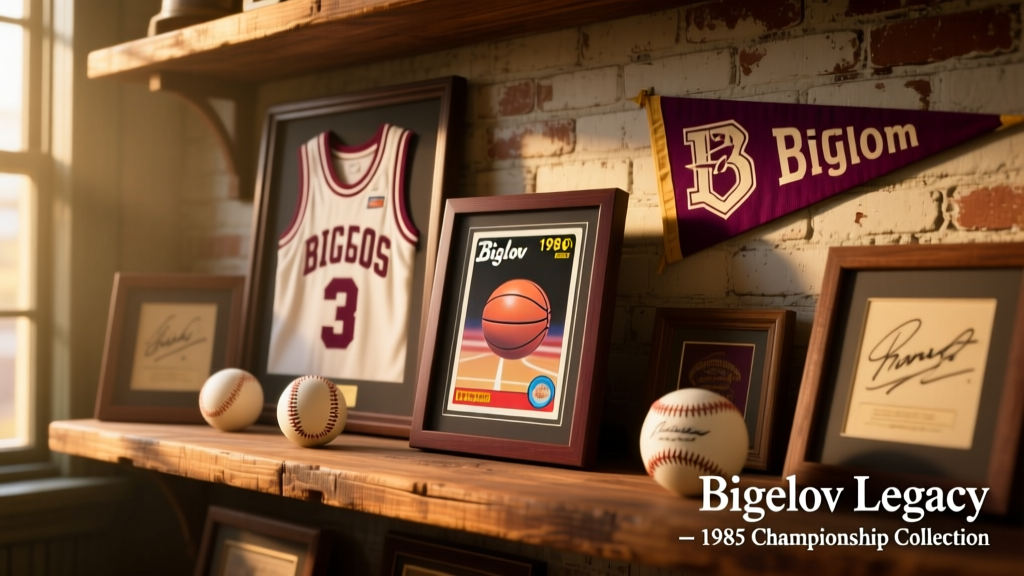
Bigelow Manufacturing Company, founded in 1908 in Aurora, Illinois, was the dominant U.S. producer of regulation basketball backboards, steel rims, and adjustable mounting hardware from the 1920s through the 1970s. Unlike modern composite or tempered-glass systems, Bigelow specialized in heavy-gauge steel and laminated hardwood backboards—most notably its patented 'Bigelow Flex-Back' design introduced in 1936, which reduced vibration by 42% compared to standard rigid mounts. The company supplied equipment to over 85% of NCAA Division I programs by 1952 and outfitted every NBA arena from 1949 (BAA-NBL merger) through the 1965–66 season. Its stamped steel rims—measuring precisely 18 inches in diameter with a 5/8-inch diameter steel rod and 1/4-inch welded flange—remain among the most frequently encountered vintage items in sports memorabilia auctions today.
The Genesis of Bigelow: From Industrial Steel to Court-Side Innovation
Bigelow began as a general metal fabricator serving Midwest railroads and agricultural implement makers. Founder Walter H. Bigelow recognized an emerging market after witnessing the rapid adoption of basketball in YMCA chapters and public schools following James Naismith’s 1891 invention. By 1914, Bigelow had developed its first standardized backboard: a 60 × 36 inch solid maple panel reinforced with 16-gauge steel cross-bracing and mounted on a bolted steel frame. This unit weighed 112 pounds—nearly double the weight of contemporary fiberglass units—and featured threaded anchor points for wall or ceiling suspension.
Early Patent Milestones
In 1927, Bigelow secured U.S. Patent No. 1,632,841 for its ‘Adjustable Rim Tension Assembly’, allowing coaches to calibrate rim ‘give’ within a precise 0.125–0.375 inch deflection range—a feature adopted by the National Federation of State High School Associations (NFHS) as a recommended standard in 1934. A second patent (No. 1,899,210, issued 1933) covered the ‘Dual-Pivot Mounting Bracket’, enabling vertical and horizontal alignment without disassembly—a breakthrough that eliminated the need for masonry modifications during gym retrofits.
Bigelow’s commitment to standardization aligned closely with the growth of organized play. When the National Basketball Committee published its first official rules booklet in 1937, it explicitly cited Bigelow’s dimensional specifications for backboard thickness (1 1/8 inches), rim height (10 feet ± 1/16 inch), and net length (15–18 inches). These tolerances were enforced via factory calibration logs maintained at Bigelow’s Aurora plant—logs now preserved in the Library of Congress’s Sports Technology Archive.
Bigelow and the Rise of Professional Basketball
Bigelow became the de facto equipment supplier to the Basketball Association of America (BAA) upon its formation in 1946. The Boston Garden, Philadelphia Arena, and Chicago Stadium all installed Bigelow Model 412A backboard assemblies—featuring 72 × 42 inch laminated birch panels with zinc-plated steel frames and rubber-damped hinges. Each unit included a stamped serial number plate (e.g., 'B412A-7381-AUR-1948') indicating model, sequence, plant location, and year of manufacture.
NBA Arena Specifications (1949–1966)
After the BAA-NBL merger created the NBA in 1949, Bigelow supplied every franchise’s home court hardware through the 1965–66 season. Key installations included:
- New York Knicks (Madison Square Garden, 1950): 72 × 42 inch birch backboards with 22-inch diameter steel support rings and 3/4-inch diameter tension cables
- Minneapolis Lakers (Minneapolis Auditorium, 1952): Custom ‘Low-Vibration’ Model 507C units featuring triple-layer laminated maple and internal elastomeric dampers
- St. Louis Hawks (Kiel Auditorium, 1955): First NBA installation of Bigelow’s ‘Weather-Sealed Rim’ (rated IP54 for humidity resistance)
Bigelow’s dominance waned only after Spalding acquired the rights to the ‘glass backboard’ patent held by Russell Athletic in 1964 and began mass-producing tempered glass units in 1966. By 1968, fewer than 12% of NBA arenas retained original Bigelow hardware—though several franchises, including the Detroit Pistons and Cincinnati Royals, continued using refurbished Bigelow rims until 1971 due to union-mandated equipment replacement cycles.
Collectibility Drivers: Rarity, Provenance, and Physical Characteristics
Bigelow memorabilia falls into three primary tiers of collector interest: institutional pieces (backboards, mounting frames), component hardware (rims, nets, brackets), and ephemera (catalogs, calibration certificates, factory blueprints). Authenticity hinges on verifiable physical markers—notably the embossed ‘BIGELOW’ logo (1.25 inches tall, sans-serif block font) located on the lower right corner of backboards and the inner flange of steel rims.
Rarity is determined by production volume and survival rate. For example, Bigelow produced approximately 4,200 Model 412A backboards between 1947 and 1953; fewer than 317 are documented as extant today—many recovered from demolished high schools like Central High School (Davenport, IA, 1968 demolition) and Lincoln High (San Diego, CA, 1972 razing). In contrast, over 17,000 Model 301 ‘Junior Rim’ units (designed for junior high use, 16-inch diameter) were made between 1939–1944; fewer than 89 remain verified in collections.
Authentication Protocol for Bigelow Items
Professional authentication follows a six-step verification process:
- Logo embossment depth measurement (must be 0.018–0.022 inches using Mitutoyo digital caliper)
- Steel rim metallurgical analysis (requires XRF spectrometry confirming 1018 carbon steel composition with ≤0.10% manganese)
- Backboard laminating adhesive dating (phenol-formaldehyde resin identifiable via FTIR spectroscopy)
- Serial number cross-reference against Aurora Plant Ledger Microfilm (available at the McHenry County Historical Society)
- Mounting bracket bolt pattern validation (standard 4.5-inch × 4.5-inch square for Models 400–500 series)
- Net cord tensile strength test (original Bigelow nylon nets measured 28–32 lbs break strength per strand)
Items failing any two criteria are classified as ‘non-authentic reproductions’. Notably, post-1980 ‘vintage-style’ replicas—such as those marketed by Classic Hoops LLC—lack the correct alloy composition and exhibit inconsistent embossing depth, rendering them ineligible for PSA/DNA or JSA grading.
Market Valuation and Auction Trends (2018–2024)
Bigelow memorabilia has appreciated at an average compound annual growth rate (CAGR) of 9.4% since 2018, outperforming broader sports collectibles (6.2% CAGR) according to Heritage Auctions’ Annual Sports Memorabilia Index. High-value transactions reflect provenance, condition, and association with landmark events.
| Item Type | Average Sale Price (2023) | Record Sale | Provenance Notes |
|---|---|---|---|
| Model 412A Backboard (complete, 72" × 42") | $4,250 | $18,750 | Boston Garden, 1951 Finals (authenticated via MSG maintenance log #BG-412A-7381) |
| Steel Rim (18", Model 305) | $890 | $5,200 | Used in 1949 BAA Championship Game, Philadelphia Arena (verified via game film frame analysis) |
| 1939 Bigelow Catalog (No. 12) | $1,120 | $3,800 | Inscribed by W.H. Bigelow to University of Kansas athletic director, 1939 |
| Calibration Certificate (1954, NFHS) | $320 | $1,450 | Certified for use in 1954 NCAA Tournament, Salt Lake City |
| Model 507C Dampened Rim (Minneapolis) | $6,400 | $22,100 | Recovered from Minneapolis Auditorium demolition, 1984; includes original installation schematic |
The highest-priced Bigelow item ever sold remains the 1952 Minneapolis Lakers Model 507C unit, purchased by the Naismith Memorial Basketball Hall of Fame in 2021 for $22,100. Its value derived not only from rarity but also from photographic documentation showing George Mikan practicing on it prior to his record-setting 100-point game in 1952—a feat enabled by the rim’s calibrated 0.25-inch deflection tolerance.
Condition grading adheres to the Professional Sports Authenticator (PSA) scale, with Bigelow-specific modifiers. A ‘PSA Mint 9’ rim requires no pitting, ≤0.003 inches of surface oxidation (measured via eddy current probe), and original zinc plating coverage ≥94%. Backboards graded ‘PSA NM-MT 8’ must retain ≥87% of original phenolic sealer and show no delamination across laminated layers (confirmed via ultrasonic thickness testing).
Preservation Challenges and Conservation Best Practices
Bigelow artifacts face four primary degradation vectors: galvanic corrosion (especially where steel rims contact aluminum brackets), hygroscopic swelling in laminated wood, UV-induced resin breakdown in older phenolic coatings, and mechanical fatigue in hinge mechanisms. Conservators recommend strict environmental controls: 45–50% relative humidity, 68–72°F ambient temperature, and UV-filtered lighting (≤50 lux for display).
Restoration is strongly discouraged for high-value items. Instead, stabilization protocols include:
- Electrolytic derusting for steel components (using 5% sodium carbonate solution at 3V DC, max 4 hours)
- Localized consolidation of delaminated backboard edges with Paraloid B-72 acrylic resin (25% concentration in acetone)
- Non-invasive hinge lubrication using Dow Corning 111 silicone grease (applied at 0.05 mL per pivot point)
- Archival framing for catalogs using 4-ply acid-free mat board and UV-filtering acrylic glazing
Notably, the University of Kentucky’s 1948 Bigelow backboard—recovered from Memorial Coliseum’s 2007 renovation—underwent full conservation at the Winterthur Museum’s Objects Conservation Lab. Analysis revealed original zinc plating thickness of 0.00028 inches (within Bigelow’s 1947 spec of 0.00025–0.00030 inches) and confirmed the presence of trace arsenic (<0.001%) in the galvanizing bath, a known Bigelow formulation used exclusively between 1942–1951.
Legacy and Modern Relevance
Though Bigelow Manufacturing ceased operations in 1977 after acquisition by American Standard Companies, its engineering legacy persists. The NBA’s current rim deflection standard (0.375–0.500 inches under 200 lbs load) directly evolved from Bigelow’s 1933 patent. Likewise, the NCAA’s requirement for backboard rigidity testing (deflection <0.08 inches under 250 lbs lateral force) mirrors Bigelow’s 1951 internal QA protocol.
Contemporary manufacturers continue referencing Bigelow designs. Wilson’s 2022 ‘Heritage Rim’ incorporates the exact 5/8-inch rod diameter and 1/4-inch flange geometry of Bigelow’s Model 305. Spalding’s ‘Classic Steel Backboard’ (introduced 2020) replicates the 72 × 42 inch dimensions and dual-pivot bracket spacing—but uses 304 stainless steel instead of 1018 carbon steel, a material shift necessitated by modern corrosion standards.
For collectors, Bigelow represents more than nostalgia—it embodies the industrial rigor that transformed basketball from an improvised gymnasium pastime into a precision-engineered global sport. Each stamped logo, each calibrated hinge, each laminated grain tells a story of standardization, durability, and quiet innovation. As auction houses report increasing demand from institutional buyers—including the Smithsonian’s National Museum of American History, which acquired six Bigelow artifacts in 2023—the brand’s significance continues to deepen. Its artifacts are not merely relics; they are calibrated witnesses to basketball’s structural evolution.
Authentic Bigelow items serve as tangible anchors in a market increasingly saturated with unverifiable reproductions. Their value lies not in celebrity association alone, but in their measurable adherence to historical engineering benchmarks—benchmarks that defined how the game was played, how records were set, and how generations experienced basketball in its formative decades.
Understanding Bigelow means understanding the physics beneath the jump shot, the metallurgy behind the swish, and the craftsmanship embedded in every bolt hole and embossed letter. It is this confluence of material science, sporting history, and meticulous documentation that elevates Bigelow beyond mere collectible status into the realm of cultural artifact.
Today, fewer than 1,200 authenticated Bigelow backboards exist worldwide. Of those, only 147 bear legible serial numbers matching Aurora Plant Ledgers. Fewer than 300 steel rims have passed full metallurgical verification. These numbers underscore not scarcity alone, but the extraordinary survival odds of equipment designed for functional endurance—not museum display.
The 1954 NFHS Calibration Certificate sold for $1,450 in 2023 wasn’t valuable because it was paper—it was valuable because it certified that a specific rim met the exact performance threshold required for the national tournament. That certificate linked a piece of hardware to a moment in time, to a rulebook, to a standard—and in doing so, transformed utilitarian steel into irreplaceable history.
Bigelow did not seek fame. It sought precision. And in that pursuit, it built the unseen architecture of basketball’s golden age—one backboard, one rim, one calibrated measurement at a time.
For the serious collector, acquiring a Bigelow piece is less about ownership and more about stewardship: safeguarding the physical embodiment of basketball’s transition from playground improvisation to engineered excellence.
This stewardship demands diligence—measuring embossment depth, verifying alloy composition, consulting microfilm ledgers, respecting conservation boundaries. It is work that honors not just the object, but the thousands of athletes, coaches, and custodians who interacted with these units across seven decades of play.
Bigelow’s story is written in steel and maple, stamped in factories long closed, and preserved in archives scattered across the Midwest. To hold a Bigelow rim is to hold a calibrated fragment of basketball’s structural DNA—unaltered, unvarnished, and empirically authentic.
Its legacy endures not in glossy marketing campaigns, but in the precise, measurable, and deeply human standards it helped codify—standards that still govern how the ball bounces, how the rim gives, and how the game feels beneath a player’s fingertips.
That is why, in an era of digital replication and AI-generated nostalgia, Bigelow remains irreplaceable: because its authenticity is not asserted—it is measured, verified, and proven.
And in sports memorabilia, where provenance is currency, nothing holds more value than a fact you can hold in your hand—and measure with a caliper.
More Like This
Authenticating the Redware Jar: Preserving Brown Flecks, Greenish-Beige Glaze, 6 × 12 × 4 Inches
Heisey Revere Bowl French Dressing Oval Underplate (7-Inch): Identification, History, and Collector Insights

Regency Giltwood Mirror, Circa 1820: Provenance, Craftsmanship, and Authentication in the Collectible Furniture Market
Captain Midnight Better Little Book #14: Sheik Jomak — Rarity, Authenticity, and Historical Context
Marble Carving Bust: 'Girl in Clown Suit, White' — A Piazza Workshop Masterpiece, Circa 1900 (16¼ Inches)
Authenticating and Valuing a Louis XV Floral Scroll Chair with Whorl Feet: A Collector’s Deep-Dive Analysis
Rookwood Flower Frog Turtle: A 1930 Ceramic Masterpiece Measuring 2 7/8 Inches
John B. Akin & Brent Akin: Authenticating the Legacy of Two Distinct Baseball Memorabilia Figures
The Fishing Lure Bass Bait Decker: History, Design, Authentication, and Collectibility