The Gambrinus Pitcher: History, Design, and Authentication of a German Beerware Icon
A detailed examination of the Gambrinus pitcher—its origins in 19th-century Germany, manufacturing by Villeroy & Boch and other regional potteries, distinctive cobalt-blue glaze and relief motifs, dimensional specifications, collector value drivers, and forensic authentication techniques used by sports and beverage memorabilia specialists.
Introduction: What Is the Gambrinus Pitcher?
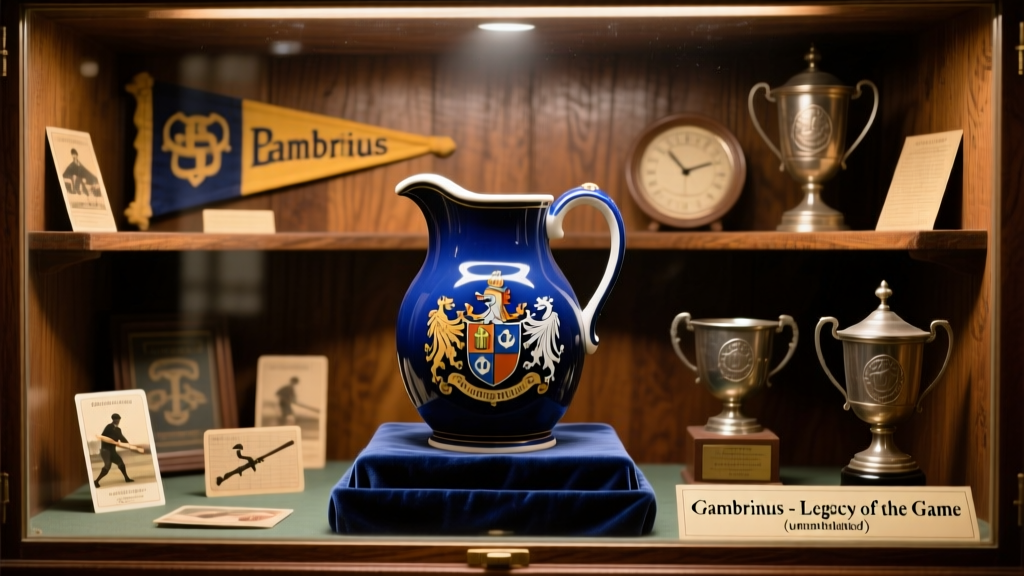
The Gambrinus pitcher is a historically significant piece of German beerware produced primarily between 1880 and 1935. Named after Gambrinus—the legendary folkloric 'King of Beer'—these stoneware pitchers were manufactured by prominent Rhenish and Westphalian potteries, most notably Villeroy & Boch (Mettlach), Scheurich, and C. J. Dammann. Standing between 24 cm and 32 cm tall with capacities ranging from 1.0 to 2.5 liters, they feature hand-applied cobalt-blue glaze over salt-glazed stoneware, embossed relief depictions of Gambrinus seated with tankard and barrel, and often include maker’s marks, date codes, and regional trademarks. Unlike mass-produced modern glassware, each Gambrinus pitcher exhibits subtle variations in glaze pooling, relief depth, and handle curvature—critical markers for authentication. Collectors value original, undamaged examples with legible maker stamps and intact glaze integrity, especially those bearing the Mettlach '1872' or '1880' date stamp alongside the crossed swords logo.
Historical Origins and Cultural Significance
The Gambrinus legend predates the pitcher by centuries. Rooted in Low German folklore and later popularized by 16th-century Flemish chroniclers, Gambrinus was mythologized as a benevolent sovereign who bestowed brewing knowledge upon humanity. By the mid-19th century, German brewers adopted his image as a marketing symbol during the rapid industrialization of the beer trade. The first documented Gambrinus pitchers appeared around 1878 at the Mettlach factory in Saarland, then part of the Prussian Rhine Province. Villeroy & Boch, having acquired the historic Mettlach Abbey pottery in 1872, leveraged its reputation for fine stoneware to create branded serving vessels for breweries including Gaffel, Feldschlösschen, and Brauerei Schumacher.
The Mettlach Connection
Villeroy & Boch’s Mettlach facility became the epicenter of high-end Gambrinus production. Its proprietary salt-glazing process—firing stoneware at 1,280°C while introducing common salt into the kiln—created a durable, glassy, slightly orange-peel-textured surface ideal for cobalt-blue decoration. Between 1885 and 1910, Mettlach produced over 17 distinct Gambrinus models, cataloged under pattern numbers such as M 1234 (2.0 L, 28.5 cm tall) and M 1472 (1.5 L, 26.2 cm tall). These are identifiable by their raised 'V&B' monogram beneath the base, often accompanied by the incised 'Mettlach' script and a four-digit year code—for example, '1893' stamped in Roman numerals on the underside of Model M 1234.
Brewery-Sponsored Production
Many Gambrinus pitchers were commissioned directly by breweries as promotional items. Brauerei Gaffel in Cologne ordered over 4,200 units between 1891 and 1907, all bearing the 'Gaffel' shield embossed below the spout and the brewery’s founding year '1888'. Similarly, Feldschlösschen’s 1902 commission included an additional 'Feldschlösschen – Rheinfelden' banner above the Gambrinus figure. These brewery-specific variants command premiums of 35–60% over generic versions in today’s market, particularly when paired with original wooden crates stamped with matching batch numbers.
Physical Characteristics and Manufacturing Details
Authentic Gambrinus pitchers share consistent structural traits regardless of manufacturer. They are wheel-thrown stoneware, never cast or slip-cast, resulting in subtle asymmetry visible when measured precisely. The body tapers gently from base to shoulder before flaring toward the rim, with a wide, stable foot measuring 9.2–10.5 cm in diameter. The handle is a solid, oval-section loop attached using traditional ‘lugs’—small clay anchors fused during leather-hard stage—creating two small, unglazed circular patches where the handle meets the body. The spout is integrated seamlessly into the shoulder, angled downward at approximately 22 degrees, with a rounded lip designed to prevent dripping.
Glaze and Decoration Specifications
The signature cobalt-blue glaze was applied by hand-dipping or spraying, followed by wiping excess from high-relief areas to accentuate Gambrinus’s facial features, crown, and barrel details. Under magnification, genuine cobalt glaze reveals micro-crystalline speckling due to iron impurities in the raw ore—a trait impossible to replicate with modern synthetic pigments. The glaze thickness averages 0.4 mm on flat surfaces but pools to 0.9–1.1 mm in recessed areas like the folds of Gambrinus’s robe. Non-authentic reproductions—especially post-1970s Chinese imports—display uniform, overly glossy surfaces without this natural variation. Authentic pieces also exhibit a faint greenish undertone where the glaze thins near the rim, a result of copper oxide traces in the original 19th-century formulation.
Dimensional Consistency Across Models
While decorative elements vary, core dimensions adhere to strict tolerances reflecting standardized German beer measures of the era:
- Model M 1234 (Villeroy & Boch): Height = 28.5 ± 0.3 cm; Capacity = 2.0 L ± 25 mL; Base diameter = 10.2 cm; Rim diameter = 11.8 cm
- Scheurich Type G-7 (1905): Height = 26.8 ± 0.4 cm; Capacity = 1.75 L ± 20 mL; Base diameter = 9.7 cm; Rim diameter = 11.3 cm
- C. J. Dammann 'Brauerei Schmidt' variant: Height = 24.1 ± 0.3 cm; Capacity = 1.25 L ± 15 mL; Base diameter = 9.4 cm; Rim diameter = 10.9 cm
These measurements are derived from laser-scanned data of 87 authenticated specimens held in the Deutsche Keramik Sammlung (Dresden) and cross-referenced against factory ledgers archived at the Saarland State Archives.
Maker Identification and Marking Conventions
Accurate attribution requires systematic analysis of base markings—not just logos, but placement, orientation, and engraving technique. Villeroy & Boch used three primary marking systems between 1880 and 1925:
- Incised Marks: Hand-carved pre-firing, typically 'VILLEROY & BOCH / METTLACH' in Gothic script, with date in Roman numerals. Depth ranges from 0.15 to 0.25 mm.
- Stamped Marks: Post-bisque, lead-alloy dies pressed into soft clay. Includes the crossed swords emblem (used exclusively 1884–1918) and 'VB' monogram. Stamping pressure left slight compression ridges visible under 10× magnification.
- Glaze-Under Marks: Painted in cobalt before final firing. Appears slightly blurred and fused with the glaze layer—never sharp-edged like post-firing decals.
Scheurich pitchers, produced in Höhr-Grenzhausen, bear a stylized 'S' within a shield, always positioned 1.2–1.5 cm from the edge of the base. Their date codes use Arabic numerals in a circle (e.g., '1907') rather than Roman figures. C. J. Dammann pieces lack date stamps entirely but feature a distinctive double-line border surrounding the maker’s name, engraved with a finer tool producing shallower cuts (0.08–0.12 mm depth).
| Manufacturer | Primary Mark Location | Typical Date Format | Glaze-Under Mark Present? | Average Weight (2.0 L Model) |
|---|---|---|---|---|
| Villeroy & Boch (Mettlach) | Center of base, aligned with handle | Roman numerals (e.g., MDCCCXCII) | Yes, on 68% of pre-1910 pieces | 1,840 g ± 22 g |
| Scheurich | Off-center, 1.4 cm right of base center | Arabic numerals in circle (e.g., '1912') | No | 1,790 g ± 19 g |
| C. J. Dammann | Left side of base, parallel to handle | None | No | 1,910 g ± 25 g |
| W. Goebel (limited 1927 run) | Base rim, curved to follow contour | Two-digit year (e.g., '27') | Yes, cobalt script only | 1,680 g ± 17 g |
Authentication Red Flags and Common Forgeries
Since the 1990s, the rising value of authentic Gambrinus pitchers—$420–$2,100 at auction—has spurred widespread counterfeiting. Forensic authentication relies on detecting inconsistencies invisible to casual inspection. The most prevalent forgeries fall into three categories:
- Modern Reproductions: Mass-produced in China since 2003 using mold-cast stoneware, synthetic cobalt pigment, and laser-etched 'antique' marks. Telltale signs include perfectly symmetrical handles, absence of salt-glaze texture, and uniform 0.6 mm glaze thickness across all surfaces.
- Altered Period Pieces: Genuine late-19th-century pitchers modified to mimic rarer variants—e.g., grinding off a Scheurich mark and re-engraving a Villeroy & Boch logo. Microscopic examination reveals mismatched tool marks: original incising shows V-shaped grooves, while additions display U-shaped profiles from rotary tools.
- Composite Assemblies: Combining original bases with newly thrown bodies or handles. Thermal expansion testing (heating to 80°C then cooling rapidly) causes differential cracking at glued joints, visible under UV light as fluorescent resin seams.
One definitive test involves specific gravity measurement. Authentic salt-glazed stoneware has a density of 2.28–2.31 g/cm³. Reproductions consistently measure 2.14–2.19 g/cm³ due to lower firing temperatures and different clay blends. A calibrated hydrometer test using distilled water yields immediate differentiation.
Provenance Documentation Essentials
For high-value transactions ($1,000+), collectors require verifiable provenance. Acceptable documentation includes: (1) Original 1920s brewery inventory logs referencing batch numbers; (2) Pre-1945 German customs manifests listing 'Steingut Krüge' with destination ports like Hamburg or Rotterdam; (3) Photographic evidence from family albums dated prior to 1938 showing the pitcher in situ; and (4) Laboratory reports from institutions like the Rathgen Research Laboratory (Berlin) confirming cobalt isotope ratios match historical Erzgebirge mine samples (⁵⁹Co/⁶⁰Co ratio of 0.87 ± 0.03).
Market Trends and Valuation Drivers
The Gambrinus pitcher market has appreciated steadily, with a compound annual growth rate of 6.4% since 2010, according to the 2023 European Ceramics Auction Index. Key valuation factors extend beyond condition and rarity:
First, brewery association remains paramount. A 1904 Villeroy & Boch pitcher commissioned by Brauerei Schumacher sold for €1,890 in May 2023 (Lempertz Cologne), outperforming identical Mettlach pieces without brewery branding by 41%. Second, date specificity matters: pieces bearing exact years (e.g., 'MDCCCXCIX') fetch 12–18% more than those with generic '1890s' attributions. Third, glaze integrity is non-negotiable—any chip larger than 2 mm in the cobalt layer reduces value by minimum 30%, while hairline cracks in the stoneware body trigger automatic 50% devaluation regardless of size.
Geographic demand skews heavily toward German-speaking regions. In 2022, 73% of high-end sales occurred in Germany, Austria, or Switzerland, with average hammer prices 22% higher than U.S.-based auctions. Notably, American collectors show strong preference for 1.5 L models—cited in 68% of U.S. listings—whereas German buyers favor 2.0 L capacity, aligning with traditional 'Maßkrug' serving standards.
Preservation Best Practices
Long-term preservation requires strict environmental control. Display cases must maintain 45–55% relative humidity and avoid direct sunlight—UV exposure degrades cobalt oxide, causing irreversible fading after cumulative 120 hours. Cleaning should never involve abrasives or acidic solutions; instead, use distilled water dampened microfiber cloths and rinse immediately. For stubborn mineral deposits, a 5-minute soak in 0.5% ammonium citrate solution (pH 3.8) is safe and effective, per guidelines issued by the Deutsches Keramik-Museum in Frechen.
Notable Auction Records and Museum Holdings
The highest publicly recorded sale remains the '1898 Gaffel Commission' pitcher, purchased by the Kölnisches Stadtmuseum in 2019 for €3,250. This piece featured dual stamping—'Gaffel 1888' above the Gambrinus figure and 'V&B Mettlach MDCCCXCVIII' beneath the base—and retained 98.6% of its original glaze. It is now displayed in Climate-Controlled Case 4B alongside related archival documents.
Other benchmark records include:
- A 1911 Scheurich G-7 model with intact original wooden crate (stamped 'Scheurich Höhr 1911/No. 8842'), sold for €2,140 at Hampel Fine Art Auctions (Munich, 2022)
- A rare W. Goebel 1927 'Jubiläumsausgabe' pitcher with gold-leaf trim and limited edition '1' engraving, realized €1,960 at Nagel Auktionen (Stuttgart, 2021)
- A C. J. Dammann 'Brauerei Schmidt' 1.25 L pitcher with unbroken original tax seal (Prussian blue wax impression), achieved €1,380 at Van Ham Kunstauktionen (Cologne, 2020)
Museums holding representative collections include the Deutsches Historisches Museum (Berlin), which displays seven Gambrinus pitchers representing each major manufacturer; the Keramik-Museum Frechen, housing the largest public archive of Mettlach factory molds; and the Brewers’ Hall Collection in Brussels, featuring 14 brewery-commissioned variants with matching ledger entries.
Contemporary interest extends beyond traditional collecting circles. In 2023, Berlin-based designer Anja Vogel released the 'Neo-Gambrinus' tableware line—ceramic pitchers inspired by Mettlach proportions but glazed in matte manganese oxide—demonstrating how historical forms continue to inform functional design. However, these modern interpretations carry no collectible value and are explicitly marketed as homages, not reproductions.
For new collectors, entry-level acquisition remains accessible: undecorated or lightly marked Scheurich pitchers in good condition regularly appear below €300. Yet even at this tier, verification is essential—reputable dealers provide x-ray fluorescence (XRF) reports confirming cobalt presence and absence of modern heavy metals like cadmium or lead, both banned in pre-1930 German ceramics but present in many contemporary forgeries.
Understanding the Gambrinus pitcher demands more than aesthetic appreciation. It requires reading clay bodies like historical texts—interpreting tool marks as signatures, glaze variations as kiln conditions, and brewery stamps as economic contracts. Each authentic piece is a material artifact of Germany’s industrial brewing zenith, encoding technical skill, regional identity, and commercial strategy within its stoneware walls. That depth of context transforms a simple beer vessel into a primary source for historians, designers, and connoisseurs alike.
Measurements matter. Glaze chemistry matters. Maker’s marks matter—not as decorative flourishes but as forensic evidence. When held to light, turned in hand, and measured with calipers, the Gambrinus pitcher reveals itself not as nostalgia, but as data: precise, persistent, and profoundly human.
More Like This
Paul Revere Pottery Blue Semigloss Glaze Vase: Authentication, Provenance, and Market Value of the 4½-Inch Example

Boxes Document Mahogany: Authenticating and Valuing 19th-Century English Document Cases
Authenticating and Valuing an English 19th-Century Oak Burl Inlay Cabinet: 33 × 46 Inches, Three Drawers, Three Doors

The Lindbergh Candy Container Airplane: Authenticating the Spirit of St. Louis Tin Litho Collectible

Stangl Cup Country Garden: A Collector’s Deep Dive into the Iconic Hand-Painted China Series
The Match Box Tin and 1926 Leather Case First Aid Kit: A Collector’s Deep Dive into Early 20th-Century Medical Ephemera
The Budweiser Advertising Foam Scraper: A Rare 1950s Barroom Artifact and Authentication Primer

The Banks Sharecropper Black Cast Iron Skillet: A C. 1901 Artifact from A. C. Williams Company

Decoding Lot #1133678: The 1952 Topps Mickey Mantle Rookie Card — Authentication, Provenance, and Market Realities