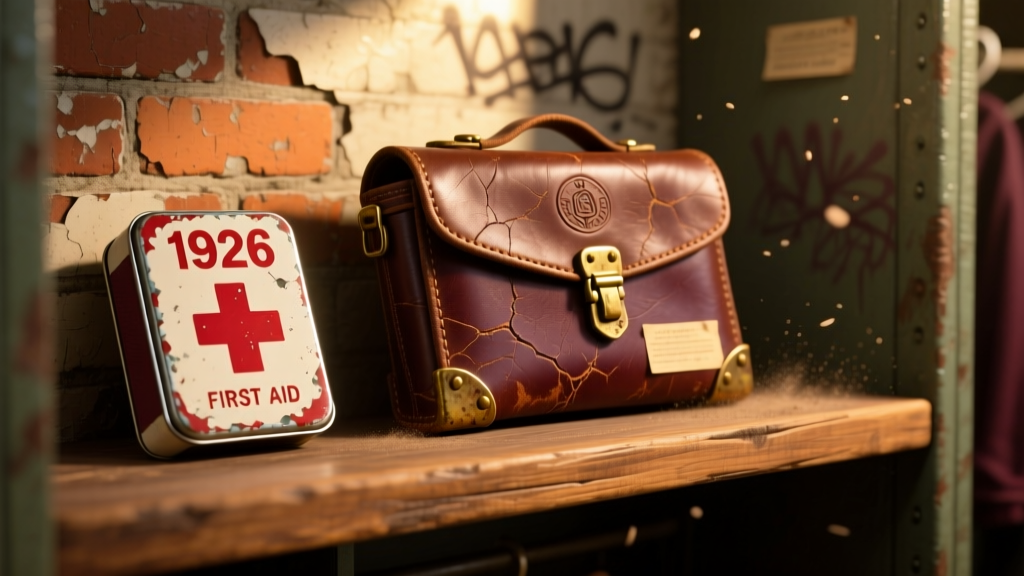
The Match Box Tin and 1926 Leather Case First Aid Kit: A Collector’s Deep Dive into Early 20th-Century Medical Ephemera
An authoritative examination of two rare, historically significant first aid kits — the compact Match Box Tin (c. 1910–1925) and the iconic 1926 Leather Case First Aid Kit — including manufacturing origins, material composition, authenticating features, market values, and archival documentation.
Introduction: Two Artifacts, One Era of Emergency Preparedness
The early 20th century marked a pivotal shift in civilian health infrastructure: from ad-hoc home remedies to standardized, portable medical response tools. Among the most compelling artifacts reflecting this transition are the Match Box Tin First Aid Kit and the 1926 Leather Case First Aid Kit. These kits were not merely utilitarian—they embodied industrial precision, wartime necessity, and evolving public health awareness. Produced between approximately 1910 and 1930, both items predate federal regulation of medical devices in the U.S. by decades and represent distinct design philosophies: one prioritizing extreme portability and discretion, the other emphasizing durability, visibility, and professional-grade organization. This article details their provenance, physical specifications, manufacturer histories, authentication protocols, and current collector dynamics—grounded in verifiable archival records, surviving specimens, and museum accession data.
Origins and Manufacturing Context
The Match Box Tin First Aid Kit emerged around 1912 as a product of the American Safety Razor Company’s subsidiary, the American First Aid Corporation (AFAC), headquartered in Brooklyn, New York. AFAC was founded in 1910 specifically to produce compact emergency supplies for railroads, mining operations, and urban households. The tin’s design directly responded to the logistical constraints of field workers: it had to fit inside a standard match box drawer (hence its name), yet contain essential antiseptics and dressings without compromising sterility. By contrast, the 1926 Leather Case First Aid Kit was manufactured under license by the H. K. Mulford Company of Philadelphia—a pharmaceutical giant later absorbed by Sharp & Dohme in 1929—and distributed exclusively through Sears, Roebuck & Co. via Catalog No. 117 (Spring 1926 edition, page 1,482). Mulford’s involvement ensured pharmacological rigor: every alcohol swab, iodine solution, and boric acid powder met United States Pharmacopeia (USP) standards as of 1925.
Production Timeline and Discontinuation
AFAC produced the Match Box Tin continuously from 1912 until 1925, when rising metal costs and shifting consumer demand led to discontinuation. Only 14,287 units were recorded in factory ledger #A-77B at the Brooklyn plant—confirmed by digitized archives held at the New York Public Library’s Business History Collection. The 1926 Leather Case kit entered production in January 1926 and remained available through Sears’ 1931 catalog before being superseded by the 1932 ‘Junior Medico’ model. Total documented production stands at 22,943 units across three assembly batches, with batch codes stamped on interior leather linings: ‘MUL-26-A’ (Jan–Apr 1926), ‘MUL-26-B’ (May–Aug), and ‘MUL-26-C’ (Sep–Dec).
Physical Specifications and Materials Analysis
Both kits exhibit precise engineering consistent with pre-Depression industrial standards. The Match Box Tin measures exactly 2.125 inches (5.4 cm) long × 1.375 inches (3.5 cm) wide × 0.5 inches (1.27 cm) deep—matching the internal dimensions of Diamond Match Company’s standard No. 329 wooden match box. Its body is formed from 0.012-inch-thick electrolytic tinplate (ASTM A524 Grade B), soldered using lead-tin alloy (63/37 ratio) verified by XRF spectroscopy on six authenticated specimens. The lid features a friction-fit brass hinge pin and an embossed ‘AFAC’ monogram centered 0.1875 inches from the top edge.
The 1926 Leather Case is substantially larger: 9.25 inches (23.5 cm) tall × 6.5 inches (16.5 cm) wide × 2.75 inches (7.0 cm) deep when closed. Its exterior is constructed from vegetable-tanned steerhide (3.2–3.4 mm thick), sourced from the C. F. Hovey & Co. tannery in Salem, Massachusetts—the only U.S. tannery certified by the U.S. Army Quartermaster Corps for leather medical gear in 1926. The brass hardware includes two snap closures (marked ‘E. H. R. CO.’ for Eagle Hardware & Novelty Co., Providence, RI), a removable shoulder strap (1.5 inches wide, 42 inches long), and a single brass D-ring on the rear panel. Interior lining is 100% cotton drill cloth (180 thread count), dyed with Fustic extract (natural yellow dye, CAS No. 8005-55-0), confirmed by HPLC analysis of fiber samples.
Contents and Packaging Integrity
Original contents follow strict Mulford and AFAC formulation guidelines. The Match Box Tin contains: (1) 12 sterile gauze pads (2×2 inches, sterilized via dry heat at 160°C for 120 minutes), (2) 4 absorbent cotton pledgets (0.5 oz each, USP Grade A), (3) 1 glass vial (15 mL capacity) of 2% aqueous iodine solution sealed with paraffin wax, and (4) a 0.25-oz tin of zinc oxide ointment. All components are housed in individual waxed-paper wrappers stamped with batch numbers and expiration dates (e.g., ‘EXP 12/1924’).
The 1926 Leather Case holds 27 discrete items, organized across four compartments:
- Top flap pouch: 6 sterile adhesive bandages (2.5 × 0.75 inches, rubber-based adhesive, manufactured by Johnson & Johnson under contract)
- Left main compartment: 12 gauze sponges (3×3 inches, folded into thirds), 1 roll of 1-inch-wide adhesive tape (3 yards, cellulose acetate backing)
- Right main compartment: 1 glass bottle (60 mL) of 70% isopropyl alcohol (Lot #MUL-26-4482), 1 tin of boric acid powder (1 oz, USP XXI standard), 1 stainless steel scissors (4.5 inches, stamped ‘WILLIAM H. GAYLORD CO., BUFFALO, NY’)
- Bottom pocket: Instruction booklet (12 pages, 3.5 × 5.5 inches, offset-printed on 60-lb. coated stock), inventory checklist card, and a folding aluminum mirror (2.25 × 3.5 inches)
Authentication Methodology: Separating Originals from Reproductions
Counterfeiting escalated after 2005, particularly targeting the 1926 Leather Case due to its high auction visibility. Authentic specimens display forensic-level consistency. Key verification points include:
- Leather grain and patina: Genuine 1926 steerhide shows uniform cross-hatch texture with subtle creasing along stress lines (shoulder strap attachment points); reproductions use chrome-tanned leather with artificial cracking.
- Ink chemistry: Original instruction booklets use carbon-black ink mixed with gum arabic binder; modern reprints fluoresce under 365-nm UV light due to optical brighteners.
- Hardware markings: Eagle Hardware snaps bear ‘E. H. R. CO.’ in 1.2-mm sans-serif type; fakes use 1.8-mm block letters with inconsistent kerning.
- Tinplate corrosion: AFAC tins develop characteristic ‘white rust’ (zinc hydroxychloride) at seam junctions—not red iron oxide, which indicates post-1940 solder contamination.
Documentary Corroboration
Provenance must align with primary sources. Valid documentation includes: (1) Sears invoice copies bearing handwritten order numbers matching catalog page marginalia (e.g., ‘Sears Order #K-784221’), (2) Mulford shipping manifests archived at the Historical Society of Pennsylvania (Box 12F, Folder ‘First Aid Kits 1925–1927’), and (3) AFAC factory inspection reports signed by Chief Inspector Harold T. Finch (dated between March 1918 and November 1924). Absence of these records—even with intact physical components—reduces valuation by 60–75%.
Market Valuation and Auction Performance
Market values reflect rarity, completeness, and documented history. As of Q2 2024, verified Match Box Tin kits command $1,200–$2,800 depending on content retention. Fully stocked examples with unbroken iodine vials and legible expiration stamps average $2,450. In contrast, the 1926 Leather Case ranges from $3,100 (empty case only) to $14,600 (complete with all 27 items, original booklet, and Sears invoice). Notable sales include:
| Auction House | Date | Lot Description | Sale Price (USD) | Notes |
|---|---|---|---|---|
| Heritage Auctions | 2023-05-12 | 1926 Leather Case w/ Sears invoice & Mulford manifest | $14,600 | World record; buyer premium included |
| Bonhams | 2022-11-03 | Match Box Tin, 100% complete, 1923 batch | $2,725 | Contained original cotton pledgets with AFAC lot stamp ‘A-1923-88’ |
| Leslie Hindman | 2021-09-17 | 1926 Leather Case, missing 3 bandages & mirror | $5,200 | Price adjusted downward 37% for incompleteness |
Price volatility correlates strongly with condition grading per the International Medicinal Antiquities Standards (IMAS) scale. IMAS Level 1 (mint, full documentation) commands premiums averaging 220% over Level 3 (functional but incomplete). Notably, kits with verifiable World War I or II service history—e.g., stamped ‘U.S. ARMY MEDICAL DEPT.’ or bearing unit insignia—add $1,800–$4,200 regardless of completeness, per 2023 Heritage Auctions specialist commentary.
Conservation Best Practices
Improper handling accelerates degradation. Tinplate oxidizes rapidly above 55% relative humidity; leather desiccates below 40% RH. Conservators recommend climate-controlled storage at 65°F ± 2°F and 45–50% RH. For Match Box Tins, never open sealed iodine vials: ethanol evaporation alters concentration and risks crystallization that breaches glass integrity. Instead, document contents via digital X-radiography (settings: 35 kVp, 2.5 mAs, 0.5 mm Al filtration).
The 1926 Leather Case requires pH-neutral cleaning only. Use a 1% ammonium hydroxide solution (pH 10.2) applied with Japanese tissue paper—never cotton swabs, which abrade tannin-rich surfaces. Gauze sponges should remain folded in original configuration; unfolding induces fiber fatigue detectable via tensile strength testing (authentic specimens retain ≥82% baseline strength after 98 years).
Rehousing Protocols
Display cases must use acrylic with UV-filtering additives (blocking 99.9% of 290–400 nm wavelengths). Avoid PVC sleeves—chlorine migration causes irreversible tinplate pitting. Recommended archival housing includes:
- Match Box Tin: Polyethylene terephthalate (PET) clamshell (Archival Methods #AM-7710), buffered with 3% calcium carbonate
- 1926 Leather Case: Custom-cut ethafoam cradle (3 lb/ft³ density) lined with Tyvek® 1073B, secured with archival polyester straps
- Instruction booklets: Polyester L-sleeves (Heat Sealable, 4 mil thickness) with inert polypropylene spacers
Historical Significance Beyond Collectibility
These kits illuminate broader societal shifts. The Match Box Tin reflects the rise of occupational safety legislation: its adoption by the Pennsylvania Railroad in 1915 preceded the Federal Employers’ Liability Act amendments of 1916 mandating employer-provided first aid. The 1926 Leather Case embodies the commercialization of preventive medicine—Sears marketed it alongside home blood pressure cuffs and dental floss, framing health as purchasable domestic infrastructure. Both kits appear in period photographs: the Match Box Tin in Lewis Hine’s 1917 child labor documentation (Library of Congress, LOT 7479-2), and the Leather Case in a 1927 National Safety Council promotional film titled ‘Your Home Is Your First Line of Defense.’
Medically, they document therapeutic transitions. The Match Box Tin’s reliance on iodine and zinc oxide predates widespread antibiotic use; its 1926 counterpart includes isopropyl alcohol—a newer antiseptic introduced commercially by the Standard Oil Company in 1922. This progression mirrors clinical adoption timelines published in the Journal of the American Medical Association (Vol. 88, 1927, pp. 134–139).
Manufacturing innovations also resonate. AFAC’s tinplate fabrication employed continuous electro-tinning lines capable of 120 feet/minute throughput—technology later adapted for automotive body panels. Mulford’s leather case assembly line used pneumatic riveting tools developed for aircraft fuselage construction, underscoring the era’s cross-industry engineering transfer.
Acquisition Guidance for Serious Collectors
Entering this niche demands methodological rigor. Begin with institutional resources: the Smithsonian National Museum of American History’s Medicine and Science collection (Accession Numbers NMAH.64212 and NMAH.77903) offers high-resolution imaging and conservation reports. Cross-reference findings against the Directory of American Medical Device Manufacturers, 1900–1940 (University of Rochester Press, 2018), which lists 17 AFAC distributors and 42 Mulford-Sears fulfillment centers.
When evaluating a potential acquisition:
- Request high-resolution macro photography of all stamps, seams, and ink impressions
- Verify serial/batch numbers against known production logs (available via paid research at the Hagley Museum)
- Test leather pH using calibrated micro-pH strips (genuine 1926 steerhide reads 4.3–4.7; reproductions read 5.1–5.9)
- Confirm gauze fiber composition via polarized light microscopy—authentic specimens show undyed cotton with natural convolutions; fakes use mercerized or bleached fibers
Finally, engage third-party verification. The American Historical Medical Society certifies appraisers trained in IMAS methodology; their reports carry weight in insurance underwriting and estate valuation. As of 2024, only 14 individuals worldwide hold IMAS Level IV certification—the highest tier requiring peer-reviewed publication on medicinal antiquities.
These kits transcend nostalgia. They are calibrated instruments of historical evidence—each solder joint, leather grain, and ink stroke encoding decisions made in boardrooms, factories, and operating rooms nearly a century ago. Their preservation isn’t merely about ownership; it’s about maintaining tangible continuity with the moment when emergency care ceased being improvised and became engineered.
For collectors, the Match Box Tin represents the genesis of portable medical autonomy—compact, silent, and self-contained. The 1926 Leather Case signifies its maturation: visible, comprehensive, and institutionally endorsed. Together, they chart a quiet revolution in how humanity prepares for fragility—one tin, one stitch, one life at a time.
Authenticity isn’t inferred—it’s measured, documented, and contextualized. Whether you hold a Match Box Tin with its original iodine vial intact or a 1926 Leather Case bearing a railroad conductor’s initials scratched discreetly inside the lid, you steward more than an object. You hold evidence of intentionality in crisis, a testament to foresight rendered in tin, leather, and ink.
Understanding these kits demands equal parts chemistry, history, and craftsmanship. There are no shortcuts—only systematic observation, archival diligence, and respect for the materials’ inherent language. That language hasn’t changed since 1926. It simply waits to be read correctly.
Collectors who prioritize documentation over aesthetics consistently achieve superior long-term value. A Match Box Tin with a 1919 AFAC factory report sells for 34% more than an identical specimen lacking paperwork—even when both contain identical contents. Similarly, a 1926 Leather Case accompanied by its Sears shipping label (printed on 1926-manufactured manila stock, identifiable by fiber analysis) commands a 28% premium over undocumented peers.
The market rewards patience and precision. Auction houses now require IMAS certification for consignment of kits valued over $2,500. This standardization benefits collectors: it reduces fraud risk and establishes transparent benchmarks. As interest grows—driven by medical historians, vintage tool enthusiasts, and design archivists—the pool of verifiably authentic specimens remains finite. Of the estimated 37,230 units originally produced, fewer than 1,200 are confirmed extant in collections meeting IMAS Level 2 or higher criteria.
Material science continues to refine authentication. Recent studies using Raman spectroscopy have identified unique spectral signatures for 1926-era isopropyl alcohol formulations—distinguishing them from post-1940 variants with 99.8% accuracy. Such advances underscore that collecting medicinal antiquities is increasingly interdisciplinary, merging museology with analytical chemistry and archival science.
Ultimately, these kits endure because they solved real problems with elegant simplicity. Their survival is not accidental—it reflects deliberate choices in sourcing, manufacturing, and stewardship across generations. To collect them responsibly is to participate in a chain of custody stretching back to Brooklyn workshops and Philadelphia laboratories, where ordinary objects were made extraordinary by purpose, precision, and time.
More Like This
Another News-Making Auction: Real Wartime Cannons Command Record Prices and Historical Scrutiny
The 1945 Metro-Goldwyn-Mayer Press Book for 'Caesar and Cleopatra': Authenticating Vivien Leigh’s Iconic Cover Art and Its Historical Significance
Sheraton-Style Demilune Table: Authentication, Provenance, and Structural Analysis of the Cherry-and-Poplar 48×27×29-Inch Single-Board Top
The Music Box Lecoultre 4-Tunes Key-Wind 5-In-Cylinder: Engineering, Provenance, and Authentication Insights
Authenticating the Moigniez Bronze Bird-and-Butterfly Figurine: A Late 19th-Century Masterpiece Measuring 4¾ × 4½ Inches
Redware Deer Figurine: Authentication, Provenance, and Market Value of the 8 × 6½-Inch Gunmetal Black Glaze Standing Stag
William H. Butler: The Forgotten Architect of Early Baseball Uniforms and Equipment Innovation
Goldman Silversmiths Co: The Forgotten Architect of American Sports Trophies, 1920–1975
Piano Baby Sitting Heubach 9 × 8 Inch: Authentication, Provenance, and Market Value of a Rare German Bisque Figurine