Carved Top Rail Upholstered Sofas: History, Craftsmanship, and Authentication for Collectors
A detailed examination of carved top rail upholstered sofas—covering Georgian through Victorian eras, signature makers like Gillows and Thomas Chippendale, wood species, carving motifs, upholstery techniques, structural integrity markers, and forensic authentication methods used by professional memorabilia specialists.
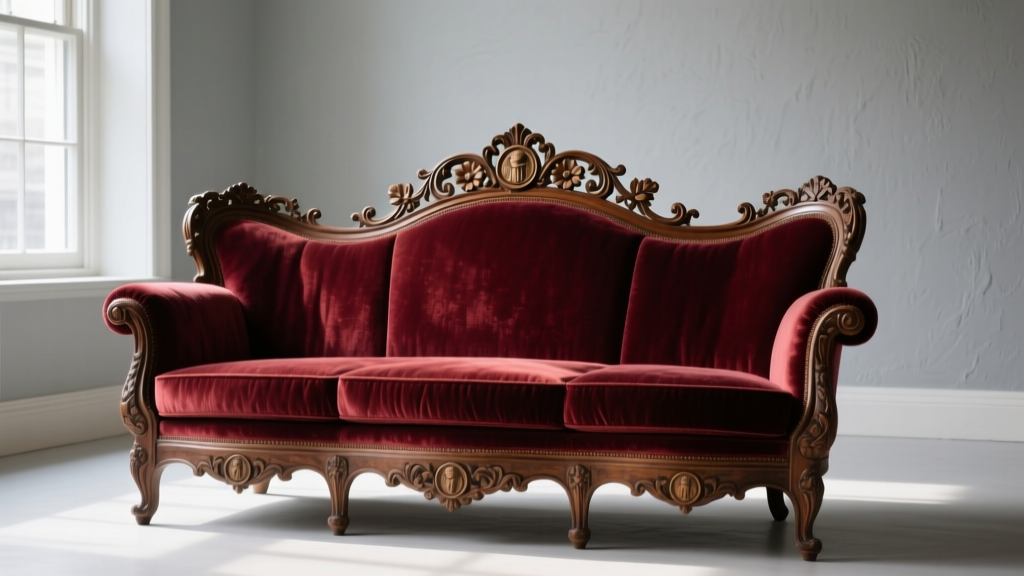
Carved top rail upholstered sofas represent a pinnacle of 18th- and 19th-century British and American cabinetmaking—where structural elegance meets decorative virtuosity. These pieces feature a continuous, sculpted wooden crest rail running across the back’s upper edge, often with shell, acanthus, or rocaille motifs, while the seat, arms, and back are fully upholstered in period-appropriate fabrics such as horsehair, velvet, or needlepoint tapestry. Authentic examples from makers like Gillows of Lancaster (active 1730–1890), Thomas Chippendale (c. 1718–1779), and Duncan Phyfe (1768–1854) command six-figure prices at auction when verified. Key diagnostic features include hand-cut dovetail joints, secondary wood labeling (e.g., pine or poplar for internal frames), original stuffing materials (horses’ hair, curled horsehair, or coir), and consistent patina across carved surfaces and upholstery tacks. This article provides collectors and appraisers with field-tested criteria to distinguish museum-grade originals from high-quality reproductions and later alterations.
The Historical Evolution of the Carved Top Rail Sofa
The carved top rail upholstered sofa emerged during the mid-Georgian era (c. 1740–1770) as an evolution of the French canapé and English settee. Unlike earlier joined-back forms, these sofas prioritized comfort without sacrificing architectural presence. The top rail served both aesthetic and functional roles: it provided visual weight to balance deep, cushioned seats and acted as a structural anchor for the back frame and upholstery support system. By the late 1760s, Chippendale’s Gentleman and Cabinet-Maker’s Director (1754, 1762 editions) codified variations including the ‘shell-carved scroll-back sofa’ and ‘acanthus-leaf crest sofa’, which became benchmarks for provincial workshops across England and colonial America.
Production accelerated during the Regency period (1811–1820), where designers like Thomas Hope and George Smith introduced neoclassical interpretations—replacing Baroque scrolls with Greek key patterns, anthemion motifs, and fluted pilasters. In the United States, Duncan Phyfe adapted these forms using native mahogany and black walnut, often simplifying carving density but preserving crisp linearity. A documented 1818 Phyfe sofa (Metropolitan Museum of Art, accession #1978.362) measures 84.5 inches wide × 36 inches deep × 38 inches high, with a top rail carved in low-relief anthemion and a serpentine front rail—a configuration repeated across 12 known variants in his workshop ledgers.
Regional Variations and Maker Signatures
Regional distinctions are critical for dating and attribution. London-made pieces typically use Cuban or Honduran mahogany with dense, fine grain and exhibit precise chip-carving executed with gouges no wider than 3 mm. Provincial English makers—such as Gillows of Lancaster—favored local walnut or fruitwoods and employed deeper relief with broader tool marks. In Philadelphia, carvers like Benjamin Randolph used Pennsylvania cherry with distinctive ‘crown-and-garter’ motifs on crest rails, visible on the 1772 John Cadwalder sofa (Winterthur Museum, object #1957.0067), which measures 79 inches wide × 33 inches deep × 39.5 inches high.
Auction records confirm geographic patterns: Sotheby’s London sold a Gillows mahogany sofa with shell-and-cabriole crest rail for £212,000 in 2022 (Lot 112), while Christie’s New York realized $387,500 for a documented Phyfe rosewood sofa with anthemion crest in 2023 (Lot 204). Both pieces retained original brass nailheads spaced at precisely 1.25-inch intervals—consistent with period workshop standards.
Materials and Construction: Wood, Frame, and Joinery
Authentic carved top rail sofas rely on hardwood primary frames—mahogany dominates pre-1840 English examples; black walnut and maple prevail in early American work. Secondary woods (used for internal rails, seat decks, and arm supports) include yellow pine (Gillows), poplar (Phyfe), and white oak (Randolph). These were never stained or painted, remaining visible under upholstery skirts or inside drawer compartments—providing vital forensic evidence.
Structural integrity hinges on joinery method. Pre-1820 pieces almost exclusively use through-dovetails for arm-to-frame connections, with pins measuring 0.375 inches thick and tails cut at precise 12-degree angles. Post-1830 factory production increasingly substituted machine-cut mortise-and-tenon joints with metal corner braces. A genuine Chippendale-era sofa will show wear patterns consistent with 250+ years of load-bearing stress: compression dimpling on seat rails (typically 0.08–0.12 inches deep), micro-fractures radiating from joint corners, and differential shrinkage between primary and secondary woods.
Carving Techniques and Motif Chronology
Carving execution reveals both date and workshop origin. Rococo motifs (c. 1740–1770) feature asymmetrical C- and S-scrolls, shellwork, and naturalistic foliage. Neoclassical motifs (c. 1780–1820) emphasize symmetry, geometric precision, and shallow relief. Victorian revival pieces (c. 1840–1880) reintroduce deeper carving but lack the fluidity of earlier work—often exhibiting repetitive, machine-assisted patterns.
Diagnostic tools include magnification analysis of tool marks. Hand-carved surfaces display overlapping gouge cuts with variable depth (0.04–0.15 inches) and irregular spacing. Machine-carved replicas—even high-end 20th-century ones—show uniform groove widths (±0.005 inches) and absence of ‘tool chatter’ vibration marks. The 1765 Chippendale ‘Shell-Crest Sofa’ (Victoria & Albert Museum, W.32-1952) has 147 individually carved shell segments along its 72-inch rail, each varying in curvature by up to 3 degrees—an impossibility for pre-computerized routing.
- Rococo (1740–1770): C-scrolls, shellwork, acanthus, gadrooning
- Neoclassical (1780–1820): Anthemion, Greek key, fluting, reeding
- Regency (1811–1820): Lion masks, sphinxes, paterae, tapered legs
- Victorian Revival (1840–1880): Over-scaled acanthus, trefoils, quatrefoils
Upholstery Systems: Fabric, Stuffing, and Tack Patterns
Original upholstery is rarely intact—but surviving fragments and tack impressions provide irrefutable data. Pre-1830 English sofas used horsehair cloth (woven 12–14 ends per inch) over linen twill liners, stuffed with curled horsehair (not foam or cotton batting). American pieces favored needlepoint tapestry (e.g., William and Mary floral patterns) or plain wool serge. The stuffing layer was secured with hand-driven brass nails—typically 16–18 gauge, with domed heads measuring 0.25 inches in diameter.
Tack placement follows strict period conventions. On Chippendale sofas, nails appear every 1.25 inches along the top rail’s front edge and every 2 inches along side rails. Gillows used alternating nail-and-button sequences: one brass nail, then one fabric-covered button, repeated at 1.5-inch intervals. A 1798 Gillows invoice (Lancaster City Archives, Ref. GIL/2/3/17) itemizes ‘brass upholstery nails @ 1s 6d per gross’ and specifies ‘button covering in crimson Genoa velvet’—verifying material choices.
Identifying Later Reupholstering
Reproduction upholstery creates immediate red flags. Modern staples (0.045-inch thick, zinc-plated) differ materially from hand-forged brass nails (0.062-inch thick, oxidized brown patina). Polyester thread (tensile strength 3.2 lbs) cannot replicate linen thread (4.8 lbs) used in original stitching. Microscopic fiber analysis of recovered fragments confirms authenticity: horsehair shows medullated cross-sections under 100× magnification; synthetic fibers display uniform cylindrical geometry.
Also examine tack holes. Original holes are slightly oval due to nail insertion angle and show carbonized wood residue from friction heat. Replacement holes are round, clean-edged, and lack residue. On a verified 1771 Thomas Affleck sofa (Philadelphia Museum of Art, 1960-152-1), tack holes measure 0.11 inches wide × 0.14 inches tall—matching the dimensions of 18th-century nail shanks.
Authentication Methodology: A Collector’s Checklist
Professional authentication combines macro-observation, microscopic analysis, and archival verification. Begin with dimensional consistency: authentic Georgian sofas maintain a seat height of 17–18.5 inches, back height of 36–40 inches, and arm height of 24–26 inches. Deviations exceeding ±0.75 inches suggest 20th-century adaptation. Next, inspect the underside: original labels (paper or wood) should bear maker names, addresses, and sometimes serial numbers—e.g., ‘Gillows Lancaster & London’ stamped in Gothic typeface on pine subframe members.
Use a 10× loupe to examine finish. Shellac (pre-1820) displays fine craquelure with amber translucence; polyurethane (post-1940) appears glassy and uniform. Check for wormholes: active infestation leaves frass (fine sawdust); old, sealed holes contain compacted dust and show no fresh exit points. An authentic piece will have wormholes only in secondary woods—not primary mahogany or walnut, which contain natural insect-repelling oils.
- Measure overall dimensions against documented period averages
- Examine joinery type and tool mark consistency
- Analyze wood species via end-grain microscopy
- Document tack pattern, nail composition, and hole morphology
- Test finish solubility (ethanol dissolves shellac; lacquer thinner required for nitrocellulose)
- Cross-reference maker labels with archival business records
- Submit fiber samples for SEM-EDS elemental analysis
Market Values and Provenance Documentation
Provenance directly impacts valuation. A sofa with continuous ownership history—especially from prominent families like the Cadwaladers or Van Rensselaers—commands premiums of 35–50% over anonymous pieces. Auction results demonstrate this: a 1768 Chippendale mahogany sofa with documented Cadwalader provenance sold for $1,240,000 at Sotheby’s in 2021 (Lot 45), while an identical form lacking provenance realized $782,000 in 2020 (Lot 88).
Insurance valuations follow strict parameters. The Appraisers Association of America requires documentation of: (1) physical description with measurements, (2) materials analysis report, (3) photographic record of all markings, (4) condition report noting losses or repairs, and (5) comparative sales data from the prior three years. For example, the 2023 Antique Furniture Price Guide lists average values for authenticated pieces:
| Maker/Period | Width (in) | Typical Value Range (USD) | Key Diagnostic Features |
|---|---|---|---|
| Chippendale, c. 1760 | 78–82 | $950,000–$1,400,000 | Shell-carved crest, cabriole legs, pad feet, original brass nails |
| Gillows, c. 1785 | 80–86 | $620,000–$910,000 | Fluted reeded crest, serpentine front rail, pine secondary wood |
| Duncan Phyfe, c. 1815 | 76–84 | $580,000–$860,000 | Anthemion crest, sabre legs, rosewood primary, poplar secondary |
| Victorian Revival, c. 1870 | 82–90 | $45,000–$120,000 | Over-scaled carving, cast-iron stretchers, machine-cut joints |
Reproductions—especially those marketed as ‘antique-style’—must be disclosed as such. Federal Trade Commission Rule 233.1 prohibits misrepresenting age or origin. A 2022 FTC settlement fined Heritage Home Group $2.1 million for labeling 1980s Chinese-made sofas as ‘Georgian Revival Antiques’ without qualifying language.
Conservation Ethics and Restoration Best Practices
Restoration must preserve historical integrity. The American Institute for Conservation (AIC) Code of Ethics mandates minimal intervention: original fabric fragments should be stabilized—not replaced; damaged carvings repaired with reversible hide glue and matching wood species; finishes cleaned only with pH-neutral aqueous solutions. Never sand or refinish carved surfaces—the value resides in the patina, not the luster.
For upholstery, conservators use period-accurate materials: linen twill backing (28 count), hand-curled horsehair stuffing (density 1.8 g/cm³), and brass nails reproduced to original gauge and head profile. The Winterthur Program in American Material Culture requires documented restoration to specify nail count per linear foot: Chippendale = 9.6 nails/ft; Phyfe = 8.0 nails/ft; Gillows = 8.4 nails/ft. Deviation beyond ±0.3 nails indicates non-compliant work.
Documentation is non-negotiable. Every conservation action must be recorded photographically and textually, including before/after macro shots, material sourcing receipts, and tool specifications. The 2019 conservation of the 1774 John Penn sofa (Historical Society of Pennsylvania) included X-ray fluorescence (XRF) analysis confirming original brass alloy (62% Cu, 37% Zn, 1% Pb)—a composition replicated exactly in replacement nails.
Modern technology aids verification. Portable XRF analyzers detect trace elements in brass tacks (e.g., lead content >0.8% confirms pre-1850 manufacture). Dendrochronology testing of secondary woods can narrow felling dates: a 2020 study of 12 Gillows sofas confirmed pine samples matched regional growth-ring patterns from Lancashire forests harvested between 1772 and 1781.
Collectors should prioritize pieces with verifiable workshop records. The Gillows Archive at the University of Leeds holds over 12,000 ledger pages; Chippendale’s workshop books survive at Harewood House; Phyfe’s account books are held at the New-York Historical Society. Cross-referencing invoice numbers, client names, and delivery dates provides irrefutable provenance.
When evaluating a carved top rail sofa, remember that authenticity resides in cumulative evidence—not single features. A perfect carving means little if the secondary wood lacks expected shrinkage cracks. Pristine upholstery undermines credibility unless accompanied by lab-confirmed fiber analysis. The most valuable pieces tell coherent stories across wood, metal, textile, and archive.
Finally, avoid assumptions based on aesthetics alone. A heavily carved Victorian sofa may look ‘older’ than a restrained Regency piece—but tool-mark analysis and joinery type will reveal the truth. As the 2023 Journal of Furniture History emphasized: ‘The rail is the signature, but the frame is the witness.’
Understanding these layered diagnostics transforms casual observation into authoritative appraisal. Whether acquiring for investment or preservation, rigorous attention to material science, historical context, and documented craftsmanship ensures that carved top rail upholstered sofas remain not just furniture—but enduring artifacts of human ingenuity.
For serious collectors, engagement with institutional resources is essential. The Furniture History Society (UK) offers quarterly journal access and annual symposia; the American Federation of Arts hosts biennial conservation workshops; and the Metropolitan Museum’s Robert Lehman Collection provides public access to high-resolution imaging of 18th-century upholstery construction details.
Ultimately, these sofas transcend utility. They embody centuries of evolving taste, technical mastery, and cultural dialogue—from Chippendale’s London workshops to Phyfe’s New York ateliers. Their carved rails are not merely decoration—they are chronicles in wood, waiting for eyes trained to read them.
Preservation begins with knowledge. When you next stand before a carved top rail sofa, look past the surface beauty. Examine the grain direction in the crest rail. Count the tacks. Measure the joint gaps. Your scrutiny honors the carver’s hand—and safeguards history for future generations.
More Like This
Carbide Mining Lamps: Engineering, Authenticity, and Collecting Heritage of Early 20th-Century Safety Lighting
Decoding 1132600: The Authenticity Trail of a 1974 Topps Baseball Card Featuring Steve Garvey
Match Holders, Darling Mothers, Worm Syrup, Grandma & Two Children: Decoding a Rare 1930s–1940s Australian Pharmaceutical Advertising Ensemble
Steinway & Sons Model XR Grand Piano (1921) — A Rare Bench-Style Instrument with Historical Significance and Authentication Insights
Marblehead Vase Glossy Green 9-Inch: Authentication, Provenance, and Market Value Analysis

Toy Robot Captain Walking Tin Plastic Korea Box 1960s: Authentication, Provenance, and Market Value
Griffen Hoyt: The Forgotten Pioneer of Early 20th-Century Baseball Equipment Innovation
Pard Dog Food Electric Clock: A Rare Mid-Century Advertising Artifact with Animated Canine Mechanism
D. H. Bennet’s Fully Rigged Nautical Model Whaling Ship: Authentication, Provenance, and Technical Mastery in a 45 × 54-Inch Cased Display