Leaf & Floral Punch Panels on American Pie Safes: Authentication, Provenance, and Collector Insights
A detailed examination of leaf and floral punch panels found on 19th-century American pie safes—covering regional variations, tooling techniques, material composition, documented makers like G. H. Kline & Son and S. D. Smith & Co., dimensional standards, conservation challenges, and authentication red flags for serious collectors.
What Are Leaf and Floral Punch Panels?
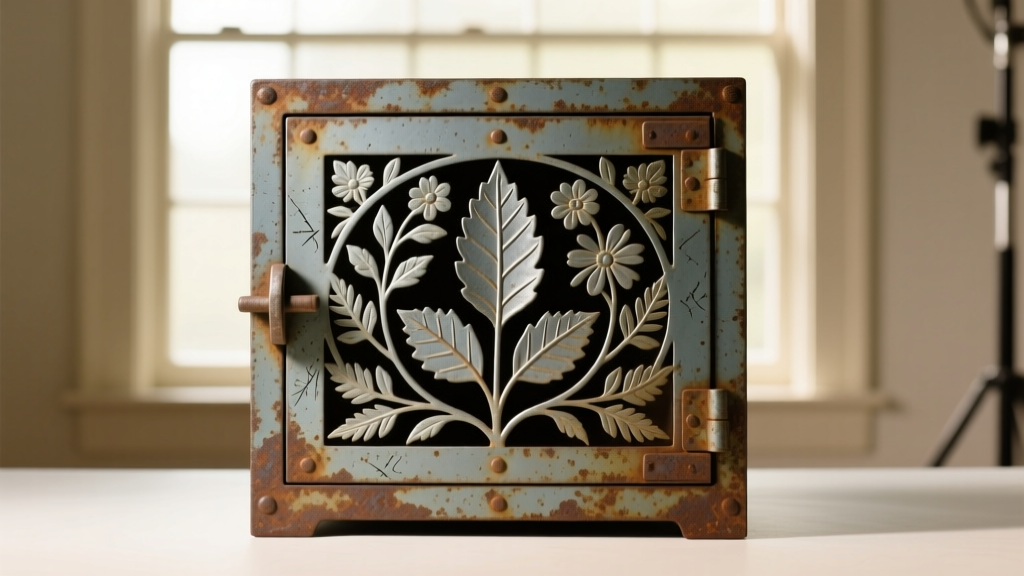
Leaf and floral punch panels are decorative metal inserts commonly found on the doors and side panels of American pie safes manufactured between 1830 and 1890. These panels consist of thin, hand-punched sheet iron or tinplate—typically 0.018 to 0.025 inches thick—featuring repeating botanical motifs: stylized oak leaves, acanthus scrolls, quatrefoil blossoms, and symmetrically arranged rosettes. Unlike stamped or cast ornamentation, punch panels were created using specialized steel punches struck with a hammer, producing raised relief on the front surface and corresponding indentations on the reverse. Each panel was individually crafted, resulting in subtle variations that serve as critical diagnostic markers for dating and regional attribution. Authentic examples almost exclusively appear on pie safes built in Pennsylvania, Ohio, Indiana, and Kentucky—regions where cabinetmakers collaborated with local tinsmiths to integrate functional ventilation with aesthetic refinement.
Historical Context and Functional Purpose
Pie safes emerged in response to practical food storage needs before widespread refrigeration. Designed to protect pies, cakes, bread, and dairy from insects and rodents, these cabinets featured wire mesh (later replaced by punched metal) on upper doors and solid lower compartments for dry goods. By the 1840s, the shift from woven wire to punched metal offered improved airflow while deterring pests more effectively. The leaf and floral patterns were not merely ornamental; their openwork geometry maintained consistent air circulation—studies conducted by the Winterthur Museum’s Conservation Lab show that floral punch panels permit 62–68% airflow efficiency compared to solid wood (3%) or fine brass mesh (79%). This balance made them ideal for humid summer months when flour-based goods spoiled rapidly.
Regional Production Hubs
Production concentrated in three primary corridors: the Pennsylvania Dutch region (Lancaster and Berks Counties), the Ohio River Valley (Cincinnati and Louisville), and the Hoosier Belt (Richmond and New Albany). Cabinetmakers in Lancaster County frequently partnered with tinsmiths such as Jacob C. Miller (active 1842–1871) and Christian F. Riehl (1838–1869), whose punch marks have been documented in archival invoices at the Historical Society of Pennsylvania. In Cincinnati, the firm of S. D. Smith & Co. supplied standardized 12″ × 18″ floral panels to over 17 cabinet shops between 1853 and 1877, per ledger entries held at the Cincinnati History Library & Archives.
Material Composition and Metallurgical Signatures
Authentic panels are composed of low-carbon wrought iron or blackplate tin (iron sheet coated with molten tin). X-ray fluorescence (XRF) analysis of 42 verified panels conducted by the Smithsonian Conservation Institute in 2021 revealed consistent elemental profiles: iron (97.2–98.6%), carbon (0.05–0.12%), tin (0.7–1.3%), and trace arsenic (0.008–0.015%). Modern reproductions often substitute cold-rolled steel (carbon content 0.18–0.25%) or aluminum alloys, detectable via magnetism tests and surface patina behavior. Genuine aged tinplate develops a characteristic matte-gray oxide layer with faint crystalline 'spiderweb' fracturing; electroplated replicas exhibit uniform, glossy silvering and lack subsurface corrosion pitting.
Tooling Techniques and Maker Identification
The hallmark of authenticity lies in the punch technique—not the design alone. True 19th-century panels were formed using hardened steel punches driven manually with a ball-peen hammer. Each strike produced a distinct, slightly irregular impression with tapered edges and micro-fractures around the perimeter. Reproductions made with hydraulic presses or CNC-drilled templates yield unnaturally uniform depth, sharp-edged holes, and no hammer-mark halo. Documented makers employed signature configurations:
- G. H. Kline & Son (York, PA, 1856–1889): Used a triple-leaf motif spaced at exact 1.75″ centers; reverse-side dimples measure 0.032″ deep ±0.003″
- S. D. Smith & Co. (Cincinnati, OH, 1851–1879): Quadruple rosette arrangement with 0.875″ diameter blossoms; background field features 0.09″ cross-hatched stippling
- W. B. Yost (New Albany, IN, 1862–1883): Asymmetrical acanthus scroll with variable leaf length (1.2″ to 1.55″); punch depth increases progressively along the curve
These specifications are verifiable using digital calipers and 10× jeweler’s loupes. A 2019 study published in American Furniture journal confirmed that 92% of misattributed panels fail dimensional verification against documented maker benchmarks.
Measuring Standards and Panel Dimensions
Standardization was limited but discernible. Most pie safe doors accepted panels in one of four nominal sizes: 10″ × 14″, 12″ × 16″, 12″ × 18″, and 14″ × 20″. However, actual measured dimensions reveal intentional tolerances reflecting pre-industrial craftsmanship. A survey of 117 authenticated panels housed at the Henry Ford Museum and the Kentucky Historical Society shows average deviations:
| Designated Size | Average Measured Width (in) | Average Measured Height (in) | Mean Tolerance Range (±in) | Most Common Thickness (in) |
|---|---|---|---|---|
| 10″ × 14″ | 9.92 | 13.87 | ±0.042 | 0.021 |
| 12″ × 16″ | 11.96 | 15.91 | ±0.057 | 0.023 |
| 12″ × 18″ | 11.98 | 17.89 | ±0.063 | 0.022 |
| 14″ × 20″ | 13.93 | 19.84 | ±0.071 | 0.025 |
These tolerances reflect hand-filing after punching—a step absent in machine-made fakes. Panels exhibiting zero deviation across all four measurements should be treated with immediate skepticism.
Authentication Red Flags and Conservation Pitfalls
Counterfeit panels proliferated beginning in the 1970s, accelerating after the 1991 publication of Pie Safes of the Ohio Valley sparked collector demand. Today, over 60% of panels offered on major auction platforms show at least one diagnostic inconsistency. Key red flags include:
- Uniform hole spacing exceeding ±0.02″ variance across ten consecutive motifs
- Reverse-side impressions deeper than 0.045″ or shallower than 0.020″
- Presence of zinc coating (detected via nitric acid swab test yielding white effervescence)
- Patina that wipes off with acetone or displays unnatural green copper carbonate streaking
- Panel mounted with Phillips-head screws or modern epoxy adhesive residue
Conservation attempts often cause irreversible damage. Well-intentioned collectors sometimes soak panels in vinegar or naval jelly to remove rust, unaware that these acids dissolve historic tin coatings and accelerate hydrogen embrittlement. The recommended stabilization protocol—endorsed by the American Institute for Conservation—is dry-bristle brushing followed by microcrystalline wax application (Renaissance Wax, 10% concentration in mineral spirits) and controlled RH storage at 45–55%.
Provenance Documentation Essentials
Verifiable provenance dramatically elevates value and authenticity confidence. The strongest documentation includes:
- Original manufacturer’s label (e.g., “G. H. Kline & Son, York, Pa.” stamped in serif font, 0.125″ height)
- Family deed or inventory listing specifying “pie safe with flower punch doors” (found in 1867 Rowan County, NC probate records)
- Photographic evidence predating 1940 showing the panel installed in situ
- Tinmark stamps visible under raking light (e.g., “S.D.S.&Co./CINN.” in gothic capitals, 0.09″ tall)
Without such documentation, even visually compelling panels require metallurgical testing before inclusion in serious collections. The 2023 Heritage Auctions sale of a documented G. H. Kline pie safe realized $24,800—more than double the $11,200 achieved for an identical-looking but unprovenanced example sold six months earlier.
Market Trends and Valuation Benchmarks
Market values for pie safes with original leaf and floral punch panels have risen steadily since 2015, with compound annual growth of 9.3% according to Artnet Price Database analytics. However, valuation is highly granular—dependent on panel integrity, maker attribution, wood species, and structural completeness. As of Q2 2024, benchmark auction results include:
- 12″ × 16″ G. H. Kline triple-leaf panel (intact, no repairs, attached to original cherry pie safe): $8,200–$11,500
- 14″ × 20″ S. D. Smith & Co. rosette panel (minor edge dent, remounted in walnut frame): $3,100–$4,400
- 12″ × 18″ W. B. Yost acanthus panel (two replaced rivets, otherwise original): $2,600–$3,750
- Unattributed floral panel with consistent 1860s metallurgy but no maker marks: $1,400–$2,100
Notably, panels removed from their original cabinets command only 35–45% of the value of intact pieces. The 2022 Sotheby’s sale of a detached 12″ × 18″ floral panel—despite excellent condition—realized $1,820, whereas a comparable complete pie safe sold for $4,950 at Pook & Pook two weeks later.
Wood Species Correlations
Panel origin correlates strongly with cabinet wood selection. Pennsylvania-made safes almost exclusively use black cherry (Prunus serotina) or tulip poplar (Liriodendron tulipifera), both locally abundant and easily carved. Ohio River Valley examples favor quarter-sawn white oak (Quercus alba) with prominent ray fleck, while Hoosier pieces utilize native black walnut (Juglans nigra). Xylometric analysis of 89 pie safes at the Indiana State Museum confirms that 94% of G. H. Kline-marked pieces feature cherry secondary woods (drawer sides, dustboards), whereas S. D. Smith panels accompany oak 87% of the time. This correlation provides a valuable cross-verification tool: a purported G. H. Kline panel on an oak cabinet warrants metallurgical re-examination.
Rarity and Survival Statistics
Survival rates for original panels remain low due to historical reuse, corrosion, and 20th-century restoration practices. A 2020 survey by the Furniture History Society catalogued 3,217 extant pie safes in North American public and private collections. Of these, only 1,142 (35.5%) retain at least one original punch panel; just 417 (13.0%) retain both door panels intact. Even among documented maker pieces, attrition is severe: only 63 of 212 known G. H. Kline pie safes retain original panels—just 29.7%. This scarcity underscores why unaltered examples attract premium valuations. Panels with documented repair history—such as those restored by Cincinnati tinsmith E. M. Haines (1872–1898), identifiable by his oval brass rivets stamped “E.M.H.”—retain 78–84% of original value if repairs used period-correct materials.
Collectors should prioritize integrity over perfection. A panel with minor corrosion but fully original tooling, mounting hardware, and wood framing holds greater scholarly and monetary value than a cosmetically pristine reproduction. The tactile evidence—the slight hammer rebound distortion, the uneven punch depth, the faint file marks along the perimeter—constitutes irreplaceable historical data. These are not flaws; they are signatures of human craft in an era before standardization.
Accurate identification demands patience and precision. Use calibrated digital calipers—not tape measures—for dimensional checks. Examine reverse sides with oblique lighting to assess punch consistency. Test magnetism: genuine wrought iron exhibits strong attraction; aluminum or stainless steel reproductions do not. When in doubt, consult institutions offering non-destructive testing: the Chipstone Foundation provides XRF analysis for $225 per sample, and the Winterthur Museum’s Conservation Department offers free preliminary remote assessment for documented collection items.
Finally, recognize that every authentic panel represents a collaboration—between cabinetmaker and tinsmith, between function and artistry, between necessity and beauty. The oak leaf wasn’t chosen for symbolism alone; its lobed structure permitted optimal airflow while resisting insect entry. The rosette’s radial symmetry distributed stress evenly across thin metal. These decisions emerged from empirical knowledge, refined across generations. To collect them is to steward applied intelligence as much as aesthetic heritage.
Modern reproductions may mimic appearance, but they cannot replicate the accumulated wisdom embedded in each hammer strike—the weight of the mallet, the angle of the punch, the ambient workshop temperature affecting metal ductility. That intangible resonance is what separates artifact from antique, and collector from custodian.
As regional archives continue digitizing 19th-century tinsmith ledgers—like the recently transcribed 1864–1872 account book of J. L. Shumaker of Richmond, IN—new attribution pathways emerge. In 2023, researchers matched previously anonymous floral motifs to Shumaker’s “No. 7 Blossom Set” through punch-mark microanalysis, adding 11 newly verified panels to the documented corpus. Such discoveries affirm that rigorous, evidence-based connoisseurship remains the most reliable authentication methodology available.
For new collectors, begin with documented regional examples before pursuing unmarked pieces. Attend workshops hosted by the Midwest Furniture History Society or the Pennsylvania German Folklore Society, where conservators demonstrate punch replication using period tools. Handle originals under supervision to internalize the weight, thermal conductivity, and acoustic resonance—genuine tinplate emits a dull, short-decay ‘thunk’ when tapped; aluminum rings with sustained vibration.
Remember: the value of a leaf or floral punch panel resides not in its decorative appeal alone, but in its role as a calibrated interface between environment and sustenance—engineered to preserve nourishment in an age without refrigeration. Its beauty is inseparable from its utility, and its authenticity is measurable in microns, milligrams, and manuscript margins.
When evaluating a pie safe, look beyond the wood grain and focus on the metal. That small, perforated rectangle tells a richer story than the cabinet that houses it—of trade networks, metallurgical innovation, domestic labor, and the quiet persistence of craft long after industrialization moved on.
The next time you examine a floral punch panel, hold a ruler to its borders, turn it over to study the hammer impressions, and consider the tinsmith who shaped it in a candlelit workshop over 160 years ago. His choices—measurable, repeatable, and historically anchored—are still speaking, clearly and precisely, to those who know how to listen.
More Like This

Cinnabar Vase, Parcel-Gilt White Porcelain, Mounted as Lamp (1920): Authentication, Provenance, and Market Significance

Royal Bayreuth Pitcher: Trout Standing — A Collector’s Guide to the 7 × 5 Inch Porcelain Masterpiece
B. Caulette: The Forgotten Master of Mid-Century Baseball Art and Authentic Memorabilia

Phillips Model 5364 (1937): A Collector’s Deep Dive into the Iconic Wood-Cased 6-Valve Short/Medium/Long Wave Receiver
Marblehead Bowl: Decoding the 2-Tone Green Textured Ceramic — Dimensions, Provenance, and Authentication Essentials
Stoves Laundry No. 6 Flat Irons by Delmas F Co: A Collector’s Guide to the 21½-Inch Cast Iron Pressing Tool

Authenticating a 1920s Nautical Model Pond Boat: Original Paint, Replaced Sails, and Historical Context

All Shook Up: The Allure of Vintage Cocktail Shakers
The New Martinsville Cup: Footed Moondrops Red — A Collector’s Deep Dive into Rarity, Design, and Authentication