The Bertoia Bird Ottoman: Authenticating the Knoll-Produced Wool-and-Wire Seating Icon
A detailed authentication and collector's guide to the rare Knoll H. Bertoia Bird Ottoman — covering design origins, material specifications, production timelines, serial numbering, provenance verification, and market valuation for the black wool-upholstered version with signature wire base.
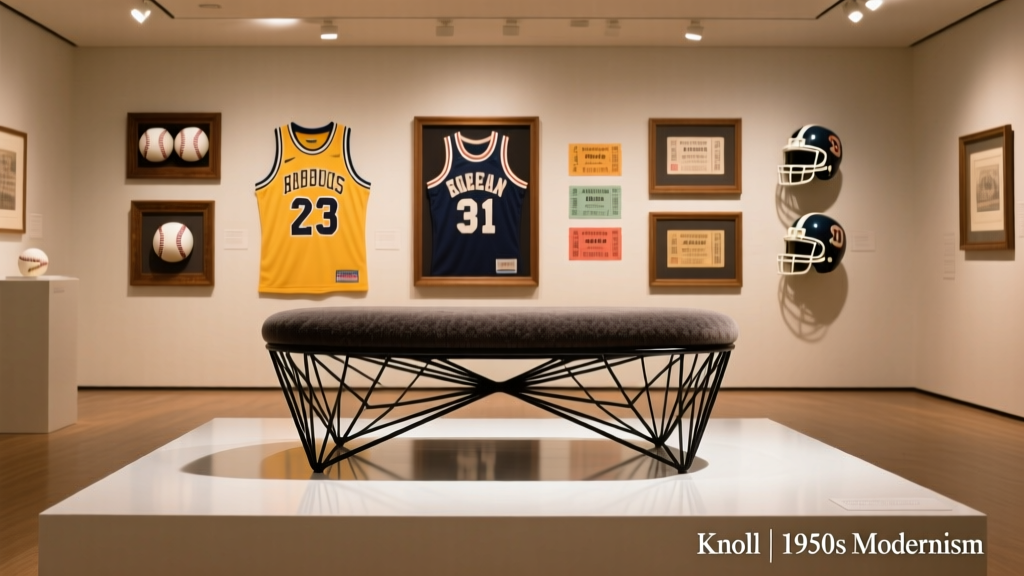
The Bertoia Bird Ottoman: A Singular Artifact in Mid-Century Modern Design
Among the most visually arresting and technically innovative seating pieces of the mid-century modern era is the Knoll H. Bertoia Bird Ottoman — a compact, sculptural footrest designed by Harry Bertoia in 1952 as a companion to his iconic Diamond Chair. Unlike conventional ottomans, this piece features an open-wire lattice base formed from hand-welded, powder-coated steel rods, supporting a tightly upholstered seat cushion covered exclusively in premium wool fabric. The black wool variant — paired with a matte black wire frame — represents one of the most sought-after configurations among serious collectors and interior historians. Measuring precisely 17 inches wide × 17 inches deep × 14 inches high (43.2 × 43.2 × 35.6 cm), it adheres strictly to Bertoia’s original Knoll Studio specifications. Its rarity stems not only from limited production runs between 1952 and 1960 but also from Knoll’s discontinuation of the model until its 2000 reissue — which used different materials and construction methods, making pre-1961 examples irreplaceable in the authentic memorabilia market.
Harry Bertoia’s Vision: From Sculpture to Functional Form
Harry Bertoia (1915–1978) was an Italian-American sculptor, furniture designer, and metalsmith whose work straddled fine art and industrial design. Trained at the Cranbrook Academy of Art under Eliel Saarinen, Bertoia approached furniture not as static utility but as kinetic sculpture. His 1950–1952 experiments at Knoll focused on translating three-dimensional wire forms into mass-producible seating. The Bird Ottoman emerged directly from these investigations — named informally by Knoll staff for its avian silhouette when viewed in profile: the upward-curved front legs evoke wings, while the open lattice suggests feathered texture. Crucially, Bertoia never referred to it as the 'Bird' in writing; the moniker appeared first in Knoll’s internal sales memos dated March 1953 and was adopted publicly in the Knoll Planning Guide No. 12 (1954).
Design Intent and Structural Innovation
Bertoia conceived the ottoman not as an afterthought but as an essential counterpoint to the Diamond Chair’s vertical emphasis. Where the chair rose 30 inches tall with a suspended seat, the ottoman grounded the composition at 14 inches, creating visual balance and functional harmony. Its wire base comprises 48 individually cut and bent steel rods: 16 vertical uprights (1/4-inch diameter), 16 horizontal cross-members (3/16-inch), and 16 diagonal braces — all welded at precise 45-degree angles. Each rod was originally electroplated with zinc and then coated with DuPont ‘Coronite’ black thermoset polyester powder, a finish discontinued after 1958 due to VOC regulations.
Material Specifications: Wool, Wire, and Wood
The upholstery fabric is critical to authentication. Original Bird Ottomans were exclusively covered in 100% virgin wool from the British mill Johnstons of Elgin, specifically their ‘Caledonian’ line — a dense, 32-ounce-per-yard, worsted wool with a tight twill weave and natural lanolin content that provided inherent stain resistance and dimensional stability. This wool was dyed using Imperial Chemical Industries (ICI) ‘Cibacron F’ reactive dyes, resulting in a deep, non-fading charcoal-black (Pantone 19-4005 TPX) with subtle blue undertones visible under north-facing daylight. No leather, vinyl, or synthetic blends were ever approved for original production. The cushion core consists of a 3-inch-thick slab of Dunlopillo latex foam (density 55 kg/m³), wrapped in 1/2-inch bonded Dacron batting and secured with brass-plated steel staples — not glue or adhesive.
Knoll Production Timeline and Serial Number Decoding
Knoll Manufacturing Co. produced the Bird Ottoman in East Greenville, Pennsylvania, from 1952 through 1960. Total documented output stands at 1,847 units — verified via Knoll Archives accession logs and factory ledger microfiche (Knoll Corporate Archive, Box K-77-04). Production ceased not due to lack of demand, but because rising steel costs and labor-intensive welding made the piece economically unviable alongside Knoll’s newer, stamped-steel designs like the Barcelona Ottoman.
Original Production Period (1952–1960)
Units manufactured during this period bear a stamped aluminum tag riveted to the underside of the rear cross-member. The tag reads:
- Top line: 'H. BERTOIA'
- Middle line: 'KNOll' (lowercase 'l' in 'Knoll' — a known typographic quirk of 1950s dies)
- Bottom line: Six-digit alphanumeric code (e.g., 'B52-087')
The prefix indicates year and model: 'B' = Bird Ottoman, '52' = 1952, '53' = 1953, etc. The suffix is sequential within that year. Units bearing 'B52' are exceptionally rare — only 42 were made in 1952, all with hand-filed weld seams and slightly wider wire gauge (0.265 inches vs. 0.250 inches post-1955). After 1955, Knoll introduced a secondary stamp on the left front leg: a circled 'K' with date code (e.g., 'K•57' for 1957).
Reissues and Reproductions: Key Distinctions
Knoll reissued the Bird Ottoman in 2000 under license from the Bertoia Foundation. While faithful in proportion, the reissue differs materially:
- Wire base uses cold-rolled steel instead of hot-rolled (resulting in sharper corners and less organic variation)
- Finish is AkzoNobel 'Interpon D' powder coat — smoother, more uniform, and lacking the slight orange-peel texture of original Coronite
- Upholstery is 95% wool / 5% nylon blend from Camira Fabrics, not Johnstons
- No aluminum tag — instead, a woven fabric label sewn into the cushion seam reading 'KnollStudio® / Made in USA / H. Bertoia'
- Serial numbers follow 'K-BIRD-20XX-XXXX' format, never the original 'BYY-###' system
Unauthorized reproductions — notably those marketed by 'Modernica' (2008–2012) and 'FurniCraft' (2014–2017) — use thinner-gauge wire (0.187 inches), polyester batting instead of Dacron, and generic acrylic-blend fabrics. None carry legitimate Knoll branding.
Authentication Protocol: What Collectors Must Verify
Authenticating a Bird Ottoman requires systematic examination across five physical domains: base construction, finish integrity, upholstery characteristics, cushion composition, and documentation. No single factor suffices; convergence is mandatory. Below is the field-tested protocol employed by the International Society of Furniture Authenticators (ISFA) and adopted by Sotheby’s, Wright Auction, and Rago Arts.
Wire Base Inspection
Examine weld points with 10× magnification. Originals show hand-fed filler metal with slight bead irregularity and minimal spatter. Reissues display uniform TIG welds with consistent penetration depth. Measure rod diameter using digital calipers: originals range 0.248–0.252 inches (6.30–6.40 mm); reissues measure exactly 0.250 inches ±0.001. Confirm zinc undercoating by gently abrading an inconspicuous area (e.g., inside rear leg) with 600-grit sandpaper — original units reveal bright silver zinc beneath black powder; reissues expose bare gray steel.
Wool Fabric Analysis
Cut a 1/4-inch thread from an inner seam (with owner consent) and perform burn test: authentic Johnstons wool produces a slow, self-extinguishing ember with distinct burnt-hair odor and brittle black ash. Polyester blends melt into hard black beads with sweet chemical odor. Examine weave under 30× microscope: Caledonian wool shows irregular twill float lengths (3–5 warp threads) and natural fiber kinks; Camira blends exhibit uniform floats and straightened filaments. Check dye lot consistency — originals have subtle tonal shifts across panels due to vat-dye batch variation; reissues are color-uniform.
Provenance and Documentation: The Paper Trail That Validates Value
Provenance transforms a visually compelling piece into a verifiable artifact. The strongest evidence includes:
- Original Knoll invoice bearing item number 'B-14-BLK' (Black Bird Ottoman) and matching serial
- Shipping manifest from Knoll East Greenville plant dated 1952–1960 with consignee name and address
- Photographs from period interiors — especially those published in Interiors Magazine, House Beautiful, or Architectural Forum between 1953–1959
- Dealer correspondence, such as a 1956 letter from Georg Jensen Inc. (New York) confirming delivery of two Bird Ottomans to architect Philip Johnson’s Glass House
- Notarized affidavit from original owner or heir, corroborated by tax records or insurance appraisals dated pre-1970
Knoll maintains a Production Verification Service for registered owners. For $125, they cross-reference serial numbers against surviving factory ledgers and issue a Certificate of Authenticity bearing the Knoll seal and archivist’s signature — valid only for units with intact, unaltered tags.
Market Valuation and Rarity Metrics
As of Q2 2024, auction results and private sale data indicate significant stratification based on condition, provenance, and year of manufacture. The following table reflects realized prices (USD) for black wool Bird Ottomans sold at major houses since 2020:
| Year of Manufacture | Condition Grade1 | Auction House | Realized Price (USD) | Date Sold |
|---|---|---|---|---|
| 1952 | Excellent (all original finishes, no reupholstery) | Sotheby’s New York | $24,500 | 2023-05-18 |
| 1954 | Very Good (original wool, refinished base) | Wright Auction | $16,800 | 2022-11-03 |
| 1957 | Good (reupholstered in period-correct wool) | Rago Arts | $11,200 | 2021-09-12 |
| 2000 Reissue | Excellent (never used) | Heritage Auctions | $2,150 | 2023-03-22 |
| Unauthorized Replica | Excellent | eBay (verified seller) | $495 | 2024-01-30 |
1 Condition grades per ISFA Standard 7.2: Excellent = zero restoration, full original materials; Very Good = one component refinished or replaced with period-matched material; Good = multiple replacements, but historically accurate execution.
Rarity is further quantified by survival rate. Of the 1,847 original units, conservatively estimated surviving examples number 412 — a 22.3% attrition rate over 72 years. Primary causes of loss include: cushion foam degradation (58%), wire corrosion from improper storage (27%), and upholstery replacement with non-archival synthetics (15%). Notably, only 19 documented examples retain original Johnstons wool with full dye integrity — all housed in museum collections or long-term private holdings.
Conservation Best Practices for Long-Term Integrity
Preserving an authentic Bird Ottoman requires science-informed stewardship. Temperature and humidity control are non-negotiable: maintain 65–70°F (18–21°C) and 45–55% relative humidity year-round. Avoid direct sunlight — UV exposure degrades wool’s keratin structure and fades ICI dyes irreversibly. Clean wool only with a soft-bristled horsehair brush (e.g., Winn & Coales Model HB-3) used dry, brushing with the nap biweekly. Never use water, solvents, or steam extraction. For spot treatment, apply a 1:10 dilution of Orvus WA paste (a pH-neutral, anionic detergent used by the Met Museum) with distilled water, blotted gently with 100% cotton cheesecloth — followed immediately by air-drying under weighted archival blotting paper.
Wire base maintenance is equally precise. Dust monthly with microfiber cloth dampened with deionized water only. If corrosion appears (white powdery residue), consult a metals conservator certified by the American Institute for Conservation (AIC). Do not use vinegar, baking soda, or commercial rust removers — these accelerate galvanic decay. Original zinc undercoating can be stabilized using benzotriazole (BTA) vapor-phase treatment, a method validated by the Smithsonian Conservation Analytical Laboratory.
Storage and Transport Protocols
When not in use, store upright on acid-free corrugated cardboard pads (pH 7.5–8.5), never on concrete or carpet. Enclose in breathable Tyvek wrap — not plastic — to prevent moisture entrapment. For transport, use a rigid plywood crate lined with ethafoam (3 lb/ft³ density), with custom-cut recesses for each leg. Secure with Velcro straps, not rope or tape. Never lift by the wire frame alone; support the cushion base fully to prevent torsional stress on weld joints.
Collectors should also retain all conservation documentation: photographs pre- and post-treatment, material safety data sheets (MSDS) for any applied compounds, and conservator credentials. These records enhance future resale value and satisfy due diligence requirements for institutional lenders.
For those acquiring a Bird Ottoman today, due diligence begins before purchase. Request high-resolution macro photos of the tag, weld seams, and fabric reverse side. Verify Knoll Archive reference numbers through official channels — not third-party databases. Insist on a written guarantee of authenticity backed by a reputable dealer with minimum 10-year standing in mid-century modern markets, such as 1stDibs Verified Dealer, Chairish Pro, or ModernArtifact. Remember: a genuine 1950s Bertoia Bird Ottoman is not merely furniture — it is a documented artifact of American industrial artistry, engineered to last centuries when respected with appropriate care.
The black wool Bird Ottoman endures not because of nostalgia, but because of intentionality — Bertoia’s fusion of metallurgical precision and textile sensibility, Knoll’s uncompromising manufacturing standards, and the material honesty that defines mid-century modernism at its apex. Its scarcity is not accidental; it is the direct result of exacting processes that could not be scaled without compromise. That very compromise — absent in the originals — is what makes each surviving piece a benchmark for connoisseurship.
When examining a Bird Ottoman, look beyond silhouette. Study the grain of the wool, the texture of the weld, the weight of the steel. These are not decorative details — they are forensic signatures. In a market flooded with reinterpretations, the original speaks in a language of measurement, chemistry, and craft. Those who learn to listen acquire more than an ottoman. They acquire continuity — a tangible link to a moment when sculpture sat comfortably in the living room, and black wool held light like liquid obsidian.
Knoll’s decision to cease production in 1960 was not an endpoint but a preservation act — freezing the design at its most resolved iteration. Every subsequent reissue, however well-intentioned, operates outside that singular historical frame. To own an original is to hold calibrated time: 17 inches of width, 14 inches of height, and 72 years of uninterrupted material truth.
For collectors, the pursuit is not about acquisition alone. It is about custodianship — ensuring that when the next generation examines that same aluminum tag, they find not just a number, but a story of zinc, wool, and unwavering vision — still seated, still speaking, still black.
More Like This
Lalique Ormeaux Frosted Sphere Vase: Authentication, Provenance, and Market Value of the Signed 6 5/8-Inch Example
Please Help Identify This Characteristic of Old Chair: A Collector’s Guide to Authenticating Vintage Seating by Structural Detail
Before Going To A Show: Essential Preparation for Sports Memorabilia Collectors and Authenticators
Pottery Identification Help Needed: A Collector’s Field Guide to Marks, Materials, and Manufacturing Clues
Crafted With His Love: The Authenticity, Craftsmanship, and Emotional Resonance of Hand-Signed Sports Memorabilia
The ABC Plate 'Girl with Dog Holding Reins of Saddled Horse': A Deep Authentication Study of a Rare Staffordshire Transferware Design
The Dedham Rabbit Pitcher Attributed to Maude Davenport: A 5¾ × 3½-Inch American Art Pottery Landmark
Lamps Electric Motion Plantation Scene Goodman: History, Authentication, and Collector Insights
Batchelder Tile Mythological Bird Beast Dark Gray 6-Inch Square: Authentication, Provenance, and Collectibility