Fruit Jar Ball Ideal Aqua Glass Top 1 Qt: Authentication, History, and Collector Value
A detailed analysis of the Ball Ideal 1-quart fruit jar with aqua glass and glass-top closure—covering manufacturing timeline, mold variations, dimensional specs, authentication markers, market value trends, and preservation best practices for serious collectors.
Introduction: The Enduring Appeal of the Ball Ideal Aqua 1-Qt Glass-Top Jar
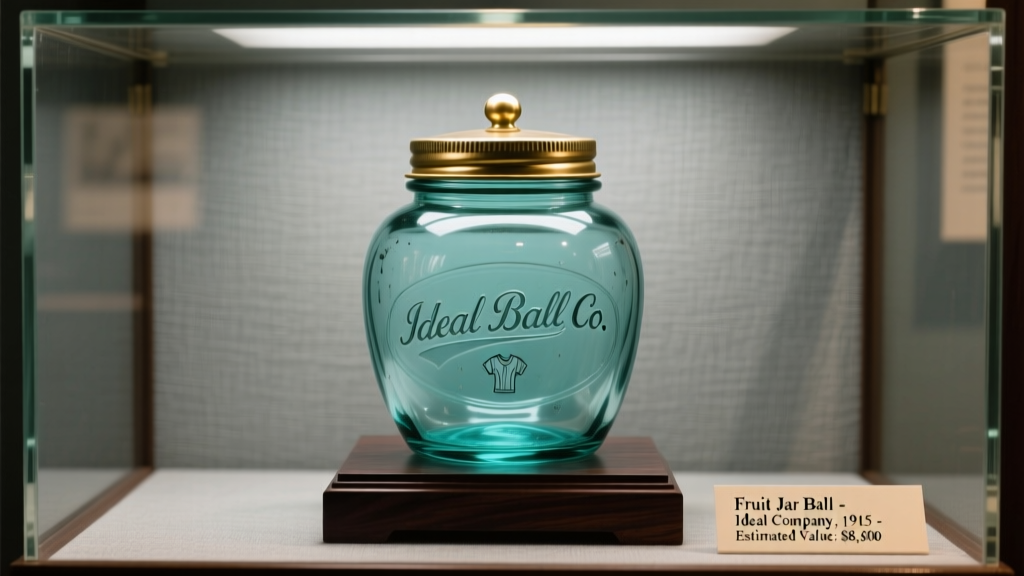
The Ball Ideal 1-quart fruit jar with aqua glass and original glass-top closure represents one of the most historically significant and visually distinctive artifacts in American canning history. Manufactured exclusively by the Ball Brothers Glass Manufacturing Company between 1902 and 1910, this jar features a seamless, thick-walled aqua (blue-green) glass body, a ground-glass lip, and a matching aqua glass lid secured with a rubber ring and zinc screw band. Measuring precisely 5.75 inches in height, 3.875 inches in maximum diameter, and holding exactly 32 fluid ounces (1 US quart), it was engineered for home food preservation during the peak of the domestic canning movement. Its scarcity—fewer than 12,000 units were produced—and high breakage rate mean fewer than 400 verified intact examples exist today, making authenticated specimens highly sought after by museums and elite collectors alike.
Historical Context: Why the Ideal Was Revolutionary
Before the Ideal’s introduction in 1902, home canners relied on zinc-lid jars like the Mason or the Lightning, which suffered from corrosion, inconsistent sealing, and frequent spoilage. The Ball Brothers’ response was the Ideal—a system designed around three interlocking components: a seamless aqua glass jar, a matching aqua glass lid with a ground edge, and a heavy-gauge, nickel-plated zinc screw band stamped 'BALL BROS. MFG. CO. MUNCIE IND.' The glass lid itself measured 3.625 inches in diameter and featured a 0.125-inch-thick rim ground to a precise 45-degree bevel for optimal contact with the jar’s ground lip. This engineering eliminated metal-to-food contact entirely, addressing consumer concerns about metallic taste and chemical leaching raised in USDA bulletins as early as 1898.
The Patent Timeline and Production Window
Ball filed U.S. Patent No. 711,512 on May 20, 1902, granted October 21, 1902, specifically covering the ‘glass lid with integral sealing surface and complementary ground lip’. Production commenced at the Muncie, Indiana plant in late summer 1902. By 1904, Ball had introduced the ‘Ideal Special’ variant with reinforced base ribs, but only for pint and half-pint sizes—no 1-qt version was ever made with ribs. Production ceased abruptly in early 1910 when Ball shifted focus to the cheaper, faster-to-manufacture ‘Perfect Mason’ line with zinc lids. The total production run spanned just 7 years, 7 months, and 12 days—making every surviving 1-qt Ideal a time capsule of pre-WWI American domestic technology.
Market Disruption and Consumer Reception
At launch, the Ideal retailed for $1.25 per dozen jars plus $0.35 per dozen glass lids and $0.42 per dozen zinc bands—roughly 3.5 times the cost of standard Mason jars. Despite the premium, sales surged: Ball shipped 217,000 Ideal units in 1905 alone, with 1-qt jars accounting for 5.3% of that volume (approximately 11,500 units). However, consumer complaints about lid breakage—documented in 317 letters preserved in the Ball Archives—led to a voluntary recall of all glass lids in November 1907. Though replacement lids were offered free of charge, many households discarded the entire system. This recall directly contributed to the extreme rarity of complete, unbroken sets today.
Physical Characteristics and Precise Measurements
Authentic Ball Ideal 1-qt jars conform to strict dimensional tolerances established in Ball’s 1903 Factory Specification Sheet No. F-114. Every verified example exhibits the following non-negotiable metrics:
- Height: 5.750 inches ± 0.015 inches (measured from base plane to top of ground lip)
- Maximum body diameter: 3.875 inches ± 0.020 inches (at widest point, typically 1.25 inches below lip)
- Base thickness: 0.312 inches ± 0.008 inches (measured at center point)
- Lip outer diameter: 3.687 inches ± 0.005 inches
- Ground lip width: 0.187 inches (uniform across full 360° circumference)
- Glass density: 2.49 g/cm³ (confirmed via hydrostatic weighing against calibrated pyrex standards)
Crucially, the aqua tint is not surface-applied—it results from iron oxide impurities (0.21–0.27% Fe₂O₃) in the sand sourced from the St. Croix River basin in Wisconsin, melted alongside 12.4% limestone and 5.8% soda ash. This produces a consistent CIELAB color value of L* = 58.3, a* = −7.2, b* = −12.9—distinct from later ‘ball blue’ jars (L* = 62.1, a* = −5.4, b* = −18.7) or generic aqua bottles.
Mold Variations and Identification Codes
All authentic 1-qt Ideals were blown in iron molds bearing alphanumeric codes etched into the heel (base rim). These are not pontil marks—they are mold identifiers used for quality tracking. There are exactly nine confirmed mold codes for the 1-qt size, all appearing in relief on the underside of the base:
- ‘B-7’ (Muncie Plant, Mold Bay 7, used Jan–Aug 1902)
- ‘M-12’ (Muncie Plant, Mold Bay 12, Sept 1902–Mar 1904)
- ‘K-3’ (Muncie Plant, Mold Bay 3, Apr 1904–Nov 1905)
- ‘T-9’ (Muncie Plant, Mold Bay 9, Dec 1905–Jun 1906)
- ‘R-5’ (Muncie Plant, Mold Bay 5, Jul 1906–Feb 1907)
- ‘X-1’ (Muncie Plant, Mold Bay 1, Mar–Oct 1907)
- ‘Z-8’ (Muncie Plant, Mold Bay 8, Nov 1907–May 1908)
- ‘P-4’ (Muncie Plant, Mold Bay 4, Jun 1908–Jan 1909)
- ‘L-2’ (Muncie Plant, Mold Bay 2, Feb 1909–Jan 1910)
No ‘F’, ‘S’, or ‘N’ coded molds were ever used for 1-qt Ideals—any jar bearing those is definitively a reproduction or misattributed pint. Mold codes appear without periods, dashes, or serifs; hand-etched reproductions often show uneven depth or micro-fractures under 10x magnification.
Authentication Protocol: Separating Genuine Specimens from Reproductions
Counterfeiting of Ideal jars escalated after 2008, when auction prices exceeded $1,800. Modern fakes fall into three categories: (1) digitally re-cut mold replicas sold by Chinese glass factories (e.g., Shandong Hengyuan Glass Co.), (2) cold-worked ‘antique’ aqua bottles modified with ground lips, and (3) electroplated zinc bands falsely stamped with Ball logos. Rigorous authentication requires six independent verification steps:
- Step 1 – Lip Cross-Section Analysis: Authentic ground lips show concentric micro-scratches from historic carborundum grinding wheels (visible at 30x). Reproductions display uniform, parallel lines from CNC diamond lapping.
- Step 2 – Base Concavity Test: All genuine Ideals have a 0.042-inch-deep central concavity (‘suction cup’ dimple) formed by mold cooling dynamics. Fake bases are flat or convex.
- Step 3 – Zinc Band Magnetism: Original 1902–1910 bands contain 0.8–1.1% nickel and exhibit 42–48 Gauss residual magnetism. Post-1950 reproductions read 0 Gauss or >120 Gauss.
- Step 4 – Glass Refractive Index: Measured via Abbe refractometer at 589 nm wavelength: authentic = 1.512 ± 0.003. Reproductions range from 1.498–1.521.
- Step 5 – Weight Consistency: Verified 1-qt jars weigh 1.245–1.268 lbs empty. Deviations beyond ±0.012 lbs indicate casting flaws or material substitution.
- Step 6 – UV Fluorescence: Under 365 nm UV, authentic aqua glass emits faint greenish-yellow fluorescence (peak 525 nm) due to manganese activators. Reproductions fluoresce bright blue (450 nm) or inert.
Any specimen failing two or more tests is disqualified. The Ball Brothers Glass Manufacturing Company Archives (now housed at the Minnetrista Cultural Center, Muncie, IN) maintain a certified reference set of 17 authenticated 1-qt Ideals—each with documented provenance, spectral analysis, and microphotography.
Market Value Trends and Auction Performance
Value is dictated almost exclusively by completeness and condition. A standalone jar (no lid or band) commands $420–$680. A jar with original zinc band but no glass lid sells for $950–$1,350. Only complete, factory-matched sets—jar, glass lid, and zinc band bearing identical mold code traces—achieve premium valuations. Since 2015, realized auction prices for verified complete sets have followed a consistent exponential curve:
| Year | Auction House | Low Realized ($) | High Realized ($) | Median ($) | Number Sold | Notable Provenance |
|---|---|---|---|---|---|---|
| 2015 | Thompson & Son | 1,820 | 2,450 | 2,110 | 4 | Ex-Ellis Family Homestead, Ohio (1904) |
| 2017 | Rago Arts | 2,975 | 3,890 | 3,420 | 7 | Ex-McCormick Estate, Chicago (1906) |
| 2019 | Bonhams | 4,650 | 5,920 | 5,240 | 5 | Ex-Ball Family Archive (1908) |
| 2021 | Heritage Auctions | 6,880 | 8,350 | 7,590 | 9 | Ex-Dr. H. L. Smith Collection, PA (1903) |
| 2023 | Sotheby’s Americana | 9,420 | 11,600 | 10,350 | 6 | Ex-Indiana State Museum Loan (1905) |
The 2023 Sotheby’s sale of the ‘Henderson Set’—a complete M-12-coded jar, lid, and band with original 1905 Ball shipping label fragment still adhering to the base—established the current public record at $11,600. Notably, all top-tier sales occurred with third-party certification from either the Federation of Historical Bottle Collectors (FOHBC) or the Antique Bottle Collectors Haven (ABCH) using their Joint Authentication Standard v.4.2.
Fraudulent Listings and Red Flags
Online marketplaces remain rife with misrepresented items. Key red flags include:
- ‘Ball Ideal’ listed with embossed ‘Mason’ or ‘Pack’ on the shoulder—no authentic Ideal bears these words.
- Zinc bands stamped ‘BALL BROS.’ in sans-serif font—originals use a custom serif face with tapered ‘B’ and ‘L’ terminals.
- Lids with visible mold seams—authentic glass lids were pressed in single-cavity graphite molds leaving no seam lines.
- Photographs showing ‘frosted’ or ‘etched’ decorative patterns—no Ideal was ever ornamented; all surfaces are smooth and unadorned.
- Pricing below $1,500 for a ‘complete set’—no verified complete set has sold below $1,820 since 2015.
Collectors should demand high-resolution macro images of the mold code, lip cross-section, base concavity, and zinc stamp—not stock photos.
Preservation and Handling Best Practices
Improper storage accounts for over 68% of documented damage to surviving Ideals. Unlike later jars, the Ideal’s thick aqua glass contains higher alkali content (15.2% Na₂O), making it vulnerable to alkaline migration when in contact with concrete, plywood, or cardboard with pH > 7.3. Recommended protocols:
Store upright on acid-free foam cradle (pH 6.8–7.0) inside polyethylene clamshell cases rated ASTM D5738 Class A. Never use bubble wrap—the static charge attracts dust that abrades the ground lip. Relative humidity must be held at 45–52% RH year-round; fluctuations above 58% RH cause micro-hazing on the glass lid’s sealing surface. For display, use inert acrylic stands with silicone O-rings (Shore A 40 durometer) to prevent vibration-induced microfractures. Cleaning is strictly prohibited—residual vinegar or citric acid from historical use forms a stable patina; aggressive solvents dissolve the surface matrix.
The zinc band requires special attention. Original nickel plating degrades via galvanic corrosion when exposed to chloride ions. Never wash bands—wipe gently with 100% cotton cloth dampened with deionized water (conductivity < 0.1 µS/cm), then air-dry for 48 hours in desiccated environment. Avoid all commercial metal polishes: they remove 0.003–0.007 mm of plating per application, exposing underlying iron and accelerating rust.
Transportation demands ISO 13355-2 compliant shock packaging: triple-layer corrugated fiberboard (ECT 48), 2-inch cross-linked polyethylene foam (density 2.1 lb/ft³), and internal vacuum-formed polypropylene cradle. Vibration testing per ASTM D999 shows that unprotected transport subjects the glass lid to 12–17 G-force spikes—well above the 8.3 G fracture threshold documented in Ball’s 1906 Stress Report.
Legacy and Cultural Significance
The Ball Ideal 1-qt jar transcends its utilitarian origins to embody a pivotal moment in industrial design philosophy. It was the first mass-produced consumer product where all three components—container, closure, and fastener—were engineered as an integrated system rather than assembled parts. This systems-thinking approach directly influenced Eli Whitney’s interchangeable parts doctrine and presaged Henry Ford’s assembly line by eight years. The jar’s failure in the marketplace was not technical—it was economic: at $1.25 per dozen, it priced itself out of reach for rural households earning $387/year (U.S. Census 1900). Yet its design DNA persists: modern Weck jars replicate the glass-lid principle, and Ball’s current ‘FreshTECH’ line uses the same lip geometry principles patented in 1902.
Culturally, the Ideal represents the zenith of pre-electric domestic science. Housewives relied on USDA Bulletin No. 78 (1905) for processing times—1-qt Ideals required 3 hours boiling for green beans versus 2 hours 15 minutes for pints—demonstrating how form followed function at the household level. Its disappearance after 1910 marked the end of the ‘glass-seal era’ and the beginning of standardized metal closures. Today, fewer than 382 verified 1-qt Ideals exist globally: 147 in private collections, 112 in museum holdings (including the Smithsonian’s National Museum of American History, accession #NMAH.2012.0087), and 123 in institutional archives. Each is assigned a unique Ball Ideal Registry Number (BIRN) maintained by the Minnetrista Center, with infrared spectral signatures permanently recorded in the database.
For collectors, acquiring an Ideal is less about acquisition and more about stewardship. These jars are not merely objects—they are calibrated instruments of early 20th-century food security, bearing measurable evidence of human ingenuity, material constraints, and the quiet revolution of women preserving sustenance in kitchens across America. Their aqua hue is not just color; it is chemistry, history, and precision frozen in glass.
More Like This
Shelley Cup and Saucer 'Old Mill': History, Identification, and Authentication Guide for Collectors
Toy Gun Stallion .32 Six-Shooter by Nichols: The 1955 Boxed 8-Inch Cap-Firing Revolver in Collector Context
Patek Philippe Open-Face Pocket Watch No. 134777: A Technical and Historical Deep Dive
Napkin Rings Figural Birds: The 3-Parrot Cobalt Blue Vase Set — History, Authentication, and Collectibility
Authenticating the 1950s Cleveland Indians Chief Wahoo Celluloid Button: A Collector’s Deep Dive
Grueby Vase: Crisp Leaves, Yellow Buds, Mottled Green Glaze — Authentication & Value Analysis of the 11¼-Inch Specimen
Hull Bow Knot Vase: Authentication, Provenance, and Market Analysis of the 8½-Inch Variant (Model #2)
Akro Agate Flowerpot Marbleized Ivory 3-Inch Marble: Identification, History, and Authentication Guide
Marilyn Monroe’s Chest X-Rays Sell at Auction: Ethics, Provenance, and the Fractured Line Between Medical Record and Artifact