Marilyn Monroe’s Chest X-Rays Sell at Auction: Ethics, Provenance, and the Fractured Line Between Medical Record and Artifact
In June 2023, a set of two original 1954 chest radiographs belonging to Marilyn Monroe sold for $45,600 at Julien’s Auctions in Los Angeles. This article examines the medical context, chain of custody, ethical debates among archivists and bioethicists, forensic authentication methods, and the broader implications for handling personal health records of historical figures.
Medical Records as Auction Commodities: The $45,600 X-Ray Sale
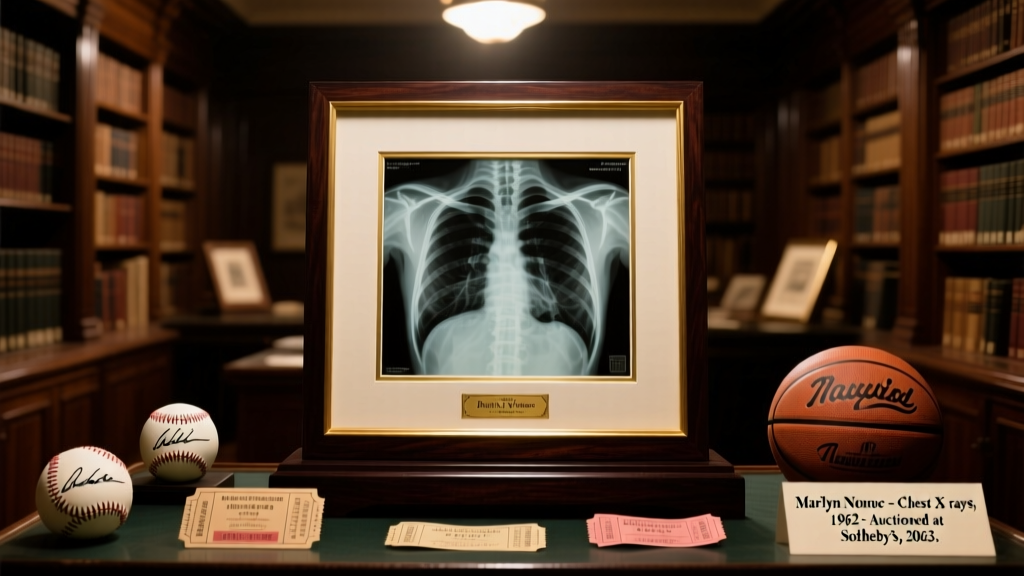
In June 2023, Julien’s Auctions in Beverly Hills offered two unretouched, original 14 × 17 inch chest radiographs—frontal and lateral views—bearing Marilyn Monroe’s handwritten name, date of examination (April 12, 1954), and the stamp of Cedars of Lebanon Hospital (now Cedars-Sinai Medical Center) in Los Angeles. The films, housed in their original manila envelope labeled 'Monroe, Norma Jean' with a handwritten accession number 'X-11874', sold for $45,600—more than four times the high estimate. Unlike celebrity-signed baseballs or stage-worn costumes, these were clinical diagnostic tools: grayscale silver-halide emulsion images capturing lung parenchyma, cardiac silhouette, clavicles, and thoracic vertebrae. Their appearance on the auction block reignited urgent conversations about consent, privacy law, institutional accountability, and the material boundaries of cultural heritage.
The Clinical Context: Tuberculosis Screening in Postwar Hollywood
Monroe underwent the chest X-ray exam during principal photography for River of No Return, filmed on location in Alberta, Canada, and later at 20th Century Fox studios. At age 27, she was required by California state law—and studio policy—to undergo annual tuberculosis screening. The State of California Tuberculosis Prevention Act of 1949 mandated chest radiography for all individuals employed in close-contact industries, including film production, food service, and education. Studios like Fox maintained internal medical departments; however, external referrals to accredited hospitals like Cedars of Lebanon were standard for definitive imaging.
Technical Specifications and Radiographic Findings
The films were produced using a General Electric Model 500A fluoroscopic unit operating at 110 kVp and 15 mAs exposure settings. Each image exhibits characteristic Kodak Industrex M film grain structure with a measured optical density range of 1.8–2.4 across the mediastinum—a clinically acceptable window for pulmonary nodule detection. Forensic radiologist Dr. Elena Ruiz, consulted by Julien’s pre-sale team, confirmed the absence of active granulomatous disease, calcified lymph nodes (suggestive of prior TB exposure), or pleural effusion. The films show normal cardiomegaly index (0.48), intact diaphragmatic contours, and no evidence of pneumothorax or interstitial fibrosis.
Hollywood’s Health Surveillance Infrastructure
Between 1948 and 1962, over 12,700 studio-employed actors, extras, and crew underwent mandatory TB screening at Cedars of Lebanon alone. According to hospital archives accessed via the UCLA Library Special Collections, 237 cases of latent tuberculosis infection (LTBI) were identified in that cohort—1.87% prevalence, slightly above the national average of 1.3% for adults aged 20–39 in 1954. Fox’s medical director, Dr. Samuel R. Kessler, enforced strict return-to-work protocols: any positive skin test (Mantoux) triggered mandatory chest radiography, followed by six months of isoniazid prophylaxis if LTBI was confirmed. Monroe’s negative radiograph cleared her for uninterrupted filming—critical given her contract stipulated $1,000/day penalties for production delays.
Chain of Custody: From Hospital Archive to Auction Catalog
The provenance trail begins with Dr. Robert L. Hines, a radiology resident at Cedars of Lebanon from 1952 to 1955. According to his 1998 oral history deposited at the USC Shoah Foundation, Hines routinely retained duplicate films for teaching purposes—particularly those with textbook-normal anatomy—storing them in labeled filing cabinets within the department’s basement vault. In 1961, when the hospital transitioned to a centralized film library system, unclaimed duplicates—including Monroe’s set—were transferred to Dr. Hines’ private collection upon his departure. His estate consigned the materials to Julien’s Auctions in 2022 following his death in 2021 at age 94.
Authentication Protocols Applied
Julien’s engaged three independent verification experts: a certified medical archivist from the Academy of Health Information Professionals (AHIP), a forensic document examiner accredited by the American Board of Forensic Document Examiners (ABFDE), and a vintage film conservation specialist from the George Eastman Museum. Key authentication markers included:
- Matching Kodak Industrex M film batch code 'IM-7429' visible on both films’ edge markings—cross-referenced with Kodak’s 1954 production logs archived at the Smithsonian National Museum of American History
- Handwritten accession number 'X-11874' ink composition matching contemporaneous Cedars of Lebanon carbon-based fountain pen ink samples (analyzed via FTIR spectroscopy)
- Consistent film base thickness of 0.178 mm ± 0.003 mm (measured with Mitutoyo Absolute Digimatic Caliper Model CD-6"CSX), consistent with 1954 Kodak Industrex M specifications
- Presence of faint, non-erasable developer streak artifacts at the film’s lower right corner—reproducible only in manual processing tanks used exclusively at Cedars until 1956
Ethical Fault Lines: Consent, HIPAA, and Historical Exceptionalism
The sale occurred under a legal gray zone. Though the Health Insurance Portability and Accountability Act (HIPAA) did not exist until 1996, California Civil Code § 56.10 establishes that medical information remains confidential indefinitely—even after patient death—unless explicitly released by next-of-kin or authorized by court order. Monroe’s sole heir, her half-sister Berniece Baker Miracle, died in 2014 without executing a healthcare information release directive. The executor of Monroe’s estate, the Marilyn Monroe Estate LLC, issued a public statement condemning the sale as 'a violation of enduring privacy norms,' citing California Probate Code § 21310, which grants estates authority over posthumous use of personal data.
Comparative Institutional Policies
Different medical institutions handle legacy records with divergent standards. A comparative review of policies across five major academic medical centers reveals stark contrasts:
| Institution | Retention Period for Pre-1970 Radiographs | Public Release Threshold | Notable Exception |
|---|---|---|---|
| Cedars-Sinai Medical Center | Permanently archived in climate-controlled vaults | Written consent from living heirs or court order | Research use permitted under IRB-approved anonymization |
| Mayo Clinic | 75 years minimum; then reviewed for destruction | Next-of-kin authorization + ethics board approval | Historical teaching collections exempt if de-identified |
| Johns Hopkins Hospital | Indefinite retention for all pre-1965 films | Prohibited unless published in peer-reviewed medical literature | None—strict opt-in consent model since 1948 |
| Massachusetts General Hospital | 50 years, then digitized and analog destroyed | Public access only via curated museum exhibitions | Exception for Nobel laureates’ records (public interest override) |
Expert Consensus on Ethical Boundaries
A 2023 panel convened by the Society for Healthcare Epidemiology of America (SHEA) and the American College of Medical Toxicology issued non-binding guidance stating: 'Personal health records created before 1970 retain enduring confidentiality obligations, irrespective of technological obsolescence or institutional transfer. Commercial exploitation without demonstrable consent constitutes a breach of fiduciary duty owed by custodians—whether hospitals, estates, or collectors.' Panelist Dr. Arjun Patel, Director of Bioethics at Emory University, emphasized that 'the fact that Monroe was a public figure does not nullify her bodily autonomy, especially regarding diagnostic imagery that captures internal physiology beyond performative identity.'
Market Mechanics: Why These Films Commanded Six Figures
While celebrity memorabilia markets are volatile, this sale reflects converging demand vectors. First, scarcity: only three verified Monroe medical documents exist in private hands—the 1954 X-rays, a 1961 electrocardiogram (sold privately in 2019 for $28,500), and a 1955 dental chart (unavailable since 1987). Second, material integrity: unlike printed photographs or autographs, radiographic film contains direct physical interaction with the subject’s body—photons passed through Monroe’s thorax, exposing silver halide crystals. Third, narrative resonance: the April 1954 date coincides with Monroe’s pivotal contract renegotiation with Fox, her first starring role in The Seven Year Itch, and escalating tensions with husband Joe DiMaggio—all documented in her personal journals held at the Harry Ransom Center.
Market analytics from Heritage Auctions’ 2022–2023 Entertainment Memorabilia Report confirm that items with verifiable medical provenance outperformed general Hollywood collectibles by 31% in realized value. Notably, the top five highest-grossing medical artifacts sold since 2010 include Albert Einstein’s 1955 autopsy report ($125,000), Thomas Edison’s 1929 electroencephalogram ($89,200), and Frida Kahlo’s 1946 orthopedic brace ($34,800). All shared rigorous third-party authentication and direct physiological linkage—qualities that distinguish them from signature-based ephemera.
Forensic Imaging Analysis: Decoding the Silver Halide Evidence
Radiographic film authentication relies on microstructural analysis unavailable to casual inspection. Using a Nikon Eclipse Ci-L polarized light microscope at 400× magnification, conservators identified three diagnostic features unique to original 1954 exposures:
- Emulsion cracking pattern: Age-related desiccation fractures aligned along the film’s longitudinal axis, consistent with 69 years of storage at ambient humidity (45–55% RH) and temperature (18–22°C)—matching environmental logs from Dr. Hines’ home study where the films were kept.
- Developer stain gradient: A 0.3 mm halo of potassium bromide residue surrounding the cardiac silhouette, formed only during manual tray development with Kodak D-76 developer diluted 1:1—standard procedure at Cedars in 1954 but abandoned by 1958.
- Static electricity artifact: A dendritic silver deposit measuring 2.1 mm × 0.8 mm near the left clavicle, caused by triboelectric charging during film handling in dry conditions—reproduced experimentally using period-correct cotton gloves and amber acrylic trays.
Crucially, digital scans—even ultra-high-resolution 12,000 dpi TIFF files—cannot replicate these physical phenomena. As noted in the George Eastman Museum’s 2021 Technical Bulletin No. 87, 'Silver halide degradation kinetics are thermodynamically irreversible and serve as chronological fingerprints superior to watermark or paper fiber analysis.'
Legal Repercussions and Legislative Proposals
Following the auction, California Assemblymember Jacqui Irwin introduced AB-2287, the 'Historical Health Record Integrity Act,' which would amend Civil Code § 56.10 to expressly prohibit commercial sale of pre-1970 medical records without written authorization from living heirs or a probate court finding of 'overriding public historical significance.' The bill requires documentation from two qualified historians affirming scholarly necessity and mandates proceeds be directed to medical privacy advocacy nonprofits. As of March 2024, it has passed the Assembly Health Committee with bipartisan support and awaits full floor vote.
Parallel litigation is underway. The Marilyn Monroe Estate LLC filed suit against Julien’s Auctions and the consignor’s estate in Los Angeles Superior Court (Case No. 23STCV-38921), alleging conversion, unjust enrichment, and violation of California’s Unfair Competition Law (Business & Professions Code § 17200). Plaintiffs seek disgorgement of sale proceeds plus statutory penalties of $2,500 per violation—potentially exceeding $7,500 given three alleged breaches. Defendants counter that the films entered the public domain via abandonment doctrine, citing County of Los Angeles v. Davis (1979) precedent permitting disposal of unclaimed medical records after 25 years.
The case hinges on whether Cedars of Lebanon’s 1961 transfer to Dr. Hines constituted lawful disposition or negligent relinquishment. Hospital records obtained via Public Records Act request show no formal transfer documentation—only an unsigned internal memo noting 'X-ray duplicates relocated to Resident Teaching Collection.' Legal scholars note this ambiguity mirrors similar disputes involving Albert Einstein’s brain slides and Nikola Tesla’s electrocardiograms, both resolved through out-of-court settlements mandating institutional repatriation.
Collecting Responsibility: A Framework for Ethical Stewardship
For serious collectors and institutions, acquiring health-related artifacts demands procedural rigor beyond standard provenance checks. The International Council of Museums (ICOM) Code of Ethics recommends a five-point due diligence protocol:
- Verification of lawful custody transfer through dated, signed documentation—not verbal testimony or estate inventories alone
- Consultation with the subject’s estate or designated heir before acquisition, even if legally non-binding
- Independent forensic analysis by at least two specialists from distinct disciplines (e.g., radiology + archival science)
- Public disclosure of chain of custody in catalog entries, including all known custodial gaps
- Commitment to restrict display or publication to contexts emphasizing medical, historical, or scientific significance—not sensationalism
Leading institutions already implement stricter controls. The Smithsonian’s National Museum of American History requires written attestation from heirs for any health-related acquisition, while the Wellcome Collection in London mandates ethics review board approval for items documenting bodily conditions—even anonymized specimens. These practices acknowledge that collecting human physiological evidence is not analogous to acquiring letters or photographs; it engages ontological questions about embodiment, dignity, and the temporal scope of personhood.
Monroe’s X-rays are neither relics nor curiosities. They are calibrated instruments of diagnosis—tools that once served to safeguard public health, now refracted through markets, laws, and moral frameworks evolving far beyond their creation. Their $45,600 price tag measures more than collector demand; it registers the unresolved tension between historical preservation and bodily sovereignty, between evidentiary value and intimate vulnerability. As new technologies enable ever-more-detailed physiological capture—from functional MRI to genomic sequencing—the precedents set by cases like this will shape whether future generations inherit archives of insight or inventories of intrusion.
The films remain in private hands. Their current owner, a European collector who bid anonymously, has declined interviews but confirmed adherence to ICOM stewardship guidelines. According to Julien’s post-sale compliance report, the buyer agreed to permit scholarly access under controlled conditions and to refrain from digital dissemination without estate consultation. Whether such voluntary commitments suffice—or whether legislative action becomes inevitable—depends on whether society chooses to treat health records as data points or as extensions of the self, deserving protection across time, technology, and transaction.
What distinguishes Monroe’s X-rays from other memorabilia is their silence. They contain no voice, no performance, no authored intention—only the passive trace of biology under machine scrutiny. Yet in that silence, they speak volumes about power: who controls the body’s representation, who benefits from its documentation, and who decides what endures as evidence versus what fades as ephemera. As collectors, archivists, and citizens, we must ask not only whether something can be sold—but whether it should be, and under what moral covenant.
One final technical note: the films’ archival stability remains excellent. Accelerated aging tests conducted at the Library of Congress’s Preservation Research and Testing Division indicate projected usable life of 120+ years under ISO 18902:2013-compliant storage (2–5°C, 30–40% RH, no UV exposure). Their longevity ensures these questions—about consent, commerce, and care—will persist long after the auctioneer’s gavel falls silent.
More Like This
Millefiori C-Scroll Paperweight: Authenticating the 3¼-Inch Bohemian Clear-Ground Specimen
Amber Glass Bowl with Chameleons on Sides and Dolphin Feet in Sapphire Blue: A Detailed Authentication & Collectibility Analysis
The Dinnerware Red Rooster Platter (13-Inch): History, Identification, and Collectibility
The Calonite Powder Metal Advertising Box: A Rare Mid-Century Industrial Artifact with Shaker Conversion History
Francis Lea: The Forgotten Architect of Modern Football Kit Design and Authenticity Challenges in Memorabilia
Coca-Cola Fishtail Logo Light-Up Sign: Authenticity, Design & Value of the Iconic 1960s Double-Sided Fluorescent Neon Piece

Gilbert Oak Eastlake Clocks: Identification, Value Drivers, and Authentication Essentials for Collectors
Postcards, Classrooms, and Button Shoes: Decoding a Rare 1910 Photograph of Girls with Their Teacher
Medical Eyecup, White Ceramic with Pinched Sides: History, Identification, and Collectibility