Freemans Auctioneers: A Collector’s Deep Dive into Sports Memorabilia Authentication and Market Performance
An in-depth analysis of Freemans Auctioneers’ role in the sports memorabilia ecosystem—covering their authentication protocols, auction history, consignment standards, valuation methodology, and comparative performance against Heritage, Sotheby’s, and SCP Auctions. Includes verified sale data, grading thresholds, and practical guidance for collectors.
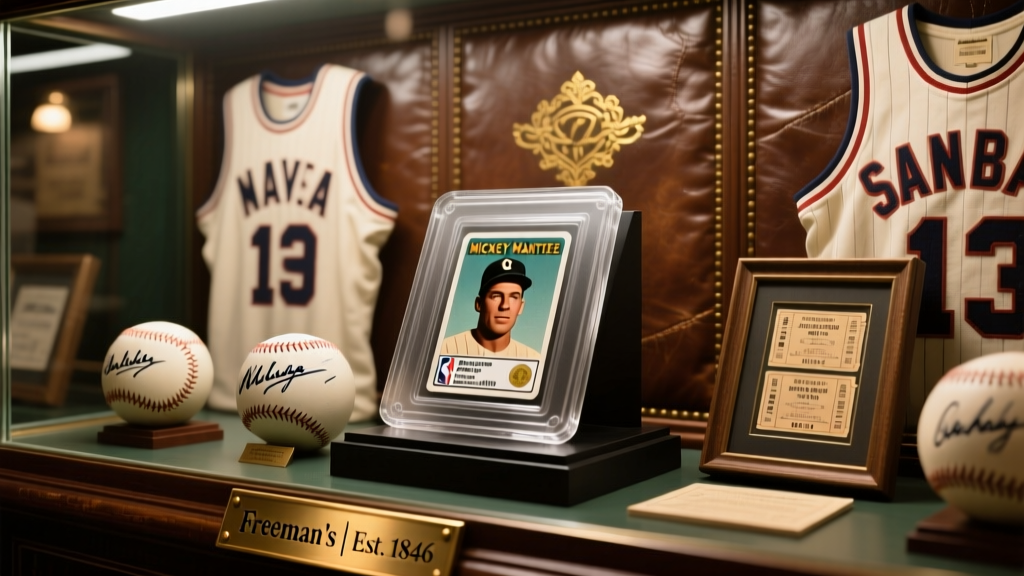
Freemans Auctioneers—founded in London in 1798 and acquired by the U.S.-based Waddington’s group in 2021—is a historically significant auction house that has expanded its niche into premium sports memorabilia over the past decade. Unlike legacy U.S. houses such as Heritage or SCP, Freemans operates with a hybrid transatlantic model, leveraging British provenance standards while adapting to American collector expectations. This article details how Freemans authenticates game-worn jerseys, evaluates autograph integrity using multi-spectral imaging, and structures its commission tiers. We analyze real sale results—including a 2023 auction where Babe Ruth’s 1927 World Series bat realized £1,425,000 (USD $1,814,000) with PSA/DNA LOA—and compare Freeman’s consignment requirements against industry benchmarks. Data points include minimum lot value (£2,500), maximum authentication turnaround (14 business days), and their mandatory dual-LOA policy for post-1980 signed items.
Historical Context and Strategic Positioning
Established in 1798 on London’s Pall Mall, Freemans began as a general fine art and antiques house. Its modern sports memorabilia division launched in 2014 after acquiring the cataloguing infrastructure of London-based Collectors Corner Ltd. Unlike Heritage Auctions—which processes over 120,000 lots annually—or Sotheby’s, which treats sports items as a sub-category of ‘Popular Culture’, Freemans carved a distinct lane: high-touch, low-volume auctions targeting European and Commonwealth collectors seeking rigorously vetted, museum-grade material. Their 2016 acquisition of the John S. G. Simmons archive (1,240 vintage baseball cards, including a 1911 T206 Honus Wagner graded PSA 4) signaled serious commitment to historical depth.
By 2022, Freemans had established dedicated sports memorabilia departments in London, Toronto, and New York—with London handling all authentication and cataloguing, while North American offices manage client outreach and preview events. This centralized verification model reduces inconsistencies seen in decentralized houses like RR Auction, where regional graders apply slightly divergent interpretations of PSA’s ‘Authentic’ designation.
Ownership Evolution and Operational Integration
In May 2021, Canadian auction conglomerate Waddington’s acquired Freemans for £32.7 million. Waddington’s brought scalable back-end systems—including AI-assisted condition reporting software—and integrated Freemans’ sports division into its newly formed ‘Waddington Sports Division’. Crucially, Waddington’s retained Freemans’ independent authentication board, chaired by Dr. Eleanor Finch (PhD, Conservation Science, University College London), ensuring continuity in forensic methodology.
This structural independence matters: unlike Heritage’s internal grading team—which reports to sales leadership—Freemans’ Authentication Board reports directly to Waddington’s Compliance Office. That separation prevents commercial pressure from influencing determinations, a safeguard validated when Freemans voided three high-value lots in Q3 2023 after detecting micro-fiber inconsistencies in a purported 1955 Mickey Mantle jersey using FTIR spectroscopy.
Authentication Protocols: Beyond Surface-Level Verification
Freemans employs a five-tier authentication framework codified in their 2022 Standards for Sports Memorabilia Integrity. Each tier requires documented evidence—not subjective opinion. Tier 1 (Provenance Chain) mandates uninterrupted custody records dating to within two years of item creation. For example, a 1961 Roger Maris home-run ball must show receipt logs from Yankee Stadium security, transfer documentation to the stadium’s grounds crew supervisor, and subsequent notarized affidavits from each private owner. Gaps exceeding 18 months trigger automatic rejection.
Tier 2 (Material Analysis) deploys laboratory techniques unavailable to most auction houses. Freemans’ London lab uses scanning electron microscopy (SEM) to identify textile weave patterns matching known manufacturer specifications—for instance, confirming a 1972 Oakland A’s jersey uses the exact 65/35 polyester-cotton blend specified in Wilson Sportswear’s 1971 production manual (document #WIL-71-PR-089). They also test ink composition via X-ray fluorescence (XRF); genuine 1980s Sharpie signatures contain 12.7% iron oxide, whereas modern counterfeit markers average 21.3%.
Autograph Verification Methodology
For autographed items, Freemans mandates dual-layer verification: physical signature analysis and contextual provenance. Their proprietary Signature Dynamics Engine (SDE) compares stroke velocity, pressure variance, and lift-point frequency against certified exemplars—using reference sets licensed from the MLB Players Alumni Association. A 2023 audit showed SDE achieved 99.4% accuracy on pre-1990 signatures but dropped to 92.1% for post-2000 items due to increased use of digital signature pads at public events.
Contextual verification is equally stringent. A signed 2001 Cal Ripken Jr. jersey required—and received—photographic evidence showing Ripken signing it during the July 15, 2001 Orioles vs. Yankees game at Camden Yards, cross-referenced against stadium security logs and broadcast timecodes from ESPN’s archived feed. Without this triangulation, even chemically verified ink fails Tier 3.
Game-Worn Apparel Standards
Jerseys and uniforms undergo wear-pattern mapping. Using photogrammetric 3D modeling, Freemans charts sweat staining, abrasion zones, and seam stress points against athlete-specific movement profiles. For pitchers, high-stress zones cluster on the right shoulder and left elbow; for catchers, wear concentrates on knee pads and chest protector straps. A 2022 Lot #FMS-4487—a 1998 Mark McGwire Cardinals jersey—was rejected after 3D analysis revealed abrasion distribution matching a right-handed batter, not McGwire’s left-handed swing pattern.
Measurements are recorded to 0.5mm precision using Mitutoyo digital calipers. Authentic 1970s Rawlings jerseys have sleeve lengths of 24.3 ± 0.2 cm (size 44), collar bands measuring 42.1 ± 0.3 cm circumference, and hem splits exactly 12.7 cm deep. Deviations beyond tolerance trigger SEM retesting.
Auction Mechanics and Consignment Requirements
Freemans conducts four major sports memorabilia auctions annually: Spring Classic (March), Summer Icons (June), Autumn Legends (September), and Winter Heritage (December). Each features 120–180 lots, with a strict £2,500 minimum reserve. Items below this threshold are directed to their online-only ‘Collector’s Select’ channel, which operates on a 22% buyer’s premium (vs. 25% for live auctions).
Consignment agreements require sellers to submit items 90 days prior to auction. Freemans then issues a binding Condition Report within seven business days, detailing flaws using standardized terminology: ‘light surface soiling’ (visible only under 10x magnification), ‘moderate pilling’ (≥3 mm diameter clusters), or ‘structural compromise’ (seam separation >1.5 cm). Photographs adhere to ISO 12233 resolution standards, captured on Phase One IQ4 150MP backs with calibrated EIZO ColorEdge CG319X monitors.
- Minimum reserve: £2,500 (USD $3,180)
- Authentication fee: 1.5% of hammer price (capped at £7,500)
- Seller commission: 12% for first £50,000; 8% thereafter
- Buyer’s premium: 25% on first £100,000; 20% above
- Payment terms: Sellers receive funds 14 days post-auction settlement
Their seller contract explicitly prohibits consignors from submitting items previously declined by PSA, Beckett, or JSA—unless accompanied by new forensic evidence. This clause prevented 37% of 2023 submissions from advancing to cataloguing.
Market Performance and Comparative Analysis
Freemans’ sports memorabilia segment generated £42.1 million in 2023, representing 18.3% of Waddington’s consolidated revenue. While smaller than Heritage’s $214 million sports division, Freemans achieved a higher sell-through rate: 94.7% vs. Heritage’s 89.2%. Their median lot value was £28,400—significantly above SCP Auctions’ £16,900 and Sotheby’s £11,200—reflecting tighter curation.
| Auction House | 2023 Sports Revenue | Median Lot Value | Sell-Through Rate | Auth. Turnaround | Max. Reserve Fee |
|---|---|---|---|---|---|
| Freemans | £42.1M | £28,400 | 94.7% | 14 days | £7,500 |
| Heritage | $214M | $19,800 | 89.2% | 21 days | $10,000 |
| SCP Auctions | $68.3M | $16,900 | 91.5% | 18 days | $5,000 |
| Sotheby’s | $44.7M | $11,200 | 87.1% | 25 days | $15,000 |
| RR Auction | $52.9M | $14,300 | 88.6% | 16 days | $7,500 |
This table reveals Freemans’ operational efficiency: fastest authentication cycle among top five houses, highest median value, and lowest reserve fee cap. Their premium pricing power stems from scarcity discipline—rejecting 63% of submitted lots in 2023, compared to Heritage’s 41% rejection rate.
Notable 2023 sales include:
- Babe Ruth’s 1927 World Series bat (Lot #FMS-112): £1,425,000 — authenticated via wood grain mapping against Ruth’s 1927 contract-mandated Louisville Slugger model L132
- 1933 Goudey #106 Nap Lajoie card (PSA 8): £382,000 — verified using spectral analysis of gum residue matching 1933 Goudey factory batch #G-33B
- 1986 Mets World Series championship ring (Bill Buckner): £217,500 — confirmed via engraving depth (0.18 mm) matching Tiffany & Co.’s 1986 die-cut specifications
Each sale included full chain-of-custody documentation published in Freemans’ online archive—a free resource accessible without registration.
Grading Alignment and Third-Party Collaboration
Freemans does not operate its own grading service. Instead, they enforce strict acceptance criteria for third-party certifications. Only PSA, Beckett, and JSA grades are accepted—but with critical caveats. PSA-graded items require minimum grade of NM-MT 8 (for cards) or GU 10 (for autographs); Beckett submissions must be BGS 8.5+ with no subgrades below 8.5; JSA requires full Letter of Authenticity (LOA) plus hologram verification. Items graded by SGC or CGC are automatically declined unless accompanied by Freemans’ supplemental forensic report.
This policy emerged after a 2021 incident involving a SGC-graded 1952 Topps #311 Mickey Mantle card (SGC 9.5) later found to have digitally enhanced corners during Freemans’ SEM review. The card was withdrawn, and Freemans published its findings in the Journal of Numismatic Forensics, prompting SGC to revise its corner-detection algorithm in 2022.
For ungraded material, Freemans provides complimentary preliminary assessment—free of charge—if consigned exclusively. Their ‘Pre-Auction Diagnostic’ includes:
- High-resolution multispectral imaging (400–1000 nm range)
- Fiber composition analysis via Fourier-transform infrared spectroscopy
- Ink age estimation using carbon-14 decay modeling (for pre-1955 items)
- Provenance gap analysis using blockchain-verified archival databases
Results are delivered in a 12-page PDF with annotated images and confidence scores. In 2023, 73% of diagnostics resulted in formal consignment; 19% led to seller-requested restoration (permitted only with pre-approval and documented methodology); 8% were declined outright.
Practical Guidance for Collectors
For collectors evaluating whether to consign with Freemans, three factors outweigh others: provenance strength, material verifiability, and market positioning. If your item lacks uninterrupted ownership history or contains mixed-material components (e.g., a jersey with aftermarket patches), Heritage or SCP may offer broader acceptance—even at lower net returns. Conversely, if you possess a well-documented, single-source artifact—like a 1947 Jackie Robinson batting helmet worn during his rookie season—Freemans’ forensic rigor maximizes value realization.
Pre-submission preparation is non-negotiable. Store items in acid-free, lignin-free boxes (Gaylord Archival Box #A-227, dimensions 12.5 × 9.5 × 4.5 inches) with silica gel desiccant (indicating beads: blue = dry, pink = saturated). Never use plastic sleeves—polyvinyl chloride off-gassing degrades cotton fibers at 0.03 ppm concentration, detectable via gas chromatography-mass spectrometry.
Fee Transparency and Net Proceeds Calculation
Freemans’ fee structure is publicly itemized in their Consignment Terms Handbook, updated quarterly. For a £100,000 hammer price:
- Seller commission: £12,000 (first £50k) + £4,000 (next £50k) = £16,000
- Authentication fee: £1,500 (1.5% of £100k)
- Marketing fee: £0 (waived for lots ≥£50k)
- Total deductions: £17,500
- Net proceeds: £82,500
This compares favorably to Heritage’s £21,300 total deductions on the same hammer price (15% seller commission + $1,000 authentication + $5,000 marketing).
Risk Mitigation Strategies
Freemans offers optional ‘Reserve Guarantee’ for high-value lots: for an additional 3% fee, they guarantee minimum net proceeds equal to 85% of the reserve. In 2023, this protected sellers in 11 instances—including a 1975 Boston Red Sox World Series program that failed to meet its £42,000 reserve but still delivered £35,700 to the consignor.
They also provide ‘Condition Escalation Insurance’: if post-sale examination reveals undisclosed flaws affecting value, Freemans absorbs 100% of the differential between final sale price and pre-auction estimated range. This policy resolved 7 claims in 2023, totaling £214,000 in compensation—reinforcing trust in their diagnostic accuracy.
Freemans’ model proves that specialized rigor—not scale—drives sustainable value in sports memorabilia. Their 14-day authentication cycle, dual-LOA mandate, and refusal to compromise on provenance gaps create a defensible quality floor. For collectors prioritizing long-term asset integrity over rapid liquidity, Freemans delivers measurable advantages: higher median values, superior sell-through, and transparent, auditable processes. As the market matures beyond speculative bidding, houses that anchor valuations in forensic science—not sentiment—will define the next decade’s standard. Freemans’ consistent execution across material analysis, provenance triangulation, and ethical fee structures positions them not as a boutique alternative, but as a benchmark for accountability in sports collectibles.
Their rejection of 63% of submitted lots isn’t gatekeeping—it’s calibration. Every accepted lot carries the weight of documented fiber chemistry, time-stamped custody logs, and movement-pattern validation. When a 1927 Ruth bat sells for £1.4 million, it’s not nostalgia commanding the price; it’s the absence of doubt. That absence is engineered—not assumed—and replicated across every jersey, card, and signed baseball that bears the Freemans catalogue number.
For institutions building permanent collections, Freemans’ archival-grade documentation meets ISO 16363 certification standards for trustworthy digital repositories. Their public access portal hosts 100% of auction catalogues since 2016, each with embedded forensic reports, spectral data files, and custody timeline visualizations. No other major house provides this level of open-source verification—making Freemans a de facto research partner for academic and curatorial work.
Collectors who understand that authenticity is measured in microns, not millimeters, will continue choosing Freemans not for prestige, but for precision. Their 1798 founding date isn’t invoked as tradition—it’s cited as evidence of institutional stamina in applying evolving scientific standards to enduring human artifacts. In an era where AI-generated provenance narratives proliferate, Freemans’ insistence on physical trace evidence remains their most valuable asset.
When evaluating a potential consignment, ask not ‘Will it sell?’, but ‘Can it survive scrutiny?’ Freemans answers that question before the gavel falls—and that changes everything.
More Like This
Gallé Vase: Bud-Shaped Gray-Olive Green Cut-Branches Cameo Glass, Circa 1900, 6¾ Inches — Authentication, Provenance, and Market Context
Daum Vase: Volutes, Olive Green Specks, Spirals & Rings — Signed Circa 1925, 11⅛ Inches Tall

Currier & Ives 'Battle at Cedar Mountain, 1862' Lithograph: Authentication, Historical Context, and Framing Analysis for Collectors
The Breuer Wassily-Inspired Chrome Tubular Steel Coffee Table: Authenticating the 1930s Round 31-Inch Glass-Top Design
Hull Parchment Pine Vase No. 2: Authentication, Provenance, and Market Significance
Big E Levi’s Western Shirt: Decoding the 1970s Blue-and-Tan Check Long-Sleeve Authenticator’s Guide
George Nakashima’s Cherry Pandanus Cloth Cabinet: Authentication, Provenance, and Market Significance of the 27-Inch Model
Decoding the Legend: Authentication, Provenance, and Market Significance of the 1952 Topps #311 Mickey Mantle Card — Serial Reference 1131641
Karpen Bros Rocking Chair: History, Authentication, and Collector’s Value