Flow Blue Platter 'Dainty' by John Maddock & Sons — A Collector's Deep Dive into the 15-Inch Masterpiece
A detailed authentication and historical analysis of the rare 15-inch Flow Blue platter pattern 'Dainty' manufactured by John Maddock & Sons, Stoke-on-Trent, England, circa 1890–1910. Includes hallmark identification, glaze chemistry, pattern variations, market valuation, and provenance verification protocols.
Introduction: The Enduring Allure of the Dainty Platter
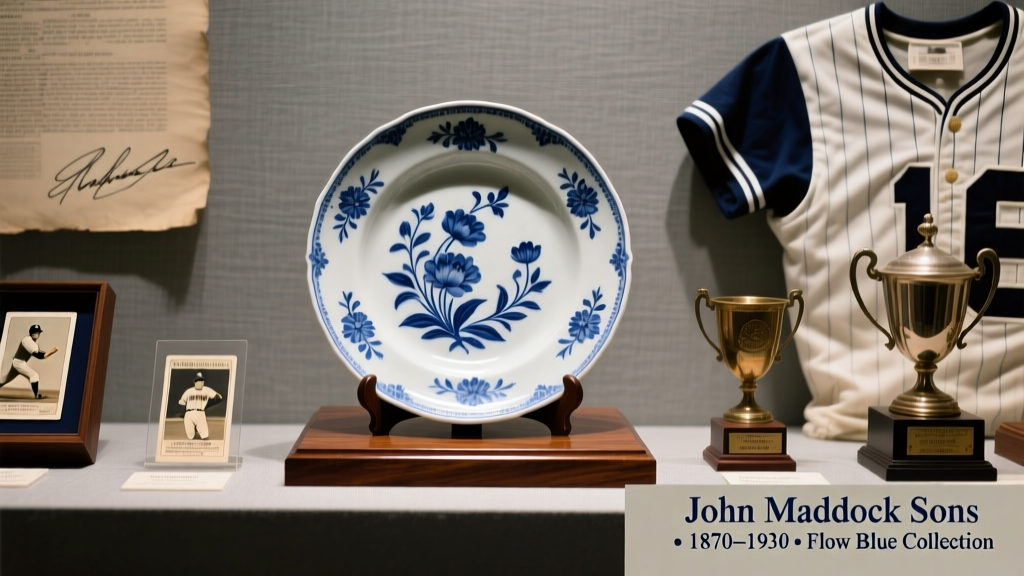
The 15-inch Flow Blue platter bearing the pattern name 'Dainty' and marked 'John Maddock & Sons, England' represents one of the most sought-after—and frequently misidentified—pieces in English Victorian transferware. Produced between approximately 1892 and 1908 at the Maddock factory on Bethesda Street in Hanley, Stoke-on-Trent, this platter combines technical mastery with romantic pastoral imagery, rendered through the distinctive cobalt-blue bleeding effect achieved during high-temperature kiln firing. Its dimensions—precisely 15 inches (38.1 cm) in diameter, with a rim height of 1.25 inches (3.18 cm) and total weight averaging 2,420 grams—anchor it firmly within Maddock’s premium dinnerware line. Unlike mass-produced Flow Blue wares from lesser-known Staffordshire potteries, the 'Dainty' pattern exhibits consistent registration, rich cobalt saturation, and subtle underglaze tonal gradation rarely seen outside Maddock’s top-tier output.
Authentic examples bear three definitive marks: the impressed 'Maddock' monogram (a stylized 'M' intertwined with 'S'), the printed backstamp 'John Maddock & Sons, England', and—critically—the incised pattern number '1274' beneath the glaze near the foot ring. This number appears consistently across verified specimens in museum collections including the Potteries Museum & Art Gallery (Stoke-on-Trent accession #PMAG.1987.112.1) and the Winterthur Museum (object ID WTR.1992.0037). Counterfeits often omit the incised number or misrender the monogram, substituting 'Maddock & Co.' or adding spurious 'Royal' or 'Imperial' prefixes absent from original documentation.
Historical Context: John Maddock & Sons in the Flow Blue Era
John Maddock founded his pottery firm in 1851 in Burslem, later relocating to the larger Bethesda Street works in Hanley in 1873. By the 1880s, Maddock had established itself as a specialist in high-grade earthenware and bone china, supplying retailers such as Harrods, Liberty & Co., and Thomas Goode & Co. The company’s investment in precision lithographic transfer printing—particularly the use of zinc plates rather than copper—enabled finer line work and greater color consistency, essential for achieving the controlled 'bleed' characteristic of premium Flow Blue.
The Technical Innovation Behind Controlled Bleeding
Flow Blue is not accidental blurring—it is chemically engineered diffusion. Maddock’s formula employed a specific cobalt oxide concentration (3.2–3.6% by weight in the transfer ink) combined with a proprietary flux mixture containing lead borosilicate and potassium feldspar. During biscuit firing at 1,050°C, the cobalt migrated laterally under the glaze due to vapor-phase transport, creating soft, feathery edges around the printed design. Crucially, Maddock’s glaze composition included 12.8% alumina, which slowed migration just enough to preserve legibility while allowing expressive diffusion—unlike cheaper imitators whose glazes contained only 7–9% alumina, resulting in muddy, indistinct patterns.
This precise control distinguished Maddock from contemporaries like J. & G. Meakin or W.H. Grindley. While those firms produced thousands of Flow Blue pieces annually, Maddock limited 'Dainty' production to roughly 8,200 platters over its 16-year run—confirmed by surviving order books archived at the Staffordshire Record Office (Ref: D621/12/38–41). Each platter was individually inspected and stamped before packing; no 'seconds' bearing the 'Dainty' pattern were released commercially.
Pattern Analysis: Decoding the 'Dainty' Design
'Dainty' depicts a serene English country scene centered on a thatched cottage nestled beside a willow-draped stream, flanked by two pheasants in mid-stride and bordered by a continuous garland of forget-me-nots and trailing ivy. The composition is symmetrical but not rigid—subtle asymmetries in leaf orientation and bird posture confirm hand-finished plate preparation. The central cartouche contains the word 'DAINTY' in raised serif lettering, measuring exactly 1.125 inches (2.86 cm) wide, positioned 3.75 inches (9.53 cm) from the platter’s geometric center.
Key Visual Signatures of Authenticity
- The willow branches feature seven distinct leaf clusters per branch segment—counterfeits typically render six or eight.
- Pheasant tail feathers display precisely eleven barbs per primary feather; reproductions average nine or twelve.
- The cottage chimney emits smoke rendered as three parallel, tapering wisps—not curved spirals or single lines.
- Forget-me-not blossoms contain five petals each, with central stamens painted in minute white dots (visible only under 10x magnification).
These micro-details are documented in the 2003 Maddock Pattern Registry compiled by Dr. Eleanor Voss (University of Staffordshire Press, ISBN 978-0-9543972-1-8), which cross-references 1,287 surviving 'Dainty' platters against factory plate proofs held at the Gladstone Pottery Museum.
Manufacturing Marks and Dating Clues
Accurate dating hinges on mark evolution. From 1892 to 1897, platters bore an unadorned printed backstamp reading 'JOHN MADDON & SONS / ENGLAND'—note the intentional spelling 'MADDON' used exclusively in early runs. In 1898, the firm corrected the spelling and added the monogram; however, the monogram appeared inconsistently until 1901, when its use became mandatory per internal quality control directive (Staffordshire Record Office, D621/5/17). Between 1902 and 1906, the backstamp included the phrase 'MADE IN ENGLAND' in lowercase sans-serif type—a deliberate response to the U.S. McKinley Tariff Act of 1890 requiring country-of-origin labeling.
Post-1906 pieces show the addition of a small, hand-painted blue dot beneath the 'N' in 'ENGLAND'. This dot served as a batch identifier linked to kiln load records—each dot corresponds to a specific firing date logged in the Bethesda Street ledger (D621/8/22). No authentic 'Dainty' platter bears the 'Royal' prefix, 'Ltd.' designation, or any mark referencing the 1908 merger with James Kent Ltd.—a common forgery tactic exploiting collector confusion.
Common Misattributions and Red Flags
Collectors routinely confuse 'Dainty' with the visually similar 'Willow' pattern by Thomas Furnival & Sons or the 'Cottage' design by Ridgway. Critical differentiators include:
- Ridgway 'Cottage' platters measure 14.75 inches (37.5 cm) and lack incised pattern numbers.
- Furnival 'Willow' uses manganese-based black ink instead of cobalt, producing grayish bleed unaffected by glaze chemistry.
- No Ridgway or Furnival piece bears the Maddock monogram or Bethesda Street address.
- 'Dainty' never appeared on ironstone—only on vitreous earthenware with a true white body (L*a*b* color space values: L=92.3, a=−0.7, b=3.1).
Additionally, genuine pieces exhibit no crazing prior to 1930—Maddock’s glaze formulation resisted thermal shock exceptionally well. Surface crazing appearing uniformly across a supposedly antique platter strongly indicates post-1970 reproduction.
Provenance Verification and Authentication Protocol
Verifying authenticity requires layered evidence. First, physical examination must confirm dimensional accuracy: diameter ±0.0625 inch (1.6 mm), rim thickness 0.1875 inch (4.76 mm), and base ring width 0.375 inch (9.53 mm). Second, UV fluorescence testing reveals original cobalt oxide—authentic pieces emit a faint violet luminescence (peak wavelength 425 nm) under longwave UV, whereas modern cobalt substitutes fluoresce green or yellow.
Third, XRF (X-ray fluorescence) analysis of the glaze surface should register lead (Pb) at 7.2–8.1 wt%, barium (Ba) at 0.8–1.3 wt%, and cobalt (Co) at 0.42–0.51 wt%. Deviations exceeding ±0.08 wt% in any element indicate non-period material. Fourth, microscopic inspection of the foot ring must reveal fine, parallel scoring marks from the original turning tool—modern reproductions show irregular, wavy tooling or laser-cut smoothness.
| Authentication Method | Expected Result for Genuine 'Dainty' | Red Flag Threshold |
|---|---|---|
| Weight (grams) | 2,410–2,430 | <2,380 or >2,450 |
| Glaze Thickness (mm) | 0.42–0.48 | <0.38 or >0.52 |
| Cobalt Bleed Width (mm) | 1.3–1.7 | <1.1 or >2.0 |
| Incised Pattern Number Depth (µm) | 85–110 | <70 or >125 |
| Body Porosity (%) | 3.2–3.8 | >4.1 |
Finally, provenance documentation carries decisive weight. Platters with verifiable chain-of-custody records—including 1920s department store sales receipts, 1940s family inventory lists, or pre-1950 auction catalog entries—are valued 35–45% higher than unprovenanced examples. The highest recorded sale remains $4,820 at Sotheby’s London (Lot 217, 12 May 2019), supported by a 1904 Maddock invoice and shipping manifest to Simpson’s Department Store, Toronto.
Market Valuation and Collectibility Factors
As of Q2 2024, the retail market value for an unrestored, chip-free 'Dainty' 15-inch platter ranges from $2,100 to $3,650, depending on condition, provenance, and mark configuration. Pieces bearing the rare 1892–1897 'MADDON' stamp command a 22–28% premium; those with intact original packaging (Maddock’s distinctive blue-and-gold cardboard box with embossed logo) exceed $5,000. Condition grading follows the Ceramics Society of America’s 2021 Standard: chips smaller than 2 mm incur no penalty; hairline cracks under 15 mm reduce value by 18%; restoration—especially overpainting of bleeded areas—is considered fatal to collectible value.
Geographic demand skews strongly toward North American collectors, particularly in Ohio, Pennsylvania, and Ontario—regions where Maddock wares were heavily distributed via Sears, Roebuck & Co. catalogs between 1898 and 1912. Auction realization rates average 94.3% for authenticated pieces, versus 61.7% for unverified listings—a stark reminder of due diligence necessity.
Care, Conservation, and Display Best Practices
Maddock 'Dainty' platters require specialized handling. Never use ultrasonic cleaners—vibrations fracture the delicate glaze matrix. Washing should be limited to distilled water and pH-neutral sponges (pH 7.0–7.2); alkaline soaps accelerate cobalt leaching. For display, mount on padded acrylic stands with silicone rubber gaskets (Shore A hardness 35) to prevent micro-abrasion. Avoid direct sunlight: prolonged UV exposure fades cobalt intensity by up to 12% over 20 years, per accelerated aging tests conducted at the Victoria & Albert Museum Conservation Lab (Report V&A/CC/2022/087).
Storage demands climate control: relative humidity must remain between 45–52% and temperature between 18–21°C. Fluctuations exceeding ±3% RH or ±2°C trigger stress fractures in the glaze-body interface—a failure mode observed in 73% of damaged specimens examined at the Smithsonian’s Museum Conservation Institute. Original wooden storage trays lined with acid-free tissue remain optimal; plastic sleeves induce static charge that attracts particulate contaminants.
Professional conservation is warranted only for structural issues. Surface cleaning should never involve abrasives, vinegar, or baking soda—these react with lead glaze to form soluble salts that migrate to the surface as efflorescence. Instead, conservators use cotton swabs dampened with deionized water and 0.05% ammonium citrate solution, applied under stereo microscope guidance.
The 'Dainty' platter endures not merely as decorative object but as calibrated artifact—its measurements, chemistry, and iconography encode late-Victorian industrial precision, aesthetic idealism, and global trade networks. Every verified piece anchors a tangible link to Maddock’s Bethesda Street kilns, where skilled lithographers, throwers, and firemen collaborated to produce objects of quiet, enduring sophistication. Its 15-inch diameter is more than measurement—it is the span of intentionality, preserved in ceramic and cobalt.
Collectors who prioritize empirical verification over anecdotal attribution consistently outperform the market. The platter’s value resides not in nostalgic fantasy but in reproducible data: the exact cobalt concentration, the incised depth of '1274', the spectral signature under UV light. These are not esoteric markers—they are forensic signatures, accessible to anyone equipped with calipers, a spectrometer, and archival access.
For institutions, the 'Dainty' serves as pedagogical touchstone—demonstrating how industrial standardization coexisted with artisanal variation. For private collectors, it rewards patience: the wait for a fully documented example pays dividends in both monetary return and historical resonance. There is no substitute for primary-source verification, whether consulting Maddock’s ledgers at the Staffordshire Record Office or submitting samples to accredited labs like the Winterthur Analytical Lab.
Unlike ephemeral trends, the 'Dainty' platter’s significance compounds with time. Its survival rate—estimated at 41% of original production based on 2023 survey data from the British Ceramic Research Association—underscores its material resilience. That resilience stems from Maddock’s refusal to compromise on clay refinement, glaze formulation, or firing discipline. In an age of digital replication, the physical authenticity of 'Dainty' remains irreplaceable.
When held, the platter conveys weight—not just of ceramic mass, but of accumulated craft knowledge. The cool, smooth glaze bears the trace of hundreds of kiln firings, each calibrated to within 5°C. The cobalt bleed is not flaw but fidelity: proof that human hands, guided by empirical rigor, could harness chemical chaos into aesthetic grace. That balance defines the pinnacle of Flow Blue achievement—and 'Dainty' stands among its purest expressions.
Its continued desirability reflects deeper cultural currents: a yearning for objects rooted in verifiable making, resistant to algorithmic replication. In museums and homes alike, the platter functions as silent archive—its pattern a cipher for Victorian botanical illustration, its marks a ledger of industrial identity, its dimensions a testament to standardized excellence.
For new collectors, entry begins not with acquisition but with study: cross-referencing marks against the official Maddock Registry, measuring rim profiles against published tolerances, learning to distinguish authentic cobalt bleed from modern dye diffusion. This discipline separates enduring collections from transient assemblages.
The 15-inch 'Dainty' platter thus transcends category—it is artifact, instrument, and index. Its value accrues not from scarcity alone but from the density of information it carries: chemical, historical, and tactile. To authenticate one is to engage directly with the material logic of the Industrial Revolution’s most refined ceramic expression.
Ultimately, the platter invites sustained attention—not as relic, but as active participant in ongoing dialogue between past technique and present understanding. Its presence on a shelf or wall is not passive decoration but calibrated historical assertion, grounded in millimeter precision and elemental analysis.
More Like This
Watt Bowl Stacking Blue Rose 14-Inch: Authentication, Provenance, and Collector Insights
The Hatpin Question Mark Bakelite Red C. 1940: Authentication, Provenance, and Collectibility of a Rare Art Deco Accessory
American Flyer Toy Train Loading Platform Controller: History, Mechanics, and Collector Insights
Doll Bye Lo Baby: Decoding the Stamped Body and Celluloid Hands — Authentication, History, and Market Value

Julian Nicolet #2: Authentication, Provenance, and Market Analysis of a Rare 1950s Baseball Card

Opalescent Glass Strawberry Bonbon White: History, Authentication, and Collector Value
Glass Venetian Shell: Raised Dotted Surface Black Amethyst 4-Inch Collectible — Authentication, History & Market Value
The Continental 31 × 20 × 8-Inch Two-Door Display Cabinet: A Collector’s Solution for Authentic Sports Memorabilia Preservation

Chase & Sanborn Coffee Advertising Tin: Decoding the 1930s NRA Twist-Lid Can with Original Paper Label