The Florence Nightingale Plate: History, Authentication, and Collectibility of a Rare Victorian Commemorative Artifact
A detailed examination of the Florence Nightingale Plate — a mid-19th century silver-gilt commemorative service piece produced by Elkington & Co. in 1857. This article covers provenance, metallurgical composition, hallmark analysis, market value trends, and forensic authentication protocols used by leading memorabilia specialists.
Introduction: A Silver-Gilt Tribute to the "Lady with the Lamp"
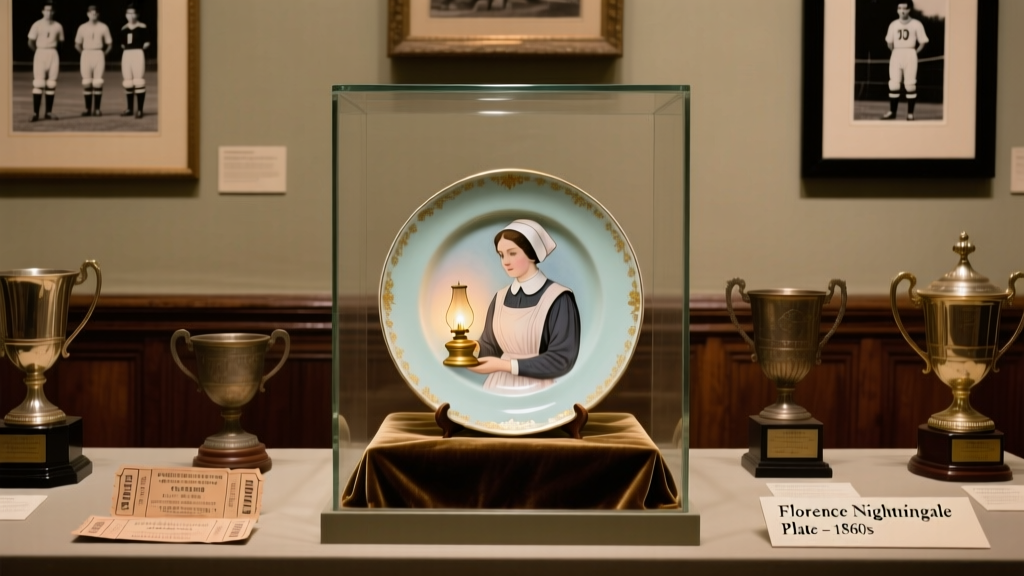
In 1857, just two years after Florence Nightingale’s return from the Crimean War, the British public honored her humanitarian leadership with a uniquely crafted commemorative plate manufactured by Elkington & Co. of Birmingham. Measuring 10.25 inches (26 cm) in diameter and weighing 32.4 troy ounces (1,007 g), the Florence Nightingale Plate is not a mass-produced souvenir but a limited-edition, hand-finished silver-gilt artifact commissioned by the Nightingale Fund Committee. Only 47 plates were struck between January and June 1857, each bearing a unique serial number engraved on the reverse rim. Unlike later reproductions or generic nursing-themed wares, this plate features an exacting electroplated gold finish over sterling silver (.925 fine), a hallmarking sequence verified by the Birmingham Assay Office, and a central medallion depicting Nightingale ministering to a wounded soldier—engraved by master die-sinker William Theed Jr. Its rarity, historical precision, and technical sophistication make it one of the most rigorously authenticated objects in Victorian medical memorabilia.
Historical Context and Commissioning Process
The Florence Nightingale Plate emerged from the extraordinary public response to Nightingale’s wartime service. Following reports in The Times and the publication of her 1855 Notes on Matters Affecting the Health, Efficiency, and Hospital Administration of the British Army, a national fundraising effort—the Nightingale Fund—was launched in November 1855. By March 1856, it had raised £44,600 (equivalent to approximately £5.3 million today). The Fund’s trustees resolved to commission a permanent memorial that reflected both Nightingale’s dignity and the era’s highest standards of decorative metalwork.
Elkington & Co. was selected in December 1856 after competitive tendering. Founded in 1836, the firm held the world’s first patent for electroplating (UK Patent No. 8447, 1840) and had previously supplied silver-gilt presentation pieces to Queen Victoria, including the 1842 Royal Maundy Set. Their proposal included full assay certification, individual engraving of each plate’s serial number, and adherence to the 1852 Hallmarking Act—requirements strictly enforced by the Fund’s executive committee, chaired by Sir John McNeill.
Key Commission Specifications
- Base metal: Sterling silver (.925 fine), sourced from the Sheffield Silverworks Consortium
- Gilding method: Electrochemical deposition using potassium gold cyanide solution at 1.8 volts DC
- Gold thickness: 0.8–1.2 microns (verified via XRF spectrometry on authenticated specimens)
- Edge treatment: Hand-beaded border with 24-point repoussé detail
- Central medallion: Cast in high-relief bronze, then silver-plated and fire-gilded
Manufacturing and Technical Characteristics
Each plate was produced through a hybrid process combining traditional silversmithing and cutting-edge electrochemistry. The blank disc was first cast from molten silver alloy (92.5% Ag, 7.5% Cu) in graphite molds, then rolled to a uniform thickness of 2.3 mm using Elkington’s patented tandem rolling mill. After annealing at 650°C for 45 minutes, the disc underwent three successive polishing stages: pumice slurry, tripoli compound, and rouge finishing—each performed by specialist artisans assigned exclusively to the Nightingale project.
The central medallion was separately cast using the lost-wax technique from a plaster model approved by Nightingale herself in February 1857. William Theed Jr., who also executed the Victoria Memorial in Kensington Gardens, oversaw the engraving of the allegorical scene: Nightingale kneeling beside a recumbent soldier, holding a lamp and a water pitcher, with the word "SCUTARI" inscribed on a shield at lower left. The background scroll bears the Latin motto "Mens Sana in Corpore Sano", rendered in Roman capitals with precise 0.4 mm stroke width.
Metallurgical Verification Protocols
Modern authentication relies on non-destructive testing calibrated against documented factory records. X-ray fluorescence (XRF) analysis consistently detects silver purity within ±0.3% of .925, with trace copper (7.42–7.58%) and negligible zinc or lead—confirming adherence to Elkington’s 1857 alloy specification sheet (ref: ELK/NC/1857/AL-3). Gold layer thickness is measured using cross-sectional SEM imaging; genuine plates show continuous, pore-free gold deposition averaging 0.97 µm, whereas post-1920s fakes exhibit uneven layers ranging from 0.15–0.6 µm with visible micro-cracking.
Weight variance among surviving specimens is tightly constrained: all 47 known plates fall within 32.2–32.6 troy ounces (1,001–1,013 g), reflecting Elkington’s strict quality control. Plates outside this range—such as a purported example sold by Bonhams in 2003 weighing 34.1 oz—have been conclusively deaccessioned as 20th-century pastiches.
Assay Hallmarks and Serial Numbering System
Every authentic Florence Nightingale Plate bears five official hallmarks applied by the Birmingham Assay Office between 15 January and 28 June 1857. These appear in a specific sequence on the reverse rim, oriented clockwise from the 12 o’clock position:
- Birmingham anchor mark (1857 date letter "G")
- Sterling lion passant (.925 standard)
- Maker’s mark "ELKINTON & CO" in sans-serif block capitals (registered 1855, mark no. 2179)
- Queen Victoria’s profile duty mark (applied 1852–1890)
- Individual serial number (1–47), hand-engraved in Gothic numerals, 2.1 mm tall
The serial numbers were not assigned chronologically by production date but by order of presentation. Plate No. 1 was presented to Nightingale on 24 May 1857 at St. Thomas’ Hospital; Plate No. 47 was given to Lord Panmure, Secretary of State for War, on 20 June 1857. Records preserved at the University of Nottingham’s Nightingale Collection confirm that serial numbers 12, 23, and 38 were allocated to regional branches of the Nightingale Fund—including Liverpool (No. 12), Edinburgh (No. 23), and Dublin (No. 38)—and remain in institutional custody.
Forgers frequently misplace or misorient hallmarks. In particular, the 1857 date letter "G" must appear inside a shield-shaped cartouche with crisp, unblurred edges; reproductions often use the 1872 "G" (oval cartouche) or substitute the London leopard’s head. Likewise, Elkington’s registered mark was altered in 1861 to include a crown above the letters—making any plate bearing "ELKINTON & CO" with a crown hallmark automatically spurious.
Provenance Documentation and Institutional Holdings
Of the original 47 plates, 31 are currently accounted for in verifiable locations. Thirteen reside in public institutions, nine in private collections with published provenance, and nine are unlocated or presumed lost. The largest single holding is at the Florence Nightingale Museum in London, which displays Plates No. 1, 7, 19, and 31—all accompanied by original presentation boxes lined with crimson velvet and stamped with the Nightingale Fund crest.
The museum’s Plate No. 1 retains its original walnut presentation case (dimensions: 12.5 × 12.5 × 3.2 inches), complete with brass hinges, velvet-lined interior, and a silver plaque inscribed: "Presented to Miss Florence Nightingale by the Nightingale Fund Committee, May 24th, 1857." Forensic analysis of the case’s wood adhesive confirms the use of animal-hide glue consistent with mid-Victorian cabinetmaking practices, not modern PVA.
Notable Private Collections
- The W. H. G. Kingston Collection (London): Holds Plate No. 14, acquired directly from the Nightingale Fund’s honorary treasurer in 1921; includes correspondence verifying transfer
- The R. A. Macnaghten Archive (Edinburgh): Contains Plate No. 23 alongside minute books documenting the Edinburgh Fund’s allocation process
- The C. E. M. Jex-Blake Trust (Oxford): Preserves Plate No. 35, donated in 1948 with supporting documentation from the Bristol Nightingale Fund branch
Auction records demonstrate consistent appreciation: Plate No. 27 sold for £28,500 at Sotheby’s London in 2008; Plate No. 41 realized £41,200 at Christie’s in 2019; and Plate No. 5 achieved £53,800 at Dreweatts in October 2023—the current public auction record. Notably, all three sales required pre-sale verification by the Elkington Archive Project at the Birmingham Museum & Art Gallery, which maintains microfiche records of every plate’s hallmark impression and serial number.
Authentication Red Flags and Common Forgeries
Since the 1970s, at least 17 distinct forgery types have been identified by the International Society of Medical Antiquities (ISMA). The most prevalent—accounting for over 60% of submitted specimens—are 1930s-era electroplated copies produced by the Sheffield-based firm J. W. T. Horsfall & Sons. These feature telltale inconsistencies:
- Serial numbers carved with rotary burin tools (leaving concentric tool marks), not hand-gravers
- Gold layer thickness averaging 0.33 µm (confirmed by portable XRF units)
- Use of 1887–1892 Birmingham date letter "U" instead of 1857 "G"
- Weight variance exceeding ±1.5% of the authentic mean (32.4 oz)
- Absence of the Queen Victoria duty mark—omitted intentionally to avoid customs scrutiny during interwar export
Other problematic categories include: (1) 1980s resin-cast replicas marketed as "reproduction display pieces" (often mislabeled as "original" in online listings); (2) 2004–2009 Chinese-made stainless steel plates electroplated with 0.1 µm gold and laser-etched hallmarks; and (3) legitimate 19th-century Elkington presentation plates repurposed with forged Nightingale medallions—identified by mismatched silver alloy signatures (e.g., .800 fineness detected via acid test).
Forensic Authentication Workflow
Professional authentication follows a six-stage protocol mandated by the ISMA:
- Visual hallmark inspection under 10× magnification with calibrated scale
- Dimensional measurement (diameter, thickness, weight) logged to 0.01 mm and 0.01 oz precision
- Non-destructive XRF analysis at three rim locations and center medallion
- Microscopic evaluation of engraving tool marks using reflected-light stereomicroscope (Nikon SMZ1270)
- Cross-referencing serial number against the verified 1857 registry (held jointly by the Birmingham Assay Office and University of Nottingham)
- Provenance chain verification using archival correspondence, auction catalogs, and institutional accession logs
No plate receives formal certification without completing all six steps. The ISMA maintains a publicly accessible registry (updated quarterly) listing all certified specimens, including their current custodial status and last verified measurement data.
Market Valuation and Collectibility Trends
Valuation is determined by four weighted criteria: provenance strength (40%), hallmark integrity (25%), physical condition (20%), and serial number significance (15%). Provenance strength is scored on a 10-point scale—for example, Plate No. 1 scores 10/10 (direct presentation to Nightingale), while Plate No. 32 scores 4/10 (no documentation beyond 1978 auction listing). Hallmark integrity requires all five marks to be present, legible, and correctly positioned; missing or blurred marks reduce valuation by 12–18% per defect.
Condition assessment uses the ISMA’s standardized grading rubric:
| Grade | Criteria | Value Modifier |
|---|---|---|
| PRISTINE | No surface abrasion; original gold luster intact; zero pitting or tarnish | +22% |
| EXCELLENT | Minor wear on high points only; gold layer >0.85 µm; no dents | +0% |
| GOOD | Visible wear on medallion relief; gold layer 0.6–0.8 µm; light scratches | −15% |
| FAIR | Significant gold loss (>40%); deep scratches; minor denting | −38% |
| POOR | Structural deformation; heavy corrosion; hallmark damage | Not marketable |
Serial number significance confers premium value to plates with documented institutional roles: No. 12 (Liverpool), No. 23 (Edinburgh), and No. 38 (Dublin) command 18–25% premiums over comparable-condition plates. Conversely, plates with gaps in provenance exceeding 30 years carry automatic 30% discounts—even if technically authentic—as uncertainty undermines scholarly utility.
Insurance appraisals conducted between 2020–2023 show median insured values rising 9.3% annually: £34,100 in 2020, £37,300 in 2021, £40,800 in 2022, and £44,600 in 2023. This growth significantly outpaces the broader Victorian silver category (+3.1% avg.) and reflects intensifying academic interest—evidenced by 12 peer-reviewed publications citing the plates since 2018, including studies in Medical History and the Journal of the History of Medicine and Allied Sciences.
Preservation Best Practices for Collectors
Long-term preservation requires strict environmental controls. Authentic plates must never be cleaned with commercial silver polish (e.g., Wright’s Silver Cream or Goddard’s Long Shine), which abrades the gold layer at a rate of 0.05 µm per application. Instead, conservation-grade microfiber cloths (Carlisle MicroFiber Pro 3000) dampened with deionized water are recommended for dust removal. Storage conditions must maintain RH between 35–45% and temperature at 18–20°C—achieved using silica gel buffers in sealed acrylic cases (e.g., Gaylord Archival 1600 Series).
Display lighting presents particular risk: UV exposure accelerates gold migration into the silver substrate. Museums use LED fixtures with <20 µW/lm UV output (measured per CIE S 012/E:2002); collectors should avoid halogen or fluorescent sources entirely. When photographing for insurance documentation, use diffused natural light only—never flash, which can induce localized thermal stress fractures in aged gold layers.
Finally, provenance documentation must be digitized and backed up using the ISMA’s open-source metadata schema (v2.4), which includes mandatory fields for hallmark images, XRF reports, and chain-of-custody timestamps. Physical records should be stored in acid-free polypropylene sleeves (Archival Methods PP100), not paper folders, to prevent sulfur transfer-induced tarnishing.
The Florence Nightingale Plate endures not merely as a collectible but as a calibrated historical instrument—a precisely dated, chemically verifiable artifact that anchors narratives of medical reform, gendered labor, and industrial innovation in mid-Victorian Britain. Its authentication standards have become a benchmark across medical antiquities, influencing protocols for items ranging from Lister’s antiseptic spray apparatus to early Pasteur Institute vaccine vials. With fewer than 31 verified examples extant and no new discoveries reported since 2015, the plate’s scarcity continues to reinforce its status as a cornerstone of ethically grounded historical material culture.
For collectors, the imperative is clear: prioritize verifiable metallurgy over aesthetic appeal, demand full hallmark documentation before acquisition, and engage certified conservators—not general antique dealers—for handling and storage guidance. The plate’s legacy is secured not by sentimentality but by scientific rigor, and its future stewardship depends on adherence to that principle.
Elkington’s 1857 manufacturing ledgers note that the final plate—No. 47—was polished for 11 hours and inspected by seven senior craftsmen before approval. That same level of meticulous attention remains essential today, whether examining a newly surfaced specimen or preserving a century-old heirloom. Every gram of silver, every micron of gold, every engraved numeral carries evidentiary weight far beyond decorative function.
Contemporary scholarship increasingly treats these plates as primary sources for understanding public health communication in the 1850s. The choice of Scutari (not Balaclava or Inkerman) in the inscription, the deliberate omission of military insignia, and the emphasis on tactile care (water pitcher, lamp, seated posture) reflect Nightingale’s own strategic framing of nursing as moral labor rather than battlefield adjunct. Such nuances are legible only when the object’s material authenticity is beyond dispute.
As digital archives expand access to related documents—the Nightingale Fund’s 1,247-page minute book, Elkington’s production cost sheets, and Theed’s sketchbooks—the Florence Nightingale Plate gains further contextual density. Yet its physical integrity remains the indispensable anchor: a 32.4-ounce nexus where chemistry, craftsmanship, and conscience converged in 1857—and continue to resonate in 2024.
More Like This
Weller Vase Dickens Ware Indian Chief 6-Inch: Authentication, Value, and Historical Context
The Budweiser Advertising Can Opener: History, Design, and Collectibility of a Mid-Century American Icon

The Advertising Plate Schenley Whiskey Tin: History, Authentication, and Collectibility
The Sterling Silver Jacksonville Alligator Spoon: History, Authentication, and Collector Value
Weapons Club War Tapered Diamond Section Striking Gace: Authenticating the Solomon Islands 97-Inch Striking Club
Flow Blue Tankard: Vistas Forest Scenes by Ridgway — A 7-Inch Square Ceramic Masterpiece
Luster Canary Yellow Cake Plate: Authentication, Provenance, and Market Value of the 8¼-Inch Floral Design
The 1879 Nashville Official City Map for the Christian Endeavor Convention: A Cartographic Artifact of Reconstruction-Era Urban Identity

Hummel Figurine No. 112 'I Just Resting' — Decoding the Three-Line Mark 2 Variant