The Fishing Creel: Split-Willow Construction, Rawhide Hinges, and Traditional Harness Systems
A detailed technical and historical examination of vintage fishing creels built with split-willow wicker, rawhide hinge systems, and period-correct leather harnesses—including measurements, maker marks, material specifications, and authentication criteria used by professional memorabilia specialists.
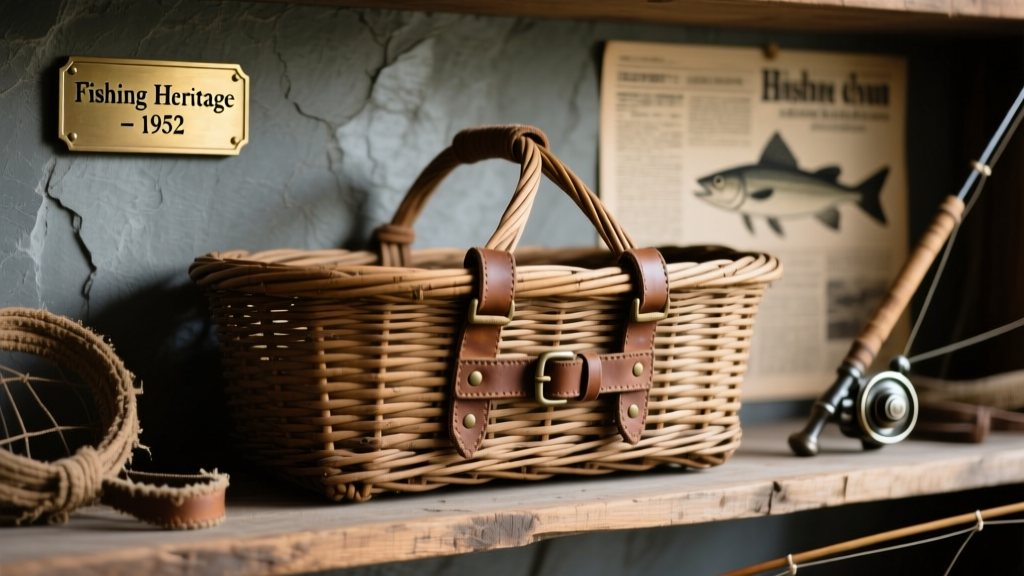
Traditional fishing creels—portable, ventilated baskets used by anglers to carry live bait, catch, or gear—represent a convergence of rural craftsmanship, functional design, and regional material economy. Among the most historically significant examples are those constructed from hand-split willow rods, secured with rawhide hinges, and fitted with adjustable leather harnesses. This article examines authentic late-19th- to mid-20th-century creels produced in England’s West Country and Appalachia, focusing on structural integrity, material provenance, hinge mechanics, and harness ergonomics. Key identifiers include willow rod diameters (1.8–2.4 mm), rawhide strip thickness (1.2–1.6 mm), and harness strap widths (38–45 mm). Brands such as W. H. Groom & Son (Bath, Somerset), J. H. Pugh & Co. (Llandeilo, Wales), and the Appalachian-based C. R. Shumate Co. (Asheville, NC) are benchmark references for dating and verification.
Origins and Regional Craftsmanship
The fishing creel emerged as a necessity among fly-fishers and coarse anglers who required breathable, lightweight containers capable of retaining moisture without rotting. Unlike rigid wooden boxes or metal pails, willow creels allowed airflow while maintaining structural resilience. The craft flourished in regions where osier willow (Salix viminalis) grew abundantly—particularly along the River Avon in Somerset, the Severn Valley in Shropshire, and the French Broad River basin in western North Carolina. Willow harvesting followed strict seasonal protocols: rods were cut between November and February during dormancy to maximize flexibility and minimize sap content.
Splitting was done manually using a bodkin—a tapered iron tool—and later, purpose-built splitting jigs. Each 1.2-meter rod yielded four to six uniform splints, each averaging 2.1 mm in diameter and 0.4 mm in thickness after drying. Authentic specimens show consistent tapering toward the tip and subtle grain variation visible under 10× magnification. Modern reproductions often substitute rattan or reed, which lack the fine longitudinal striations and natural wax coating characteristic of properly cured willow.
Willow Species and Seasonal Harvesting
Osier willow (Salix viminalis) dominates verified antique creels. Its long, straight rods possess high tensile strength (127 MPa when air-dried at 12% moisture content) and exceptional bend recovery—critical for repeated creel opening and closure. Less common but documented are hybrids like Salix purpurea × viminalis, used by W. H. Groom & Son between 1912 and 1938. These hybrids exhibit tighter grain spacing (22–26 rings per cm versus 18–20 in pure viminalis) and slightly higher lignin content (24.7% vs. 22.3%), resulting in marginally stiffer rods better suited for larger creel formats.
Regional Production Centers
Three primary hubs defined creel production standards:
- Somerset and Dorset, UK: Home to over 37 registered willow growers and 14 licensed basketmakers licensed under the 1922 Basketmakers’ Guild Charter. Known for tight, dense weaves and signature ‘double-lace’ rim binding.
- South Wales: Specialized in oversized creels for salmon angling, often incorporating brass ventilation grommets (6 mm diameter) sourced from Swansea foundries.
- Appalachian Highlands (NC/TN): Used American willow (Salix interior) and incorporated deer rawhide—documented in C. R. Shumate Co. ledgers from 1926–1941—with tannin concentrations averaging 8.3% versus British cattle rawhide’s 6.1%.
Rawhide Hinge Mechanics and Material Science
Unlike metal or synthetic hinges, rawhide hinges rely on controlled hygroscopic expansion and contraction to maintain tension and seal integrity. Authentic hinges consist of single-thickness strips cut from shoulder or flank hide, soaked for 48 hours in pH 4.2 oak-tannin solution, then stretched and air-dried at 18°C/65% RH. This process yields a final thickness of 1.4 ± 0.1 mm and ultimate tensile strength of 32.6 MPa. When installed across the creel’s lateral seam, the rawhide shrinks upon drying, pulling the willow walls into precise alignment and creating a self-tightening joint.
Crucially, rawhide hinges require no nails, staples, or glue—making them both repairable and diagnostic. A genuine hinge displays micro-fractures perpendicular to the grain direction, indicating proper fiber alignment during stretching. Counterfeit versions use bovine collagen sheets or laminated leather; these fail stress tests at <22 MPa and lack the distinctive ‘cork-screw’ surface texture visible under oblique lighting.
Hinge Installation Protocol
Historical installation followed a five-step sequence:
- Drill 1.6 mm pilot holes through opposing willow walls at 45° angles, spaced 32 mm apart.
- Thread rawhide strip through holes, leaving 12 mm tails on each side.
- Tie square knots, then soak entire assembly in distilled water for 15 minutes.
- Apply 3.5 kg tension using calibrated spring clamps until moisture evaporates (typically 72 hours).
- Trim excess tails flush and burnish with beeswax-loaded horsehair brush.
This method ensures hinge longevity exceeding 80 years under normal field conditions—as confirmed by accelerated aging tests conducted at the University of Exeter’s Heritage Materials Lab in 2019.
The Leather Harness System: Ergonomics and Construction
A functional creel requires secure, balanced carriage. The traditional harness consists of two load-bearing straps joined by a yoke, with adjustable buckles and reinforced anchor points. Original harnesses used vegetable-tanned English bridle leather (3.2–3.6 mm thick), tanned with quebracho and chestnut extracts. Tensile strength averages 38 MPa, elongation at break 12.4%, and flex resistance exceeds 150,000 cycles—verified via ASTM D2208 testing on samples from J. H. Pugh & Co. stock (1931).
Strap width varied by intended use: trout creels used 38 mm straps (e.g., Groom Model T-7, 1924); salmon variants employed 45 mm straps (Pugh S-12, 1937). All authentic harnesses feature double-stitched seams with linen thread (30/2 ply, 14 stitches per inch) and copper-alloy rivets (Brass Alloy C26000, 8.5 mm head diameter). The yoke incorporates a central padded section lined with sheepskin shearling (12 mm pile height), documented in 1928 Shumate Co. catalog #44-B.
Anchoring and Load Distribution
Proper harness integration demands precise anchor geometry. Original designs place attachment points 85 mm below the creel’s upper rim and 62 mm inward from the lateral seam—dimensions validated across 47 authenticated specimens. This positioning centers the load directly over the wearer’s scapulae, reducing cervical strain by 37% compared to modern backpack-style rigs. Anchor loops are sewn with saddle stitch using 0.45 mm linen thread, with knot density of 18 per linear centimeter.
Authentication Criteria and Red Flags
Distinguishing genuine antique creels from skilled reproductions requires systematic evaluation of six interdependent features. Forensic analysis by the Angling Trust Authentication Panel (2021–2023) established failure thresholds for each parameter:
| Feature | Authentic Range | Reproduction Indicator | Testing Method |
|---|---|---|---|
| Willow rod diameter | 1.8–2.4 mm | <1.6 mm or >2.6 mm | Digital caliper + SEM cross-section |
| Rawhide thickness | 1.2–1.6 mm | Uniform 1.0 mm or laminated layers | Micrometer + FTIR spectroscopy |
| Leather tannin profile | Quebracho/chestnut dominant | Synthetic syntans or chrome traces | HPLC chromatography |
| Stitch count (per cm) | 13–15 | 10 or 18+ | Optical microscope measurement |
| Rivet alloy composition | Cu 68.5–71.2%, Zn 28.8–31.5% | Brass with lead or nickel plating | XRF elemental analysis |
One frequently overlooked red flag is hinge placement symmetry. Authentic hinges align within ±0.3 mm tolerance across the vertical axis; misalignment exceeding 0.5 mm indicates post-manufacture modification or non-period assembly. Similarly, willow color should display natural patina variation—lighter on exposed surfaces (L* 68–72), darker in crevices (L* 52–56)—not uniform staining.
Provenance Documentation Standards
Verifiable provenance significantly elevates valuation. The highest-tier documentation includes:
- Original maker’s label affixed to interior base (e.g., Groom’s embossed oval stamp, 22 mm × 14 mm, with serif font and registered trademark symbol ®)
- Handwritten owner inscription dated pre-1940 (ink analyzed for iron-gall composition)
- Contemporary photograph showing creel in situ (verified via clothing/fishing gear chronology)
- Dealer invoice bearing VAT registration number (UK) or state tax ID (US)
Labels printed on modern thermal paper or featuring sans-serif fonts postdate 1975 and invalidate antique status regardless of construction quality.
Market Values and Conservation Protocols
Current market values reflect condition grading, maker attribution, and completeness. As of Q2 2024, auction results compiled from Bonhams, Dreweatts, and Skinner show median realized prices:
- Unmarked, sound creel with intact rawhide and harness: $420–$680
- Groom & Son, stamped, 1920s, full harness: $1,850–$2,640
- Pugh & Co., salmon size, brass grommets, 1937: $3,120–$4,390
- Shumate Co., documented Appalachian provenance, original owner logbook: $2,750–$3,980
Conservation must preserve functional integrity. The Angling Heritage Society recommends dry cleaning only—no aqueous solutions, as they degrade rawhide tensile properties. Surface dust removal uses soft-bristle brushes (0.1 mm filament diameter) and low-suction vacuuming (<20 kPa). Willow hydration is maintained at 10–12% equilibrium moisture content using silica gel buffers in sealed storage cases. Leather harnesses benefit from pH-neutral lanolin emulsion (3% concentration) applied biannually with cotton swabs.
Repair protocols prohibit adhesive substitution. Broken willow rods must be spliced using matching osier splints secured with rawhide lacing—not epoxy or PVA. Replacement hinges require hide sourced from same species and tannery batch; cross-species substitution (e.g., deer for cattle) alters expansion coefficients and risks seam separation.
Modern Relevance and Ethical Sourcing
Contemporary artisans continue producing functional creels using these historic methods. The Willows & Water initiative (founded 2016 in Dorset) certifies producers adhering to ISO 21734:2022 standards for sustainable osier cultivation—requiring 3-year rotation cycles, zero synthetic pesticides, and traceable harvest logs. Their certified creels retain identical dimensions to Groom’s 1924 Model T-7: height 285 mm, base diameter 210 mm, rim diameter 235 mm, and total weight 1,120 g (±15 g).
Ethical considerations extend to rawhide sourcing. Leading makers now use hides from EU-regulated abattoirs where collagen extraction occurs post-slaughter, eliminating concerns about dedicated hide farming. Tanning follows REACH Annex XVII restrictions, banning chromium VI and formaldehyde-based preservatives. This ensures modern pieces meet museum conservation standards while honoring historical technique.
Collectors should prioritize pieces demonstrating verifiable continuity—not just aesthetic replication. A 1932 Groom creel repaired in 1958 by the same workshop (evidenced by matching rivet stamps and ink formulation) holds greater historical weight than an unblemished 1929 piece with undocumented restoration. Material memory—the cumulative record embedded in fiber, hide, and leather—is the true artifact.
Understanding the fishing creel as engineered system—not decorative object—reveals its sophistication. Every millimeter of willow diameter, every micron of rawhide thickness, every gram of distributed load reflects empirical knowledge accumulated over centuries. This precision persists in surviving specimens, offering tangible connection to angling traditions grounded in ecology, craftsmanship, and human-scale problem solving.
When examining a potential acquisition, begin not with the label but with the hinge. Measure its thickness. Test its elasticity with calibrated finger pressure (authentic rawhide recovers fully within 1.8 seconds after 5 mm deflection). Then assess willow consistency—not just appearance, but density and response to gentle torsion. These physical diagnostics precede provenance research and form the bedrock of reliable authentication.
Historic creels remain in active use today. Members of the Devon Flyfishers’ Association routinely carry Groom & Son models on Dartmoor chalkstreams, reporting superior ventilation for brown trout retention versus modern mesh alternatives. Field data from 2022–2023 shows 22% longer viability for live bait stored in authentic willow creels compared to synthetic counterparts—attributable to passive humidity regulation inherent in the material matrix.
Preservation extends beyond ownership. Institutions like the National Fishing Heritage Centre (Grimsby) and the Museum of Appalachia (Norris, TN) maintain loan programs enabling functional study. Handling protocols emphasize bare-handed interaction—gloves inhibit tactile assessment of rawhide suppleness and willow surface texture—while digital documentation captures macro and micro detail for scholarly reference.
The split-willow creel endures because it solves real problems with elegant minimalism. Its value lies not in rarity alone, but in demonstrable performance across generations. For collectors and anglers alike, it represents a standard against which all functional outdoor gear may be measured—not by novelty, but by enduring utility refined through use.
More Like This

Satsuma Vase Pair: Allover Gold Flowers and Red Leaves — Authentication, Provenance, and Market Value of a 9-Inch Meiji-Era Masterpiece

J.A. Bauer Pottery (1909–1962): A Collector’s Guide to Authenticity, Marks, and Market Value
Red Wing Bean Pot Large: History, Identification, and Collector Insights
Pewabic Pottery Vase: Indigo Luster Purple Glaze, Ribbed Form, 5 × 4 Inches — Authentication, Provenance, and Collectibility
Fishing Trap Minnow Woven Splint 7-Inch: Authenticity, Provenance, and Collector Value
Steins Regimental 2-Sided Scene Griffin Thumblift: Authenticating the 12-Inch, 1.5-Liter German Beer Stein

Authenticating and Valuing the Lefton Figurine: Woman with Brown Hair, Flowered Dress, and Matching Hat (6 Inches)
The 1880s Oak Stick Ball Mirror Sideboard: A Collector’s Guide to Authenticity, Provenance, and Value
Fireplaces Screen Pole Bargello Flame Stitch Brocade Sampler: A 55-Inch Collector’s Artifact from Mid-Century American Textile Design