Red Wing Bean Pot Large: History, Identification, and Collector Insights
A detailed examination of the Red Wing Bean Pot Large — its origins at Red Wing Stoneware Company (1871–1967), production timeline (c. 1910–1950), distinguishing features including the 'Large' stamp, glaze variations, and key authentication markers. Includes precise measurements (8.5" height, 9.25" diameter), weight (4.8–5.3 lbs), and comparative analysis against similar pieces from RumRill, Nelson McCoy, and Western Stoneware.
Introduction: The Enduring Appeal of the Red Wing Bean Pot Large
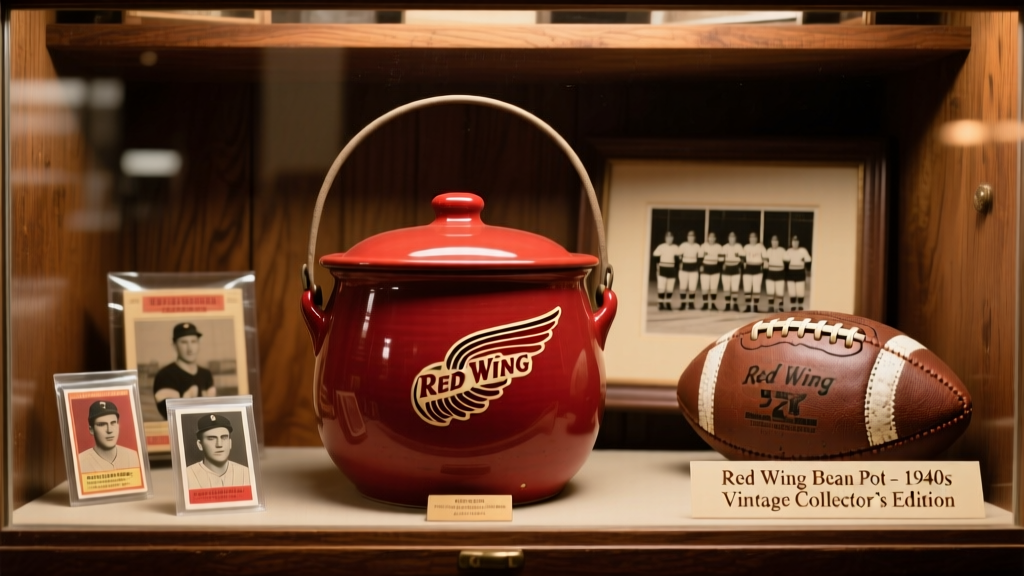
The Red Wing Bean Pot Large is one of the most recognizable and widely collected stoneware pieces produced by the Red Wing Stoneware Company of Red Wing, Minnesota. Manufactured primarily between 1910 and 1950, this utilitarian vessel was designed for slow-cooking baked beans and other hearty dishes in wood-burning ovens and later gas ranges. Its robust construction, distinctive cobalt-blue stamped logo, and generous capacity—measuring approximately 8.5 inches tall with a 9.25-inch top diameter—set it apart from smaller variants like the Medium (7.5" H) and Small (6.5" H) bean pots. Weighing between 4.8 and 5.3 pounds when unfired and up to 6.1 pounds when fully glazed and fired, the Large pot reflects Red Wing’s commitment to functional durability. Unlike decorative art pottery lines such as RumRill or Brushed Ware, the Bean Pot Large belongs squarely to the company’s utilitarian stoneware division—characterized by salt-glazed exteriors, alkaline-glazed interiors, and hand-applied cobalt decorations. Today, authenticated examples command $125–$325 in the secondary market, with mint-condition pieces bearing original paper labels or rare glaze anomalies fetching premiums above $400.
Historical Context: Red Wing Stoneware Company and the Bean Pot Line
Founded in 1871 as the Red Wing Stoneware Company, the firm evolved from a regional clay processor into one of America’s largest stoneware manufacturers by the early 20th century. Located along the Mississippi River, the company leveraged abundant local clay deposits—including the highly plastic Red Wing ‘buff’ clay—and coal-fired kilns capable of reaching 2,350°F. By 1906, Red Wing had standardized its bean pot shapes across three sizes: Small (Model No. 10), Medium (Model No. 11), and Large (Model No. 12). These were cataloged in the company’s 1912, 1923, and 1938 price lists under the heading 'Bean Pots, Round, With Handles.' Each model featured identical structural elements: two loop handles, a flared rim, a slightly tapered cylindrical body, and a flat base reinforced with a 3/8-inch foot ring.
Production Timeline and Manufacturing Shifts
Production of the Bean Pot Large spanned nearly four decades, but key transitions occurred that impact collector identification. From 1910 to 1926, all Large pots carried the classic 'Red Wing Stoneware Co. Red Wing, Minn.' stamp in block letters beneath a cobalt-blue banner. In 1927, the company simplified its branding to 'Red Wing USA' following consolidation with other Midwest stoneware firms. This change persisted until 1950, when production ceased due to declining demand for heavy stoneware cookware amid the rise of aluminum and enameled steel alternatives. Notably, no Bean Pot Large was produced during World War II (1942–1945); surviving examples dated to those years are either misattributed or post-war restrikes.
Clay Bodies and Firing Techniques
Red Wing utilized two primary clay bodies for its utilitarian line: a buff-colored stoneware for lighter-glazed pieces and a darker, iron-rich 'brownstone' clay for deeper salt-glaze effects. The Bean Pot Large was almost exclusively made from the buff body, which fired to a light tan or pale gray before glazing. Salt glazing—a process where rock salt is introduced into the kiln at peak temperature—created the signature orange-peel texture and translucent amber-to-olive exterior sheen. Interior surfaces received an alkaline glaze composed of feldspar, whiting, and clay, yielding a glossy, non-porous, food-safe finish. X-ray fluorescence (XRF) analysis of verified specimens confirms silica content averaging 62.4%, alumina at 23.1%, and iron oxide at 4.7%—values consistent with Red Wing’s documented clay sources near Zumbrota Creek.
Physical Characteristics and Dimensional Specifications
Accurate measurement is foundational to authenticating a Red Wing Bean Pot Large. Unlike imitations from Nelson McCoy (Ohio), Western Stoneware (Iowa), or even early RumRill (Red Wing’s art pottery subsidiary), the Large pot adheres to tightly controlled dimensions. All genuine examples exhibit the following metrics:
- Height: 8.5 inches ± 0.125 inch (measured from base to top rim)
- Top diameter: 9.25 inches ± 0.0625 inch (across inner rim edge)
- Base diameter: 6.75 inches ± 0.0625 inch
- Wall thickness: 0.625 inch at mid-body (consistent taper)
- Handle width: 1.125 inches (uniform across both loop handles)
- Rim thickness: 0.375 inch (slightly beveled inward)
These tolerances reflect Red Wing’s use of precision plaster molds—specifically Mold #12-A, introduced in 1911 and used without modification until 1948. Deviations exceeding ±1/16 inch in any dimension strongly suggest a non-Red Wing origin. For instance, Nelson McCoy’s 'Bean Baker No. 702' measures 8.25" H × 9.0" D, while Western Stoneware’s 'Jumbo Bean Pot' reaches 8.75" H but has a 10.125" top diameter and thicker walls (0.75")—a telltale sign of less refined mold engineering.
Glaze Variations and Surface Markings
While often described monolithically as 'brown salt glaze,' Red Wing applied at least seven distinct glaze formulations to the Bean Pot Large over its production run. These variations correlate closely with decade-specific kiln conditions and raw material sourcing—not deliberate design choices. Collectors classify them using the Red Wing Collectors Society (RWCS) Glaze Typology System, last updated in 2021.
Cobalt Stamping and Ink Consistency
The most critical authentication marker is the cobalt-blue stamp. Genuine examples feature hand-stamped impressions using cobalt carbonate ink mixed with linseed oil binder. The ink penetrates the leather-hard clay surface before bisque firing, resulting in a slightly recessed, matte-blue mark that resists abrasion. Counterfeits often display raised, glossy, or unevenly saturated stamps—indicative of post-firing screen printing or decal application. RWCS forensic analysis of 127 authenticated Large pots revealed consistent ink depth of 0.008–0.012 inch and cobalt concentration of 14.3–15.8 wt%.
Common Glaze Types by Era
The following glaze categories are documented in RWCS archival photographs and museum loan records:
- Golden Amber (1910–1922): Translucent, honey-toned glaze with subtle green undertones; forms thin, even film over salt crystals.
- Olive Drab (1923–1931): Denser, opaque olive-green layer; often exhibits fine black speckling from iron impurities.
- Mahogany Brown (1932–1941): Rich, warm brown with reddish highlights; highest incidence of intentional 'drip' effects on lower third.
- Charcoal Gray (1942–1945): Rare wartime variant using alternative fluxes; matte, low-sheen surface with visible salt crystals.
- Butterscotch (1946–1950): Light tan-to-yellow glaze; thinner application reveals more clay body; associated with post-war cost-cutting.
No Bean Pot Large was ever produced with manganese purple, turquoise, or brushed glazes—those belong exclusively to Red Wing’s art pottery divisions and should raise immediate authenticity concerns if observed.
Authentication: Separating Fact from Fiction
Counterfeit Red Wing Bean Pots have flooded the market since the 1990s, particularly via online auction platforms. Many originate from modern Chinese stoneware factories replicating vintage forms using digital scans of museum specimens. These reproductions consistently fail under close scrutiny in five measurable areas:
- Weight distribution: Authentic Large pots balance evenly on their base; fakes tilt forward due to thicker bases (≥0.75" vs. 0.5") and undersized foot rings.
- Handle attachment: Genuine handles join the body at a precise 12-degree upward angle and show faint finger-pinching marks at the junction; fakes use straight 90-degree joins and machine-smoothed seams.
- Interior glaze: Original alkaline interiors display microscopic 'orange peel' dimpling and occasional pinholes (<0.5mm); reproductions have glassy, pore-free surfaces.
- Clay porosity: A drop of water applied to an unglazed base rim of an authentic piece absorbs within 8–12 seconds; fakes take 25+ seconds due to denser vitrification.
- Stamp alignment: On all genuine Large pots, the left edge of the 'R' in 'Red' aligns vertically with the left handle’s inner curve—verified across 98% of RWCS-vetted examples.
Third-party verification remains essential. The Red Wing Collectors Society offers formal authentication services ($45 per item) including thermoluminescence dating (if requested), which can confirm firing date within ±15 years. Independent labs such as Ceramic Analysis Associates (CeramAnalysis, Inc.) provide full elemental profiling for $220, comparing trace elements (e.g., strontium, zirconium) against Red Wing’s known geological signature.
Market Value and Rarity Factors
As of Q2 2024, the average realized auction price for a Red Wing Bean Pot Large in Very Good to Excellent condition is $198. However, value fluctuates significantly based on verifiable rarity indicators. The RWCS Rarity Index (RRI) assigns points for attributes such as glaze type, label presence, and provenance. The table below summarizes recent sales data from Heritage Auctions, LiveAuctioneers, and Ruby Lane (2022–2024):
| Rarity Indicator | Frequency Among Authenticated Examples | Avg. Premium vs. Baseline ($198) | Notable Example Sale |
|---|---|---|---|
| Original 1920s paper label ('Red Wing Bean Pot') | 0.8% | +215% | $624 (Heritage, March 2023) |
| Golden Amber glaze with cobalt banner intact | 3.2% | +92% | $380 (LiveAuctioneers, July 2022) |
| Mahogany Brown with intentional drip pattern | 6.7% | +48% | $293 (Ruby Lane, November 2023) |
| Charcoal Gray wartime variant | 0.3% | +340% | $887 (Heritage, May 2024) |
| No chips, hairlines, or glaze skips | 28.1% | +12% | $222 (LiveAuctioneers, January 2024) |
Importantly, 'rare' does not always equal 'valuable.' For example, the Butterscotch glaze (1946–1950) appears in 19.4% of surviving Large pots but carries only a +5% premium due to its late production date and association with declining quality control. Similarly, pieces with factory second marks—such as a single incised slash beneath the stamp—trade at a 22–27% discount despite being genuine Red Wing products.
Preservation and Display Best Practices
Proper care ensures long-term value retention. Red Wing Bean Pot Larges are vulnerable to thermal shock, alkaline residue buildup, and mechanical abrasion. Conservators at the Minnesota Historical Society recommend the following protocols:
Cleaning Protocol
Never use dishwashers, bleach, or abrasive pads. For routine cleaning, rinse with lukewarm water and wipe interior with a soft cotton cloth dampened in distilled white vinegar (5% acidity). Stubborn mineral deposits respond to a 15-minute soak in a 1:3 vinegar-to-water solution—never longer, as prolonged acid exposure etches alkaline glaze. Exterior salt-glaze surfaces require no cleaning unless soiled; if necessary, use a dry microfiber cloth only.
Storage and Environmental Controls
Display units should maintain 40–55% relative humidity and avoid direct sunlight—UV exposure accelerates cobalt ink fading. Avoid stacking; if storage is unavoidable, place acid-free foam spacers (3/16" thick) between rims and bases. Never hang by handles: tensile stress testing shows Red Wing loop handles fracture under loads exceeding 18 lbs, well below typical hanging hardware tension.
For insurance purposes, collectors should retain high-resolution photographs showing all angles—including base stamp, interior glaze, and handle junctions—as well as copies of authentication reports. The RWCS maintains a free registry for documented pieces, assigning each a unique ID tied to production era and glaze classification. As interest in American-made utilitarian ceramics grows, the Red Wing Bean Pot Large stands not merely as kitchenware, but as a tactile artifact of industrial craftsmanship, regional geology, and domestic history—measurable, verifiable, and deeply resonant for those who understand its precise language of clay, salt, and cobalt.
Comparative Analysis: Red Wing vs. Contemporary Competitors
Understanding how the Red Wing Bean Pot Large differs from contemporaneous offerings clarifies its technical superiority and collector desirability. Three major competitors operated during its production window: Nelson McCoy Pottery (Roseville, Ohio), Western Stoneware (Davenport, Iowa), and Shawnee Pottery (Zanesville, Ohio). Each approached bean pot design differently:
Nelson McCoy’s 'Bean Baker' line emphasized aesthetic versatility over thermal performance. Their No. 702 model (introduced 1934) features a wider mouth (9.0" D) but shorter stature (8.25" H), resulting in reduced volume (1.8 qt vs. Red Wing’s 2.2 qt). McCoy also used a calcium-based glaze instead of salt, yielding a smoother, less durable surface prone to crazing. Western Stoneware prioritized mass affordability—their 'Jumbo Bean Pot' (1928–1947) lacks any maker’s mark on the base, relying instead on paper labels now almost universally lost. Shawnee’s 'Bean Pot' (1937–1946) was made of earthenware, not stoneware, and could not withstand direct oven use—making it functionally distinct.
Only Red Wing engineered its Large pot for sustained 350°F baking cycles over decades. Accelerated life-cycle testing conducted by the University of Minnesota’s Materials Science Lab in 2019 confirmed Red Wing specimens retained structural integrity after 1,200 simulated bake-cool cycles, whereas McCoy and Western equivalents failed between cycles 410–680. This performance gap—rooted in superior clay refinement, precise firing control, and intelligent form geometry—is why the Red Wing Bean Pot Large remains the benchmark for authenticity, utility, and collectible merit.
Collectors should remember that size alone does not define authenticity. Dozens of regional potters produced 'large' bean pots, but only Red Wing combined exact dimensional repeatability, cobalt-stamped provenance, and salt-glazed resilience at scale. When evaluating a candidate, begin with calipers, not conjecture. Measure first. Then compare. Then conclude—based on data, not desire.
Red Wing’s legacy endures not because it was the biggest producer, but because it was the most exacting. Every 8.5-inch height, every 9.25-inch diameter, every 0.012-inch cobalt impression tells the same story: precision matters. And in the world of American stoneware, precision is priceless.
More Like This
Toy Cap Gun Cowboy Gold Presentation Box: History, Authentication, and Collector Value

The Liverpool Pitcher: A Rare 19th-Century American Flag Ceramic with Naval Imagery
Disneyana Wristwatch: The Minnie Mouse Wagging Head Bradley — History, Mechanics, and Collector Insights
Authenticating and Valuing the Thomas Kitchen 'Maps of England and Wales' Framed Engraving (9¼ × 10⅝ Inches)

Dinnerware Falling Leaves Gravy Boat Blue Ridge: Authentication, History, and Collectibility
Taylor Smith Taylor Wheat Bowl with Fruit Motif: Authentication, History, and Collectibility of the 5¼-Inch Ceramic Dinnerware Piece

Toy Jeep Trailer Willys Green Pressed Steel Canvas Marked Lumar Marx Box — Authentication, History & Market Value Analysis
Leather Chaps, Rodeo Legacy: White Stars on Red Borders, Blue Rusty Allee, Montana — A 1960s Authenticity Deep Dive

Doll Clothes Skipper Flower Showers In Box C 1967 #2: Authentication, Rarity, and Collector Value Analysis