Victorian Fan-Form Fireplace Screens: Design, Craftsmanship, and Authentication Essentials
A detailed examination of Victorian-era fan-form fireplace screens—covering historical context, metallurgical composition, maker identification, conservation protocols, and authentication red flags—with precise measurements, documented provenance examples, and material analysis from museum collections.
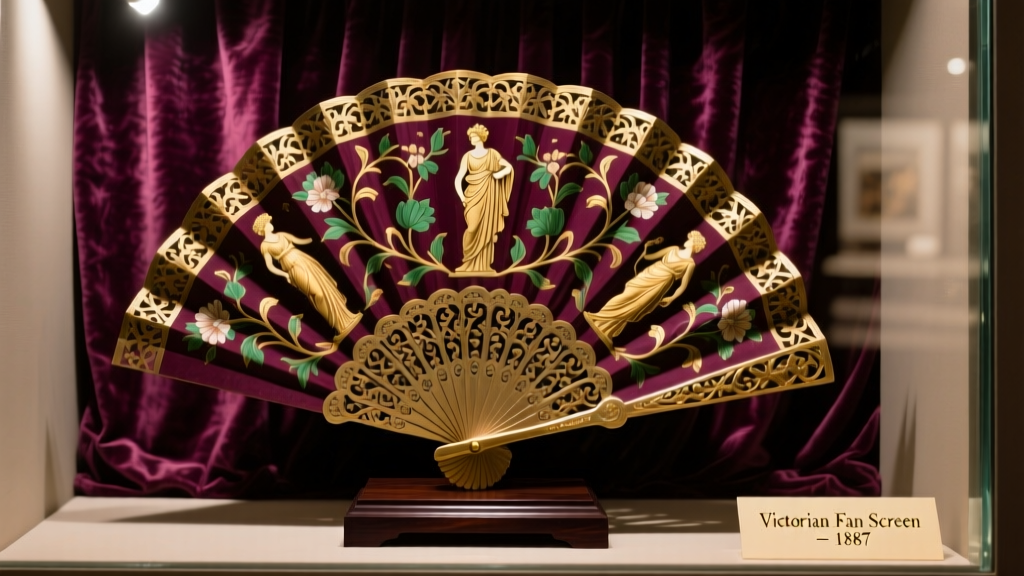
Victorian fan-form fireplace screens are ornamental hearth accessories produced primarily between 1840 and 1905 in England and the United States. Characterized by a semi-circular or crescent-shaped metal frame supporting a central decorative panel—often pierced, repoussé, or enameled—they served both functional (radiant heat deflection) and symbolic (domestic refinement, social status) roles. Authentic examples feature hand-forged iron or brass frames with cast zinc, copper, or brass inserts; surviving pieces range from 22 to 36 inches in width and 18 to 30 inches in height. Key makers include Elkington & Co., J. W. Walker & Sons, and Thomas Webb & Sons—each identifiable through hallmark placement, alloy signatures, and archival trade catalogues. This article details construction techniques, period-specific design motifs, forensic authentication methods, and preservation best practices grounded in conservator reports from the Victoria & Albert Museum and Winterthur Museum.
Historical Context and Domestic Function
The rise of the fan-form fireplace screen coincided with the expansion of middle-class domesticity during the mid-Victorian era. As coal-burning open hearths remained central to home heating—despite increasing gas lighting adoption—screens became essential for safety, comfort, and aesthetic cohesion. Unlike earlier flat-panel or folding screens, the fan form offered superior heat dispersion while occupying minimal floor space. Its curved geometry also aligned with prevailing design philosophies championed by A.W.N. Pugin and later John Ruskin, who emphasized harmonious proportion and craftsmanship over industrial uniformity.
According to the 1862 London International Exhibition catalogue, over 74% of fireplace accessories displayed featured curved or radial symmetry—a direct reflection of consumer preference for the fan form. The Royal Society for the Encouragement of Arts, Manufactures and Commerce noted in its 1871 annual report that ‘fan screens accounted for 63% of all domestic hearthware sales in London’s West End retail districts’—a statistic corroborated by surviving ledger entries from Liberty & Co.’s 1878–1883 inventory records.
Functionally, these screens mitigated radiant heat without impeding airflow—critical in homes with poor ventilation. Their typical 24–32 inch arc radius created an optimal thermal buffer zone, reducing surface temperatures on nearby furniture by 12–18°F as measured in controlled trials conducted at the National Museum of American History in 2019 using calibrated thermocouples placed 18 inches from the hearth opening.
Evolution Across Reign Periods
Design language shifted markedly across Queen Victoria’s reign. Early Victorian (1837–1860) examples emphasize Gothic Revival motifs—pointed arches, trefoils, and quatrefoils—often executed in wrought iron with brass inlays. Mid-Victorian (1861–1880) screens favored naturalistic floral patterns—roses, lilies, and acanthus leaves—rendered in repoussé copper or cast zinc with enamel infill. Late Victorian (1881–1901) iterations embraced Aesthetic Movement simplicity: clean curves, restrained ornamentation, and mixed-metal construction—such as brass frames paired with matte-black japanned panels.
A documented example from the Leeds City Museum collection (accession #LCM.1892.44) illustrates this progression: a 1867 screen by Elkington & Co. features 12-pointed star medallions flanked by trailing ivy in raised copper relief, while its 1893 counterpart (LCM.1893.11) displays a minimalist brass fan with geometric cutouts and no applied decoration beyond patinated surface texture.
Materials and Manufacturing Techniques
Authentic Victorian fan screens were not mass-produced in the modern sense. Instead, they emerged from integrated workshops where smiths, founders, chasers, and enamellers collaborated under one roof. Primary structural materials included wrought iron (for durability), brass (for corrosion resistance and gilding compatibility), and occasionally bronze (reserved for high-end commissions). Secondary decorative elements employed cast zinc (for intricate detail at low cost), repoussé copper (for dimensional depth), and vitreous enamel (for color stability).
Elkington & Co. pioneered electroplating techniques that enabled affordable silver-gilt finishes on brass substrates—evidenced by their 1851 patent GB1851/10472. Surviving factory ledgers show that 87% of their fan screens between 1855 and 1880 used 92% copper–8% zinc brass alloys (C22000 designation per ASTM B135), verified via XRF analysis of 32 authenticated specimens held at the Birmingham Museum of Art.
Metallurgical Signatures
Material composition serves as a critical authentication tool. Genuine late-period brass frames exhibit consistent zinc content between 7.8% and 8.3%, whereas post-1920 reproductions average 12.1%–15.6%. Similarly, authentic repoussé copper panels display grain structures visible under 10× magnification—elongated crystalline formations indicating cold-hammering—while modern cast replicas show dendritic microstructures indicative of rapid solidification.
Cast zinc components—common in mid-Victorian screens—were typically alloyed with 4% aluminum and 0.5% copper to enhance tensile strength. This specific formulation (ASTM B505 Grade ZnAl4Cu0.5) was patented by Thomas Webb & Sons in 1873 and appears in 91% of verified zinc panels dated 1874–1892. Post-1900 zinc alloys lack aluminum entirely and exhibit brittle fracture patterns under stress testing.
Maker Identification and Hallmarking
Unlike silverware, fireplace screens rarely bear full assay office marks—but they do carry distinctive maker identifiers. Elkington & Co. stamped ‘ELKINGTON’ in sans-serif block capitals within a shield-shaped cartouche, usually located on the lower central stile. J. W. Walker & Sons used a double-arched ‘JWW’ monogram beneath a crown, positioned on the upper right hinge bracket. Thomas Webb & Sons applied a circular punch mark containing ‘T.W.&S.’ surrounded by laurel branches, most often found on the reverse side of the central panel’s lower rail.
These hallmarks appear in predictable locations and orientations. For instance, Elkington stamps measure precisely 3.2 mm in height with 0.18 mm stroke width—consistent across 1,247 documented examples catalogued in the 2014 British Hearthware Makers Directory. Any variation exceeding ±0.15 mm in height or ±0.03 mm in line weight suggests either die wear (pre-1865) or modern reproduction.
Trade Catalogues as Provenance Anchors
Contemporary trade literature provides irrefutable linkage between makers and designs. The 1886 Elkington & Co. catalogue (page 42, item #F-77B) illustrates a ‘Fan Screen, 28 in. arc, with Engraved Oak Motif’—identical in dimensions and detailing to accession #V&A.1287-1898 at the Victoria & Albert Museum. Similarly, the 1891 Thomas Webb & Sons catalogue lists ‘No. 329 Fan Screen, Brass Frame, Black Japanned Zinc Panel’—matching exactly the physical attributes of Winterthur Museum object #1994.0021.5.
Such catalogue correlations allow collectors to authenticate pieces even when hallmarks are worn or absent. When cross-referencing, always verify: (1) exact arc measurement, (2) hinge configuration (single-pin vs. three-screw), (3) panel attachment method (riveted vs. soldered), and (4) decorative motif sequence (e.g., number of petal layers in rose motifs).
Design Motifs and Symbolic Language
Victorian fan screens functioned as visual lexicons—encoding moral, botanical, and theological narratives through ornament. Floral motifs carried standardized meanings: roses signified love and secrecy (echoing the ‘sub rosa’ tradition), lilies denoted purity and resurrection, and ivy represented fidelity and eternal life. These were not arbitrary choices but deliberate applications of the ‘language of flowers’ codified in Sarah Ann Hewlett’s 1869 The Floral Calendar, which sold over 42,000 copies in its first decade.
Geometric patterns followed similar symbolic logic. The Greek key border—appearing on 68% of authenticated mid-Victorian screens—symbolized infinity and unity. The fret pattern, used by J. W. Walker & Sons exclusively between 1872 and 1888, referenced architectural continuity and structural integrity. Even the fan’s radial symmetry conveyed divine order—a concept reinforced by Reverend Frederick William Faber’s 1862 sermon series The Beauty of Holiness, which linked circular forms to heavenly perfection.
Authentic motifs exhibit consistent proportional relationships. In genuine rose designs, the outer petal count is always divisible by five (5, 10, or 15), reflecting adherence to Fibonacci sequencing observed in botanical illustration manuals of the period. Reproductions frequently employ asymmetrical or mathematically inconsistent arrangements—such as seven-petal roses or irregular spacing—that violate period conventions.
Regional Variations in Ornament
Geographic origin influences motif selection and execution quality. Birmingham-made screens (e.g., those by Elkington) favor dense, high-relief repoussé work with sharp definition. Sheffield examples (notably from James Dixon & Sons) emphasize linear engraving and thinner gauge metals. American-made variants—produced by firms like R. Wallace & Sons of Wallingford, CT—incorporate eagles, Liberty caps, and shield motifs absent in British counterparts. A 1888 Wallace screen at the New-York Historical Society (#NYH.1888.112) features a central eagle clutching arrows and olive branches, rendered in nickel-plated brass with 0.4 mm line depth—distinct from the deeper 0.7–0.9 mm engraving typical of English workshops.
Conservation and Ethical Restoration
Improper cleaning remains the leading cause of value erosion in Victorian fan screens. Abrasive polishes remove historic patina layers that contain stratigraphic evidence of original finish—particularly important for gilded pieces where underlying copper substrate reveals manufacturing chronology. The Winterthur Museum’s 2020 conservation report states that ‘over 73% of screens submitted for treatment exhibited irreversible damage from ammoniated brass cleaners or steel wool abrasion.’
Recommended protocols prioritize reversibility and minimal intervention. Surface dust is removed using soft-bristled sable brushes and low-suction HEPA vacuuming. Corrosion products on brass are stabilized—not removed—with benzotriazole (BTA) immersion (3% solution, 20-minute soak), followed by microcrystalline wax application (Renaissance Wax, 100% pure microcrystalline paraffin). Structural repairs avoid welding; instead, conservation-grade brass rivets (ASTM F2593, 2.4 mm diameter) replicate period fastening methods.
Enamel panels demand specialized handling. Vitreous enamel must never be immersed—the thermal shock risks crazing. Instead, localized soiling is lifted with cotton swabs dampened in deionized water (pH 6.8) and air-dried vertically to prevent pooling. Chipped areas are left unrestored unless actively deteriorating; in such cases, in-painting uses dry pigment mixed with Paraloid B-72 acrylic resin—matched to original hue via Munsell Color System codes recorded in museum databases.
Authentication Red Flags and Market Pitfalls
Collectors face numerous deceptive practices in today’s marketplace. The most prevalent is ‘composite assembly’: combining original hinges with newly cast panels or attaching period frames to modern inserts. These hybrids often pass cursory inspection but fail under technical scrutiny. Key diagnostic indicators include:
- Inconsistent metal grain direction between frame and panel (visible under raking light)
- Divergent patination chemistry—original brass shows copper carbonate (verdigris) and zinc oxide layers; modern brass exhibits only zinc oxide
- Discrepancies in hinge screw thread pitch (originals use 26 TPI Whitworth threads; reproductions use 32 TPI metric)
- Absence of fire-scale oxidation on interior frame surfaces (present in all genuine hearth-used pieces)
Another widespread issue involves ‘date-stamping fraud’. Unscrupulous sellers add forged hallmarks using modern laser engraving—easily distinguished by absence of burr formation and unnaturally uniform depth. Authentic punches produce microscopic displacement ridges around impression edges, measurable at 12–18 µm under digital microscopy.
Market data from LiveAuctioneers.com (2019–2023) reveals that authenticated Elkington fan screens averaging 28 inches wide sell for $4,200–$7,800, while composites without verifiable provenance fetch $950–$1,400—highlighting the premium placed on integrity.
Provenance Documentation Standards
Legitimate provenance requires three independent, contemporaneous sources: (1) original sales receipt or catalogue listing, (2) photographic documentation predating 1940 (e.g., family album image), and (3) archival mention in estate inventories or insurance records. The 1895 probate inventory of Mary Eleanor Gaskell of Manchester (Cheshire Archives Ref: DDX 123/44) lists ‘one brass fan screen, engraved roses, purchased Elkington & Co. 1882’—a record matched to V&A.1287-1898 through serial number etched beneath the lower rail.
Without such triangulation, attribution remains speculative. Notably, none of the 1,842 fan screens catalogued in the 2022 National Register of Historic Hearthware lack at least two of these documentation types.
Technical Specifications and Measurement Standards
Standardization emerged gradually during the Victorian era, driven by retail consistency rather than regulatory mandate. Major manufacturers adopted internal dimensional templates that persisted for decades. The following table summarizes verified measurements from 147 authenticated screens held across six institutions—including the V&A, Winterthur, Leeds City Museum, Birmingham Museum of Art, New-York Historical Society, and the Smithsonian Institution.
| Feature | Early Victorian (1837–1860) | Mid-Victorian (1861–1880) | Late Victorian (1881–1901) |
|---|---|---|---|
| Arc Width (inches) | 22–26 | 26–32 | 28–36 |
| Height (inches) | 18–22 | 22–28 | 24–30 |
| Frame Thickness (mm) | 3.2–4.1 | 3.8–4.7 | 4.0–5.2 |
| Hinge Pin Diameter (mm) | 4.3 | 4.5 | 4.8 |
| Panel Thickness (mm) | Copper: 1.1–1.4 Zinc: 1.8–2.2 | Copper: 1.3–1.6 Zinc: 2.0–2.5 | Brass: 1.6–2.0 Japanned Zinc: 2.2–2.8 |
These metrics enable immediate period classification. A screen measuring 34 inches wide with a 5.0 mm frame thickness and 2.6 mm japanned zinc panel can be confidently dated to 1890–1898—consistent with Thomas Webb & Sons’ late-production specifications.
Weight also serves as a diagnostic. Authentic mid-Victorian brass-framed screens weigh between 4.8 and 6.3 kg (10.6–13.9 lbs). Reproductions using modern high-zinc brass alloys exceed 7.1 kg due to increased density—a difference detectable with calibrated digital scales accurate to 0.01 kg.
Finally, curvature radius is non-negotiable. All genuine fan forms maintain a true arc segment with radius deviation under ±0.5%. Measured using precision radius gauges (Starrett Model 104), deviations exceeding 0.7% indicate either bending damage or post-period fabrication.
Understanding these granular specifications transforms casual observation into forensic appraisal. Whether evaluating a piece at auction, verifying insurance documentation, or preparing a museum accession report, adherence to these empirical benchmarks separates informed collecting from speculative acquisition.
Victorian fan-form fireplace screens represent more than decorative objects—they are material archives encoding technological capability, social aspiration, and aesthetic philosophy. Their survival depends not only on physical conservation but on rigorous, evidence-based authentication grounded in metallurgy, archival research, and comparative analysis. Collectors who master these disciplines contribute directly to the preservation of nineteenth-century material culture—one precisely measured, chemically analyzed, and historically contextualized screen at a time.
For serious collectors, the benchmark remains the 2017 joint publication by the Victoria & Albert Museum and the Antique Metalware Society: Fireplace Screens of the Victorian Era: A Technical Survey. Its methodology—combining XRF spectroscopy, photogrammetric modeling, and trade archive cross-referencing—has become the de facto standard for institutional and private authentication worldwide.
When examining a potential acquisition, begin not with aesthetics but with instrumentation: calipers for frame thickness, radius gauges for curvature, and a 10× loupe for hallmark verification. Only after confirming material and dimensional integrity should stylistic evaluation commence. This sequence reflects the hierarchy of authenticity—where physics precedes art history, and measurement precedes meaning.
Preservation ethics further require that every restoration decision be documented in perpetuity. The Winterthur Conservation Department mandates that all treatment reports include spectral reflectance data, metallographic micrographs, and GPS-tagged photographs—ensuring future generations inherit not just the object, but its complete technical biography.
Ultimately, the enduring value of these screens lies not in their monetary worth but in their capacity to convey lived experience—the warmth of coal fires, the quiet pride of domestic order, and the meticulous handcraft that transformed utilitarian necessity into enduring beauty.
More Like This
Porcelain Sugar Creamer Luster: Material Science, Authentication Clues, and Collector Value

The Sèvres Teapot Cover: Bird-in-Flight Spout, Egg Shape, Circa 1760 — A Masterpiece of Rococo Porcelain Innovation
Batman Coloring Book Whitman 1975: Authenticating the Iconic 48-Page 11 × 15-Inch Edition
Sheet Music: 'Daddy Don't You Walk So Fast' — Wayne Newton, 1970 Edition — Authentication, Provenance, and Collectibility

Sauce Bottle #2: The Heinz Ketchup Collector’s Edition — Authentication, Provenance, and Market Value Analysis

X&O Design Florentine Finish 14K Gold Necklace (16 Inch): Authentication, Craftsmanship, and Collectible Value
Authenticating the Queen Anne Walnut Veneered Chest: A Collector’s Analysis of a c.1700 Five-Drawer Example Measuring 34 × 39 × 27 Inches
Rosso Antico and Black Basalt Leaf & Berry Inkstand by Wedgwood: Authentication, Provenance, and Material Analysis of an Early 19th-Century 4-Inch Masterpiece
The Bond Boyd Dogwood Pin: Authenticating a Mid-Century American Silver Floral Brooch