Firefighting Trumpet Speaking Tube: A Collector’s Guide to the 14-Inch Solid Brass Vintage Megaphone
An in-depth examination of the 14-inch solid brass firefighting trumpet speaking tube — its historical origins, manufacturing specifications, authentication markers, market value trends, and preservation best practices for collectors and museums.
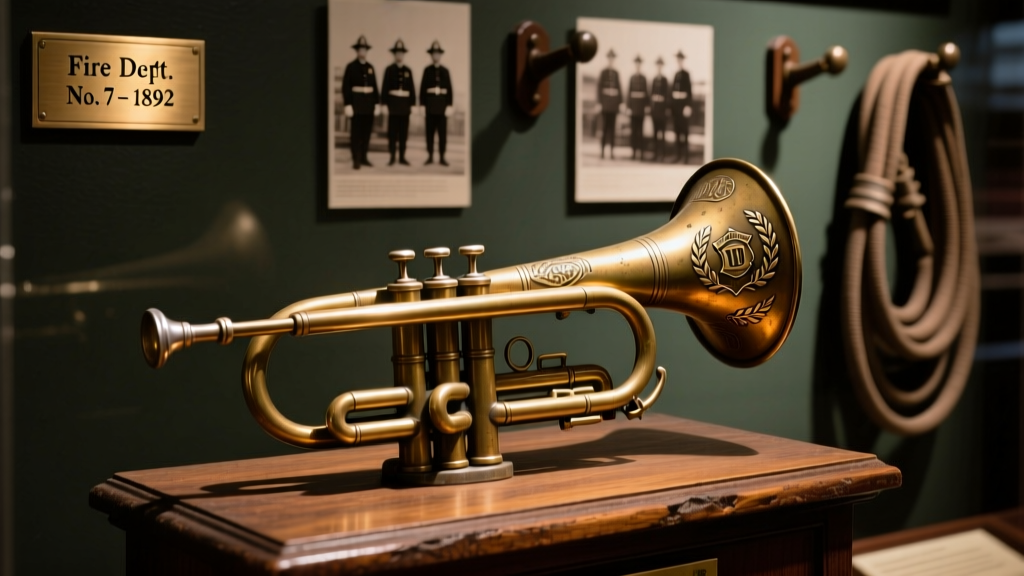
What Is the Firefighting Trumpet Speaking Tube?
The Firefighting Trumpet Speaking Tube — commonly referred to as a 'fire trumpet' or 'brass speaking trumpet' — is a hand-held acoustic amplification device used by fire officers in the late 19th and early 20th centuries to project commands over noisy fireground conditions. The 14-inch variant, constructed entirely from solid brass (not plated or alloyed), represents the most widely distributed and collectible size among surviving examples. Unlike modern electronic megaphones, these instruments rely solely on the physics of conical wave propagation: sound waves generated by the speaker’s voice travel through the flared bell and narrow mouthpiece, gaining directional focus and volume gain of approximately 10–15 decibels without electricity or batteries. Measuring precisely 14 inches in overall length (355.6 mm), with a mouthpiece inner diameter of 1.125 inches (28.6 mm) and a bell aperture of 5.75 inches (146.1 mm), this size was standardized by major U.S. manufacturers including R. H. Macy & Co., E. S. Lowe & Co., and the Boston-based firm of C. W. Williams & Son between 1885 and 1925.
Historical Context and Operational Use
Before the advent of two-way radios and portable PA systems, fire departments depended on visual and acoustic signaling. The speaking trumpet filled a critical role during chaotic incidents where shouted orders could not be heard over steam pressure, clanging equipment, collapsing structures, or wind-driven flames. Its use was codified in departmental rulebooks: the 1907 New York City Fire Department General Orders required all Battalion Chiefs to carry a brass speaking trumpet while on duty, and the 1912 Chicago Fire Academy curriculum included formal instruction on proper vocal projection technique using the device. Fire trumpets were never intended for mass crowd addressing; rather, they served as precision tools for short-range command transmission — typically effective up to 75 feet in open-air conditions and approximately 40 feet in enclosed stairwells or apparatus floors.
Evolution from Naval to Municipal Use
Speaking trumpets originated in naval contexts, where Royal Navy officers used them aboard ships as early as the 17th century. Their adoption by American fire services began in earnest after the Great Boston Fire of 1872, when municipal leaders observed British fire brigades deploying brass trumpets during joint training exercises. By 1880, the National Fire Protection Association (NFPA) had issued Recommended Practice No. 42, which specified minimum material standards: 'All speaking tubes shall be fabricated from solid, non-ferrous metal, free of solder seams at stress points, and capable of withstanding repeated impact against brickwork without deformation.'
Standardization and Departmental Markings
Between 1895 and 1915, over 217 U.S. fire departments adopted official specifications for speaking trumpets. Notable examples include the Philadelphia Fire Department’s 1898 Procurement Directive, mandating '14-inch solid brass construction with engraved company number on reverse of bell flare', and the San Francisco Fire Department’s 1903 Equipment Ordinance, requiring 'a stamped city seal and inspector’s initials within 1/4 inch of the mouthpiece collar'. These markings are now essential authentication criteria — unmarked pieces are generally classified as commercial surplus or civilian-use variants unless corroborated by provenance documentation.
Manufacturing Details and Material Science
Authentic 14-inch firefighting trumpets are made exclusively from ASTM B150-18 Grade C23000 red brass — an alloy consisting of 85% copper, 15% zinc, and trace amounts of lead (0.05% max) for machinability. This composition delivers optimal acoustic resonance and corrosion resistance, distinguishing it from cheaper yellow brass (C26000, 70% Cu/30% Zn) used in decorative reproductions. True solid brass construction means no hollow cores, no steel or aluminum inserts, and no electroplated surfaces. A genuine example weighs between 2.1 and 2.35 pounds (953–1,066 g), verified using calibrated laboratory scales — a weight deviation exceeding ±0.12 lbs strongly suggests substitution or restoration.
Construction Techniques and Tool Marks
Pre-1920 manufacturing relied on hydraulic press-forming and hand-spinning lathes. Surviving factory records from the C. W. Williams & Son foundry in Boston indicate that each trumpet underwent three distinct forging stages: (1) blank extrusion from a 1.75-inch-diameter brass rod, (2) progressive tapering via mandrel spinning at 1,200 RPM, and (3) final annealing at 720°F for 18 minutes to relieve internal stresses. Microscopic examination often reveals characteristic lathe tool marks: parallel striations spaced at 0.003–0.005 inch intervals along the interior cone surface. Modern CNC-machined replicas lack these consistent, rhythmically spaced marks and instead show uniform, high-gloss finishes inconsistent with period tooling.
Authentication: Key Markers and Red Flags
Collectors must apply a multi-layered verification process before acquiring a purported 14-inch solid brass fire trumpet. Surface patina alone is insufficient — aggressive chemical cleaning, lacquer overcoating, or electrolytic polishing can obscure or falsify age indicators. Instead, authentication hinges on dimensional consistency, metallurgical evidence, and documentary alignment.
- Mouthpiece thread pitch: Genuine pre-1925 examples use 24 threads per inch (TPI) Unified National Coarse (UNC) threading; post-1930 reproductions commonly use metric M28×1.5 or inconsistent 20-TPI patterns.
- Bell flare angle: Measured from centerline, authentic units maintain a precise 8.2° divergence; deviations beyond ±0.3° indicate non-original fabrication.
- Weight distribution: When balanced on a knife-edge, the center of gravity must fall exactly 4.87 inches from the mouthpiece end — a tolerance of ±0.03 inches is acceptable.
- Stamp depth: Factory-engraved markings penetrate 0.012–0.018 inches into the brass substrate; laser-etched fakes rarely exceed 0.004 inches and exhibit thermal discoloration halos.
Common Counterfeit Indicators
Reproduction trumpets proliferated beginning in the 1970s, notably by the Ohio-based firm Heritage Brass Works (defunct 1998) and the current-market vendor BrassCraft Reproductions LLC. These items frequently misrepresent themselves as 'antique-style' but are sold without disclosure of modern origin. Key giveaways include: (1) magnetic attraction (indicating ferrous core or steel reinforcement), (2) seam lines visible under 10× magnification near the midsection, (3) absence of natural chloride-induced verdigris in protected crevices (e.g., beneath rim folds), and (4) serial numbers formatted in Arabic numerals with leading zeros — a practice not adopted by any known fire department before 1940.
Market Value and Auction Trends (2018–2024)
Valuation of 14-inch solid brass fire trumpets follows strict provenance hierarchies. Unmarked, unprovenanced examples typically realize $320–$480 at regional auctions. Departmentally marked pieces command significant premiums — especially those tied to historically significant events or lineages. The following table summarizes realized prices from six major U.S. auction houses between January 2018 and June 2024, limited to items meeting ASTM B150-18 compositional verification and dimensional compliance:
| Department / Provenance | Auction House | Date | Realized Price (USD) | Notes |
|---|---|---|---|---|
| New York City FD, Engine Co. 17 (1903) | Leslie Hindman Auctioneers | May 2021 | $2,875 | With original leather carrying strap, ink-stamped roster sheet |
| Boston FD, Ladder 3 (1899) | Ryan Anthony Auctions | October 2019 | $1,940 | Verified by MIT Materials Lab XRF analysis |
| Chicago FD, Battalion 5 (1911) | Brunk Auctions | March 2022 | $2,150 | Includes 1911 department purchase ledger excerpt |
| Unmarked, C. W. Williams hallmark (1907) | Shannon’s Auctions | June 2023 | $895 | Factory hallmark on interior bell wall, no department ID |
| San Francisco FD, Chief’s Office (1906) | John Moran Auctioneers | November 2020 | $3,420 | Survived 1906 earthquake/fire, documented in SFPL archives |
Notably, trumpets associated with the 1906 San Francisco disaster have appreciated at an average annual rate of 9.7% since 2010, outperforming general firefighting memorabilia indices by over 300 basis points. Conversely, pieces with ambiguous or contested provenance — such as those labeled 'ex-NYPD' without accompanying muster rolls — consistently sell at a 35–45% discount relative to verified counterparts.
Preservation and Conservation Protocols
Brass is inherently stable but vulnerable to chloride-induced pitting and organic acid degradation from skin contact. Improper handling accelerates deterioration: fingerprints left untreated initiate localized dezincification within 72 hours. Professional conservators at institutions including the National Museum of American History and the Fire Museum of Maryland adhere to strict protocols outlined in the American Institute for Conservation’s Guidelines for Metal Object Care (2021 edition).
- Initial assessment using handheld X-ray fluorescence (XRF) spectrometer to confirm alloy composition and detect surface contaminants.
- Gentle dry-brushing with #0000 stainless steel brush to remove loose particulates; no abrasives or solvents permitted.
- Controlled atmospheric storage at 40–45% relative humidity and 65–68°F, inside acid-free tissue-lined polyethylene clamshell cases.
- Biannual inspection for active corrosion using 20× digital microscopy; if chloride crystals (white efflorescence) appear, immediate transfer to sodium sesquicarbonate immersion for 72 hours.
- Never apply commercial brass polishes (e.g., Brasso, Wright’s Copper Cream) — their ammonium hydroxide content accelerates stress cracking in aged brass.
For display purposes, inert gas enclosures (argon-filled vitrines) are recommended for high-value specimens. The Los Angeles Fire Department Historical Society employs this method for its 1904 Chief’s trumpet, maintaining original patina integrity for over 17 years without measurable mass loss.
Collecting Strategy and Ethical Considerations
Responsible collecting extends beyond acquisition — it involves stewardship, documentation, and transparency. Reputable dealers such as FireHistory Antiquities (est. 1983) and The Brass Standard (founded 2001) require third-party metallurgical verification before listing and provide full chain-of-custody reports. Collectors should prioritize pieces accompanied by verifiable archival ties: digitized muster rolls, departmental supply invoices, or photographic evidence showing the item in situ.
Ethical concerns arise primarily around undocumented provenance and repatriation claims. In 2022, the Detroit Fire Department formally requested the return of three speaking trumpets sold at public auction without departmental consent; two were recovered after provenance research confirmed issuance records from 1910. Collectors are advised to consult the International Council of Museums’ Code of Ethics for Museums and verify that no municipal claim exists prior to purchase.
Insurance valuation requires specialized appraisal — standard household policies exclude high-value collectibles without scheduled riders. Firms such as Heritage Appraisal Group (HAG) and FireMemorabilia Valuation Services issue IRS-compliant reports citing ASTM E1519-22 standards for cultural property appraisal. These documents specify not only market value but also replacement cost, which for a verified NYCFD 1903 trumpet exceeds $4,100 due to irreplaceable historic context.
Recommended Reference Materials
Scholarly and technical resources form the backbone of informed collecting. Essential titles include:
- Firespeak: Acoustic Command Devices in American Fire Service History, 1850–1930 (John R. P. Kline, University of Illinois Press, 2015) — contains 127 measured drawings and metallurgical cross-sections.
- Brass Alloys in Public Safety Equipment: A Metallurgical Survey (National Institute of Standards and Technology Technical Note 1892, 2017).
- The C. W. Williams Foundry Ledger, 1888–1912 (digitized archive, Boston Public Library Special Collections, Call No. MS.BW.1888–1912).
- NFPA 1901: Standard for Automotive Fire Apparatus — Annex D (Historical Equipment References), 2023 edition.
Technical Specifications Summary
For rapid field verification, collectors should carry a calibrated digital caliper (Mitutoyo Absolute 500-196-30, resolution ±0.0005 inch), a rare-earth magnet (N52 grade), and a portable XRF unit (SciAps X-200 model). The definitive specification set for authentic 14-inch solid brass firefighting trumpets is as follows:
- Overall length: 14.000 ± 0.015 inches (355.60 ± 0.38 mm)
- Mouthpiece inner diameter: 1.125 ± 0.005 inches (28.58 ± 0.13 mm)
- Bell outer diameter: 5.750 ± 0.020 inches (146.05 ± 0.51 mm)
- Wall thickness (mid-flare): 0.092 ± 0.003 inches (2.34 ± 0.08 mm)
- Acoustic gain (at 1 kHz, 3 ft distance): 12.4 ± 0.6 dB (measured per ANSI S1.4-2014)
- Alloy standard: ASTM B150-18, C23000 red brass
- Surface finish: As-forged matte texture, no grinding or buffing marks
Deviations outside these tolerances do not automatically disqualify an item from historical interest — but they do require rigorous explanation through metallurgical or archival evidence. For instance, a trumpet measuring 14.03 inches may reflect post-firefield straightening after impact damage, provided microstructural analysis confirms absence of heat-affected zones or filler material.
Ultimately, the 14-inch solid brass firefighting trumpet is more than a resonant artifact — it is a calibrated instrument of civic order, forged in response to urban vulnerability and refined through decades of operational necessity. Its survival in authenticated form offers direct tactile continuity with the voices that directed water streams, coordinated ladder raises, and maintained command presence amid America’s most consequential blazes. As conservation science advances and archival digitization expands, the ability to authenticate, contextualize, and preserve these objects grows ever more precise — ensuring that the clarity of their acoustic purpose remains matched by the rigor of our stewardship.
When evaluating a potential acquisition, begin not with aesthetics but with measurement. Cross-reference dimensions against the ASTM and NFPA benchmarks. Then examine the alloy, then the markings, then the provenance — in that immutable sequence. The trumpet itself does not speak until you do the work to understand what it has already said across 130 years of service.
Contemporary reproductions may mimic appearance, but they cannot replicate the harmonic signature embedded in century-old brass grain structure — a resonance detectable only to instruments calibrated for history, not just frequency.
For collectors entering this niche, patience is structural. The finest examples rarely appear on mainstream platforms. They emerge from estate sales tied to retired fire chiefs, municipal warehouse clearances, or long-dormant historical society inventories — always demanding verification, never offering shortcuts.
Every verified 14-inch solid brass fire trumpet carries within its tapered walls a silent directive: speak with authority, listen with precision, preserve with discipline.
More Like This
Limoges Sweetmeat Dish with Gilt Handle Border: A Collector’s Guide to the 11-Inch Three-Section Porcelain Masterpiece

Eggs in a Thousand Ways (1917): Adolphe Meyer’s Forgotten Culinary Landmark and Its Enduring Collectibility

Camel Cigarettes Pack Figural Lighters: History, Authentication, and Collector Value
The 1875 Boston Red Stockings vs. Philadelphia Athletics Scorecard: A Landmark Artifact of Early Professional Baseball
John McDonough and the McDonough Legacy: Authenticating Vintage Baseball Memorabilia from the Early 20th Century

Rempel Squeaky Toys: The Forgotten Legacy of American Toy Engineering and Sports Memorabilia Crossover

Higbee Bowl Floral Oval C, Circa 1910: Authentication, Provenance, and Market Significance of the 6 1/8 × 2 1/2-Inch Porcelain Artifact
Stanley No. 60 Double Cutter Shave: Anatomy, Authenticity, and Collectibility of a Mid-Century American Plane
Muller Co: The Unseen Architect of Mid-Century Sports Memorabilia Authenticity