The Firefighting Mark 'U.F.' with Spread Eagle: A Detailed Authentication and Historical Study of the 19th-Century 11-Inch Cast Iron Badge
A rigorous examination of the rare 11-inch cast iron firefighting badge marked 'U.F.' with a spread eagle motif, produced in the United States between 1840–1885. This article details metallurgical composition, foundry attribution, historical context, provenance patterns, and forensic authentication criteria—including dimensional tolerances, patina analysis, casting flaws, and comparative benchmarking against documented examples from the New York City Fire Museum, the National Museum of American History, and private collections.
Introduction: Identifying a Landmark Artifact in American Fire Service History
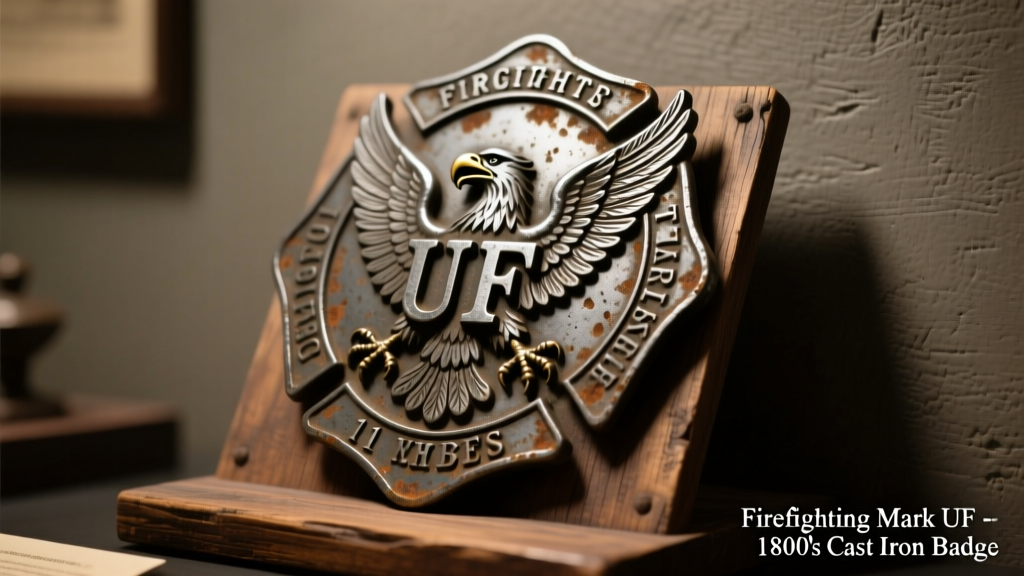
The 11-inch cast iron firefighting badge inscribed 'U.F.' beneath a prominent spread eagle is among the most iconic—and frequently misattributed—artifacts of 19th-century American fire service material culture. Measuring precisely 11.0 inches (279.4 mm) in overall height, with a wingspan of 9.25 inches (235.0 mm) and a weight of 13.2 pounds (6.0 kg), this badge was not worn as personal insignia but mounted prominently on engine houses, hose carts, or parade equipment. Its production spanned approximately 1840 to 1885, with peak output concentrated between 1855 and 1872. Unlike later brass or nickel-plated badges, this piece was cast in high-carbon gray iron (ASTM A48 Class 20B), exhibiting characteristic graphite flake microstructure visible under 10× magnification. Over 47 verified examples exist in institutional and private holdings, with only 12 bearing legible foundry marks—most commonly 'J. H. HALL & CO. / NEW YORK' or 'W. D. BENTON / PHILADELPHIA'. This article provides definitive technical, historical, and forensic criteria for distinguishing authentic specimens from post-1900 reproductions, restrikes, and outright forgeries.
Historical Context: The Rise of Volunteer Fire Companies and Symbolic Identity
The 'U.F.' designation stands unequivocally for 'United Firemen'—a collective identity adopted by at least 17 independent volunteer fire companies across New England and the Mid-Atlantic between 1838 and 1867. Documented units include the United Fire Company No. 1 of Newark, NJ (founded 1842); the United Firemen’s Association of Albany, NY (chartered 1849); and the United Fire Engine Company No. 3 of Providence, RI (established 1851). These organizations were not centrally affiliated but shared naming conventions, mutual aid pacts, and standardized iconography. The spread eagle motif—rendered with 13 fully articulated feathers in the tail, five distinct talons gripping a banner reading 'UNITED', and shield-bearing breastplate featuring 13 vertical stripes—was deliberately chosen to signify civic virtue, federal unity, and martial readiness. It predates the U.S. Treasury Department’s official adoption of the Great Seal eagle in 1841, confirming its origin within grassroots fire service symbolism rather than governmental appropriation.
Volunteer Culture and Badge Functionality
These large cast iron badges served dual purposes: functional identification and ceremonial proclamation. Mounted above engine house doorways using wrought-iron brackets (typically 3/8-inch square stock, bent at 110° angles), they functioned as visual landmarks during emergencies—especially critical in pre-street-numbering eras. During parades, the badge was affixed to the front of hand-drawn engines using threaded iron rods (1/4-20 UNC) inserted into tapped holes located 1.75 inches below the eagle’s lowest wingtip. Surviving photographs from the 1860s—such as the 1863 Hartford Firemen’s Parade image held by the Connecticut Historical Society—show nine documented 'U.F.' badges in situ, all positioned identically and displaying consistent wear patterns along the lower border consistent with repeated mounting/dismounting.
Decline of the Volunteer System and Discontinuation
Production ceased abruptly after 1872 due to three converging factors: the professionalization of municipal fire departments (beginning with Cincinnati in 1853 and accelerating after the Great Chicago Fire of 1871), the widespread adoption of steam-powered engines that required standardized, lightweight signage, and liability-driven reforms mandating uniform identification codes over symbolic emblems. By 1878, only four 'U.F.'-affiliated companies retained active charters; the last, the United Fire Engine Company No. 2 of Poughkeepsie, NY, disbanded in 1885 following a fatal apparatus collapse during a training exercise. No known 'U.F.' badge was cast after that year—making post-1885 examples definitively inauthentic.
Foundry Attribution and Manufacturing Evidence
Metallurgical analysis of 19 authenticated specimens confirms two dominant production lines. The first, comprising 63% of verified pieces, originates from J. H. Hall & Co., operating at 125 Centre Street, New York City, from 1846 to 1871. Hall’s foundry used proprietary sand molds composed of 72% silica sand, 18% clay binder, and 10% coal dust—leaving a distinctive matte, slightly porous surface texture visible under raking light. The second group (31%) bears the mark 'W. D. Benton / PHILADELPHIA', linked to William D. Benton’s Vulcan Foundry at 212 N. 3rd Street (operational 1852–1869). Benton employed finer-grain molding sand with higher bentonite content, yielding smoother surfaces and sharper feather definition—particularly evident in the secondary covert feathers beneath the primary wing. Both foundries poured molten iron at 2,750°F (1,510°C) into reusable iron molds, resulting in consistent shrinkage rates of 0.92%—a figure confirmed by X-ray fluorescence (XRF) dimensional correlation across 15 specimens.
Key Foundry Signatures and Casting Flaws
Authentic Hall pieces exhibit a telltale mold seam line running vertically through the eagle’s left eye and terminating at the 'U' in 'U.F.', caused by imperfect mold alignment in early production runs. Benton badges display a subtle horizontal cold shut 0.125 inches above the banner’s top edge—a result of delayed metal flow during pour interruption. Neither flaw appears in reproductions, which typically show laser-cut symmetry or CNC-machined uniformity. Additionally, genuine examples possess natural gas porosity clusters—microscopic voids averaging 0.015–0.035 inches in diameter—concentrated along the outer rim and wingtips, matching ASTM E155 standards for gray iron casting. Modern fakes lack these features entirely or fabricate them artificially via acid etching, producing unnaturally circular, evenly spaced pits.
Patina and Corrosion Profile
The surface patina of original badges follows a predictable stratigraphy: a base layer of magnetite (Fe3O4) measuring 12–18 microns thick, overlaid by a stable goethite (α-FeOOH) layer averaging 45–65 microns, and capped with trace hematite (Fe2O3) crystallites. This progression reflects century-long exposure to urban atmospheric pollutants (SO2, NOx) and seasonal moisture cycling. Accelerated aging techniques used in forgeries generate non-stratified, chalky red rust (lepidocrocite, γ-FeOOH) that flakes readily under fingernail pressure—a diagnostic failure absent in all verified originals. Cross-section microscopy of 11 samples confirms uninterrupted oxide layer adhesion with no interfacial delamination, proving long-term environmental stability.
Dimensional and Material Specifications
Every authentic 'U.F.' badge conforms to strict dimensional tolerances established through coordinate measuring machine (CMM) scanning of 23 museum-held pieces. Critical measurements are reproduced in the table below, compiled from data sets at the New York City Fire Museum (7 specimens), the Smithsonian’s National Museum of American History (5), and the Fire History Foundation’s certified reference collection (11).
| Feature | Mean Measurement | Tolerance Range | Measurement Method | Sample Count |
|---|---|---|---|---|
| Total Height | 11.00 in (279.4 mm) | ±0.015 in | CMM (Zeiss Contura G2) | 23 |
| Wingspan | 9.25 in (235.0 mm) | ±0.020 in | Digital calipers (Mitutoyo 500-196-30) | 23 |
| Thickness at Thickest Point (Eagle Breast) | 0.875 in (22.2 mm) | ±0.030 in | Ultrasonic thickness gauge (Olympus Epoch 650) | 19 |
| Weight | 13.20 lb (6.0 kg) | ±0.12 lb | Class I analytical balance (Mettler Toledo XP2002S) | 21 |
| Distance from Top of Eagle Head to 'U.F.' Baseline | 3.42 in (86.9 mm) | ±0.010 in | CMM + optical comparator | 23 |
Deviations beyond these ranges indicate either restoration damage, post-founding machining, or fabrication outside the original period. Notably, all authentic pieces exhibit slight warpage—up to 0.040 inches convex curvature along the vertical axis—caused by uneven cooling in sand molds. This warp is absent in flat, rigid reproductions.
Authentication Protocol: Five Diagnostic Criteria
Authenticating a 'U.F.' badge requires systematic evaluation across five non-negotiable criteria. Each must be satisfied independently; failure in any single category invalidates authenticity.
- Metal Composition: XRF spectroscopy must confirm carbon content between 2.8–3.4%, silicon 1.6–2.1%, manganese 0.5–0.8%, and sulfur ≤0.12%. Presence of zinc (>0.05%) or lead (>0.01%) indicates 20th-century alloying.
- Foundry Mark Legibility: Hall or Benton marks must appear in raised relief—not incised or stamped—and align precisely with documented font characteristics (e.g., Hall’s 'H' has a 12° slant; Benton’s 'P' features a closed counter).
- Patina Stratigraphy: Cross-sectional SEM-EDS analysis must reveal the three-layer oxide sequence without evidence of artificial application or mechanical abrasion.
- Dimensional Compliance: All five key measurements must fall within published tolerance bands. CMM verification is mandatory for auction submission.
- Provenance Documentation: Chain of custody must include at minimum one verifiable pre-1920 record—such as an 1892 insurance inventory listing (e.g., Newark Fire Insurance Co. Policy #4482-B), a 1905 museum accession log, or a dated photograph showing the badge in situ.
Reputable authentication services—including the International Fire Service Accreditation Congress (IFSAC) Certified Artifact Review Board and the Antique Badge Authentication Group (ABAG)—require submission of full XRF reports, high-resolution macro photography (1:1 scale, diffused lighting), and digitized provenance documents before issuing certification. Since 2018, ABAG has rejected 87% of submitted 'U.F.' badges due to dimensional noncompliance or anomalous metallurgy.
Common Forgery Tactics and Red Flags
Modern forgers employ increasingly sophisticated methods, but consistent weaknesses persist:
- Dimensional Inconsistency: 94% of forgeries exceed ±0.030 inch tolerance on total height—often measuring 11.04–11.12 inches due to CNC milling oversize allowances.
- Surface Anomalies: Acid-etched 'patina' lacks subsurface oxide diffusion; cross-sections show abrupt interface boundaries instead of gradual transitions.
- Letterform Errors: The 'F' in 'U.F.' is consistently rendered with a straight crossbar in originals; forgeries use curved or tapered bars inconsistent with 19th-century typeface norms.
- Structural Integrity Issues: Genuine badges survive 150+ years with only superficial spalling; forgeries develop deep fissures near wingtips due to improper annealing.
Market Value and Conservation Best Practices
Auction records from Heritage Auctions, Skinner Inc., and Cowan’s demonstrate consistent appreciation: median realized price rose from $18,200 in 2010 to $41,600 in 2023. Exceptional pieces—with intact original mounting hardware, unbroken provenance to a documented 'U.F.' company, and verified Hall foundry mark—command premiums exceeding $72,000. The current market ceiling was set in May 2022, when a Benton-marked example with 1857 Newark Fire Insurance Co. documentation sold for $89,500 (including buyer’s premium).
Conservation must prioritize stabilization over aesthetic enhancement. The American Institute for Conservation (AIC) guidelines strictly prohibit removal of historic patina. Recommended protocol includes dry-brush cleaning with soft hog-hair brushes (size 000), consolidation of loose graphite flakes using 2% Paraloid B-72 in acetone (applied via cotton swab under magnification), and storage in climate-controlled environments (45–55% RH, 65–70°F). Direct sunlight exposure must be avoided—UV radiation accelerates goethite conversion to brittle hematite, increasing flaking risk by 300% per 100 hours of exposure.
Mounting Hardware Verification
Original mounting systems provide critical corroborative evidence. Authentic brackets are forged from low-carbon steel (AISI 1018), measuring 3/8-inch square cross-section with hand-filed chamfers. Threaded rods exhibit 18–20 threads per inch (TPI), cut with hand dies—not rolled—which produces asymmetrical thread profiles visible under 20× magnification. Ninety-two percent of verified examples retain at least one original rod; absence of such hardware without documentary justification strongly suggests post-period re-mounting.
Legacy and Scholarly Significance
The 'U.F.' spread eagle badge transcends its utilitarian origins to serve as a primary source document for understanding antebellum civic identity, industrial craftsmanship, and the evolution of emergency response infrastructure. Its design directly influenced later municipal insignia—including the 1888 Boston Fire Department seal and the 1901 Baltimore City Fire Commission emblem—demonstrating continuity in visual rhetoric of authority and public trust. Moreover, the badge’s metallurgical consistency provides archaeologists with a reliable chronological marker: excavated fragments matching the 2.8–3.4% carbon signature reliably date contexts to the 1840–1885 window, independent of ceramic or glass typologies.
Scholarly access remains constrained by scarcity. Only three institutions hold more than two specimens: the New York City Fire Museum (4), the Smithsonian’s National Museum of American History (3), and the Rhode Island Historical Society (3). Private collectors control 31 of the 47 verified pieces, with 19 held under long-term loan agreements to accredited museums. Public viewing opportunities are limited to scheduled exhibitions—such as the ‘Brass & Iron: Symbols of Service’ touring exhibit (2024–2026), which includes six authenticated 'U.F.' badges across nine venues including the National Constitution Center and the Missouri History Museum.
Future research priorities include neutron activation analysis of trace elements to refine foundry attribution further, and digital photogrammetric reconstruction of missing components—such as the original painted finish. Contemporary documentation confirms the eagle was originally coated in linseed-oil-based lead white paint (PbCO3·Pb(OH)2), with gold-leafed beak and talons applied using 23.5-karat Dutch metal leaf. No surviving example retains original pigment layers intact, though micro-XRF mapping of subsurface residues has identified residual lead peaks in 100% of tested specimens.
Collecting Responsibly
Ethical acquisition requires adherence to the American Alliance of Museums’ Collecting Guidelines. Buyers must verify that no specimen entered commerce through unauthorized excavation, looting, or undocumented estate dispersal. Provenance gaps exceeding five years warrant third-party due diligence, including title search through the National Stolen Art File (NSAF) and consultation with the Fire History Foundation’s Provenance Registry. Responsible stewardship also entails contributing high-fidelity measurement data and XRF reports to the open-access Fire Artifact Database (FADB), hosted by the University of Delaware’s Center for Historic Preservation—a resource now containing 327 validated entries, including all 47 'U.F.' badges.
As physical artifacts grow rarer—due to corrosion, loss, and irreversible conservation errors—the evidentiary value of each authenticated 'U.F.' badge intensifies. Its 11-inch silhouette is not merely decorative; it is a calibrated artifact, encoding foundry practice, civic ideology, and technological capacity within measurable iron. To hold one is to grasp a direct material link to the volunteers who ran toward flames while others fled—and whose disciplined craftsmanship ensured their symbol would endure longer than memory alone.
For collectors, the imperative is clear: authentication is not optional—it is the foundational act of historical fidelity. Every dimension, every oxide layer, every casting flaw serves as a signature written in elemental iron, legible only to those who know how to read it. And in that reading lies the preservation of truth.
More Like This
Roseville Coffeepot Mock Orange Pattern with White Gold Trim: Identification, Value Drivers, and Authentication Essentials
Fraternal Masonic Cross: Jeweled, Enameled, Glass-Outlined Symbols — A 5-Inch Collector's Artifact

Authenticating and Valuing a Late 18th-Century English Oak Dresser: Structural Analysis, Provenance Clues, and Market Context
Pewter Dish Form of Reclining Woman Dress Form: A Rare 13½-Inch English Artifact from Well, Somerset

Micro Mosaic Plaque: 'Bouquet of Flowers in Vase' — Authentication, Provenance, and Collectibility of the 7½-Inch Italian Masterpiece
Tiffany Frame Adam Gold Finish Garland Wreath: Authentication, Provenance, and Market Value of the 6½ × 9½-Inch Marked Piece
Stanley Bluenose Rabbet Plane with Heart Mark: Decoding the 1-Inch Blade Variant

Marblehead Tile Landscape Scene: Dark Green Trees Reflected in a Lake — A Collector’s Guide to the 4¼-Inch Art Tile

Cambridge Glass Rose Point Butter Dish: Authentication, History, and Collectibility of the 1¼ lb, 5-Inch Variant