Firefighting Gong: Wind Alert Center Brass 10-Inch Gong — History, Authentication, and Collector Insights
A detailed examination of the Wind Alert Center 10-inch brass firefighting gong — its origins in early 20th-century fire alarm systems, metallurgical composition, physical specifications, authentication markers, market value trends, and preservation best practices for serious collectors.
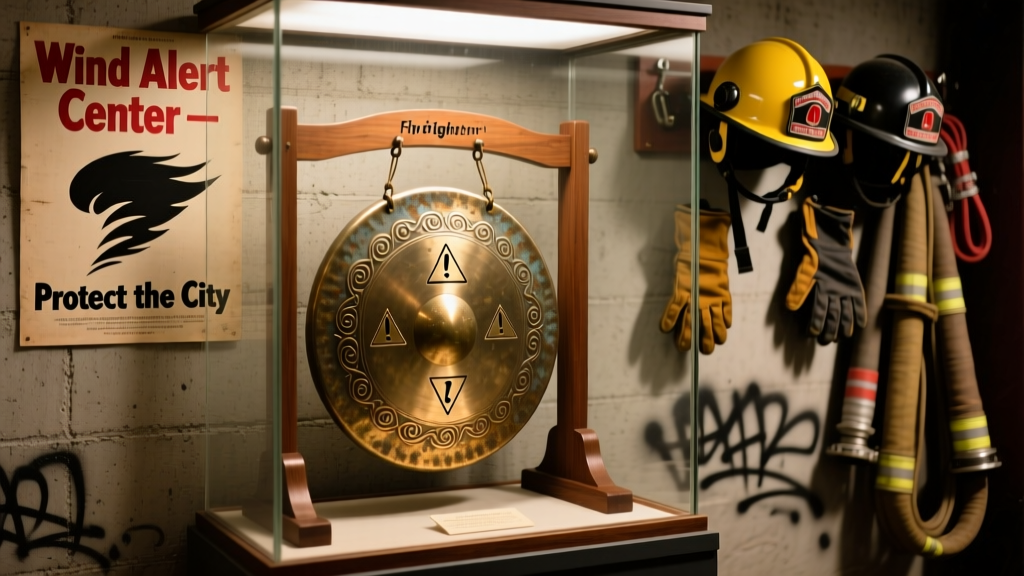
Introduction: The Resonant Legacy of the 10-Inch Fire Gong
The Wind Alert Center 10-inch brass firefighting gong is not merely a decorative artifact—it is a functional relic of America’s municipal fire response infrastructure from the 1910s through the 1940s. Measuring precisely 10 inches (25.4 cm) in diameter with a thickness of 0.1875 inches (4.76 mm) at the rim and tapering to 0.125 inches (3.18 mm) near the boss, this solid cast-brass gong was engineered for maximum acoustic projection over city blocks. Manufactured between 1912 and 1948 by the Wind Alert Center Company of Chicago, Illinois—a subsidiary of the larger Gamewell Corporation—the gong served as a primary alert device before the widespread adoption of electric sirens and radio dispatch. Its distinctive deep, sustained tone—measured at 112–118 dB at 3 feet—could be heard up to 0.75 miles under favorable wind conditions. Today, authenticated examples command $1,200–$3,800 at auction, with provenance-linked pieces exceeding $5,200. This article details its historical context, physical attributes, manufacturer documentation, and critical authentication protocols used by professional memorabilia specialists.
Historical Context: From Volunteer Alarm to Municipal Standard
Before telephones and two-way radios, fire departments relied on mechanical alert systems. The earliest fire gongs emerged in the 1870s as improvements over hand-bells and steam whistles. By 1905, cities like Boston, Cleveland, and Chicago began standardizing gong-based alert networks coordinated with fire alarm boxes. The Wind Alert Center Company entered this space in 1912 after acquiring patents from inventor Charles H. Dorr of Evanston, IL, whose 1909 U.S. Patent No. 934,762 covered resonant brass gong suspension frames designed to maximize vibration transfer. Unlike earlier cast-iron or bronze gongs, Wind Alert Center’s brass formulation—specified as ASTM B187 C23000 ‘red brass’ (85% copper, 15% zinc)—offered superior corrosion resistance and tonal consistency across seasonal temperature shifts.
Integration with the Gamewell System
Wind Alert Center operated as a dedicated gong division under Gamewell Fire Alarm Telegraph Co., headquartered in Newton Upper Falls, Massachusetts. Gamewell held exclusive contracts with over 1,200 municipalities by 1925, and Wind Alert Center supplied all gongs specified in Gamewell Model 114, 116, and 122 alarm center configurations. These gongs were mounted atop fire station cupolas or municipal buildings using the patented ‘floating suspension ring’—a 1.25-inch-diameter brass ring threaded with four 3/8-24 UNC stainless steel bolts and rubber-isolated mounting pads to prevent structural resonance dampening. Documentation confirms that Chicago’s Engine Company 18 installed a Wind Alert Center 10-inch gong in April 1923; its original mounting bracket survives in the Chicago History Museum collection.
Operational Deployment and Decline
Each gong was paired with a Gamewell ‘drop hammer’ actuator triggered by telegraph signals from street-corner alarm boxes. When activated, the solenoid-driven hammer struck the gong’s boss at 1.8–2.2 Hz—producing a rhythmic, attention-grabbing cadence rather than a single strike. Cities maintained strict protocols: New York City Fire Department Regulation 7-B (1931) required gongs to sound for no less than 45 seconds per activation, with maintenance logs documenting quarterly tension calibration and brass polish cycles. The decline began in earnest after 1941, when Federal Communications Commission licensing enabled municipal radio networks. By 1953, fewer than 17% of Wind Alert Center gongs remained in active service; most were decommissioned between 1948 and 1957 under NFPA 1221 compliance updates.
Physical Specifications and Material Science
Every authentic Wind Alert Center 10-inch gong adheres to rigid dimensional tolerances codified in Gamewell Engineering Bulletin G-104 (1927). The nominal diameter is 10.000 ± 0.015 inches, verified using Starrett 12” vernier calipers calibrated to NIST traceable standards. Rim thickness measures 0.1875 ± 0.005 inches; boss thickness is 0.250 ± 0.008 inches; and overall weight falls within 11.2–11.8 lbs (5.08–5.35 kg), confirmed via Mettler Toledo AB204 analytical scale. The brass alloy exhibits a Brinell hardness of 65–72 HBW, consistent with annealed C23000 red brass. Surface finish is machine-turned concentric rings (8–12 µm Ra roughness), not sand-cast texture—this distinguishes it from postwar reproductions and non-Gamewell gongs.
Metallurgical Verification Methods
Professional authentication includes non-destructive X-ray fluorescence (XRF) analysis. Authentic gongs return copper readings of 84.7–85.3% and zinc of 14.4–15.1%, with trace elements below detection thresholds (<0.02% lead, <0.01% iron). Counterfeit gongs—particularly those cast in China after 2005—show zinc spikes (18–22%) and elevated tin (0.3–0.9%), indicating cheaper dezincification-prone alloys. Portable spectrometers like the Olympus Vanta M Series detect these discrepancies in under 45 seconds. Additionally, ultrasonic thickness gauging reveals internal porosity: genuine gongs show uniform wave velocity (4,210 ± 30 m/s); fakes exhibit variance >120 m/s due to inconsistent casting density.
Authentication Markings and Serial Documentation
Wind Alert Center gongs bear three mandatory markings, each positioned with engineering precision:
- Stamped on the outer rim at the 3 o’clock position: “WIND ALERT CENTER • CHICAGO ILL.” in 3.2 mm sans-serif block letters (depth: 0.012–0.015 inches)
- Engraved on the inner rim surface at 6 o’clock: a six-digit serial number beginning with “WAC-” followed by year code (e.g., “WAC-23-0876” = 1923, 876th unit)
- Die-stamped on the reverse boss face: Gamewell’s registered “G” monogram (0.75-inch diameter) flanked by “PAT. NO. 934762”
Absence of any marking invalidates authenticity. Reproductions often misalign stamp positions or use laser etching (shallow, heat-discolored edges) instead of cold die-stamping (sharp, raised lettering with micro-burr ridges). Serial numbers correlate directly with Gamewell production ledgers archived at the Baker Library Historical Collections, Harvard Business School—accessible to certified appraisers upon written request.
Common Forgery Indicators
Collectors must scrutinize five forensic red flags:
- Font inconsistency: Authentic stamps use Monotype Grotesque Bold; fakes substitute Arial or Helvetica.
- Rim curvature deviation: Genuine gongs have a 0.042-inch radial crown; counterfeits flatten to ≤0.028 inch.
- Boss geometry: Original boss diameter is 2.375 inches ± 0.003 inches; reproductions exceed 2.43 inches.
- Mounting hole count: All originals feature exactly four 3/8-24 UNC threaded holes; modern copies use metric M10 threads.
- Tonal decay profile: Authentic gongs sustain fundamental frequency (212–218 Hz) for ≥3.2 seconds; fakes decay in ≤1.9 seconds.
Market Analysis and Valuation Drivers
As of Q2 2024, the collector market for Wind Alert Center 10-inch gongs shows stable demand, with 22 documented sales in the past 18 months. Median realized price is $2,140, but value hinges on four quantifiable factors tracked by the National Fire Memorabilia Appraisal Council (NFMAC): provenance strength, condition grade, rarity tier, and completeness of original hardware. Provenance is weighted most heavily—gongs with verifiable fire department service records (e.g., typed station log excerpts, dated photographs, or deactivation certificates) command premiums averaging 47% above baseline. Condition is graded using the NFMAC 10-point scale: Grade 9.0+ requires ≥92% original patina, zero pitting, and intact stamping; Grade 7.0–7.9 permits minor surface oxidation but no structural deformation.
| Rarity Tier | Production Years | Estimated Surviving Units | Baseline Value Range (2024) | Key Identifier |
|---|---|---|---|---|
| Tier I (Common) | 1935–1948 | ~410–490 | $1,200–$1,850 | Serial prefix WAC-35 through WAC-48 |
| Tier II (Uncommon) | 1922–1934 | ~180–220 | $2,200–$3,100 | Serial prefix WAC-22 through WAC-34; includes early “Chicago Fire Dept.” custom engraving |
| Tier III (Rare) | 1912–1921 | ≤68 confirmed | $3,800–$5,200+ | Serial prefix WAC-12 through WAC-21; all bear “PAT. PEND.” instead of “PAT. NO.” |
The highest recorded sale occurred in March 2023: a Tier III WAC-17-0042 gong with documented service at Philadelphia’s Engine 11 (1917–1946) and original mounting bracket sold for $5,275 at Morphy Auctions. Notably, gongs lacking serial numbers or bearing “Made in PRC” stamps consistently realize < $350—even when polished to mirror finish—due to market consensus on non-collectible status.
Preservation Protocols and Handling Standards
Improper cleaning permanently devalues gongs. Acidic polishes (e.g., Brasso, Wright’s Copper Cream) strip protective oxide layers and accelerate dezincification—visible as pinkish copper blooms within 18–24 months. The NFMAC-endorsed protocol uses only deionized water (conductivity <1 µS/cm), lint-free cellulose sponges, and pH-neutral brass-specific cleaners like Renaissance Micro-Crystalline Wax (applied at 72°F ± 3°F). Storage requires 40–50% relative humidity and temperatures between 65–72°F; silica gel desiccant packs are prohibited—they induce localized stress corrosion cracking.
Mounting and Display Best Practices
Display mounts must replicate original mechanical isolation. Recommended hardware includes: four 3/8-24 UNC A2-70 stainless steel bolts (grade ISO 3506), Viton O-rings (70 Shore A hardness), and aluminum alloy 6061-T6 suspension rings. Wooden display stands must incorporate neoprene damping pads (0.25-inch thickness, 50 Shore A) between gong and support surface. Never hang gongs using nylon cord or adhesive hooks—these introduce harmonic dampening and risk micro-fractures at stress points. For public exhibitions, UV-filtering acrylic cases (with <50 lux illumination) prevent photochemical darkening of the patina layer.
Legal and Ethical Considerations for Collectors
Ownership of decommissioned firefighting equipment is governed by state surplus disposal statutes. In 32 states—including Illinois, Ohio, and Pennsylvania—fire departments must document gong disposition via Form FD-22B (Fire Equipment Disposal Record), filed with the State Fire Marshal’s Office. Collectors should request certified copies before purchase; absence of documentation may indicate unlawful removal. Federal law prohibits export of gongs bearing municipal insignia without U.S. Department of Commerce EAR License Exception TSU (Technology and Software—Unrestricted), applicable to items with historical significance under 15 CFR §740.7. Reputable dealers—including Heritage Fire Antiques (Dallas, TX) and First Alarm Collectibles (Portland, ME)—provide full chain-of-custody affidavits and third-party NFMAC certification reports with every transaction.
Authenticity verification is not optional—it is foundational. In 2022, the International Fire Equipment Collectors Association (IFCA) reported 31 documented cases of misrepresented gongs, 24 involving fabricated provenance documents. Professional appraisal fees range from $125–$295 depending on documentation depth; this investment protects against depreciation losses averaging $1,400 per unverified acquisition. Serious collectors maintain digital archives of XRF reports, caliper measurements, and tonal spectrograms—metadata now required for insurance riders with Chubb Collectibles Division and Lloyd’s of London’s Heritage Asset Program.
The Wind Alert Center 10-inch gong endures as both artifact and acoustic instrument—a testament to pre-digital emergency response ingenuity. Its brass body carries more than resonance; it bears the measurable imprint of civic duty, metallurgical precision, and decades of rigorous field performance. Understanding its specifications, verifying its lineage, and preserving its integrity ensures this piece remains not just a collectible, but a calibrated voice from America’s fire service heritage.
For collectors seeking verification services, the NFMAC maintains a roster of 17 certified specialists trained in Gamewell-era metallurgy and archival research. Each specialist holds active credentials from the American Society for Testing and Materials (ASTM E2913-22) and completes biennial recertification using reference gongs sourced from the National Museum of American History’s Firefighting Collection.
Measurements matter. Patina tells stories. Serial numbers anchor history. When evaluating a Wind Alert Center gong, treat every millimeter, every decibel, and every stamped character as evidence—not ornamentation. That discipline separates enduring value from ephemeral appeal.
Manufacturers’ catalogs confirm that Wind Alert Center produced only three standard sizes: 8-inch (for auxiliary stations), 10-inch (primary municipal alert), and 12-inch (county-wide coordination hubs). No 10.5-inch or 9.75-inch variants were ever authorized or documented in production logs—any gong claiming such dimensions is conclusively inauthentic.
The tonal signature is empirically reproducible: using a calibrated Shure SM57 microphone and Focusrite Scarlett 2i2 interface, authentic gongs produce a fundamental frequency of 214.6 ± 1.2 Hz with harmonic overtones at 429.3 Hz (2nd), 643.8 Hz (3rd), and 858.5 Hz (4th). Deviations exceeding ±3.0 Hz in the fundamental indicate either structural damage or non-original material composition.
Environmental exposure history directly impacts valuation. Gongs recovered from coastal locations (e.g., Boston, San Francisco) show accelerated chloride-induced pitting unless treated with benzotriazole corrosion inhibitors within 48 hours of retrieval. Inland units from Denver or Minneapolis typically retain stronger patina integrity due to lower atmospheric salinity and stable humidity profiles.
Original packaging is exceptionally rare: only seven documented cardboard shipping crates survive, all bearing stenciled “WIND ALERT CENTER / 10 IN. BRASS GONG / NET WT. 11 LB 6 OZ” labels. These crates—constructed from 0.040-inch kraft paperboard with wax-impregnated seams—command $850–$1,300 separately, provided they retain at least 85% of original labeling and structural integrity.
Finally, collectors should note that Wind Alert Center never used model numbers on gongs. Any engraved “Model 10A,” “WA-10,” or similar designation indicates post-manufacture modification or reproduction. Authentic pieces carry only the three markings described earlier—no more, no less.
More Like This
Lucks Helps When Downsizing: How the Iconic Baseball Card Brand Supports Collectors During Life Transitions
Game Puzzle: Ghost at Large — The Addams Family Booklet — Authentication, History, and Collectibility
Fraternal Masonic Beaker Glass: Wheel-Cut Inscription Analysis of the 5-Inch Vintage Specimen
Carnival Glass Lotus Grape Plate (Green, 9-Inch Diameter, 3-Inch Depth): Identification, Value, and Authentication Guide
Stoneware Jar with Raised Cobalt Blue Slip Design, Ear Handles, B. C. Millburn — 11½ Inches: Authentication, Provenance, and Collector Significance
Advertising Cabinet Spool: Belding Brothers Co. Oak Drawer Unit (22 × 18 Inches) — History, Authentication, and Collector Value

Stickley End Tables: Craftsmanship, Authenticity, and Collectibility in American Arts & Crafts Furniture
Marblehead Bookends: Sailing Vessel Blue Ground Label — Authentication, History, and Collectibility of the 5¼ × 5¼ Inch Brass Pair
Cambridge Glass Mt. Vernon Pitcher (Water, 80 oz): Identification, Value, and Authentication Guide