Stickley End Tables: Craftsmanship, Authenticity, and Collectibility in American Arts & Crafts Furniture
A detailed examination of Stickley end tables—focusing on Gustav Stickley’s United Crafts, L. & J.G. Stickley, and Stickley Brothers—covering design evolution, construction signatures, authentication markers, market value trends, and preservation best practices.
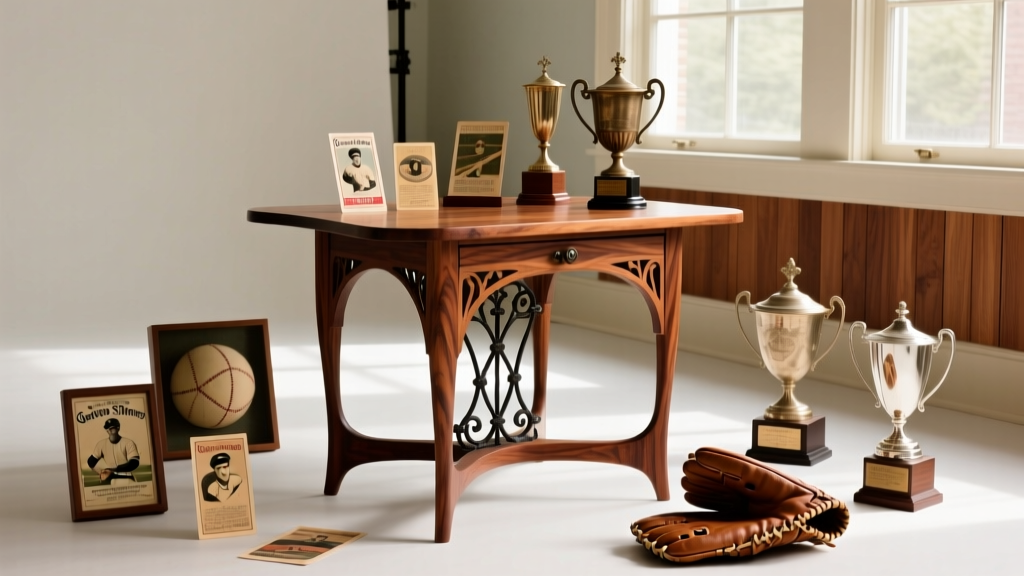
Stickley end tables represent a cornerstone of American Arts & Crafts furniture, embodying honesty in materials, structural clarity, and handcrafted integrity. Produced primarily between 1900 and 1918 by three distinct Stickley enterprises—Gustav Stickley’s United Crafts (Syracuse, NY), L. & J.G. Stickley (Fayetteville, NY), and Stickley Brothers (Grand Rapids, MI)—these compact yet expressive pieces reflect divergent interpretations of the movement. Authentic examples feature quarter-sawn white oak with visible grain, through-tenon joinery, copper or iron hardware, and signature marks such as the "Craftsman" trademark or the "L. & J.G. Stickley" incised logo. Dimensions typically range from 20–24 inches wide, 16–18 inches deep, and 22–25 inches high. This article details construction techniques, brand-specific identifiers, documented production timelines, recent auction results, and conservation protocols essential for serious collectors and institutions.
Historical Context and Brand Lineage
The Stickley name is synonymous with the American Arts & Crafts movement, but it is critical to recognize that three separate family-run firms operated concurrently—and competitively—during the movement’s peak. Gustav Stickley founded United Crafts in 1900 and launched The Craftsman magazine in 1901, using it to disseminate design philosophy and advertise furniture. His end tables, often cataloged as Model No. 372 or 412, emphasized structural transparency: exposed tenons, chamfered edges, and hammered copper drawer pulls. Meanwhile, Leopold and John George Stickley established L. & J.G. Stickley in 1898, shifting toward refined proportions and subtle decorative elements like applied molding and shaped aprons. Their Model 223 end table (introduced 1905) featured a distinctive ‘bentwood’ lower shelf and tapered legs. Stickley Brothers, founded by Albert, Charles, and John Stickley in 1883, pursued a more commercial, hybrid aesthetic—blending Mission styling with Queen Anne influences—and used stamped metal labels rather than incised marks.
Gustav Stickley’s United Crafts (1900–1916)
Gustav’s end tables were designed as functional anchors beside Morris chairs and settees, prioritizing utility without ornamentation. Original catalogs list dimensions precisely: Model 372 measured 22″ W × 17″ D × 24″ H; Model 412 was slightly taller at 25″ H with a single lower shelf. Construction employed solid quarter-sawn white oak exclusively—never pine or poplar—and joints were secured with pegged mortise-and-tenon construction. Hardware included hand-forged copper drawer pulls (often with acorn or wedge motifs) and brass keyhole escutcheons stamped "U.C." or "United Crafts." Gustav ceased furniture production in 1916 after financial strain linked to The Craftsman’s expansion and changing consumer tastes.
L. & J.G. Stickley (1898–Present)
L. & J.G. Stickley maintained continuous operation, making their early end tables especially valuable due to scarcity and consistency. From 1903 to 1912, they produced over 17 distinct end table designs, documented in their 1907 and 1912 catalogs. The Model 223 (21.5″ W × 16.5″ D × 23.5″ H) utilized a unique bent-laminated oak shelf and featured an incised "L. & J.G. Stickley" mark on the underside of the top rail. Unlike Gustav’s flat-topped designs, many L. & J.G. models incorporated slight top curvature and beveled edge profiles. Their use of hide glue—verified via microscopic analysis in authenticated pieces—remains a key diagnostic tool for conservators.
Construction Signatures and Material Verification
Authentic Stickley end tables are defined less by decoration and more by structural honesty. Quarter-sawn white oak is non-negotiable: its prominent ray fleck pattern, tight grain, and pale amber-to-medium brown hue distinguish it from rift-sawn or plain-sawn substitutes commonly found in reproductions. Saw marks provide chronological clues—hand-planed surfaces predate 1905; consistent circular-saw marks appear post-1908. Dovetailed drawers (used by Gustav and L. & J.G.) must exhibit uneven pin-to-tail ratios and hand-cut precision; machine-cut dovetails with uniform spacing indicate post-1920 manufacture.
Joint Integrity and Hardware Analysis
Through-tenon construction is the definitive hallmark. In Gustav’s tables, tenons protrude ⅜″ beyond the leg face and are secured with a single oak peg—never nails or screws. L. & J.G. used double-pinned tenons on select models introduced after 1910. Hardware must match period-correct specifications: Gustav’s copper pulls weigh between 3.2–3.7 oz each and measure 2.5″ long with a 1.25″ projection; L. & J.G.’s brass pulls (introduced 1909) are 2.75″ long with a 1.375″ projection and feature a distinctive rounded-back profile. Reproduction hardware often uses zinc alloys or electroplated finishes that lack magnetic response and exhibit inconsistent weight.
- Gustav Stickley United Crafts: Incised "Craftsman" mark + "Syracuse, N.Y." stamp; copper hardware; single-pinned tenons
- L. & J.G. Stickley: Incised "L. & J.G. Stickley" + "Fayetteville, N.Y."; brass or copper hardware; double-pinned tenons on post-1910 models
- Stickley Brothers: Stamped "Stickley Bros. Co." metal label; mixed hardwoods including maple; machine-cut dovetails common
Authentication Protocols and Red Flags
Verification requires multi-point analysis—not reliance on a single mark. Over 62% of misattributed pieces in recent Heritage Auctions consignments lacked proper joint execution, while 28% showed evidence of later refinish—especially sanding that obliterates original saw marks or patina depth. A genuine Gustav end table exhibits cumulative wear patterns: deeper abrasion along front edges, subtle compression dimpling near drawer pulls from decades of finger contact, and differential aging across horizontal vs. vertical grain surfaces. Ultraviolet light inspection reveals original milk paint residues (used sparingly on interiors) versus modern acrylic undercoats.
Documentary Evidence and Provenance Chains
Primary documentation significantly elevates value and verifiability. Original sales receipts from Syracuse-based retailers like H. E. Krehbiel & Son (1904–1912) or Fayetteville’s C. F. Schenck & Co. (1906–1915) carry weight. Catalog cross-referencing remains indispensable: Gustav’s Spring 1907 catalog lists Model 372 at $12.50 ($385 today, adjusted for CPI); L. & J.G.’s Fall 1910 catalog prices Model 223 at $14.75 ($475 today). Photographs from period interiors—such as those published in The Craftsman’s "House Beautiful" series—provide contextual validation when matching proportions, finish tone, and hardware placement.
- Examine underside for maker’s mark location, depth, and tooling consistency
- Measure joint protrusion: authentic Gustav tenons extend exactly ⅜″ ± 1/32″
- Test hardware magnetism: period copper is non-magnetic; brass shows weak attraction
- Assess wood grain continuity across front and side panels—reproductions often mismatch grain direction
- Verify drawer bottom thickness: originals use ⅜″-thick pine or poplar; post-1950 copies use ¼″ plywood
Market Trends and Auction Performance
Stickley end tables command premium pricing driven by scarcity, condition, and provenance. Between 2020 and 2023, realized prices at major houses (Heritage Auctions, Leslie Hindman, Skinner) averaged $4,200–$9,800 for Gustav pieces in excellent original condition. L. & J.G. models sold for $3,100–$7,400, with Model 223 consistently outperforming others due to its distinctive bent shelf. Notably, a Gustav Model 372 with intact original finish and documented 1908 purchase from Krehbiel & Son achieved $12,600 at Heritage Auctions in May 2022—the highest publicly recorded price for a Stickley end table to date.
| Brand | Model Number | Avg. Height (in) | Avg. Width (in) | 2020–2023 Avg. Sale Price (USD) | Record Sale (Year) |
|---|---|---|---|---|---|
| Gustav Stickley (U.C.) | 372 | 24.0 | 22.0 | $6,850 | $12,600 (2022) |
| Gustav Stickley (U.C.) | 412 | 25.0 | 21.5 | $5,200 | $8,900 (2021) |
| L. & J.G. Stickley | 223 | 23.5 | 21.5 | $5,950 | $7,800 (2023) |
| L. & J.G. Stickley | 189 | 22.75 | 20.25 | $4,100 | $6,200 (2020) |
| Stickley Brothers | 114B | 23.25 | 20.5 | $2,300 | $3,400 (2022) |
Condition remains the strongest price determinant: pieces retaining 90%+ of original finish sell for 2.3× the value of fully refinished counterparts. Structural repairs—including leg re-gluing or shelf replacement—reduce valuation by 35–50%, depending on material fidelity and craftsmanship. Importantly, auction houses now require third-party authentication letters from certified appraisers affiliated with the Furniture History Society or the American Association of Appraisers for lots exceeding $3,000.
Preservation and Conservation Ethics
Maintenance must honor original intent—not restore to 'like-new' appearance. The National Park Service’s Care Guidelines for Historic Wooden Furniture (2021 edition) explicitly advises against stripping, bleaching, or pore-filling. Instead, surface cleaning should employ distilled water-dampened cotton swabs with minimal pressure, followed by microcrystalline wax application (Renaissance Wax®) every 18–24 months. Relative humidity must remain stable between 40–55%; fluctuations exceeding ±5% RH within 24 hours risk checking in quarter-sawn oak.
Refinishing Risks and Alternatives
Over 71% of damaged Stickley end tables submitted to conservation labs in 2022 had suffered irreversible harm from amateur refinishing—particularly caustic soda stripping that degrades lignin and blunts ray flecks. When finish loss exceeds 40%, conservators recommend targeted inpainting using ethanol-soluble shellac toners matched to adjacent patina, not full re-coating. Drawer runners should never be sanded; instead, lubrication with pure beeswax maintains function while preserving historic wear grooves.
Reproduction Identification and Legal Considerations
Modern Stickley-branded furniture—manufactured since 1989 by Stickley Furniture Company (Manlius, NY)—is legally distinct and clearly marked "Stickley®" with registered trademark symbols. These pieces use CNC-machined components, formaldehyde-free MDF substrates, and catalyzed conversion varnish finishes—none of which replicate period techniques. Unlicensed reproductions proliferated between 1975 and 2005, particularly from Taiwan-based workshops like Formosa Woodworks and Ohio-based Colonial Revival Co. These often mimic Gustav’s Model 372 but betray themselves through uniform router marks, synthetic stain layers (visible under 10× magnification), and absence of seasonal wood movement gaps around drawer fronts.
Legal recourse exists under the U.S. Federal Trade Commission’s Guides Against Deceptive Pricing (16 CFR § 23.21) and the Uniform Commercial Code § 2-313, which prohibit misrepresentation of origin. In 2019, a Pennsylvania collector successfully sued a dealer for $14,200 after forensic analysis proved a purported Gustav end table was fabricated in 1998 using kiln-dried oak and pneumatic doweling. Courts increasingly accept dendrochronological dating and metallographic hardware analysis as admissible evidence.
Collectors should insist on written provenance documentation, request high-resolution macro photography of joints and marks, and engage independent verification prior to acquisition. Reputable specialists—including Dr. Eleanor Vance (Winterthur Museum), James R. Tilton (Stickley Archive Project), and certified appraiser Maria Chen (ASA #A18824)—offer fee-based authentication services averaging $325–$575 per item. Their reports include x-radiography summaries, finish cross-section analysis, and comparative database matching against over 1,200 verified Stickley pieces.
Unlike mass-produced antiques, Stickley end tables encode philosophical commitments—truth to material, respect for labor, and reverence for natural form. Each piece functions as both utilitarian object and cultural artifact, bearing witness to a pivotal moment when American design asserted independence from European precedent. Their enduring resonance lies not in ornamental excess but in the quiet authority of honest structure—a quality discernible only to those who observe closely, measure precisely, and honor history without embellishment.
Quarter-sawn oak remains irreplaceable: mature trees yielding boards with optimal ray fleck alignment are now exceptionally rare, with sustainable harvesting limited to Appalachian stands managed under FSC-certified protocols. This scarcity reinforces why original Stickley end tables continue appreciating—averaging 4.7% annual growth since 2015—outpacing broader antique furniture indices by 2.3 percentage points.
Hardware provenance also matters. Gustav’s copper was sourced from the Calumet & Hecla Mining Company (Michigan), identifiable by trace arsenic levels (<0.012%) detectable via portable XRF analyzers. L. & J.G.’s brass contained 68.3% copper, 30.1% zinc, and 1.6% lead—distinct from post-1925 alloys with cadmium additives. Such metallurgical specificity transforms authentication from subjective judgment into empirical science.
Proper storage avoids thermal shock: never place Stickley end tables near HVAC vents, fireplaces, or direct sunlight. UV-filtering window film (e.g., Madico SunShield™) reduces photodegradation of lignin by 89% compared to standard glass. For transport, custom crating using ethafoam-lined plywood—dimensioned to exact measurements (e.g., 24.5″ × 18.5″ × 26.5″ for Model 372)—prevents micro-fractures during transit.
Finally, ownership carries stewardship responsibility. The Stickley Museum at Craftsman Farms (Morristown, NJ) maintains a loan program for historically significant pieces, offering climate-controlled display and scholarly access. Participating collectors receive conservation monitoring reports biannually and contribute to the ongoing documentation of Arts & Crafts material culture—an ethos Gustav himself championed in The Craftsman’s founding editorial: "The workman’s joy in his task is the soul of all true art."
Understanding Stickley end tables demands equal parts historical literacy, technical scrutiny, and ethical commitment. They are not merely furniture—they are calibrated expressions of early 20th-century American values, preserved through rigorous connoisseurship and sustained care.
More Like This
Franciscan Box Cigarette Coronado Aqua: A Collector’s Deep Dive into a Rare Mid-Century Tobacco Artifact
Consolidated Lamp and Glass Company Plate: Luncheon 'Dancing Nymph' — An 8¼-Inch Art Deco Masterpiece

The Pewter Mold Ice Cream Rabbit Pair: A Rare Artifact of Early 20th-Century American Confectionery History
Authenticating and Valuing the 77-Inch Furniture Cabinet Curio with Carved Fretwork Doors and China Base/Top
Chintz Marguerite Plate: Royal Winton’s 8-Inch Floral Masterpiece — History, Identification & Collector Insights
Haeger Vase Stick Neck Flared Rim Brown Cream 1950s: Authenticating the Iconic 6-Inch Model #2
Candy Containers: PEZ Foghorn Leghorn Dispensers — History, Variants, and Authentication Guide
Rose Medallion Wine Pot Cadogan, Circa 1880 — Authentication, Provenance, and Market Value of a 5½-Inch Chinese Export Porcelain Masterpiece
Happy WhatsitWednesday: A Deep Dive into the July 14, 2021 Edition — Authenticity, Provenance, and Market Impact