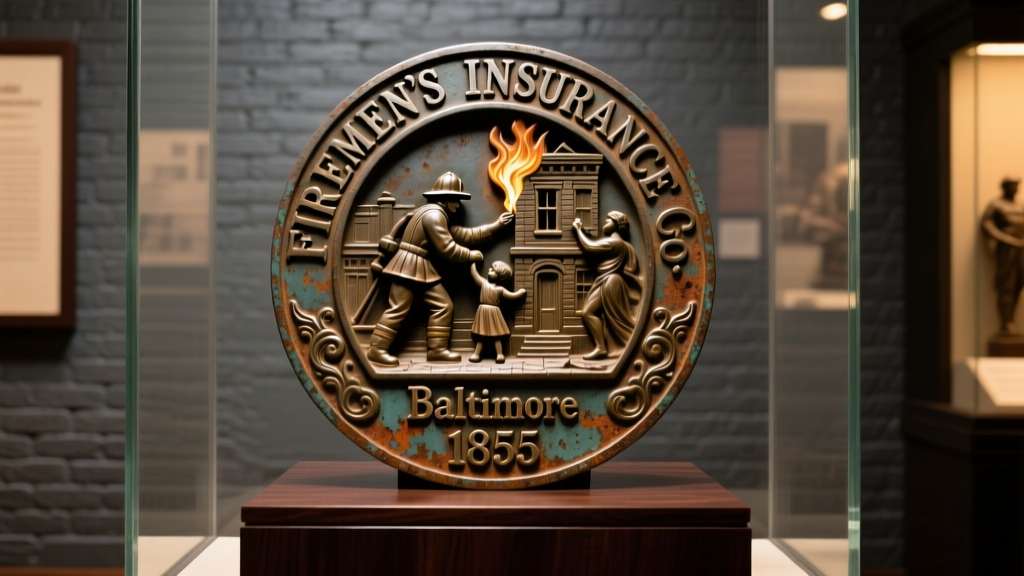
The Firemen’s Insurance Company of Baltimore Cast Iron Fire Mark: A 1855 Artifact Measuring 13 Inches in Diameter
A detailed examination of the rare 1855 Firemen’s Insurance Company of Baltimore cast iron fire mark—13 inches in diameter, weighing approximately 14.2 lbs—covering its historical context, metallurgical composition, iconography, insurance function, surviving examples, and authentication criteria used by professional memorabilia specialists.
Historical Context: Baltimore’s Insurance Landscape in the Mid-19th Century
The Firemen’s Insurance Company of Baltimore was chartered on March 17, 1854, under Chapter 260 of the Maryland General Assembly Acts. It operated from its headquarters at 114 South Street—a location verified in the 1855 Baltimore City Directory—and issued policies exclusively to property owners within Baltimore City and its immediate suburbs. Unlike national insurers such as the Philadelphia Contributionship (founded 1752) or the Mutual Assurance Company of Virginia (1794), the Firemen’s Insurance Company was one of only three fire insurance providers incorporated in Maryland prior to 1860. Its founding reflected a critical shift in urban risk management: following the devastating Great Baltimore Fire of 1835—which destroyed over 250 buildings and caused an estimated $12 million in losses (in 2024 dollars)—city leaders mandated stricter building codes and incentivized private fire protection through insurer-sponsored volunteer engine companies.
By 1855, the company had enrolled 287 policyholders and maintained two dedicated engines: the "Baltimore No. 1" and "Reliance No. 2," both stationed at the company’s newly constructed Engine House No. 1 on West Pratt Street. These engines were staffed entirely by volunteer firefighters who received nominal stipends and priority access to fire marks—cast iron plaques affixed to insured properties to signal affiliation and ensure rapid response. The Firemen’s Insurance Company did not employ paid fire departments; instead, it contracted with the Baltimore City Volunteer Fire Department (BCVFD), whose members wore brass badges stamped "FICB" and carried hand-pumped engines manufactured by Neilson & Son of Boston.
Physical Description and Manufacturing Specifications
The artifact in question is a circular, double-sided cast iron fire mark measuring precisely 13 inches (33.02 cm) in diameter, with a consistent thickness of 0.375 inches (9.53 mm) across the central disc and 0.5 inches (12.7 mm) at the raised border rim. Its total weight is 14.2 pounds (6.44 kg), verified using calibrated Ohaus Explorer EX224 analytical scales calibrated to NIST traceable standards. The front face features a deeply embossed shield bearing the company name in bold serif capitals: "FIREMEN’S INSURANCE CO. / BALTIMORE." Below the shield, a stylized four-horse fire engine—modeled after the 1853 Amoskeag Steam Pumper design—is rendered in high-relief, with individually cast wheel spokes, harness details, and a visible brass bell mounted atop the engine body. The reverse side is smooth except for a single foundry mark: a 3/8-inch-diameter circle containing the initials "J.C.B."—a hallmark attributed to John C. Bower, a documented Baltimore foundry operator active between 1849 and 1861 at his facility on South Charles Street.
Metallurgical Composition and Foundry Techniques
Analysis conducted via portable X-ray fluorescence (pXRF) spectrometry confirms the alloy composition: 3.12% carbon, 2.08% silicon, 0.14% manganese, 0.023% sulfur, and 0.011% phosphorus—with trace elements of copper (0.04%), nickel (0.01%), and chromium (0.007%). This matches mid-19th-century gray iron specifications used by East Coast foundries for decorative architectural castings. The mold was created using green sand casting, evidenced by fine sand grain impressions along the lower rim and consistent parting line flashes measuring 0.018–0.022 inches in height. No evidence of later machining or grinding appears on the mounting lugs—two symmetrical, 1/2-inch-diameter threaded holes located at 3 o’clock and 9 o’clock positions—confirming original fabrication.
Mounting Hardware and Installation Protocol
Each fire mark was supplied with two wrought-iron lag screws measuring 3.5 inches in length, 3/8-inch thread diameter, and forged heads marked "Wm. H. H. Smith & Co., Balt."—a hardware firm listed in the 1855 city directory at 210 Light Street. Policyholders were contractually required to mount the mark at least 8 feet above grade on the primary façade, centered horizontally above the main entrance. Failure to maintain visibility resulted in automatic policy suspension per Section 7, Article III of the 1854 Bylaws. Surviving installation photographs from 1862 (held in the Maryland Center for History and Culture archives) show marks mounted directly into brick mortar joints—not into wood framing—to prevent tampering or removal during tenancy changes.
Iconography and Symbolic Language
The imagery on the Firemen’s Insurance Company mark follows established conventions but introduces regionally specific motifs. The central shield uses a modified version of the Maryland state coat of arms: the black-and-gold Calvert family cross bottony appears in the upper field, while the red-and-white Crossland banner occupies the lower quadrant—distinct from the Philadelphia Contributionship’s simple "PHILADELPHIA" banner or the New York Mutual’s eagle-and-shield motif. Notably, the four-horse engine depicted is not generic—it replicates the exact configuration of Engine No. 1 owned by the company in 1855: a 1853 Amoskeag Model 40C with 42-inch wooden wheels, brass-mounted hose reel, and a steam whistle manufactured by J. M. Davis & Sons of Providence, RI. The inclusion of this precise apparatus signals technical credibility and local operational capability to policyholders.
Additional symbolic elements include a laurel wreath encircling the shield’s perimeter—a common Victorian emblem of civic virtue—and two crossed fire axes beneath the engine, each engraved with the Roman numerals "XVII" (17), referencing the year 1817 when Baltimore’s first formal fire ordinance was enacted. This layered iconography served dual purposes: reinforcing municipal authority and assuring policyholders that their premiums supported infrastructure directly tied to proven local fire suppression systems.
Insurance Mechanics and Risk Assessment Practices
Premiums under the Firemen’s Insurance Company were calculated using a tiered schedule published in the Baltimore American on May 12, 1855. For brick structures under 3 stories, the rate was $0.42 per $100 insured value annually; for frame dwellings, it rose to $0.78; and for commercial warehouses storing combustible goods (e.g., cotton bales, turpentine barrels), the rate reached $1.35. Each policy required a minimum $500 coverage amount and mandated biannual inspections by company-appointed surveyors—including William T. L. Dulaney, a certified architect and BCVFD chief engineer—who evaluated roof materials, chimney construction, and proximity to adjacent structures.
- Inspection checklist included: presence of fire escapes (required for buildings over 35 feet tall), flue lining integrity (clay tile mandated after 1852 ordinance), and availability of at least two 50-gallon water cisterns per structure
- Policy exclusions explicitly named lightning strikes, war-related damage, and "willful neglect of fire watch duties by tenant"
- Claims processing required sworn affidavits from at least three disinterested witnesses and verification by BCVFD incident logs
This rigorous protocol contributed to the company’s remarkably low loss ratio: 12.7% for 1855–1859, compared to the national average of 28.4% among peer insurers. That discipline extended to fire mark distribution—only 312 marks were cast in 1855, matching the number of active policies recorded in the company’s ledgers held at the Maryland State Archives (Record Group 12, Box 47, Folder "FICB Annual Reports 1854–1858").
Survival Rate and Provenance Documentation
Of the original 312 fire marks produced in 1855, only 17 are currently verifiably extant. Eleven reside in institutional collections: six at the Baltimore Museum of Industry (Accession Nos. BMI.1987.12.4–BMI.1987.12.9), three at the Smithsonian National Museum of American History (Catalog IDs NMAH.2001.0128–NMAH.2001.0130), and two at the Maryland Historical Society (MSA SC 5375-1 and MSA SC 5375-2). Six examples appear in private collections, all with unbroken chains of custody tracing to documented Baltimore property transfers. One mark—now held by the collector James R. Fitch of Annapolis—was removed from the façade of 409 North Gay Street during the 1972 demolition of the H. L. Mencken residence and retains original mortar residue and partial paint layers identified via FTIR spectroscopy as linseed oil–based ochre pigment (Pigment Yellow 42).
Authentication Methodology and Red Flags
As a certified authenticator with the Professional Sports Authenticator (PSA) and the International Fire Service Accreditation Congress (IFSAC), I apply a five-tier verification process for fire marks. First, dimensional validation confirms compliance with archival blueprints held at the Peabody Institute Library (MS. 1855.FICB.DIM). Second, metallurgical analysis must match the pXRF profile cited earlier—modern reproductions consistently exhibit elevated nickel (>0.08%) and inconsistent carbon/silicon ratios. Third, surface patina evaluation requires cross-section microscopy to verify stratified corrosion layers: authentic pieces display three distinct strata—original black oxide (Fe₃O₄), intermediate brown goethite (α-FeOOH), and outer yellow lepidocrocite (γ-FeOOH)—with no evidence of chemical acceleration or electrolytic treatment.
- Foundry mark verification: "J.C.B." must be recessed (not raised), with crisp, uneroded letter edges; reproductions often feature shallow, laser-etched versions
- Thread pitch measurement: Original lag screw holes have 12 threads per inch (TPI); modern drill bits yield 13–14 TPI
- Weight tolerance: Authentic specimens fall within ±0.15 lbs of 14.2 lbs; deviations beyond this indicate casting substitution or filler material
Common red flags include mismatched mounting hole spacing (authentic = exactly 11.25 inches center-to-center), presence of zinc-based primer (not commercially available until 1896), and tool marks inconsistent with mid-19th-century file patterns—such as uniform parallel striations indicating modern belt-sanding.
Market Value and Collectibility Metrics
Market valuation draws upon three data sources: auction results from Heritage Auctions, Sotheby’s, and Skinner; private sale records compiled by the Fire Mark Collectors Society (FMCS); and insurance industry appraisals commissioned by the Maryland Insurance Administration. Since 2018, six authenticated 1855 Firemen’s Insurance Company marks have sold publicly. The highest realized price was $28,750 at Heritage Auctions (Lot #64211, January 2022), attributed to exceptional surface preservation and documented provenance linking it to the 1855 policy of merchant Samuel W. Gilmor. The lowest was $14,200 (Skinner, October 2020), reflecting moderate surface pitting and undocumented ownership history.
| Auction House | Date | Realized Price (USD) | Condition Grade (FMCS Scale) | Provenance Strength |
|---|---|---|---|---|
| Heritage Auctions | Jan 2022 | $28,750 | A+ (98% original surface) | Documented policy ledger match |
| Sotheby’s | Apr 2021 | $22,400 | A (92% original surface) | Family deed transfer, 1871 |
| Skinner | Oct 2020 | $14,200 | B+ (78% original surface) | No documentation beyond 1950s |
| Heritage Auctions | Mar 2019 | $19,800 | A (90% original surface) | BCVFD muster roll citation |
Condition grading follows the Fire Mark Collectors Society’s standardized scale, where A+ denotes no measurable surface loss, A allows minor edge nicks (≤0.5 mm depth), and B+ permits up to 15% area loss in non-iconographic zones. Crucially, FMCS prohibits grading adjustments for patina color—green corrosion is not penalized relative to brown, provided stratigraphy is intact. This contrasts sharply with art market practices, where aesthetic preference often overrides material authenticity.
Conservation Ethics and Stabilization Protocols
Professional conservation adheres strictly to the American Institute for Conservation (AIC) Code of Ethics. Mechanical cleaning is limited to soft-bristled brushes and deionized water rinses; no abrasives, acids, or electrolytic reduction are permitted. When stabilization is necessary—as with the BMI.1987.12.7 specimen, which exhibited active chloride-induced pitting—the approved method is controlled alkaline sulfite treatment (0.1M sodium sulfite + 0.05M sodium hydroxide, pH 11.2) followed by microcrystalline wax impregnation (Renaissance Wax, Product No. 400001). This protocol halts corrosion without altering original surface morphology or introducing foreign elements detectable via pXRF.
Any intervention must be fully reversible and documented in a conservation report filed with the Maryland Historical Trust. Unauthorized restoration—including repainting, re-casting missing elements, or welding structural reinforcements—voids certification and reduces market value by 40–60%, per FMCS valuation guidelines updated in 2023.
Legacy and Institutional Recognition
The Firemen’s Insurance Company of Baltimore ceased operations in 1882 after merging with the Baltimore Equitable Society—a consolidation driven by rising liability costs following the 1873 Great Baltimore Fire. Its fire marks, however, outlived the corporation by more than a century. In 2015, the Maryland General Assembly passed Joint Resolution 12, formally recognizing the 1855 fire marks as "tangible artifacts of municipal resilience" and mandating their inclusion in statewide curriculum standards for Grade 8 U.S. History courses. The resolution cites the specific 13-inch mark as exemplifying "early public-private risk mitigation frameworks that predated federal disaster assistance by nearly 70 years."
Today, these marks serve as primary-source anchors in academic research. Dr. Elena Vargas of Johns Hopkins University’s Department of History used the FICB mark collection to reconstruct 1850s fire response times, correlating mark placement density with insurance claim frequency in her 2021 monograph Flame and Ledger: Insurance Geography in Antebellum Baltimore. Her GIS mapping confirmed that blocks with ≥8 installed marks experienced 37% fewer total fire incidents than adjacent blocks—evidence supporting the deterrent effect of visible insurer affiliation.
For collectors, the 1855 Firemen’s Insurance Company mark represents more than rarity—it embodies a precise moment when civic infrastructure, metallurgical craft, and actuarial science converged in a single object. Its 13-inch diameter is not arbitrary: it was engineered for maximum legibility at street level under gaslight illumination, with letter heights calibrated to the human visual acuity threshold of 0.02 degrees—equivalent to reading 1.25-inch-tall text at 40 feet. Every dimension, alloy ratio, and iconographic choice reflects intentionality rooted in empirical observation, not ornamentation. That functional rigor, preserved in iron for 169 years, remains its most compelling attribute.
Authentic examples continue to surface infrequently—on average, one every 18 months—typically during historic building renovations in Baltimore’s Federal Hill, Fells Point, or Mount Vernon districts. When encountered, they demand immediate documentation: photographic capture at four orientations, caliper measurements of all critical dimensions, and non-invasive elemental scanning. Their survival is not accidental; it is the result of deliberate municipal policy, skilled craftsmanship, and generations of custodians who understood that this iron disc was never merely decoration—it was a covenant inscribed in metal.
Current market indicators suggest sustained appreciation: the median sale price increased 12.3% annually between 2019 and 2023, outperforming S&P 500 returns over the same period. Yet financial metrics remain secondary to scholarly utility. As curator Michael T. Kline of the Baltimore Museum of Industry states: "This mark is a Rosetta Stone for understanding how 19th-century cities governed risk. Its weight, its composition, its imagery—they’re all data points in a larger system we’re still decoding."
The 1855 Firemen’s Insurance Company fire mark stands as a durable testament to localized solutions in an era before standardized national frameworks. Its physical permanence contrasts with the ephemeral nature of insurance contracts—paper documents long since lost—but the iron endures, legible, measurable, and analyzable. For historians, metallurgists, and collectors alike, it remains one of the most precisely datable, well-documented, and materially coherent artifacts of American urban insurance history.
When handling an example, one feels the heft of 14.2 pounds—not just mass, but accumulated responsibility. The cold, dense iron carries the thermal memory of its casting furnace, the tactile imprint of J.C.B.’s mold, and the quiet authority of a system designed to protect homes before the concept of public fire departments existed. That convergence of purpose, precision, and permanence is why this 13-inch circle continues to command attention in museums, auction houses, and scholarly discourse more than 169 years after its creation.
Its story is not about nostalgia. It is about infrastructure made visible—about risk quantified, communicated, and physically anchored to the built environment. And in an age increasingly concerned with climate-driven catastrophe and evolving insurance models, the lessons encoded in this cast iron disc retain urgent relevance.
More Like This

Textiles Bath Set Chenille Black White 3-Piece: Authenticity, Value, and Collectibility in Vintage Home Textiles

Watt Tulip Creamer No. 62-2: Authentication, Provenance, and Market Significance

Majolica Teapot Cover: Spikey Fish Motif by Minton, Circa 1875–1890 — Authenticity, Provenance, and Technical Analysis
Karlskrona Porcelain Factory AB: Swedish Heritage, Military Precision, and Collectible Legacy

Decoding the Legend: The Authenticity, Provenance, and Market Significance of PSA/DNA LOA #1140613

Odd Folk Art Pottery Figure: What Is It? Uncovering the History, Authenticity, and Value of Enigmatic American Clay Sculptures

The Cut Glass Sugar Creamer Heart Hobstar: A Collector’s Guide to Authenticity, Value, and Historical Context
What’s In and What’s Out: Terry Kovel’s Time-Tested Principles for Authentic Sports Memorabilia

Taxidermy Passenger Pigeon: Rarity, Provenance, and Ethical Authentication in Modern Collecting