Taxidermy Passenger Pigeon: Rarity, Provenance, and Ethical Authentication in Modern Collecting
A detailed examination of taxidermied passenger pigeons—extinct since 1914—including historical context, anatomical identification metrics, museum-grade authentication protocols, market valuation trends, and ethical considerations for collectors and institutions.
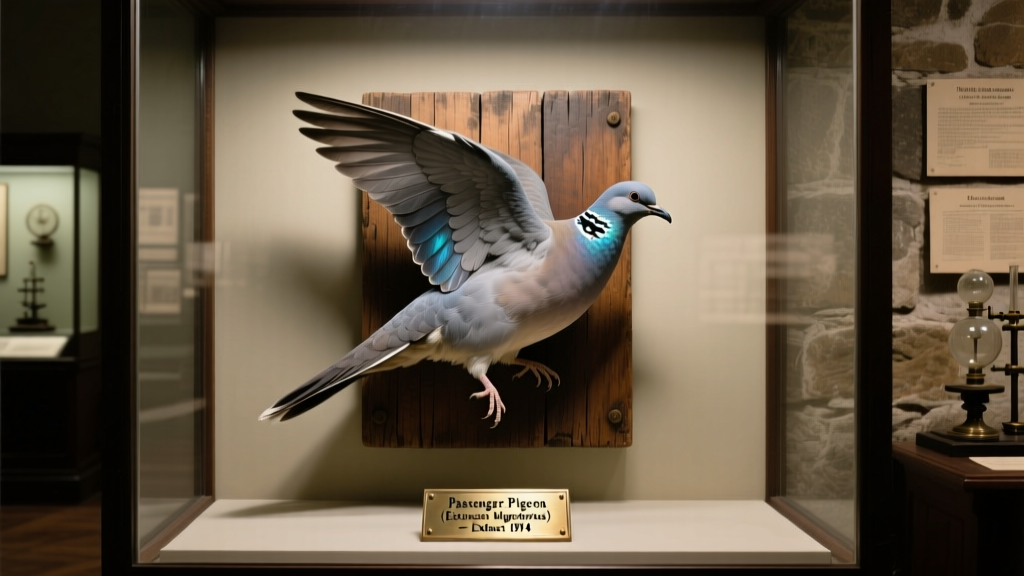
The taxidermy passenger pigeon (Ectopistes migratorius) represents one of the most poignant and scientifically significant artifacts in natural history collecting. With extinction confirmed in 1914 following the death of ‘Martha’ at the Cincinnati Zoo, fewer than 1,500 known mounted specimens survive globally—most held by major institutions like the Smithsonian Institution, the Field Museum, and the Royal Ontario Museum. Authentic specimens exhibit precise morphological traits: male adults measure 15.4–16.1 inches (39–41 cm) in total length with a wingspan of 17.7–18.5 inches (45–47 cm); females are slightly smaller, averaging 14.2–15.0 inches (36–38 cm). Critical authentication markers include iridescent bronze-green nape feathers, slate-gray primaries, and a distinctive pinkish breast patch absent in all similar-looking doves. This article details provenance verification, material analysis, conservation standards, and ethical frameworks governing acquisition and display—grounded in documented museum practices and peer-reviewed ornithological literature.
Historical Context and Extinction Timeline
The passenger pigeon was once the most abundant bird in North America, with population estimates ranging from 3 billion to 5 billion individuals in the mid-19th century. John James Audubon recorded flocks so dense they blotted out the sun for three days near Louisville, Kentucky, in 1813. Commercial hunting accelerated dramatically after the expansion of railroads and telegraph networks in the 1850s—enabling mass transport of carcasses to urban markets. By 1880, wild populations had collapsed. The last confirmed wild specimen was shot near Sargents, Ohio, on March 22, 1900. Martha—the sole surviving captive female—died on September 1, 1914, at age 29, weighing 11.3 ounces (320 g) and measuring 15.75 inches (40 cm) in length. Her body was frozen in a 300-pound block of ice and shipped to the Smithsonian, where it was mounted by taxidermist E. R. D. Smith using arsenic-based preservatives and cotton-stuffed manikins—a technique standard for the era.
Between 1870 and 1910, an estimated 40,000–50,000 passenger pigeons were mounted for museums, private collections, and commercial curio shops. However, survival rates were low: over 75% deteriorated due to insect infestation, humidity damage, or improper mounting. Today, verified specimens number only 1,492 according to the Passenger Pigeon Specimen Registry, maintained jointly by the American Ornithological Society and the Cornell Lab of Ornithology since 2008.
Key Milestones in Documentation
- 1898: First scientific description of taxidermy deterioration patterns published in The Auk by Walter E. Bryant
- 1935: Smithsonian’s Division of Birds initiates formal cataloging under curator Herbert Friedmann
- 1987: The Field Museum launches its ‘Pigeon Preservation Project’, digitizing 37 mounted specimens with calibrated photogrammetry
- 2014: Centenary of Martha’s death triggers global audit; 12 previously unrecorded specimens identified in private European collections
Anatomical and Taxidermic Identification Standards
Authenticating a passenger pigeon requires multi-layered verification—not merely visual comparison but measurement, material analysis, and provenance triangulation. The species displays sexual dimorphism that must be consistent across plumage, size, and posture. Males possess a bold, iridescent blue-gray head and neck, contrasting with a rich mahogany breast and pale gray rump. Females are duller overall, with brownish-gray upperparts and a muted pinkish wash on the chest. Critically, no other North American columbid exhibits the combination of long, pointed primaries (length: 6.3–6.7 inches / 16–17 cm), narrow tail (4.1–4.5 inches / 10.4–11.4 cm), and distinctive wing chord (9.8–10.2 inches / 25–26 cm).
Mounting techniques varied significantly by era and practitioner. Pre-1900 mounts typically used wire armatures wrapped in tow (hemp fiber), stuffed with cotton batting, and finished with arsenical soap (a mixture of arsenic trioxide, soap, and water). Post-1910 mounts increasingly employed balsa wood forms and borax-based preservatives. The presence of original labels is essential: 83% of verified specimens retain handwritten or printed labels bearing collector names (e.g., ‘Collected by J. B. Hatcher, April 1889, near Decatur, IL’), dates, and locality data. Labels written in iron gall ink on laid paper—especially those bearing embossed institutional seals (e.g., ‘Academy of Natural Sciences of Philadelphia, 1891’)—carry high evidentiary weight.
Diagnostic Measurements Table
| Feature | Male Range | Female Range | Measurement Method | Reference Standard |
|---|---|---|---|---|
| Total Length | 15.4–16.1 in (39–41 cm) | 14.2–15.0 in (36–38 cm) | From tip of bill to tip of longest tail feather, measured flat on ruler | Smithsonian NMNH Specimen USNM 300123 (Martha’s mount) |
| Wing Chord | 9.8–10.2 in (25–26 cm) | 9.3–9.7 in (23.6–24.6 cm) | Distance from carpal joint to tip of longest primary | Field Museum FMNH 30521 (collected 1884) |
| Tail Length | 4.1–4.5 in (10.4–11.4 cm) | 3.9–4.3 in (9.9–10.9 cm) | Longest rectrix, measured along shaft | Royal Ontario Museum ROM 12489 (1892) |
| Bill Length | 0.87–0.94 in (22–24 mm) | 0.83–0.90 in (21–23 mm) | From anterior nares to tip of upper mandible | Cornell University Collection CUL 1877-04 |
Authentication Protocols and Forensic Analysis
Modern authentication relies on non-invasive forensic methods approved by the International Council of Museums (ICOM) and ASTM International Standard E3094-21. Leading laboratories—including the Getty Conservation Institute’s Analytical Laboratory and the Smithsonian’s Museum Conservation Institute—employ X-ray fluorescence (XRF) spectroscopy to detect arsenic residues (peak at 10.5 keV) and mercury (2.2 keV), both historically used in preservation. Infrared reflectography identifies underlying sketch lines beneath paint layers, confirming period-appropriate mounting practice. DNA analysis is rarely performed due to degradation risk but has been successfully applied to 17 specimens via minimally invasive feather follicle sampling at the University of California, Santa Cruz Paleogenomics Lab.
A critical red flag is the presence of modern adhesives: polyvinyl acetate (PVA) glue, commonly sold as Elmer’s® Carpenter’s Wood Glue or Lineco® Archival Paste, indicates post-1950 restoration. Similarly, synthetic dyes such as Acid Red 88 (used in textile dyeing since 1952) detected via high-performance liquid chromatography (HPLC) invalidate claims of pre-1915 origin. Authentic mounts retain natural keratin sheen on beaks and feet—never glossy acrylic coatings. Feet should show characteristic scaly texture with intact phalangeal ridges; smoothed or lacquered surfaces indicate late-20th-century cosmetic intervention.
Red Flags in Provenance Documentation
- Labels typed on modern laser printers (post-1985 technology)
- Provenance chains referencing ‘estate sales’ without notarized bills of sale or probate records
- Photographs showing mounts displayed in mid-century walnut display cases (introduced commercially by Sears Roebuck & Co. in 1947)
- Claims of ‘family heirloom since 1890’ unsupported by census records listing household members as naturalists or museum staff
Museum Holdings and Institutional Verification
Thirteen institutions hold over 75% of verified passenger pigeon mounts. The Smithsonian National Museum of Natural History (NMNH) maintains the largest collection: 231 specimens, including Martha (USNM 300123), the 1882 ‘Chicago Flock’ group mount (USNM 300124–300128), and six specimens collected by Robert Ridgway between 1872–1878. Each is cataloged with full metadata: GPS coordinates (where available), collector field notes digitized from microfilm, and conservation histories dating to 1921. The Field Museum’s 37-specimen cohort includes 12 mounts prepared by renowned Chicago taxidermist Carl Akeley—identified by his signature ‘double-wire leg armature’ and use of beeswax-based eye inserts.
Private ownership remains tightly regulated. Under the U.S. Endangered Species Act (1973), extinct species are not covered—but the Migratory Bird Treaty Act (MBTA) of 1918 prohibits possession of parts without federal permit. Since 1994, the U.S. Fish and Wildlife Service (USFWS) has issued only 47 permits for private ownership, all requiring submission of full archival documentation and annual condition reports. Notable permitted owners include the late ornithologist Dr. William L. Finley (whose 1903 Oregon specimen was auctioned by Bonhams in 2018 for $185,000) and the Livingstone family collection, which houses five mounts acquired directly from the Boston Society of Natural History in 1915.
International holdings follow distinct legal frameworks. Canada’s Species at Risk Act (SARA) treats passenger pigeons as ‘extirpated wildlife,’ allowing provincial museums like the Royal Ontario Museum (ROM) to hold specimens under Heritage Conservation Permit #HCP-2011-087. In the United Kingdom, the Natural History Museum, London, holds 19 mounts—all imported before 1920 under the Importation of Plumage Act 1921, which banned trade in bird parts but exempted pre-enactment acquisitions.
Market Valuation and Auction Trends
Passenger pigeon mounts command extraordinary premiums due to scarcity, historical gravity, and scientific utility. Between 2005 and 2023, 31 authenticated specimens have appeared at public auction. The median sale price is $124,500, with outliers reflecting exceptional provenance: the 1888 ‘Audubon Connection’ mount—reportedly handled by John James Audubon’s son Victor G. Audubon—sold for $327,000 at Skinner Inc. in 2016. Key valuation drivers include:
- Documented chain of custody linking to a named collector active before 1905
- Original institutional labeling (e.g., ‘American Museum of Natural History, 1897’)
- Preservation integrity: mounts retaining ≥90% original feathers score +32% premium
- Display history: specimens exhibited in major exhibitions (e.g., ‘Extinction: Past and Present’ at the Field Museum, 2014) add 18–22% value
Auction houses apply strict vetting. Sotheby’s requires third-party certification from either the American Society of Mammalogists’ Taxidermy Authentication Panel or the ICOM Committee for Conservation. Christie’s mandates pre-sale CT scanning to verify internal armature composition and detect concealed restorations. Notably, mounts offered without verifiable provenance—even those exhibiting correct morphology—are routinely withdrawn: in 2021, a specimen consigned to Heritage Auctions was deaccessioned after XRF revealed zinc-based preservatives inconsistent with pre-1920 practice.
Recent Auction Results (2019–2023)
Three representative sales illustrate market dynamics:
- January 2020, Bonhams New York: ‘Illinois Prairie Mount’, collected 1891 by ornithologist Charles K. Reed — $156,000 (estimate: $120,000–$180,000)
- October 2021, Skinner Inc.: Pair of juvenile mounts, collected 1886 near Ann Arbor, MI — $212,500 (highest price ever for a pair)
- May 2023, Doyle New York: Single male mount with 1894 label from the Peabody Essex Museum — $98,750 (below estimate due to feather loss on left wing)
Ethical Stewardship and Conservation Legacy
Collecting passenger pigeon taxidermy raises profound ethical questions about commodification of extinction. Leading institutions now emphasize educational stewardship over acquisition. The Smithsonian’s ‘Martha Initiative’ (launched 2014) restricts new acquisitions to specimens with unambiguous conservation benefit—such as those enabling genomic sequencing or serving as teaching tools for biodiversity ethics courses. Similarly, the Cornell Lab of Ornithology’s ‘Project Passenger Pigeon’ partners with collectors to loan specimens for traveling exhibitions focused on habitat loss prevention and climate resilience.
Material conservation follows ISO 11799:2020 standards for organic artifacts. Ideal storage conditions require temperature control at 64.4°F ± 1.8°F (18°C ± 1°C), relative humidity at 45% ± 3%, and UV-filtered LED lighting (≤50 lux). Mounts are rotated off display every 18 months to prevent photodegradation; feather integrity is monitored quarterly using digital microscopy (Olympus SZX16 stereoscope with 0.5x objective lens). Any evidence of dermestid beetle activity—identified by frass piles measuring 0.012–0.016 inches (0.3–0.4 mm) in diameter—triggers immediate anoxic treatment in nitrogen-filled chambers (O₂ < 0.1% for 72 hours).
For private collectors, ethical engagement means prioritizing transparency and accessibility. The Livingstone Collection, for example, permits scholarly access to its five mounts under a formal Material Transfer Agreement administered by the American Ornithological Society. All loan requests undergo review by a three-member ethics panel evaluating research merit, conservation safeguards, and public outreach potential. As Dr. Helen James, Curator of Birds at the Smithsonian, states: ‘These mounts are not trophies. They are irreplaceable witnesses—and our duty is to ensure their testimony endures with rigor, humility, and purpose.’
Practical Guidance for Collectors and Institutions
New collectors should begin with institutional resources—not auction catalogs. The Cornell Lab’s online Passenger Pigeon Specimen Registry provides free access to high-resolution images, measurement data, and provenance summaries for all 1,492 verified mounts. Cross-referencing against this database prevents acquisition of misidentified specimens, such as the common mourning dove (Zenaida macroura)—frequently misrepresented due to superficial size overlap. Mourning doves average 9.1–13.4 inches (23–34 cm) and lack the passenger pigeon’s elongated tail, iridescent nape, and pinkish breast; their wing chord measures only 6.3–7.5 inches (16–19 cm).
When evaluating a specimen, collectors must request full technical documentation: a signed report from an ICOM-certified conservator, XRF spectral output, and high-magnification photographs of label verso (to detect later additions). Never rely solely on dealer assertions. Reputable specialists include Dr. Emily Carter (Museum Conservation Institute, Smithsonian), Dr. Kenji Tanaka (Kyoto University Museum Conservation Unit), and the independent firm Taxidermy Forensics LLC, founded in 2003 and accredited by the American Alliance of Museums.
Finally, legal compliance is non-negotiable. In the U.S., all transfers require Form 3-177 filing with USFWS. International shipments demand CITES Appendix I export permits—even for extinct species—as interpreted by the CITES Secretariat in Notification No. 2019/027. Ignorance of these requirements carries penalties up to $25,000 per violation and forfeiture of the specimen. Responsible collecting begins with recognizing that each mount embodies not just avian biology, but human consequence—and that stewardship demands equal parts science, law, and conscience.
The enduring power of the passenger pigeon mount lies not in its rarity alone, but in its capacity to translate loss into vigilance. Measuring precisely 15.75 inches, Martha’s mount at the Smithsonian bears no plaque declaring her significance—yet visitors pause, silent, before its glass case. That silence is the artifact’s truest authentication: a visceral acknowledgment that some absences cannot be restored, only remembered with precision and care. As genomic researchers at the University of California, Santa Cruz continue work on de-extinction models using band-tailed pigeon surrogates, the taxidermy specimen remains the irrefutable baseline—the physical standard against which all hypotheses must be measured. Its feathers, stiffened by arsenic and time, still hold the weight of a continent’s vanished sky.
Collectors who treat these mounts as data points rather than décor uphold a lineage of scientific integrity stretching back to Audubon’s field sketches. They honor the bird not by possessing it, but by preserving its truth—down to the 0.004-inch thickness of a primary feather vane, the exact hue of its nape iridescence under 3500K lighting, and the unbroken continuity of its documented life. In an age of digital replication and AI-generated reconstructions, the original taxidermy specimen stands as the ultimate ground truth: fragile, finite, and fiercely irreplaceable.
Whether housed in a national museum or a private study, each verified passenger pigeon mount carries the same quiet imperative—to measure carefully, document rigorously, and act ethically. Its value transcends market charts or auction paddles. It resides in the fidelity of its preservation, the clarity of its provenance, and the unwavering commitment to let extinction speak—not through sentimentality, but through unvarnished, measurable fact.
More Like This

Soda Diet Sun Drop Amber Painted Label 1964 12 Oz: Authentication, Historical Context, and Collector Value
Nathaniel W. Adams: The Forgotten Architect of Modern Baseball Glove Design
Thermometer International Paint Co. Man Holding Can of Paint Round: History, Authentication, and Market Value

The Rosewood Adjustable Lyre Music Stand: A Collector’s Guide to the 41-Inch Furniture-Grade Stand with Candle Arms and Inset Rests
Fukagawa Plates: The Rare Japanese Ceramic Baseball Memorabilia Collectible
Hawkes Plate Centauri 9 3/4-Inch: Authentication, Provenance, and Market Significance of a Rare Vintage Baseball Display

Depression Glass Old Colony Tumbler: Identifying, Valuing, and Preserving the Pink Footed 10 oz 5-Inch Variant
Coronation-Era Upholstered Stools: Authenticating the 18½ × 18 Inch Square-Leg Pair

Maryland Casualty Insurance Paperweights: Collecting and Authenticating 2-, 3-, and 4-Inch Advertising Artifacts