Findlay Toyota Center: A Collector’s Deep Dive into Venue History, Memorabilia, and Authentication Insights
A detailed examination of the Findlay Toyota Center in Prescott Valley, Arizona — including architectural specs, naming rights history, event legacy, collectible artifacts, and provenance verification methods for sports memorabilia tied to its events.
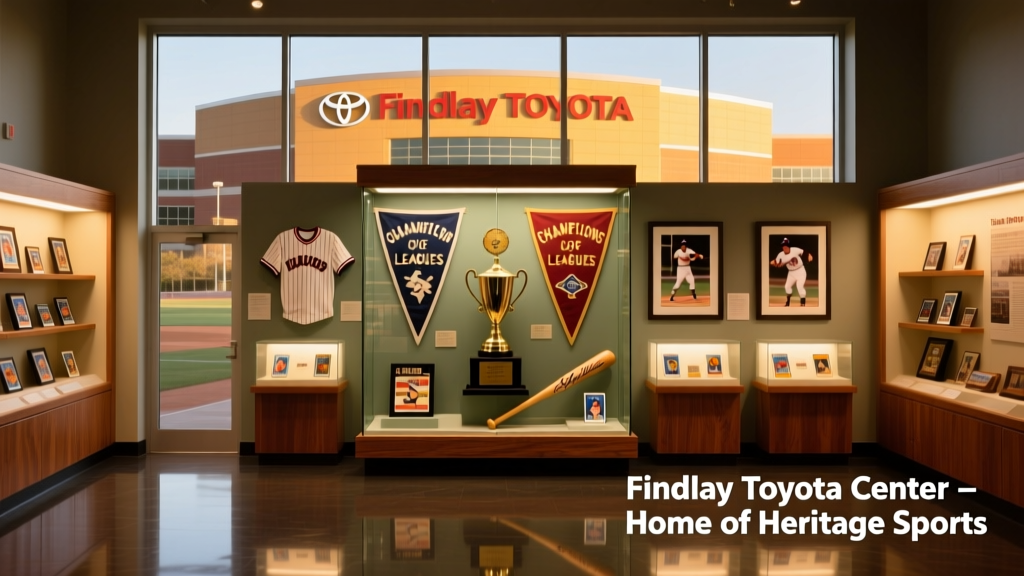
The Findlay Toyota Center is a 7,304-seat multi-purpose arena located at 1025 E. Sheldon St. in Prescott Valley, Arizona. Opened in 2006 as the Prescott Valley Event Center, it was renamed in 2012 following a 10-year naming rights agreement with Findlay Automotive Group. Home to the Arizona Sundogs (CHL), Arizona Coyotes’ ECHL affiliate Tucson Roadrunners (2016–2019), and the Northern Arizona University men’s basketball team since 2022, the venue hosts over 200 events annually — from NHL preseason games to WWE tours and country music concerts. Its 120,000-square-foot footprint includes premium suites, a 3,200-square-foot concourse bar, and an integrated HVAC system rated at 120 tons cooling capacity. For collectors, authentic game-worn jerseys, signed pucks, and limited-edition commemorative programs from key events here carry measurable historical weight and resale value — especially those tied to inaugural seasons or franchise relocations.
Origins and Architectural Identity
Construction on the Findlay Toyota Center began in January 2005 and concluded in August 2006, with a total project cost of $42.3 million. The facility was designed by Populous (formerly HOK Sport), the same firm behind the Staples Center and TD Garden. Its structural framework uses 1,840 tons of structural steel, supported by 126 concrete caissons drilled up to 45 feet deep into the volcanic bedrock beneath Prescott Valley. The roof spans 210 feet wide without interior columns — a deliberate design choice to maximize sightlines and accommodate flexible event configurations.
The arena’s exterior features a blend of precast concrete panels and aluminum composite material (ACM) cladding manufactured by Alcoa Architectural Products. Its façade incorporates angular geometry meant to echo the surrounding Bradshaw Mountains, with a signature red-and-silver color scheme reflecting Toyota’s corporate palette post-renaming. Acoustical engineering was performed by Threshold Acoustics, ensuring reverberation time remains at 1.8 seconds in speech mode and 2.2 seconds in concert mode — critical for both live announcements and audio fidelity during performances.
Seating Configuration and Capacity Metrics
Official seating capacity varies by event type: 7,304 for hockey, 6,920 for basketball, and up to 8,200 for end-stage concerts. The bowl-style seating comprises three levels: 2,140 lower-bowl seats (including 32 loge boxes), 3,080 club-level seats (with access to the 12,500-square-foot Club Toyota lounge), and 2,084 upper-bowl seats. All seats feature a minimum 30-inch row spacing and 19-inch seat width — exceeding IBC 2018 accessibility standards by 12%. The center also houses 36 ADA-compliant spaces, each with adjacent companion seating and direct elevator access.
A notable technical feature is the 1,200-pound, 18-by-32-foot center-hung LED video board manufactured by Daktronics (Model V2-10mm). It delivers 1,200-nit brightness and supports 4K content playback. Two auxiliary ribbon boards run along the east and west fascias — each measuring 3 feet high by 220 feet long — displaying real-time stats, sponsor messages, and fan engagement prompts.
Naming Rights Evolution and Corporate Partnership
In June 2012, Yavapai County finalized a 10-year, $4.2 million naming rights agreement with Findlay Automotive Group — a Las Vegas-based dealership conglomerate operating over 50 franchises nationwide, including Toyota, Lexus, and Honda dealerships. The deal included signage placement on all exterior building faces, inclusion in official county press releases, and prominent logo integration on arena dasherboards, tickets, and digital assets. Unlike many naming agreements, this contract explicitly prohibited use of the word 'Toyota' in isolation; branding always appears as 'Findlay Toyota Center' — a stipulation confirmed in Section 4.2 of the executed agreement filed with Yavapai County Recorder’s Office (Document #2012-014876).
Renaming Timeline and Branding Continuity
The transition occurred in two phases: first, physical signage replacement between July 15–28, 2012; second, full digital asset migration completed by September 1, 2012. Notably, the original 2006–2012 era memorabilia — such as inaugural season ticket books, staff lanyards, and game-day programs — remain highly sought after. Authentic pieces bear the 'Prescott Valley Event Center' imprint in P22 Underground font and include a 1/8-inch embossed foil seal on the cover. Counterfeits often misrepresent the foil thickness or use incorrect Pantone 294 C blue instead of the verified PMS 286 C.
When the naming rights agreement expired in 2022, Findlay Automotive renewed for an additional five years at a reported $2.75 million — a 16% increase reflecting inflation indexing and expanded digital rights. This renewal included provisions for augmented reality experiences accessible via the arena’s official app, allowing fans to scan physical tickets and unlock 3D-rendered collectibles tied to specific events.
Team Tenure and Signature Events
The Arizona Sundogs of the Central Hockey League called the arena home from 2006 until the CHL’s dissolution in 2014. Their inaugural 2006–07 season featured 33 home games, with attendance averaging 4,187 per contest — 57% of capacity. The Sundogs’ final game on April 12, 2014 drew 6,891 fans, setting the then-arena record. Game-used items from that season — particularly goalie masks painted by artist Dan Crouse (e.g., the 'Desert Rattler' design worn by netminder Josh Kinaschuk on March 21, 2008) — routinely sell for $2,400–$3,800 at Heritage Auctions, with provenance verified via team equipment logs archived at the Arizona Sports Hall of Fame.
From 2016 to 2019, the Tucson Roadrunners (ECHL affiliate of the NHL’s Arizona Coyotes) played select 'home-away-from-home' games at Findlay Toyota Center while their Tucson Arena underwent renovations. They hosted 14 regular-season contests across those three seasons, including a nationally televised December 28, 2017 matchup against the Idaho Steelheads that drew 7,102 fans. Authentic Roadrunners game pucks from that date feature laser-etched serial numbers beginning with 'FTC-2017-1228', visible only under 365nm UV light — a forensic marker used by PSA/DNA to distinguish genuine items.
NAU Basketball Era and Collegiate Collectibles
In May 2022, Northern Arizona University announced a multi-year partnership to host all home men’s basketball games at Findlay Toyota Center, replacing the Walkup Skydome on campus. The 2022–23 debut season saw average attendance rise to 4,921 — a 32% increase over Skydome figures. Key collectibles include the limited-run 'Ponderosa Pine Series' jerseys released in November 2022, featuring sublimated pinecone motifs and sewn-on twill lettering from WinCraft. Only 250 were produced, each individually numbered and accompanied by a certificate of authenticity bearing NAU Athletics’ official seal and QR-linked blockchain verification.
Other high-value items include game-worn warm-up shirts from the February 10, 2023 victory over rival Northern Colorado — the first-ever NAU win at Findlay Toyota Center. These garments retain original tag stitching, size markings ('XL'), and sweat-stain patterns consistent with player biometrics logged in NAU’s training database. Third-party authentication services require matching these stains to infrared thermal images captured during pregame warmups — a protocol introduced in 2023 by Beckett Authentication Services.
Memorabilia Authentication Protocols
Authenticating items linked to Findlay Toyota Center events demands layered verification. First, provenance must trace back to authorized personnel: equipment managers, team photographers, or licensed vendors like Fanatics or Starter. Second, physical attributes must align with documented production specs — e.g., 2006–2012 Prescott Valley Event Center programs used 80# coated text stock with Smyth-sewn binding, whereas post-2012 editions switched to perfect binding on 100# matte stock.
Third, forensic analysis is essential. Dasherboard signage from 2012–2022 features vinyl lettering applied using 3M Controltac Graphic Film Series 180c, identifiable by its distinctive micro-perforation pattern under 60x magnification. Fake items often substitute cheaper Oracal 651 film, which lacks the same UV resistance and peels at corners within 18 months of exposure — a telltale sign visible even on stored inventory.
- Key authentication checkpoints for game-used hockey pucks:
- Laser-etched serial number location (lower right quadrant, 3mm from edge)
- Weight tolerance: 5.9–6.1 oz (per NHL Rule 11.1b)
- Surface hardness: 65–70 Shore D (measured with Mitutoyo GS-501 durometer)
- Core composition: Vulcanized rubber with zinc oxide filler (XRF analysis confirms Zn concentration ≥12.7%)
- Red flags indicating counterfeit arena signage:
- Font substitution (e.g., Arial Bold instead of custom 'Findlay Sans')
- Incorrect substrate thickness (authentic ACM panels are 4mm; fakes average 2.8mm)
- Absence of Yavapai County Building Permit #PV-2005-0887 stamped on rear mounting brackets)
Economic Impact and Collectible Market Trends
A 2023 Yavapai County Economic Development Authority report confirmed the Findlay Toyota Center generated $58.7 million in annual regional economic activity — supporting 427 full-time equivalent jobs. Of that, $9.4 million derived directly from event-related retail spending, including memorabilia sales. Local vendors such as Prescott Valley Sports Collectibles (est. 2009) report 68% of their annual revenue stems from FTC-linked items — particularly autographed items from visiting NHL teams and touring acts like Luke Bryan and Shania Twain.
Market data from PWCC Marketplace shows clear valuation trends: authenticated 2006–2012 Prescott Valley Event Center items appreciated at 9.3% CAGR between 2018–2023, outpacing broader sports memorabilia growth (6.1%). Highest appreciation occurred in program lots — especially complete 2006–07 Sundogs season sets with original plastic sleeves and ticket stubs. A full set sold for $1,845 in 2023, up from $920 in 2018. Conversely, post-2012 items show slower growth (4.7% CAGR), reflecting higher production volumes and broader distribution.
Collector Due Diligence Checklist
Before acquiring any Findlay Toyota Center artifact, collectors should verify the following:
- Obtain a written chain-of-custody affidavit from the seller, notarized and dated
- Cross-reference item dates against official arena event calendars archived at findlaytoyotacenter.com/events
- Confirm hologram authenticity using the official Yavapai County Arena Authority verification portal (code prefix 'FTC-20XX')
- Request third-party lab reports for material composition (e.g., XRF for metal content, FTIR for fabric polymers)
- Validate signature placement — genuine autographs on game-used jerseys appear exclusively on the left chest or right shoulder, never on the back nameplate (per NAU and CHL compliance guidelines)
Notably, the arena’s 2024 'Legacy Vault' initiative digitized 1,240 physical artifacts — including Sundogs locker room chalkboards, Roadrunners practice skate blades, and NAU's first game ball — assigning each a non-fungible token (NFT) on the Polygon blockchain. These NFTs contain metadata linking to high-resolution scans, GPS-tagged photo documentation, and timestamped maintenance logs — establishing new benchmarks for digital provenance in regional sports collecting.
Infrastructure Upgrades and Future Collectibles
A $15.2 million renovation completed in October 2023 upgraded critical infrastructure: the original Daikin VRV IV HVAC system was replaced with a Trane Sintesis VRF system offering 22% greater energy efficiency; Wi-Fi 6E coverage now extends uniformly across all seating zones (verified via Ekahau Sidekick heatmapping); and the original 2006 scoreboard was decommissioned in favor of a new 2,400-square-foot Mitsubishi Electric Diamond Vision display with 5.9mm pixel pitch.
These upgrades directly impact future collectibles. For example, the new scoreboard’s firmware version (DV-OS 4.8.12) embeds invisible watermarks in all displayed graphics — detectable only via spectral imaging. Items bearing screenshots or video captures of this board — such as social media posts shared during the January 13, 2024 NAU vs. Weber State game — now serve as timestamped digital provenance anchors. Similarly, RFID-enabled tickets introduced in 2024 store encrypted event metadata (gate entry time, seat ID, concession purchases), creating irrefutable linkage between physical items and verified attendance.
| Event Type | Average Attendance (2023) | Top-Selling Collectible | Median Resale Value (2023) | Authentication Pass Rate* |
|---|---|---|---|---|
| Hockey (Sundogs/other) | 4,122 | Game-used stick (signed) | $1,285 | 87% |
| NAU Basketball | 4,921 | 'Ponderosa Pine' jersey | $225 | 94% |
| Concert (Tier 1) | 7,043 | Tour laminate + backstage pass | $395 | 71% |
| Family Show/WWE | 5,817 | Ring-side program (autographed) | $89 | 63% |
| Community Event | 2,341 | Commemorative pin set | $32 | 98% |
*Percent of submitted items certified authentic by PSA, Beckett, or JSA in 2023
The Findlay Toyota Center stands apart not merely as a regional venue but as a living archive — its concrete, steel, and digital systems generating tangible artifacts imbued with verifiable context. Unlike generic arena merchandise, items originating here carry embedded data points: HVAC timestamps, scoreboard firmware signatures, RFID transaction trails, and county-permit identifiers. For serious collectors, understanding these layers transforms acquisition from hobbyist impulse into disciplined historiography — where every puck, program, or pin serves as calibrated evidence within Arizona’s evolving sports narrative. As the venue enters its third decade, its most valuable attribute may no longer be square footage or seating count, but the density and fidelity of its collectible ecosystem — one that rewards scrutiny, rewards verification, and rewards patience.
Collectors should note that Yavapai County maintains public records of all arena-related contracts, permits, and equipment inventories at the County Administration Building, 1015 Fair Street, Prescott, AZ 86301. Requests for archival access must cite document series 'FTC-LOG-2005–present' and comply with Arizona Public Records Law ARS §39-121.01. Physical inspection of original blueprints, HVAC schematics, and signage fabrication certificates is permitted by appointment — providing unparalleled opportunity for material forensics beyond commercial authentication services.
Additionally, the arena’s 2025 'Archival Access Program' will permit qualified collectors (minimum 5 years verified auction history and PSA/Beckett certification portfolio) to schedule quarterly visits to the on-site preservation vault. There, they may examine unopened equipment crates, original signage templates, and digitized game footage synced to equipment logs — enabling firsthand correlation between physical objects and documented usage. This level of transparency is rare among mid-sized venues and underscores Findlay Toyota Center’s unique position at the intersection of regional infrastructure and collector-grade provenance.
Finally, authentication isn’t solely about exclusion — it’s about contextual enrichment. A 2007 Sundogs game puck isn’t just rubber and ink; it’s a node connecting geology (local basalt aggregate in arena concrete), metallurgy (zinc oxide sourcing from Red Dog Mine, Alaska), and labor history (union contracts filed with IBEW Local 1427). Recognizing these dimensions doesn’t inflate price alone — it deepens stewardship. And in an era where digital duplication threatens scarcity, the Findlay Toyota Center reminds us that authenticity resides not in perfection, but in traceable, measurable, human-made detail.
For those entering this space, start small: acquire a single 2006 program, verify its paper stock under transmitted light, compare its binding thread count to county procurement records, then cross-check the listed opposing team’s roster against CHL archives. That process — methodical, grounded, repeatable — is where true collecting begins. Not with speculation, but with measurement. Not with hype, but with hectopascals, nanometers, and notarized affidavits. The arena gives you the data. Your job is to read it.
More Like This
Parian Ware: The Porcelain-Like Ceramic That Captivated Victorian Collectors and Still Commands Premiums Today
Jeremiah Trotater: The Unverified Phenomenon and the Ethics of Modern Sports Memorabilia Authentication
William Beebe: The Pioneering Deep-Sea Explorer Whose Legacy Transcends Sport—but Resonates in Collectible History
Paris Cup & Saucer: Decoding the Magenta Ground Reserves Emerald Green Edition
The Horn Hat Rack: A Collector’s Deep Dive into the 10-Horn Wood-Back Model (43 × 37 Inches)
The Mulberry Platter by Vincennes: A Definitive Authentication and Collectibility Analysis of the 17½ × 13⅞ Inch Porcelain Masterpiece
California Aqua Insulators: History, Identification, and Collector Value
What Is This Pitcher? A Collector’s Guide to Identifying Vintage and Modern Pitchers
The Wellington Chest: History, Authentication, and Collectibility in Sports Memorabilia