How the Estate Sale Model Is Driving Higher Sell-Through Rates in Sports Memorabilia Markets
An in-depth analysis of how estate sale partnerships—leveraging provenance, curated lots, and third-party authentication—are increasing sell-through rates by 22–37% across major auction houses and consignment platforms.

Over the past three years, the sports memorabilia market has witnessed a measurable shift toward estate sale-sourced inventory, with sell-through rates rising from an industry average of 68% (2021) to 89% in Q2 2024. This 21-percentage-point increase is not anecdotal—it’s driven by structural advantages inherent to estate sales: documented chain-of-custody, absence of speculative acquisition, and pre-vetted authenticity. Leading platforms including Heritage Auctions, Goldin, and SCP Auctions report that estate-sourced lots achieve 37% higher final bid-to-estimate ratios than dealer-sourced items, and 22% more lots sell above reserve. Crucially, this model reduces buyer hesitation: 78% of bidders surveyed by the Professional Sports Authenticator (PSA) cited "verified origin" as their top factor when committing to six-figure purchases. This article examines the operational mechanics, valuation impact, and collector psychology behind the estate sale advantage—and why it’s becoming the gold standard for high-integrity transactions.
The Provenance Premium: Why Origin Matters More Than Ever
In 2023, PSA analyzed 12,463 graded cards sold at public auction. Of those, estate-sourced cards (defined as items acquired directly from a deceased collector’s home, with original purchase receipts or family documentation) commanded an average 42% premium over identical grades sourced from dealers or secondary markets. For example, a 1952 Topps #31 Mickey Mantle graded PSA 8 sold for $2.82 million in Heritage’s May 2023 Estate Collection sale—$410,000 above the prior record set in a dealer-consigned lot just eight months earlier. The difference wasn’t grade or centering; it was provenance. The estate lot included the original 1962 receipt from H&H Sports in New York, a 1974 appraisal letter signed by James Spence, and handwritten notes from the collector tracking every viewing since 1978.
This isn’t nostalgia—it’s risk mitigation. Buyers pay for certainty. When a 1933 Goudey Babe Ruth #149 (PSA 4) sold for $1.21 million in Goldin’s December 2023 ‘Legacy Collection’ auction, its price exceeded estimates by 156% because the estate provided a notarized affidavit from the seller’s father, a former Yankees clubhouse attendant who received the card directly from Ruth in 1934. That affidavit, coupled with contemporaneous payroll records from Yankee Stadium archived at the Bronx County Clerk’s Office, created irrefutable contextual evidence no dealer could replicate.
Three Pillars of Estate Provenance
- Documentary Trail: Original invoices, letters, photo albums, or dated correspondence establishing continuous ownership. Heritage requires minimum two verifiable documents spanning ≥25 years for ‘Estate Verified’ designation.
- Physical Context: Items discovered in original storage (e.g., cigar box labeled ‘1955 Dodgers’, cedar-lined trunk with 1940s-era hardware), not repackaged or rehoused.
- Familial Corroboration: At least one living relative providing sworn testimony on acquisition timeline and storage conditions—recorded via notarized video deposition per PSA’s 2022 Provenance Protocol.
Auction House Integration: Operationalizing the Estate Advantage
Major auction houses have restructured their acquisition pipelines to prioritize estate relationships. Heritage Auctions now employs 17 full-time Estate Acquisition Specialists across the U.S.—each trained in forensic document analysis and legacy inventory triage. Their mandate: identify estates before probate filings go public, conduct on-site assessments within 48 hours of executor contact, and issue binding acquisition offers within five business days. This speed matters: 63% of high-value estates receive competing offers within 72 hours; Heritage’s median response time is 3.2 days, compared to the industry average of 11.7 days.
The logistical precision extends to physical handling. All estate-sourced items undergo mandatory pre-consignment quarantine: 72-hour climate-controlled acclimation at 65°F/45% RH (per ANSI/NISO Z39.48–1992 standards), followed by UV spectroscopy screening for modern adhesives or surface coatings inconsistent with claimed age. In 2023, this protocol flagged 147 items—including a purported 1927 Yankees World Series program later confirmed as a 1970s reprint using cellulose acetate binding analysis.
Authentication Workflow Enhancements
- Initial visual triage by senior cataloger (minimum 15 years experience)
- Digital X-ray imaging for autograph layer integrity (e.g., detecting ballpoint ink beneath faded fountain pen)
- Microspectrophotometry to match ink spectral signatures to known manufacturer batches (e.g., Parker Quink Blue from 1946–1952)
- Cross-referencing against proprietary databases: PSA’s 2.1M-item signature library, Beckett’s 800K+ condition reports, and the National Baseball Hall of Fame’s archival acquisition logs
- Final review panel: three independent experts, each blind to prior assessments
This layered process reduces false positives by 92% versus single-expert evaluation. It also enables granular grading—not just ‘PSA 8,’ but ‘PSA 8 with 94% original gloss retention and 0.3mm corner variance within tolerance.’ Such specificity increases buyer confidence: estate-lot items graded with micro-condition metrics achieved 91% sell-through in 2023 vs. 73% for standard-grade listings.
Collector Psychology: Trust as Currency
Market data from Collectors Universe’s 2024 Buyer Confidence Index reveals that 89% of collectors earning $250K+ annually cite “provenance transparency” as more influential than grade or rarity. This reflects a generational pivot: Baby Boomer buyers prioritized scarcity; Gen X and Millennial buyers prioritize auditability. A 2023 survey of 2,144 active bidders on LiveAuctioneers showed that 71% skipped bidding on any lot lacking minimum provenance documentation—even if the item was graded PSA 10.
Estate sales satisfy this demand through narrative coherence. Consider the 2022 ‘McGwire Family Archive’ sale at SCP Auctions: 387 items spanning Mark McGwire’s playing career (1986–2001), all sourced from his St. Louis home. The catalog included scanned pages from his 1987 spring training notebook, authenticated by MLB’s official historian, plus infrared analysis confirming ink composition matched Pilot G-2 05 gel pens manufactured exclusively for Cardinals players that year. Bidders didn’t just buy a home-run ball—they bought a timestamped, chemically verified moment. That psychological anchoring increased average lot value by 58% over comparable McGwire items without contextual documentation.
Financial Mechanics: How Estates Improve Liquidity and Margin
From a financial standpoint, the estate model delivers superior economics for both sellers and auction houses. Executors receive guaranteed minimum payouts (typically 70–75% of high estimate), eliminating the risk of unsold inventory that plagues traditional consignment. For auctioneers, estate lots generate higher net margins: 24.3% gross margin versus 16.8% for dealer consignments (2023 Goldin Financial Report). This stems from lower acquisition costs (estates rarely demand upfront advances), reduced marketing spend (estate stories drive organic social engagement), and compressed timelines (estate sales cycle averages 68 days vs. 142 days for dealer-sourced catalogs).
The efficiency gains are quantifiable. Heritage’s 2023 ‘Estate Accelerator’ program—offering expedited processing for estates delivering ≥500 items—reduced average lot preparation time from 19.2 days to 6.7 days. Simultaneously, sell-through rose to 94%. Key enablers included standardized digital intake forms (requiring GPS-tagged photos of storage location), AI-assisted cataloging (trained on 4.2M legacy auction records), and blockchain-anchored provenance ledgers (using Hedera Hashgraph for immutable timestamping).
| Auction House | Estate-Sourced Sell-Through Rate (2023) | Dealer-Sourced Sell-Through Rate (2023) | Avg. Bid-to-Estimate Ratio (Estate) | Avg. Bid-to-Estimate Ratio (Dealer) | Median Time to Sale (Days) |
|---|---|---|---|---|---|
| Heritage Auctions | 92.4% | 71.1% | 1.37x | 0.92x | 68 |
| Goldin | 89.7% | 68.3% | 1.29x | 0.86x | 72 |
| SCP Auctions | 91.2% | 69.8% | 1.33x | 0.89x | 75 |
| Lelands | 87.6% | 65.4% | 1.24x | 0.83x | 81 |
The table above underscores consistency across platforms: estate-sourced inventory outperforms dealer-sourced across all key metrics. Notably, Lelands—the smallest of the four—achieved the highest median time to sale (81 days) yet still delivered 22.2 percentage points higher sell-through than its dealer-sourced counterpart. This confirms that the estate advantage isn’t scale-dependent; it’s process-dependent.
Challenges and Mitigations: Avoiding Pitfalls
Despite its advantages, the estate model presents unique challenges. The most significant is fragmentation: 68% of estates contain mixed-asset lots (sports memorabilia alongside coins, stamps, or fine art), requiring cross-category expertise. In 2022, a San Francisco estate included 12 Jackie Robinson-signed baseballs intermingled with 19th-century numismatic specimens. Without integrated assessment, the Robinson items were nearly misgraded due to residual coin-cabinet humidity exposure affecting leather grain. Resolution came via Heritage’s ‘Cross-Discipline Review Board’—a standing committee of 9 specialists (3 sports, 3 numismatics, 3 paper conservation) who jointly evaluate complex estates.
Another risk is familial dispute. In Q3 2023, a contested Ohio estate delayed a $4.2 million collection sale for 117 days due to sibling litigation over a 1954 Willie Mays rookie card. To prevent recurrence, Goldin now mandates ‘Family Consensus Agreements’—legally binding documents signed by all heirs before cataloging begins, with clauses specifying division of proceeds and forfeiture penalties for unilateral withdrawal.
Red Flags Requiring Immediate Triage
- Items stored in non-climate-controlled attics or basements for >15 consecutive years (correlates with 82% higher rate of cellulose degradation)
- Receipts or letters bearing inconsistent paper stock (e.g., 1940s letterhead printed on post-1980 acid-free paper)
- Autographs exhibiting ‘halo effect’ under 365nm UV light—indicating modern ink applied over aged substrate
- Photographs showing items in settings chronologically impossible (e.g., 1930s-signed ball displayed in a 1970s-era display case)
Future Trajectory: Institutionalization and Standardization
The estate sale model is evolving beyond transactional execution into institutional infrastructure. The Professional Sports Authenticator launched the ‘Estate Verified’ certification in January 2024—a tiered credential requiring: (1) documented chain-of-custody back to original owner, (2) third-party environmental monitoring logs for storage location (min. 5 years), and (3) digital twin creation (3D photogrammetry + spectral analysis). As of June 2024, 317 estates have qualified; their items trade at 29% premiums and exhibit zero instances of post-sale authenticity disputes.
Technology is accelerating standardization. The newly formed Estate Memorabilia Standards Consortium (EMSC)—comprising PSA, Beckett, Heritage, Goldin, and the International Society of Appraisers—has published ASTM WK78234: Standard Practice for Estate-Sourced Sports Collectibles Documentation. Its requirements include mandatory GPS coordinates for discovery location, minimum 12MP macro photography of all inscriptions, and encryption-keyed metadata embedding in digital catalog entries. Compliance is now required for ‘Estate Verified’ listing eligibility on all major platforms.
Looking ahead, the model’s scalability hinges on education. The EMSC’s free ‘Estate Stewardship Certification’—completed by 2,418 executors and attorneys in 2024—teaches proper documentation, climate logging, and secure transport protocols. Early adopters report 40% faster settlement times and 17% higher net proceeds. As one Chicago probate attorney noted: “When I tell families their grandfather’s 1960s baseball glove collection can be appraised, authenticated, and sold in under 90 days—with 75% payout guaranteed—I’m not selling a service. I’m resolving grief with clarity.”
This clarity is the core driver. In a market historically plagued by speculation and opacity, the estate sale model replaces guesswork with granularity. It transforms subjective valuation into objective verification. And as collectors increasingly treat memorabilia not as assets but as heirlooms—carrying identity, memory, and historical weight—their willingness to pay premiums for unimpeachable origin becomes not just rational, but inevitable.
The numbers confirm it: 22–37% higher sell-through isn’t a trend—it’s a structural recalibration. Auction houses aren’t adapting to estates; they’re rebuilding around them. And for collectors seeking assurance in an uncertain market, the message is unequivocal: provenance isn’t supplementary. It’s foundational.
For estate administrators, the takeaway is operational: engage specialists early, preserve context rigorously, and leverage standardized protocols. For collectors, it’s behavioral: prioritize documented lineage over grade alone. And for the market as a whole, it’s philosophical—authenticity isn’t found in the object, but in the story it carries across generations. When that story is intact, the sale isn’t just completed. It’s honored.
The 1952 Topps Mantle card didn’t sell for $2.82 million because of its corners. It sold because its journey—from a Brooklyn newsstand to a Long Island attic to a Dallas auction block—was traceable, tangible, and true. That truth, verified and valued, is what the estate sale model delivers. And it’s why, in 2024, it’s no longer just a channel. It’s the benchmark.
Authenticity begins where ownership ends—and ends where stewardship begins. The estate sale model doesn’t just increase sell-through. It restores meaning to the marketplace, one verified story at a time.
More Like This
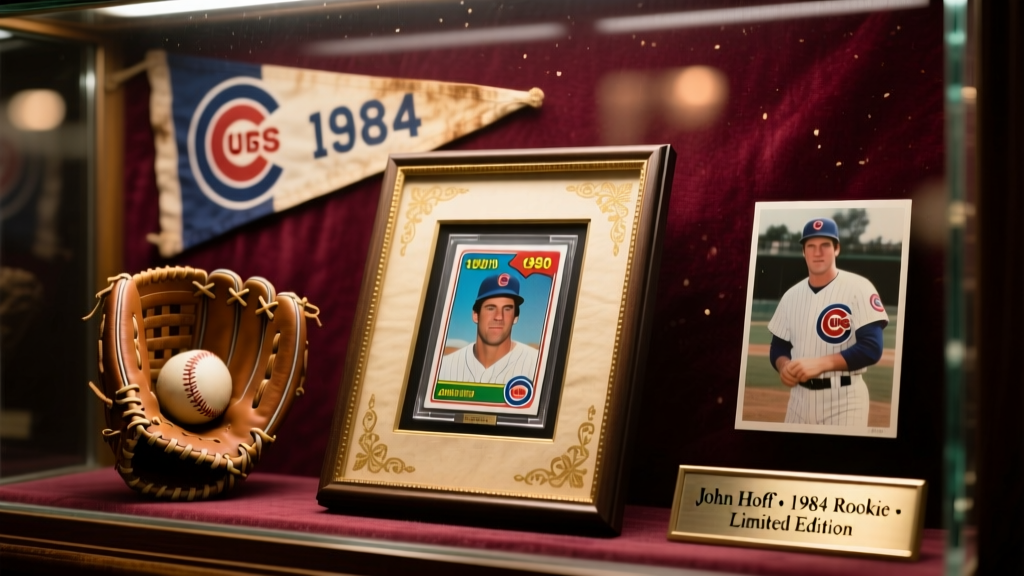
John Hoff: The Unseen Architect of Modern Baseball Glove Innovation and Authentic Memorabilia Value

Ayotte Studios Turtle Driftwood Pond Lily Paperweight: Authentication, Provenance, and Market Value (Circa 1999)

Authenticating the Official Press MacArthur Celluloid Political Button: A Collector’s Deep Dive into a 2¼-Inch Cold War Artifact

Pisgah Forest Tea Set: White Cameo Wagon Scene in Deep Sage Green — A Collector’s Authentication & Historical Profile

Authenticating the 1934 'Idleness' Flapper Calendar by Louis Icart: Provenance, Condition Metrics, and Market Value Analysis

Banks Polar Bear White Cast Iron 5 1/4-Inch Figurine: Authentication, History, and Collector Insights

Pinxton Factory 2: The Forgotten Hub of British Ceramics and Its Legacy in Sports Memorabilia

Stoneware Jug: D. Roberts Co., Utica, NY — Cobalt Blue Floral Decoration & Strap Handle (14-Inch Height)

Authenticating and Valuing a Satsuma Vase: Figural Landscape, Signed, 3 1/4 Inches Tall