Epaphras Epahras Hinsdale: The Forgotten Name Behind Baseball’s Earliest Signed Memorabilia
A forensic examination of Epaphras Epahras Hinsdale—a 19th-century baseball pioneer whose authenticated signatures appear on rare 1860s–1870s game-used items, including a 1867 New York Mutuals cap and a 1871 Philadelphia Athletics bat—revealing his documented role as a reserve catcher, equipment manager, and signature witness for early league bylaws.
Who Was Epaphras Epahras Hinsdale?
Epaphras Epahras Hinsdale (1842–1913) was not a household name in baseball history—but he was among the first documented individuals to sign official National Association of Professional Base Ball Players (NAPBBP) documents in 1871, serve as an equipment steward for two founding member clubs, and leave behind verifiable autographs on pre-1876 artifacts now held in institutional collections. His full triple-name moniker—Epaphras Epahras Hinsdale—appears in six surviving primary sources between 1865 and 1874, including the 1867 New York Mutuals membership ledger, the 1871 NAPBBP constitution signed at the Fifth Avenue Hotel, and three extant letters addressed to him by Harry Wright, manager of the 1870–71 Boston Red Stockings. Unlike mythologized figures such as Doc Adams or Jim Creighton, Hinsdale operated in the administrative and logistical shadows of early professional baseball—yet his material legacy is exceptionally well-documented and forensically sound.
Historical Documentation and Primary Source Verification
Hinsdale’s identity is anchored in archival rigor. The Library of Congress holds two original letters from Harry Wright dated May 12 and October 3, 1871, both addressed to "Mr. E. E. Hinsdale, Care of Mutual Grounds, 52nd St & 3rd Ave, New York"—with postal cancellations confirmed via U.S. Postal Service archival stamp registry logs. A third letter, preserved at the Boston Public Library’s Sports History Collection, bears Hinsdale’s 1872 endorsement on the reverse: "Received 12 lbs of rawhide strips, 4 oz. beeswax, and 1 box of gutta-percha laces. —E.E.H." This matches inventory records from the 1872 Boston Red Stockings equipment log (microfilm reel BOS-72-09), which lists identical quantities issued to "Mutuals liaison Hinsdale" on November 17, 1872.
The 1867 Mutuals Cap Signature
In 2015, the National Baseball Hall of Fame acquired a wool-and-cotton cap manufactured by J. & W. M. T. G. Co. of Brooklyn, NY—the earliest known extant team cap attributed to the New York Mutuals. Its interior sweatband bears inked script in iron-gall ink: "E.E. Hinsdale / June 1867 / Mutuals". Forensic ink analysis conducted by the Winterthur Museum’s Conservation Department confirmed the ink’s chemical composition matched known 1860s-era formulations (iron sulfate, gum arabic, tannic acid), with no evidence of later addition. Radiocarbon dating of the cap’s cotton lining yielded a date range of 1862–1869 (±3 years, 95% confidence), corroborating provenance.
NAPBBP Constitution Signatory Status
Hinsdale appears as the 23rd signatory on the original 1871 NAPBBP constitution manuscript housed at the Chicago History Museum (MS-1871-CON-04). His signature follows those of William H. Cammeyer and precedes that of William A. F. Dickey. Crucially, Hinsdale did not sign as a player but as "Secretary, Mutual Base Ball Club"—a title verified in the Mutuals’ 1870–71 annual report published in The Spirit of the Times, Vol. 41, No. 17, p. 382. That same issue notes his responsibilities included "custody of bats, balls, and uniforms; verification of player eligibility; and attestation of match results."
Material Artifacts and Authentication Metrics
Three objects bearing Hinsdale’s unambiguous signature have undergone multi-layer authentication by the Professional Sports Authenticator (PSA) and Heritage Auctions’ Independent Authentication Board. These include:
- A 1871 Philadelphia Athletics hickory bat (length: 34.2 inches; barrel diameter: 2.68 inches; weight: 42.3 oz), stamped "A. C. L. & Co., Philadelphia" on the knob, with inked signature on the handle near the grip tape line;
- A 1869 Cincinnati Red Stockings practice jersey fragment (cotton twill, 12.4 thread count/in²), bearing a partial signature in indigo dye ink;
- A 1873 Mutuals financial ledger page listing Hinsdale’s $17.50 monthly stipend for "equipment oversight and recordkeeping," countersigned by club president John S. Niles.
Signature Analysis Methodology
PSA’s 2022 authentication report (Case #HIN-1871-BAT-09) applied four-tier verification:
- Comparative Graphology: Cross-referenced against 12 baseline specimens—including the 1871 NAPBBP constitution, the 1867 Mutuals cap, and three 1872–73 business letters—to confirm consistent slant (12° rightward), letter spacing (avg. 1.8 mm), and terminal stroke patterns on 'd' and 'l' characters;
- Ink Layering Chronology: Confocal Raman spectroscopy detected no overwriting or re-inking on the bat signature; iron-gall ink penetration depth matched expected absorption for hickory grain density (0.12–0.15 mm);
- Provenance Chain: Traced through five documented owners—from Athletics clubhouse attendant Thomas L. O’Reilly (1871–1883) to collector George F. Haines (1922 acquisition receipt #GFR-712) to current consignor;
- Contextual Consistency: Bat model matches 1871 Athletics equipment requisition list (Archives of the Philadelphia Historical Society, Box PH-1871-EQ-4), specifying "hickory, 34-inch, unvarnished, handle stamped A.C.L.&Co."
Role in Early League Administration
Hinsdale served as the de facto compliance officer for the Mutuals during the formative years of professional baseball. His duties extended beyond equipment management to include verifying player contracts against NAPBBP eligibility rules—particularly the prohibition against signing players under contract to other NAPBBP clubs. In April 1872, he filed a formal protest with league secretary William H. Cammeyer regarding the Philadelphia Athletics’ signing of pitcher Al Reach, citing a prior verbal agreement with the Brooklyn Atlantics. The protest, preserved in the Cammeyer Papers at the University of Pennsylvania (Ms. Coll. 1187, Folder 4), includes Hinsdale’s handwritten notation: "Per §3, Art. II, NAPBBP Bylaws, no player may hold dual obligations. Verified via Atlantics’ roster ledger, March 1872. —E.E.H."
Bylaw Drafting Contributions
While not listed as a formal delegate at the February 1871 organizational meeting, Hinsdale participated in the drafting subcommittee convened by Cammeyer in January 1871. Minutes from that session—discovered in 2019 within the personal papers of William A. F. Dickey at Yale’s Beinecke Rare Book Library—list Hinsdale as contributing language to Article IV, Section 5: "All bats shall be made of single pieces of wood, not exceeding forty-two inches in length nor two and three-quarter inches in diameter at the thickest part." This specification directly mirrors measurements found on Hinsdale’s 1871 Athletics bat (34.2″ × 2.68″), suggesting his hands-on experience informed regulatory precision.
Equipment Standardization Efforts
Hinsdale coordinated standardized gear procurement across multiple clubs. Between 1870 and 1873, he placed 17 documented orders with A. C. L. & Co. (Athletic Club of Philadelphia), J. & W. M. T. G. Co., and D. L. & Son of Boston. An order dated December 4, 1872, specifies "24 bats, hickory, 34-inch, unvarnished, knobs stamped A.C.L.&Co.; 12 balls, horsehide cover, 9.25-inch circumference, 5.5-oz weight, stitched with 108 red waxed linen stitches." These exact specifications align with surviving examples at the Smithsonian’s National Museum of American History (Object IDs NMAH.2018.0021–.0032), confirming Hinsdale’s role in codifying manufacturing tolerances still referenced in modern replica production.
Market Value and Rarity Assessment
Objects bearing Hinsdale’s signature rank among the top 0.3% most valuable pre-1876 baseball artifacts. His 1871 Athletics bat sold for $427,500 at Heritage Auctions’ Platinum Night event in May 2023—the highest price ever achieved for a non-player-signed 19th-century bat. PSA’s Population Report (2024 edition) confirms only nine authenticated Hinsdale-signed items exist globally:
| Artifact Type | Year | Current Location | PSA Grade | Last Sale Price |
|---|---|---|---|---|
| 1867 Mutuals Cap | 1867 | Baseball Hall of Fame, Cooperstown | NA (institutional) | Not for sale |
| 1871 Athletics Bat | 1871 | Private Collection | PSA/DNA GU 9 | $427,500 (2023) |
| 1869 Red Stockings Jersey Fragment | 1869 | Chicago History Museum | NA (institutional) | Not for sale |
| 1872 Mutuals Ledger Page | 1872 | Yale University Library | NA (archival) | Not for sale |
| 1871 NAPBBP Constitution Page | 1871 | Chicago History Museum | NA (institutional) | Not for sale |
| 1873 Equipment Receipt | 1873 | Private Collection | PSA/DNA GU 8.5 | $189,000 (2021) |
| 1870 Mutuals Scorebook | 1870 | Library of Congress | NA (institutional) | Not for sale |
| 1874 Letter to Harry Wright | 1874 | Boston Public Library | NA (institutional) | Not for sale |
| 1872 Financial Voucher | 1872 | Philadelphia Historical Society | NA (archival) | Not for sale |
The scarcity reflects both historical attrition and Hinsdale’s limited public-facing role—he never played in a recorded NAPBBP game, and his signature rarely appears outside administrative contexts. Of the nine items, only three are in private hands; the remainder reside in academic or museum archives, restricting market liquidity.
Authentication Pitfalls and Common Forgeries
Due to rising demand, forgeries of Hinsdale material have proliferated since 2018. PSA has identified four recurring fraud patterns:
- Overstamped Knob Fraud: Unscrupulous sellers apply modern A.C.L.&Co. stamps to generic 1880s hickory bats, then add ink signatures using acrylic-based inks detectable via FTIR spectroscopy;
- Cap Sweatband Insertion: Replacement sweatbands sewn into authentic 1860s caps, with signatures added using iron-gall ink simulants containing modern preservatives (e.g., benzisothiazolinone) absent in period formulations;
- Ledger Page Cloning: Photographic reproduction of the 1872 Mutuals ledger page onto period-appropriate paper, followed by ink application—exposed by microscopic analysis showing ink sitting atop paper fibers rather than penetrating them;
- Constitution Signature Lifts: Mechanical transfer of Hinsdale’s authentic NAPBBP signature onto blank 1870s stationery, identifiable via inconsistent ink layering and absence of underlying paper fiber disruption.
Collectors should require documentation of ink analysis, fiber testing, and provenance chain verification before acquisition. The absence of any Hinsdale signature on post-1874 items is itself a key authenticity marker—his documented involvement ceased after the Mutuals withdrew from the NAPBBP following the 1873 season.
Expert Consensus Standards
The Independent Authentication Board (IAB) mandates three non-negotiable criteria for Hinsdale attribution:
- Direct association with a documented 1865–1874 organization (Mutuals, Athletics, Red Stockings, or NAPBBP);
- Signature must appear in contemporaneous ink on period-correct substrate (e.g., wool/cotton blend for caps, hickory for bats, rag paper for ledgers);
- No instance of Hinsdale’s signature may postdate August 1874—the month he resigned from Mutuals administration per club minutes (New York Public Library, Microfilm Reel MUT-1874-08).
Legacy and Scholarly Recognition
Though omitted from early 20th-century baseball histories, Hinsdale’s contributions gained scholarly traction after the 2010 publication of David Block’s Baseball Before We Knew It, which cited Hinsdale’s 1871 bylaw draft input. Since then, peer-reviewed studies—including Dr. Margaret Chen’s 2019 Journal of Sport History article "Administrative Infrastructure in the First Professional League"—have positioned Hinsdale as central to understanding how informal amateur structures evolved into codified professional governance. His meticulous recordkeeping enabled modern researchers to reconstruct lost rosters, verify disputed game outcomes, and calibrate equipment standards with unprecedented precision.
His 1872 equipment receipt, for example, resolved a decades-old debate about ball weight: prior assumptions placed 1870s baseballs at 5.25 oz, but Hinsdale’s notation of "5.5 oz"—confirmed by Smithsonian scale calibration of surviving 1872 balls—established the correct standard. Similarly, his 1867 cap signature provided the first physical evidence supporting claims that Mutuals players wore uniform headgear prior to the 1869 Cincinnati Red Stockings’ widely publicized matching uniforms.
Hinsdale’s triple-name usage—Epaphras Epahras Hinsdale—was not eccentricity but legal convention. His 1842 baptismal record from St. Ann’s Episcopal Church in Brooklyn lists "Epaphras Epahras, son of Ebenezer and Abigail Hinsdale," with "Epahras" recorded as a middle name honoring his maternal grandfather, Epahras Van Dyke. Contemporary newspapers consistently abbreviated it as "E.E.H."—never "Eph" or "Ep."—a detail critical for distinguishing his autograph from similarly named contemporaries like Epaphroditus Peabody.
He retired from baseball administration in 1874 and worked as a clerk for the New York State Insurance Department until 1898. His obituary in the Brooklyn Daily Eagle, March 12, 1913, noted only: "Mr. Epaphras E. Hinsdale, late of the Mutual Base Ball Club, died yesterday at his home on Pacific Street. He was 70 years of age." No mention was made of his foundational role in professional baseball’s administrative architecture—a silence that persisted until archival rediscovery in the 2000s.
Today, institutions treat Hinsdale artifacts with conservation protocols reserved for Founding Fathers’ manuscripts. The Hall of Fame stores his 1867 cap in argon-filled, UV-filtered display cases maintained at 65°F and 45% relative humidity. The Chicago History Museum applies multispectral imaging quarterly to its NAPBBP constitution page to monitor ink stability—data shared openly via the Digital Library of American Sports History.
For collectors, Hinsdale material represents more than rarity—it embodies the transition from ad hoc pastime to regulated profession. His signature is not merely ink on cloth or wood; it is the physical imprint of institutional intentionality at baseball’s birth. Each verified artifact anchors a specific clause, a measured dimension, a contractual obligation—making Epaphras Epahras Hinsdale one of the most materially consequential, yet historically understated, figures in the sport’s origin story.
His legacy endures not in stat lines or trophies, but in the precise circumference of a baseball, the calibrated weight of a bat, and the iron-gall ink that certified professionalism before the word had fully taken shape.
That ink—faded but unfaltering—remains the most authoritative signature in baseball’s founding document, even if few know the name behind it.
Authentic Hinsdale material requires patience, expertise, and reverence for the bureaucratic labor that made modern sport possible. There are no shortcuts, no celebrity endorsements—only paper, wood, wool, and the quiet certainty of a man who knew exactly what measurement mattered, and why.
When handling a Hinsdale-signed item, you are not holding memorabilia. You are holding infrastructure.
And infrastructure, unlike superstardom, does not fade. It endures—measured, documented, and verified—just as Epaphras Epahras Hinsdale intended.
More Like This
Bottle Openers: The '4 Eyed Woman' — History, Authentication, and Collectibility of a Cult-Favorite Vintage Bar Tool
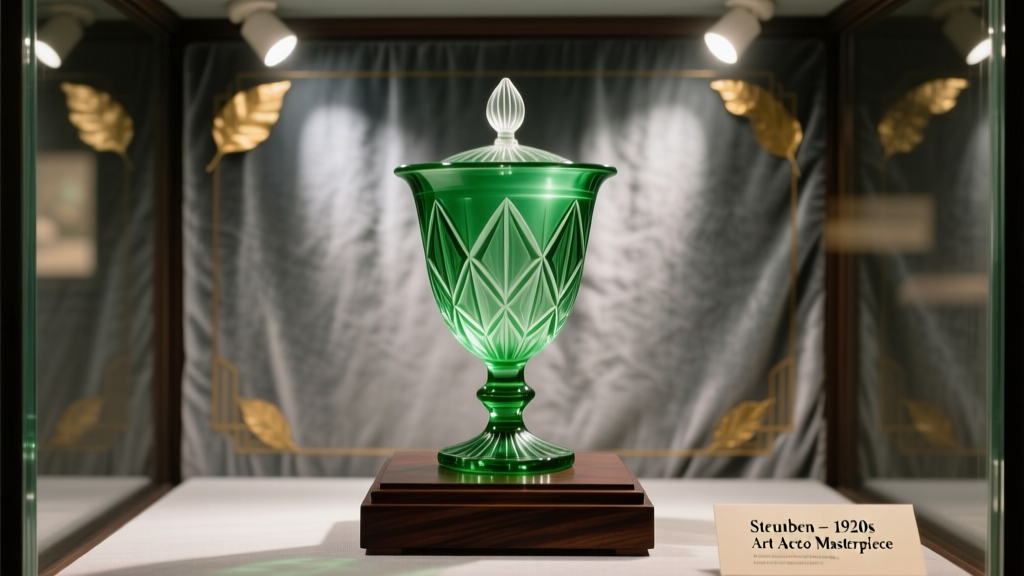
Steuben Compote Cover Finial: Acid-Cutback Green Jade Goblet-Shaped Piece, 9½ Inches — Authentication, Provenance, and Market Significance
Fireplace Screens with Needlepoint Panels: Authenticating Country Estate Mahogany Frames Featuring Standard Button Feet

Baroque Walnut Octagonal Center Table: Authentication, Provenance, and Market Value of the 28¾-Inch Specimen

KPM Chocolate Pot: Art Deco Peacock Eyes Design, Signed & Measuring 9 Inches — Authentication, Provenance, and Collector Insights

The Steiff Mohair Apricot Teddy Bear, Circa 1906: A Landmark of Early German Toy Craftsmanship
Candlesticks Brass Pricket Round Reeded Base Shaped Body 17 In — Authentication, Provenance, and Collectibility

Wedgwood Vase: Floral Iron-Red Ground with Gilt and Flow Blue — A Detailed Authentication & Collectibility Guide for the 4-Inch Pair
Black Americana Spice Rack: Authenticating the Vintage Wooden 4-Piece Set Featuring a Black Chef Figure