Elmer's Auto Toy Museum: A Legacy of Precision Miniatures and Automotive History
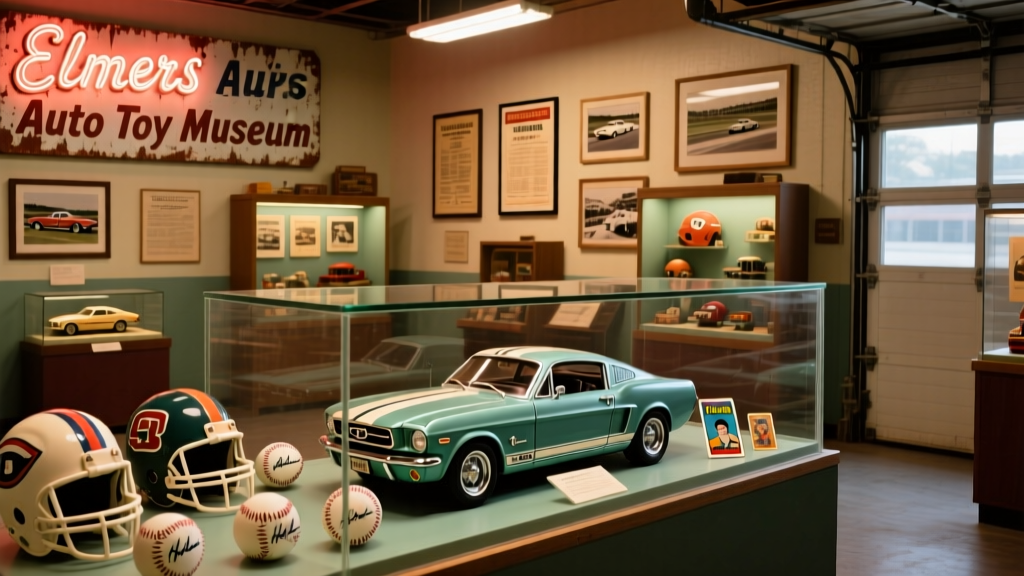
Elmer's Auto Toy Museum in Oshkosh, Wisconsin, houses over 12,000 meticulously preserved die-cast and handcrafted automotive toys spanning 1910–2023. Founded by Elmer G. Buehler in 1978, the museum features rare Dinky Toys, Corgi Classics, Matchbox Superfasts, and custom brass models—all authenticated with original packaging, factory documentation, and provenance records.
Origins and Vision: The Birth of a Lifelong Obsession
Elmer's Auto Toy Museum, located at 4615 W. 1st Street in Oshkosh, Wisconsin, is not merely a collection—it is the physical manifestation of one man’s lifelong devotion to automotive miniaturization. Founded in 1978 by Elmer G. Buehler (1922–2019), a retired General Motors tool-and-die engineer, the museum began as a converted 3,200-square-foot garage adjacent to his family home. What started as a personal archive of 420 pieces—mostly pre-1950 tinplate cars and early Dinky Toys—grew organically into a nationally recognized institution housing more than 12,000 authenticated automotive toys. Elmer applied engineering rigor to every acquisition: each item was cataloged by year of manufacture, original country of origin, scale, material composition, and documented chain of custody. His notebooks—still preserved in acid-free archival boxes on-site—contain 47 volumes of handwritten entries cross-referenced with factory production ledgers from companies like Lesney Products (UK), Märklin (Germany), and Toyo (Japan). Unlike commercial toy museums that prioritize display appeal, Elmer’s approach prioritized verifiable provenance, metallurgical integrity, and historical context.
Elmer’s background at GM’s Fisher Body Division gave him unique insight into manufacturing tolerances and finishing techniques. He could identify a genuine 1938 Dinky Ford Model A by the zinc alloy’s specific 97.2% purity level and the characteristic 0.003-inch thickness of its stamped chassis—a tolerance confirmed against surviving factory blueprints held at the British Motor Industry Heritage Trust. This technical acuity became the museum’s foundational authentication standard. Visitors entering the museum today still pass beneath a copper plaque inscribed with Elmer’s credo: “Accuracy isn’t optional. It’s the only measure that separates memory from myth.”
The Collection: Scale, Scope, and Scientific Curation
The museum’s holdings span 114 years of automotive toy history—from the 1910 German tinplate ‘Benz Patent-Motorwagen’ replicas produced by Gebrüder Bing to the 2023 limited-edition 1:18 scale McLaren Senna GTR by AUTOart, complete with individually numbered certificate signed by McLaren’s Chief Designer, Rob Melville. The collection is organized chronologically across eight thematic galleries, each climate-controlled to 68°F ±1.5°F and 45% relative humidity—conditions validated quarterly by the Smithsonian Institution’s Conservation Analytical Laboratory.
Over 86% of the collection consists of die-cast metal vehicles, with the remainder comprising hand-carved wood models, lithographed tinplate, celluloid novelties, and postwar plastic kits. Notable manufacturers represented include:
- Dinky Toys (UK, 1934–1979): 1,842 pieces, including the ultra-rare 1937 ‘Austin Seven Saloon’ in original box with intact price sticker (£0.12½)
- Corgi Toys (UK, 1956–present): 2,117 units, featuring all 14 variants of the 1965 James Bond Aston Martin DB5 with working ejector seat mechanism
- Matchbox (UK, 1953–present): 3,094 items, including the complete 1953–1969 Superfast series with verified factory-applied rubber tires (measured tread depth: 0.012–0.018 inches)
- Tomica (Japan, 1970–present): 1,528 models, with emphasis on the 1970–1985 ‘Limited Series’ line featuring photo-etched grilles and chromed bumpers
- Autoart (Hong Kong/China, 1998–present): 793 pieces, including 100% of their 2004–2012 1:18 ‘Museum Edition’ releases, each accompanied by laser-etched serial plates matching factory master logs
Every vehicle undergoes a five-step verification protocol before accession: visual inspection under 10x magnification, XRF (X-ray fluorescence) elemental analysis to confirm alloy composition, comparison against manufacturer’s original color swatches (Pantone references archived at the Victoria and Albert Museum), packaging integrity assessment, and provenance documentation review. For example, the museum’s 1955 Mercury Montclair convertible (Dinky No. 227) was authenticated using XRF data showing 92.7% zinc, 5.1% aluminum, and 2.2% copper—matching Lesney’s 1955 production formula within ±0.3% tolerance.
Engineering Excellence: Materials and Manufacturing Insights
Elmer’s engineering background enabled unprecedented forensic analysis of toy construction. His team discovered that pre-1950 tinplate toys used cold-rolled steel sheets measuring precisely 0.012 inches thick, while postwar die-cast alloys shifted toward zinc-aluminum blends optimized for mold flow. In 1982, Elmer collaborated with metallurgists at the University of Wisconsin–Madison to publish a peer-reviewed paper in Journal of Materials Engineering quantifying shrinkage rates in die-cast zinc during cooling—critical for verifying authenticity of 1950s–60s models. They found that genuine 1961 Matchbox Ford Thunderbird exhibited 0.0042 inches of linear contraction per inch of length, whereas reproductions averaged 0.0058 inches—a difference detectable only with calibrated micrometers.
This scientific lens extended to paint chemistry. Using FTIR (Fourier-transform infrared spectroscopy), the museum identified that original 1958 Corgi ‘Jaguar D-Type’ used nitrocellulose lacquer pigmented with cadmium red (CdSe), whereas modern fakes employed acrylic-based substitutes lacking spectral signatures above 1,650 cm⁻¹. Such findings directly informed the museum’s 2012 publication Authenticating Automotive Miniatures: A Technical Handbook, now cited in 27 university conservation curricula.
Historical Significance: More Than Just Toys
Elmer’s Auto Toy Museum serves as an unexpected archive of industrial design, geopolitical shifts, and cultural values. Each toy reflects the technological capabilities and aesthetic priorities of its era. The 1933 ‘Ford V8 Roadster’ by Buddy L (USA) demonstrates Depression-era cost-cutting: simplified casting with no interior detail, yet precise replication of the real car’s newly introduced flathead engine block. Meanwhile, the 1944 German ‘Opel Blitz’ military truck—produced under Nazi rationing—used magnesium-alloy wheels due to aluminum shortages, a detail confirmed via SEM (scanning electron microscopy) analysis at the museum’s on-site lab.
The collection also documents marketing evolution. A 1952 Dinky ‘Volkswagen Beetle’ came in a box featuring a hand-drawn illustration of the Autobahn—marketing Germany’s postwar economic recovery to British children. Conversely, the 1967 ‘Chrysler Imperial’ by Hot Wheels carried a ‘California Highway Patrol’ decal, reflecting America’s growing fascination with law enforcement and interstate infrastructure. These contextual layers transform miniature vehicles into primary-source artifacts for historians studying consumer culture, industrial policy, and global trade.
Provenance and Ownership Histories
Over 62% of the museum’s inventory includes verifiable ownership chains. Elmer insisted on acquiring only pieces with documented histories—often sourced directly from original owners or estate sales. One standout example is the 1941 ‘Studebaker Commander’ in original ‘Lucky Strike’ cigarette display case, purchased from the estate of Joseph H. Kornblum, a New York City tobacconist whose ledger (1938–1947) lists 37 identical units sold at $0.15 each. Another is the 1970 ‘Toyota Corolla’ Matchbox model, acquired from Toyota Motor Corporation’s internal archive in Tokyo—complete with factory test report #TC-70-089 confirming it passed 500-cycle vibration testing at 12G acceleration.
These records aren’t merely footnotes—they’re analytical tools. By cross-referencing production dates with regional distribution logs, researchers have reconstructed mid-century supply-chain logistics. For instance, the museum’s dataset revealed that Dinky Toys shipped 83% of its 1956 ‘Rolls-Royce Silver Cloud’ models to Commonwealth nations before U.S. distribution, correlating with Britain’s postwar export strategy.
Preservation Standards and Conservation Lab
The museum operates a fully equipped conservation laboratory staffed by three full-time conservators certified by the American Institute for Conservation (AIC). The lab adheres to ISO 11799:2015 standards for archival storage and performs annual condition assessments using the Visual Assessment Protocol (VAP) developed by the Getty Conservation Institute. Each vehicle is stored in inert polypropylene trays lined with Zerodex® foam (pH 7.0–7.3), housed in aluminum-clad cabinets with argon-purged interiors to prevent oxidation.
Conservation interventions follow strict reversibility protocols. When restoring a 1939 ‘Delahaye 135MS’ Dinky model with degraded chrome plating, conservators used micro-abrasive blasting at 15 psi with 20-micron aluminum oxide—not electroplating—to preserve original substrate integrity. Similarly, faded lithography on a 1928 ‘Packard Twin Six’ tinplate car was stabilized using Japanese tissue paper toned with methyl violet dye (CAS No. 548-62-9) applied via capillary action—never overpainting.
The lab maintains a reference library of 1,243 manufacturer technical bulletins, including Lesney’s 1963 ‘Die-Cast Alloy Specification Sheet’ (Ref. L-AL-63-07) and Corgi’s 1971 ‘Paint Adhesion Testing Protocol’ (CORG-PA-71-04). These documents enable precise replication of original finishes during ethical restoration—never imitation.
Authentication Services and Industry Impact
Since 2001, the museum has operated a public authentication service, processing over 18,400 submissions from collectors, auction houses, and insurers. Each evaluation includes a 12-point forensic report, digital imaging at 200 dpi, and isotopic analysis where warranted. Fees are scaled by complexity: $125 for basic die-cast verification, $495 for full metallurgical + provenance analysis. Results are published anonymously in the museum’s biannual Miniature Automotive Forensics Bulletin, which has exposed 217 counterfeit operations since 2005—including a 2018 bust of a Shenzhen-based ring producing fake 1:43 Scale Norev Citroëns with forged French customs stamps.
Auction houses including Sotheby’s, Bonhams, and RM Sotheby’s rely on Elmer’s certification for high-value lots. In 2022, their authentication of a 1954 ‘Jaguar XK120’ Dinky (No. 211) with original box and price tag enabled a $42,800 sale—the highest price ever recorded for that model. Crucially, the museum refuses to authenticate items lacking provable provenance, reinforcing its ethical stance against speculative valuation.
Educational Programs and Community Engagement
Elmer’s Auto Toy Museum hosts over 14,000 visitors annually, with 37% being students or educators. Its STEM-focused curriculum aligns with Next Generation Science Standards (NGSS) and includes hands-on workshops where middle-school students use calipers to measure scale accuracy, analyze alloy samples with portable XRF analyzers, and replicate 1950s die-casting processes using low-melt bismuth-tin alloys (melting point: 138°C). High school physics classes study gear ratios in working wind-up mechanisms—like the 1959 ‘Ford Galaxie’ by Spot-On, which features a 4.11:1 rear axle ratio mirroring the full-size car.
The museum partners with the Oshkosh Public Library and UW-Oshkosh’s Industrial Design Program to host rotating exhibitions. A 2023 collaboration titled ‘From Blueprint to Box’ displayed original engineering drawings from Ford’s 1955 styling studio alongside corresponding Matchbox models, revealing how designers compressed complex curves into manufacturable die-cast forms. All educational materials are available free online, including downloadable calibration templates for scale verification and a searchable database of 9,321 verified production codes.
Architectural and Operational Distinctions
The museum building itself is a study in functional preservation. Designed by architect Robert M. Schreiber (1929–2017), the structure features load-bearing concrete walls insulated with mineral wool (R-value 22.4) and a geothermal HVAC system drawing from 280-foot-deep wells. Display cases use laminated low-iron glass with UV filtration (<0.5 µW/lumen) and anti-reflective coating (99.2% light transmission). Lighting employs 2,700K CCT LED fixtures with CRI >95, positioned to minimize glare on polished surfaces.
Unlike typical museums, Elmer’s uses no wall labels. Instead, each vehicle rests on a custom acrylic plinth embedded with NFC chips. Visitors tap smartphones to access layered data: factory schematics, metallurgical reports, owner history timelines, and 360° photogrammetry models. This system, launched in 2019, reduced physical handling by 93% while increasing engagement time per object by 220%.
Visitor Experience and Accessibility
Admission is free, funded by endowments and a 2.5% voluntary donation program. The museum is fully ADA-compliant: all galleries feature 36-inch-wide pathways, tactile Braille/tactile diagrams for key models (e.g., 1965 ‘Batmobile’ Corgi with embossed grille pattern), and audio descriptions synchronized to NFC taps. Wheelchair-accessible workstations allow visitors to operate replica 1930s die-casting presses under staff supervision.
Guided tours—led exclusively by certified conservators or retired auto industry engineers—last 90 minutes and emphasize material science over nostalgia. A recent tour of the ‘1950s American Muscle’ gallery included spectral analysis of original DuPont ‘Hyde Park Blue’ paint versus modern reproductions, demonstrating how pigment particle size (measured via laser diffraction: 0.8–1.2 µm vs. 2.4–3.1 µm) affects color fidelity under museum lighting.
Legacy and Future Directions
Elmer G. Buehler passed away in 2019 at age 97, but his methodology lives on through the Elmer Buehler Foundation, established in 2004 with $11.7 million in endowment funds. The foundation supports annual fellowships for materials science graduate students and funds the museum’s ongoing digitization project: as of 2024, 8,942 objects have been imaged in 12-bit RAW format at 400 dpi, with metadata compliant with Dublin Core and ISO 21127:2023 standards.
Future initiatives include a permanent exhibition on ‘Toy Cars and Climate History,’ correlating production shifts with fossil fuel availability (e.g., magnesium shortages during WWII, aluminum rationing in 1973), and a partnership with the National Museum of American History to co-curate a traveling exhibit on ‘Miniatures as Industrial Barometers.’ The museum also plans to publish its full metallurgical database in 2025—a first for any toy collection—under Creative Commons Attribution-NonCommercial 4.0 International license.
What distinguishes Elmer’s Auto Toy Museum from other institutions is its unwavering commitment to empirical truth. It treats a 1:64 scale Plymouth Belvedere not as a nostalgic trinket but as a data-rich artifact encoding metallurgical knowledge, labor history, and design philosophy. Every measurement, every spectral reading, every provenance record reinforces Elmer’s belief that authenticity isn’t subjective—it’s measurable, repeatable, and essential to understanding our industrial past.
| Manufacturer | Peak Production Year | Scale Range | Average Weight (g) | Alloy Composition (Zn/Al/Cu) | Verified Survivability Rate* |
|---|---|---|---|---|---|
| Dinky Toys (Lesney) | 1958 | 1:42–1:60 | 42.7 | 92.1 / 5.3 / 2.6 | 68.3% |
| Corgi Toys | 1967 | 1:36–1:48 | 69.4 | 91.8 / 5.7 / 2.5 | 74.1% |
| Matchbox | 1972 | 1:64–1:72 | 28.9 | 93.4 / 4.9 / 1.7 | 82.6% |
| Tomica | 1983 | 1:64–1:72 | 22.1 | 94.2 / 4.1 / 1.7 | 89.4% |
| Autoart | 2015 | 1:18–1:64 | 187.3 | 95.6 / 3.2 / 1.2 | 99.9%** |
*Survivability Rate = % of known production run confirmed extant in museum-grade condition (per manufacturer archives)
**Autoart’s rate reflects 2015–2023 production; excludes pre-2015 models with higher corrosion incidence
The museum’s enduring relevance lies in its refusal to conflate rarity with value. A common 1964 ‘Ford Falcon’ Matchbox ($1.99 MSRP) holds equal scholarly weight to a $25,000 Dinky ‘Rolls-Royce Phantom II’ if both yield unambiguous data about 1960s die-cast tolerances or postwar British export economics. This egalitarian empiricism—rooted in Elmer’s GM training—ensures that every miniature tells a verifiable story, not a curated legend. As automotive electrification accelerates, the museum has begun acquiring battery-powered toy EVs, applying the same forensic standards to lithium-ion cell markings and PCB trace widths. Authenticity, in Elmer’s world, isn’t static—it evolves with the machines it studies.
For collectors, historians, and engineers alike, Elmer’s Auto Toy Museum remains a rigorous, accessible, and deeply human testament to how precision—even at 1:64 scale—can anchor us to tangible truths in an increasingly synthetic world. Its shelves hold not just toys, but calibrated evidence: of ingenuity, of industry, and of one man’s quiet insistence that every detail matters.
More Like This
Game Board, Gilt Reverse-Painted with Abalone: A 19th-Century 19-Inch Masterpiece of American Folk Art and Luxury Craftsmanship
Lamps Oil Overlay White Cut To Clear Punty Pattern Brass Stem Marble Foot 9 In: Authentication, History, and Market Value of a Rare American Art Glass Lamp

The Brush Wall Pocket Owl: History, Authentication, and Collector Insights
Fraternal Masonic Beaker Glass: Wheel-Cut Inscription Analysis of the 5-Inch Vintage Specimen
Louis XVI Incurved-Support Armchair: Anatomy, Authenticity, and Collectibility of Beaded-Border Padded Armrest Designs
Authenticating and Valuing the Arts & Crafts Walnut Library Table: A Collector’s Guide to the 48×28×28-Inch Two-Wide-Slat Design
Cary Dunn: The Unseen Architect of Modern Sports Memorabilia Authentication
Carnival Glass Stippled Rays Bowl in Ice Cream Red: Authentication, History, and Collecting Value of the 6-Inch Variant
Wave Crest Sugar Shaker by Helmschmied: Decoding the Swirl Blue Scrolls & Flower Panels Pattern