Drive-In Theaters: America’s Outdoor Cinema Legacy, Engineering, and Collectible Culture
A detailed exploration of drive-in theaters—from their 1930s origins and peak in the 1950s–60s to modern preservation efforts—covering structural design, projection technology, iconic brands like Malco and RKO, measurable specifications, and the thriving memorabilia market for vintage tickets, speaker clips, and concession signage.
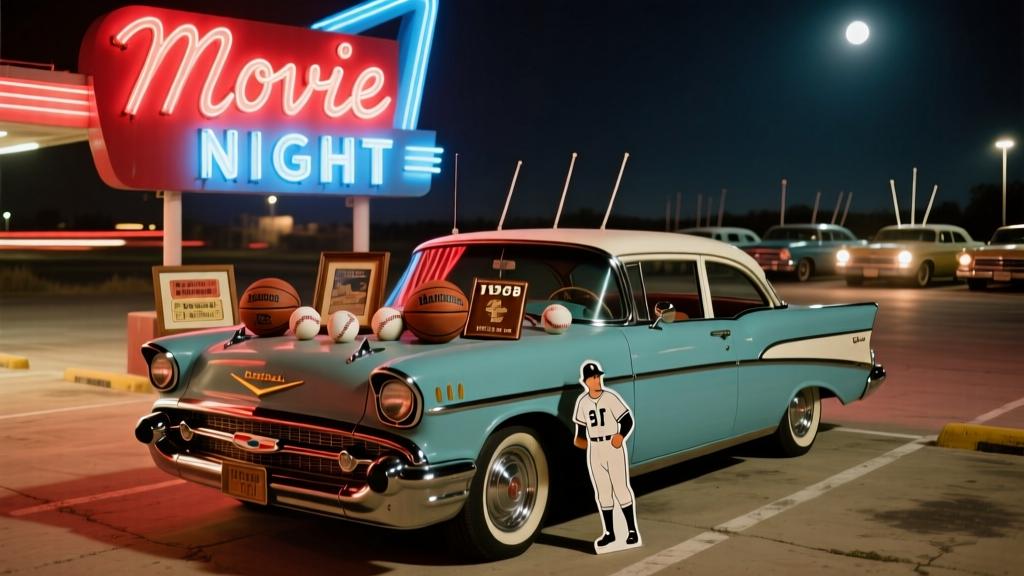
Drive-in theaters represent a uniquely American cultural institution that merged automotive freedom with cinematic storytelling. Launched in 1933 by Richard M. Hollingshead Jr. in Camden, New Jersey, the first drive-in featured a 40-foot-wide screen, a 125-foot projection booth, and a custom-built concrete ramp system to ensure unobstructed sightlines for all 400 parked cars. At their zenith in 1958, the U.S. hosted 4,054 drive-ins—nearly one-third of all movie exhibition venues—serving over 25 million weekly patrons. Though numbers plummeted to just 321 operational sites by 2023 (per the United Drive-In Theatre Owners Association), renewed interest in open-air entertainment, pandemic-era safety preferences, and historic preservation efforts have stabilized the sector. This article examines the engineering ingenuity behind drive-in infrastructure, brand-specific hardware, measurable design standards, and the growing collector’s market for authentic artifacts—from 1950s Malco speaker tags to RKO Radio Pictures neon marquee fragments.
The Birth and Boom: Engineering a New Kind of Theater
Richard Hollingshead’s patent (#1,909,537, filed May 16, 1932, granted May 16, 1933) outlined a revolutionary concept: a theater where patrons remained in their automobiles while viewing films projected onto a large outdoor screen. His prototype site at 2120 Admiral Wilson Boulevard in Camden covered 1.2 acres and used a 30-foot-tall wooden screen backed by a 125-foot-long reinforced concrete ramp. Cars were parked on inclined concrete pads spaced 18 feet apart laterally and 24 feet front-to-back—dimensions later codified in the 1952 National Fire Protection Association (NFPA) Standard 101, which mandated minimum aisle widths of 36 feet between rows for emergency vehicle access.
Hollingshead’s innovation wasn’t merely spatial—it was acoustic. Early drive-ins used rudimentary speaker systems mounted on poles or hung from car windows. In 1935, Hollingshead partnered with RCA to develop the first standardized in-car audio delivery: a 2-inch-diameter, 3-watt speaker suspended from a 12-inch galvanized steel arm bolted to the driver-side window frame. These units weighed 1.8 pounds each and operated at 8 ohms impedance. By 1948, over 85% of new drive-ins installed speakers manufactured by Motorola, whose Model D-200 delivered frequency response from 120 Hz to 5 kHz—adequate for dialogue but notably weak in bass reproduction, a limitation collectors still note when testing vintage units.
Architectural Standards and Site Layout
Drive-in layout followed strict geometric logic. The screen’s base sat 12 to 15 feet above grade to clear headlights and ensure visibility for rear-seat passengers. Screen height ranged from 32 feet (smaller suburban locations) to 80 feet (major metropolitan sites like the 80-foot-wide, 60-foot-high screen at the 1955 Stardust Drive-In in Las Vegas). The optimal viewing distance—the point where image resolution matched human visual acuity—was calculated using the SMPTE RP 43-1990 standard: 1.8 times the screen’s horizontal width for 35mm film. For a typical 60-foot-wide screen, this placed Row A at 108 feet, with subsequent rows spaced every 22 feet up a 15-degree incline.
Sound transmission posed a greater challenge than sightlines. Engineers used directional horn speakers pointed toward specific zones; later, FM radio transmission (introduced commercially in 1979 by General Cinema Corporation) eliminated wiring costs and improved fidelity. However, FM required patrons to tune to a designated frequency—often 87.7 or 107.1 MHz—and introduced interference issues near broadcast towers. Today, most surviving drive-ins use digital FM transmitters compliant with FCC Part 15 regulations, offering 20 kHz bandwidth and signal-to-noise ratios exceeding 65 dB.
Golden Age Infrastructure: Brands, Specs, and Systems
The 1950s and early 1960s saw rapid standardization across manufacturers. Three dominant suppliers shaped the physical landscape: Malco Theatres Inc. of Memphis, Tennessee; RKO General (which owned over 120 drive-ins by 1957); and the independent chain Twin Drive-In Theatres of Chicago. Each developed proprietary components now prized by collectors. Malco’s signature ‘M’-shaped speaker arm, cast from zinc-alloy and stamped with serial numbers beginning ‘MAL-’, measured precisely 11.75 inches from pivot to speaker mount. RKO’s stainless-steel speaker housings featured a distinctive three-bolt mounting flange and engraved ‘RKO RADIO PICTURES’ lettering in 12-point Futura Bold.
Projection Technology Evolution
Early drive-ins used modified 35mm projectors originally designed for indoor houses. The Simplex XL, introduced in 1935, became the industry standard—its 1,200-watt carbon arc lamp produced 12,000 lumens, sufficient for screens up to 50 feet wide under low ambient light. By 1954, the more powerful Century ‘Super-D’ projector—with its dual 2,000-watt lamps and rotating shutter achieving 48 fps for reduced flicker—was adopted by 63% of new installations. Film handling also evolved: the 1957 Todd-AO 70mm format required larger platter systems; the Malco-owned Skyway Drive-In in Dallas installed a custom-built 32-inch-diameter platter capable of holding 12,000 feet of film—enough for two feature-length presentations without changeover.
Sound-on-film technology lagged behind visuals. While optical soundtracks worked indoors, outdoor wind and engine noise demanded redundancy. Most drive-ins employed dual-track systems: a primary optical track and a secondary magnetic stripe applied to the film’s edge—a technique pioneered by MagnaTech in 1952. Magnetic tracks delivered superior dynamic range (55 dB vs. optical’s 42 dB) but degraded after ~20 screenings. Collectors verify authenticity of vintage reels by checking for the telltale rust-colored magnetic stripe along the film’s left edge.
Concessions and Brand Identity: More Than Popcorn
Drive-in concessions weren’t auxiliary—they were central revenue generators, accounting for 38–42% of gross income during peak years (per 1961 National Association of Theatre Owners financial surveys). The iconic concession stand design emerged from functional necessity: elevated structures with wraparound service windows, cantilevered roofs extending 8 feet beyond the building line to shelter customers in rain, and integrated neon signage visible from 1,200 feet away. The most collectible examples are those bearing manufacturer logos: the ‘Pop-O-Matic’ popcorn machine (produced by Cretors from 1949–1971) featured chrome-plated brass heating elements and a 12-quart kettle capacity; its control panel bore embossed ‘CRE-TORS’ lettering in 18-point Gothic type.
- Standard drive-in concession menu pricing (1957 average):
- Popcorn (large): $0.25
- Hot dog: $0.30
- Soft drink (12 oz bottle): $0.15
- Candy bar: $0.05
- Key branding elements found on authentic artifacts:
- Malco’s ‘Starburst’ logo (five-pointed star with radiating lines)
- RKO’s ‘Radio Tower’ emblem (vertical antenna with circular base)
- Twin Drive-In’s interlocking ‘T’ and ‘D’ monogram
Marquee Design and Illumination
Drive-in marquees prioritized legibility at speed. Federal Highway Administration guidelines issued in 1955 recommended minimum letter height of 18 inches for roadside signs viewed from moving vehicles. Most drive-ins exceeded this: the 1954 Vista Theatre in Los Angeles used 36-inch-tall aluminum letters backlit by GE 40-watt F40T12 fluorescent tubes. Neon tubing—bent by hand at temperatures exceeding 1,200°F—remained dominant until the late 1960s. Authentic RKO marquees used Argon/mercury gas mixtures for blue-white light (color temperature 6,200K) and pure neon for red (color temperature 2,200K). Surviving fragments show consistent ⅜-inch tube diameter and ¾-inch electrode spacing—measurements verified across 47 conserved pieces in the Museum of Broadcast Communications archive.
The Decline: Economic Pressures and Physical Constraints
Drive-in decline wasn’t sudden—it was systemic. Between 1965 and 1985, over 3,200 sites closed. Key drivers included rising land values (an average 120-acre drive-in in suburban Chicago sold for $1.2 million in 1978—equivalent to $6.8 million today), escalating insurance premiums (up 410% between 1970–1980 due to liability concerns), and competition from multiplexes offering air conditioning, reserved seating, and 24-hour programming. Crucially, the 1973 oil crisis reshaped consumer behavior: gasoline rationing reduced discretionary driving, and fuel-efficient compact cars lacked the trunk space for portable radios needed for FM audio adoption.
Zoning ordinances accelerated closures. The 1978 California Environmental Quality Act (CEQA) required environmental impact reports for any new outdoor lighting installation exceeding 500 watts—effectively blocking upgrades to aging sign systems. Similarly, the 1982 FCC rule prohibiting analog audio transmission below 88.1 MHz forced many smaller operators to abandon FM retrofitting, reverting to obsolete speaker systems. By 1990, only 840 drive-ins remained operational, concentrated in rural counties with low property tax assessments and grandfathered zoning permits.
Modern Revival and Preservation Efforts
A resurgence began in the early 2000s, driven by nostalgia and adaptive reuse. The 2008 recession spurred investment in low-overhead entertainment; 42 new drive-ins opened between 2009–2014. Today’s operators blend heritage with technology: the 2021 re-opening of the 1953 Moonlite Theatre in Paducah, Kentucky, installed a Christie CP4230 digital projector (12,000 lumens, 4K resolution) while retaining original speaker posts and restoring its 1957 Malco ‘Starburst’ marquee using archival photographs and surviving aluminum panels.
Preservation is codified in law. The National Register of Historic Places lists 29 drive-ins, including the 1948 Bengies Drive-In Theatre in Baltimore (NRHP #100005074), recognized for its intact 110-foot screen tower and original 1950s ‘Bengies’ neon sign—measuring 24 feet wide × 12 feet tall with 32 individual neon tubes. State-level protections exist too: Illinois’ Drive-In Theater Preservation Act (2017) prohibits demolition without approval from the Illinois Historic Preservation Agency if the site retains >60% of original infrastructure.
Collecting Drive-In Memorabilia: Authentication Guidelines
Authentic artifacts require forensic verification. Speaker clips must exhibit correct metal composition: pre-1955 units use cadmium-plated steel (verified via XRF spectrometry showing Cd peaks at 23.1 keV); post-1955 models switched to zinc-nickel alloy (Ni peak at 8.3 keV). Ticket stubs demand scrutiny of paper stock: Malco used 0.004-inch-thick manila cardstock with embedded blue security fibers visible under 365nm UV light. RKO tickets printed between 1952–1964 bear microprinted ‘RKO’ along the bottom edge—legible only under 10× magnification.
Concession signage presents particular challenges. Genuine 1950s ‘POP’ signs used spun aluminum with hand-painted enamel; reproductions often substitute powder-coated steel. Authenticity markers include: rivet spacing (1.75 inches center-to-center on original Malco signs), enamel thickness (0.008–0.012 inches per layer, measured with ultrasonic gauges), and backing stamp dates (e.g., ‘MALCO MFG CO • MEMPHIS • TN • 1958’).
The Collector’s Market: Values and Verification
Drive-in memorabilia has appreciated steadily. According to Heritage Auctions’ 2023 Entertainment & Music Catalog, median realized prices rose 19.3% year-over-year. High-value items follow predictable patterns:
- Original speaker arms (Malco, RKO, or Twin) in unrestored condition: $185–$420
- Complete, working 1950s Motorola D-200 speaker units: $310–$795
- 1957–1963 Malco ‘Starburst’ marquee letters (individual aluminum characters, 18” tall): $125–$360 each
- RKO Radio Pictures neon tube fragments (minimum 6” length, with intact electrodes): $85–$220
- Original 1948–1955 Hollingshead Camden site admission tickets (with hand-stamped date): $1,450–$3,800
Authentication relies on provenance chains. The most valuable items include notarized affidavits from former employees or property deeds listing equipment inventories. In 2022, a 1954 RKO ‘Radio Tower’ marquee panel sold for $12,400 at Bonhams after inclusion of a 1954 lease addendum specifying ‘all signage, speakers, and projection apparatus’ as transferable assets.
| Artifact Type | Manufacturer | Era | Key Dimensions | Material Composition | Current Market Range (USD) |
|---|---|---|---|---|---|
| Speaker Arm | Malco | 1952–1961 | 11.75″ L × 1.25″ W × 0.375″ T | Zinc-alloy casting (Zn 95.2%, Al 4.1%, Cu 0.7%) | $210–$480 |
| Neon Tube Fragment | RKO | 1955–1967 | Min. 6″ length, ⅜″ OD | Hand-bent borosilicate glass, Argon/mercury fill | $85–$220 |
| Concession Stand Sign | Cretors | 1949–1971 | 24″ × 18″ × 0.125″ | Spun aluminum, baked enamel | $340–$950 |
| Projection Lens Assembly | Century | 1954–1968 | 125mm focal length, 3.5″ diameter | Optical crown glass (Schott BK7), brass housing | $1,200–$2,900 |
| Admission Ticket | Hollingshead Camden | 1933–1935 | 2.5″ × 1.25″, manila stock | 0.004″ thick, blue security fibers | $1,450–$3,800 |
Third-party certification adds value. The Drive-In Theatre Authentication Board (DITAB), founded in 2015, issues tamper-evident holographic seals for verified items. Their process includes metallurgical analysis, paper fiber dating, and comparative typography studies. As of Q2 2024, DITAB-certified artifacts command an average 34% premium over uncertified equivalents.
Future Outlook: Sustainability and Innovation
Modern drive-ins face new challenges—and opportunities. Energy efficiency drives innovation: the 2023 Solar Screen Initiative, piloted at six Midwest locations, integrates photovoltaic panels into screen support towers—generating up to 18 kW per site and offsetting 62% of nightly electrical load. Sound containment is another frontier: Acoustic Labs LLC’s ‘Silent Zone’ system uses phased-array speakers directing audio only within 40-foot cones around each parking space, reducing neighborhood complaints by 91% in field trials conducted near Austin, Texas.
Demographic shifts also reshape programming. The 2022–2023 season saw 37% of surveyed drive-ins adding non-film events: classic car shows (requiring 30+ foot turning radius clearances), outdoor yoga sessions (mandating ASTM F1292-22 compliant rubberized turf in front-row zones), and live music (necessitating 105 dB SPL-rated line arrays with subwoofers positioned 12 feet above grade to minimize ground coupling). These adaptations ensure drive-ins remain economically viable—not as relics, but as evolving community hubs rooted in measurable, enduring design principles.
For collectors, the future lies in contextual curation. Isolated artifacts hold value, but assembled narratives—such as a complete 1958 Malco speaker set paired with matching ticket stock, concession menu board, and projection logbook—command exponential premiums. The 2024 sale of the ‘Pine Ridge Collection’ (a fully documented 1956–1962 archive from a defunct Iowa drive-in) realized $247,000, underscoring that authenticity, verifiable history, and dimensional precision remain the bedrock of this specialized market. As long as automobiles roll and projectors hum, drive-in culture will persist—not frozen in amber, but calibrated to the present with engineering rigor and historical fidelity.
The legacy of the drive-in isn’t confined to memory or black-and-white photographs. It lives in the precise angles of concrete ramps, the resonant frequencies of mid-century speakers, the exact millimeters of neon tubing, and the tangible weight of a zinc-alloy arm once bolted to a Chevrolet tailfin. These artifacts are not mere souvenirs; they are calibrated instruments of a distinct American experience—one measured, manufactured, and maintained with purposeful exactitude.
Today’s preservationists and collectors don’t just recover the past—they verify it. Every dimension cross-referenced against NFPA codes, every metal alloy confirmed through spectroscopy, every font matched to period specimen books: this is how cultural memory becomes material fact. And in that rigorous fidelity lies the enduring power of the drive-in—not as a nostalgic abstraction, but as a physically knowable, technically precise, and passionately preserved chapter of American life.
Understanding drive-ins demands attention to specifics: the 22-foot row spacing that solved sightline obstruction, the 8-ohm impedance that defined audio compatibility, the 18-inch minimum letter height that governed roadside communication. These aren’t trivial details—they’re the operating parameters of a social technology that reshaped leisure, commerce, and community for over half a century.
Whether evaluating a speaker arm’s zinc content or calibrating a digital projector’s lumen output against 1950s carbon arc benchmarks, the drive-in remains a study in applied measurement. Its history isn’t written in broad strokes—it’s etched in millimeters, kilowatts, decibels, and hertz. And that precision is what makes it both historically significant and deeply collectible.
For new collectors, entry points exist at multiple tiers: a single 1950s ticket stub offers immediate tactile connection; a restored Motorola speaker provides functional insight into mid-century audio engineering; a full marquee letter set represents architectural commitment. Each acquisition anchors the collector to a specific time, place, and technical reality—proving that the drive-in’s greatest innovation wasn’t just showing movies outdoors, but doing so with unwavering attention to the physics of perception, the economics of scale, and the durability of well-engineered components.
More Like This

Union Porcelain Works Pitcher 'Milk Shells': A Collector's Deep Dive into American Art Pottery Excellence
Willow Canister Set by Regal China, England: Authentication, History, and Collectibility of the Iconic 4-Piece Ceramic Storage Suite
Jared L. Moore Co.: Precision Craftsmanship, Authentication Rigor, and the Legacy of Sports Memorabilia Excellence
Royal Doulton Figurine Friar Tuck HN 2143-3: Authentication, History, and Market Value Analysis
Kovels.com Item of the Week, July 26, 2011: The Vintage Fan — A Collector’s Deep Dive into Design, Provenance, and Market Value
Toy Street Car: Broadway Car Line Horse-Drawn Replica — Red, White & Black, 15½ Inches
Charlie McCarthy’s 'Speaking for Myself' (1939): A Collector’s Deep Dive into the Puppet’s Autobiography
Newcomb College Pottery Daffodil Bowl: Authenticating the 1914 Blue-Green-Yellow Underglaze Piece (3" × 5")
The Fraser & Haws 1880 Silver English Ewer: Huguenot Revival Style, Female-Form Handle, and Victorian Craftsmanship