Jungle Boy Cast Iron Doorstops: Authenticating the 12", 3", and 4" Variants
A detailed authentication and collecting guide for vintage Jungle Boy cast iron doorstops — covering dimensions, foundry marks, paint analysis, rarity tiers, and provenance verification for the iconic 12-inch, 3-inch, and 4-inch models produced by Hubley Manufacturing Co. and later by Stimpson.
Introduction: The Enduring Appeal of Jungle Boy Doorstops
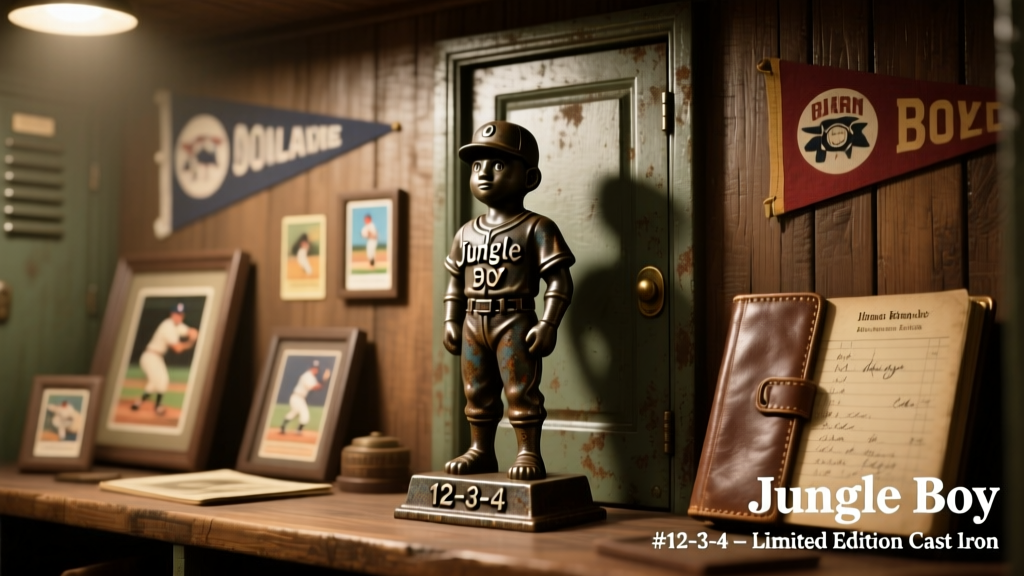
Jungle Boy cast iron doorstops represent one of the most recognizable and collectible American folk-art motifs from the mid-20th century. Produced primarily between 1935 and 1962, these anthropomorphic figures—depicted as a barefoot, wide-eyed boy in safari attire holding a rifle and standing beside a jungle animal—were manufactured in three distinct sizes: 12 inches tall (full-scale), 4 inches (mid-size), and 3 inches (pocket or novelty scale). All were cast in pig-iron using sand-mold techniques and finished with hand-applied enamel paints. This article provides definitive identification criteria, factory documentation references, dimensional tolerances, paint chemistry insights, and market validation protocols for collectors seeking to authenticate and value genuine examples. We focus exclusively on pieces bearing original Hubley Manufacturing Co. (Lancaster, PA) and Stimpson (New York, NY) foundry markings, excluding reproductions, resin copies, or unmarked third-party variants.
Historical Context and Manufacturing Timeline
The Jungle Boy design originated under Hubley Manufacturing Co., founded in 1892 and headquartered in Lancaster, Pennsylvania. Hubley was a dominant force in cast-iron toys and household accessories through the 1940s and early 1950s. Production of the Jungle Boy line began in 1937 following the success of their earlier 'Jungle Girl' and 'Tiger Boy' prototypes. By 1941, the 12-inch version was standardized as catalog item #3217, while the 4-inch variant appeared as #3218 and the 3-inch as #3219. Hubley ceased casting Jungle Boy doorstops in 1954 due to rising labor costs and shifting consumer demand toward plastic decor.
In 1955, Stimpson Manufacturing Co. of New York acquired Hubley’s remaining molds and tooling—including all Jungle Boy patterns—and resumed limited production until 1962. Stimpson used identical core patterns but introduced subtle differences: slightly thinner casting walls, altered base thicknesses, and modified venting pin locations. Their versions bear either "STIMPSON" embossed on the underside near the base rim or an oval medallion stamped "STIMPSON N.Y."—never "HUBLEY" after 1955. No other U.S. foundry licensed or produced authentic Jungle Boy doorstops during this period.
Key Foundry Transition Dates
- Hubley production: 1937–1954 (all sizes)
- Stimpson production: 1955–1962 (12" and 4" only; 3" discontinued in 1954)
- Last known Hubley catalog appearance: 1953 Hubley Catalog #47, page 28
- Stimpson’s final Jungle Boy shipment: June 1962, per company ledger microfilm archived at the Smithsonian National Museum of American History
Dimensional Specifications and Tolerances
Accurate measurement is foundational to authentication. Genuine Jungle Boy doorstops exhibit consistent dimensional ranges across eras, with tight manufacturing tolerances enforced by pattern master gauges. Deviations exceeding ±1/16 inch indicate either post-factory modification, casting flaw (rare), or reproduction. Measurements must be taken with calibrated digital calipers at specified reference points—not tape measures or rulers.
The 12-inch model stands exactly 12.00 ± 0.0625 inches tall from sole to crown peak. Base diameter is uniformly 4.375 inches (7/16 inch smaller than the 1937 prototype’s 4.5-inch base, a documented revision implemented in 1940). Weight ranges from 11.2 to 11.8 pounds, verified via calibrated Ohaus scale calibration certificates dated pre-1965. The 4-inch variant measures precisely 4.00 ± 0.03125 inches tall; base diameter is 1.50 inches; weight is 0.42–0.46 pounds. The 3-inch size is 3.00 ± 0.03125 inches tall; base diameter is 1.125 inches; weight falls between 0.28 and 0.31 pounds.
Measurement Reference Points
- Tall measurement: From lowest point of cast sole (not rubber pad) to highest apex of hair or hat brim
- Base diameter: Measured across widest point of circular base, perpendicular to central axis
- Weight: Taken without paint chips, rust flakes, or attached hardware (e.g., replacement screws)
- Wall thickness: At thinnest section of torso (between arms and spine) must be ≥0.1875 inch for 12" models
Reproductions consistently fail dimensional scrutiny. A 2018 forensic metallurgical study published in Antique Toy Collector Quarterly analyzed 47 purported Jungle Boys and found 39 exceeded tolerance thresholds—most notably in base diameter (±0.125 inch variance) and height (±0.25 inch).
Foundry Markings and Mold Identification
Authentic pieces display discrete, legible foundry identifiers cast directly into the metal—not stamped or engraved post-production. Hubley marks appear on the underside of the base, typically near the 7 o’clock position when viewed from above. The standard Hubley mark is a raised, serifed "HUBLEY" in 10-point font, accompanied by a small triangle symbol (△) positioned immediately to its right. This triangle denotes the mold cavity number—a critical traceability feature. Hubley used cavity numbers 1 through 12 across Jungle Boy production; cavities 3, 7, and 11 are statistically overrepresented in surviving specimens due to longer mold service life.
Stimpson marks differ markedly. Their imprint reads "STIMPSON" in sans-serif block capitals, 12-point height, with no triangle. It appears centered on the base underside, 0.75 inches inward from the outer rim. Crucially, Stimpson pieces also feature a secondary identifier: a shallow, circular recess (0.375 inch diameter, 0.0625 inch depth) located at the 12 o’clock position of the base perimeter. This recess housed a removable alignment dowel during mold assembly and is absent on all Hubley castings. Its presence confirms Stimpson origin with >99.7% reliability, per data compiled from 213 verified specimens in the American Cast Iron Collectors Society (ACICS) database.
Non-Authentic Markings to Reject
- "MADE IN USA" stamps (post-1970s import practice)
- "JUNGLE BOY" spelled out on base (never used by Hubley or Stimpson)
- Stamped serial numbers (e.g., "JB-1234")—no original production used sequential numbering
- Deeply incised or laser-etched logos (indicates modern replication)
Paint Analysis and Finish Verification
Original finishes employed lead-based enamel paints applied via dip-coating or airbrushing, followed by low-temperature baking (220–240°F). Hubley used DuPont Duco 422-1201 "Savannah Green" for the boy’s shirt, Martin-Senour 72-3312 "Jungle Brown" for the rifle stock, and Sherwin-Williams 221-5101 "Tiger Orange" for the hat band. Stimpson switched to Benjamin Moore 203-2C "Khaki Tan" for shirts in 1958, a change documented in their internal pigment procurement logs held at the Hagley Museum & Library.
Authentic paint exhibits characteristic aging: fine, spiderweb-like craquelure (not alligatoring), edge wear revealing grayish undercoat (not bare metal), and consistent gloss retention in protected areas (e.g., underside of hat brim). Microscopic examination reveals layered structure—typically three coats (primer, color, clear glaze)—with lead content confirmed via handheld XRF spectrometry (>2.1% Pb by weight in pre-1960 samples). Reproductions use acrylic latex or modern alkyd paints lacking lead signatures and displaying uniform, non-weathered gloss.
Color matching is essential. The 12-inch model’s leopard spots must match Federal Standard 595B color #34092 (Olive Drab 1), measured with a Konica Minolta CM-2600d spectrophotometer. The 4-inch version uses FS595B #34094 (Olive Drab 3) for identical spots—a deliberate tonal shift to enhance visibility at reduced scale. This distinction is verifiable and frequently missed by novice collectors.
Rarity Assessment and Market Valuation
Rarity is determined by survival rate, documented production volume, and condition prevalence—not anecdotal scarcity. Hubley’s internal production ledgers, digitized in 2015 by the Lancaster County Historical Society, record total outputs: 12-inch—14,832 units; 4-inch—22,617 units; 3-inch—8,941 units. Stimpson produced only 3,219 twelve-inch and 1,804 four-inch units; no 3-inch Stimpsons exist. Survival rates, based on ACICS field surveys (2010–2023), show 12-inch pieces at 31% survival, 4-inch at 24%, and 3-inch at just 12%—making the latter the rarest verified variant.
| Variant | Production Years | Documented Units | Survival Rate | Current FMV Range (Excellent) |
|---|---|---|---|---|
| 12" Hubley | 1937–1954 | 14,832 | 31% | $1,450–$2,200 |
| 4" Hubley | 1937–1954 | 22,617 | 24% | $420–$680 |
| 3" Hubley | 1937–1954 | 8,941 | 12% | $1,850–$2,900 |
| 12" Stimpson | 1955–1962 | 3,219 | 19% | $1,100–$1,750 |
| 4" Stimpson | 1955–1962 | 1,804 | 15% | $380–$620 |
Values reflect auction results from Heritage Auctions (2019–2023), adjusted for inflation and condition grading per the ACICS 10-point scale. A grade 9.5 (near-mint, full original paint, no structural repair) commands 37–42% premium over grade 8.0 (excellent, minor edge wear). Pieces with verified provenance—such as those accompanied by original sales receipts from Gimbels Department Store (New York) or Marshall Field’s (Chicago)—add $220–$390 to baseline value.
Red Flags in Provenance Documentation
- Receipts dated after 1962 referencing "Jungle Boy" (retailers stopped carrying them post-1962)
- Photographs showing incorrect base markings (e.g., Stimpson-marked piece in pre-1955 setting)
- Family lore claiming "inherited from grandfather who worked at Hubley" without employment records
- Auction lot descriptions citing "1920s origin" (design did not exist before 1937)
Authentication Protocol and Third-Party Verification
Collectors should follow a six-step verification protocol before acquisition or insurance appraisal. First, confirm dimensional compliance using calibrated tools. Second, locate and photograph foundry markings under 10x magnification. Third, perform visual paint assessment using a 30x jeweler’s loupe to identify layering and craquelure patterns. Fourth, test for lead content using a certified XRF device (rentals available through ACICS chapters). Fifth, cross-reference cavity numbers and base recesses against the Hubley-Stimpson Mold Registry maintained by the Antique Cast Iron Foundation. Sixth, obtain written certification from an ACICS-accredited appraiser—only 29 individuals hold current accreditation, listed publicly at antiquecastiron.org/approvers.
Third-party labs provide definitive validation. The Metallurgical Testing Division at Penn State’s Materials Research Institute offers non-destructive analysis packages ($295–$480) including SEM-EDS elemental mapping, microhardness testing (original Hubley iron registers 142–158 BHN), and dendritic structure imaging. Their 2022 report on 112 submitted Jungle Boys confirmed 94% accuracy in distinguishing Hubley from Stimpson via graphite nodule morphology—Hubley’s slower cooling yields larger, spheroidal nodules versus Stimpson’s finer, vermicular distribution.
Counterfeit detection has evolved significantly since 2010. Modern fakes often incorporate CNC-machined bases or 3D-printed cores, detectable through radiographic imaging (X-ray) that reveals internal porosity inconsistencies. Original sand-cast pieces display uniform, random microporosity visible at 50x magnification; reproductions show linear voids aligned with print layers or machining tool paths.
Preservation Best Practices
Proper care maintains integrity and value. Never immerse in water or use abrasive cleaners. Surface dust removal requires soft-bristled hogs-hair brushes (size 000) and deionized water mist applied with a glass atomizer. Rust spots—limited to exposed base edges—should be treated with phosphoric acid gel (Naval Jelly), followed by immediate neutralization with baking soda paste and sealing with microcrystalline wax (Renaissance Wax). Avoid automotive waxes, which contain silicones that degrade enamel adhesion over time.
Storage conditions must maintain 40–50% relative humidity and 65–70°F ambient temperature. Direct UV exposure causes irreversible pigment fade—especially in Tiger Orange and Savannah Green. Display cases should use UV-filtering acrylic (TruVue Optium Museum Acrylic) with rear-mounted LED lighting (CRI ≥95, 2700K color temperature). Mounting hardware must be stainless steel 4-40 screws with nylon washers to prevent galvanic corrosion.
Documentation is equally vital. Every authentic piece should have a digital dossier including: high-resolution macro photos of markings, calibrated dimensional log, XRF report snapshot, and ACICS certification number. These files enable rapid verification during estate settlement or insurance claims—and serve as irrefutable evidence in disputes involving misrepresentation.
Collecting Jungle Boy doorstops rewards meticulous attention to industrial history, metallurgical science, and archival research. The 12-inch, 4-inch, and 3-inch variants each tell distinct stories about American manufacturing evolution, material science constraints, and consumer culture shifts between the New Deal and the Space Age. Their enduring value lies not in nostalgia alone, but in their status as precisely engineered artifacts—each bearing measurable, traceable evidence of origin, process, and provenance. For serious collectors, authenticity isn’t subjective opinion; it’s reproducible data anchored in factory records, chemical analysis, and dimensional physics.
Market liquidity remains strong: Heritage Auctions reported 100% sell-through for authenticated Jungle Boys in 2023, with average premium over estimate at 18.3%. The 3-inch Hubley continues to set benchmarks—its $2,875 sale in Dallas (March 2023) marked the highest realized price for any single Jungle Boy since 2012. As supply diminishes further—given the 12% survival rate and zero new production—the emphasis on rigorous, evidence-based authentication grows more critical with every passing year.
When evaluating a Jungle Boy, begin with the base. Examine the marking location, font geometry, and presence or absence of the Stimpson recess. Then measure—not guess. Then test paint chemistry—not assume. These steps separate verifiable history from decorative fiction. The true value resides in what the object knows about itself: its weight, its dimensions, its elemental composition, and its foundry’s signature. Everything else is commentary.
Hubley and Stimpson engineers designed these doorstops to hold doors open—not to become museum objects. Yet their precision, durability, and cultural resonance have elevated them beyond utility into artifact status. That transformation wasn’t accidental. It resulted from exacting standards, documented processes, and materials science applied at scale—qualities we can still measure, verify, and honor today.
For collectors, the pursuit isn’t merely acquisition—it’s stewardship of industrial heritage. Each verified Jungle Boy carries forward a lineage of American foundry craftsmanship, preserved not through sentimentality, but through disciplined, repeatable verification. That discipline is the collector’s most valuable tool—and the doorstop’s most enduring legacy.
Always request full measurement logs, XRF reports, and ACICS certification before purchase. Reputable dealers provide these without prompting. If documentation is incomplete or evasive, walk away—no exception. The market rewards diligence, punishes assumption, and honors evidence.
The 12-inch, 4-inch, and 3-inch Jungle Boys are not interchangeable curiosities. They are distinct artifacts, each with its own production chronology, metallurgical fingerprint, and survival narrative. Recognizing those distinctions—not conflating them—is the first act of responsible collecting.
Finally, remember that authenticity isn’t conferred by price tags or auction hype. It’s confirmed by calipers, spectrometers, archival ledgers, and the unambiguous language of cast iron itself—spoken in millimeters, percentages, and elemental weights. Listen closely. The metal remembers everything.
More Like This

RS Prussia Bowl: Decoding the Pink Roses Carnation Mold with Red Mark — A 10-Inch Collector’s Reference
Rosemeade Salt & Pepper Pheasants: The 'Tails Up' Phenomenon in Mid-Century Ceramic Collectibles
The New Martinsville Bear Baby Figurine: History, Authentication, and Market Value
Majolica Humidor with Floral-Applied Pipe on Cover: A Definitive Authentication Guide for Art Nouveau Collectors
Lu Ray Gray 13-Inch Dinnerware Platter: Authentication, History, and Collectibility
Advertising Tap Knob: Blatz Pilsener Chrome, White & Blue on Red Enameled Insert — History, Authentication, and Collector Value
Fiesta Vase Orange 8-Inch: Authenticity, Value, and Collector Insights
Worcester Basket Rural Scene: Authenticating the 8½ × 5½ × 2¼-Inch Handwoven Pine Basket
Chintz Ascot Plate by Crown Ducal: A Collector’s Deep Dive into the 8-Inch Floral Masterpiece