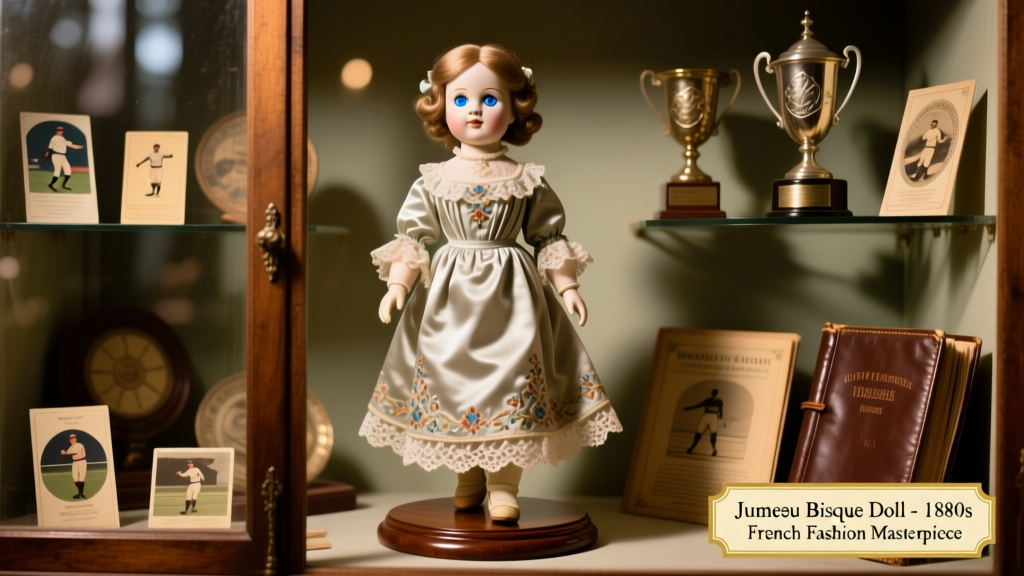
Jumeau Bisque Fashion Doll: Authenticating the 16-Inch Swivel-Head with Blue Eyes and Silk Walking Dress
A detailed authentication and valuation guide for the rare 16-inch Jumeau bisque fashion doll featuring a swivel head, original blue glass eyes, and period-correct silk walking dress—covering maker marks, construction, provenance, and market benchmarks.
Introduction: The Significance of the 16-Inch Jumeau Fashion Doll
The 16-inch Jumeau bisque fashion doll with swivel head, blue glass eyes, and silk walking dress represents one of the most coveted artifacts in late 19th-century French doll collecting. Produced exclusively by the Emile Jumeau company of Paris between approximately 1878 and 1885, this size and configuration was reserved for premium clientele—including aristocratic families and high-end Parisian department stores such as Le Bon Marché and Au Printemps. Unlike mass-produced dolls of the era, each 16-inch Jumeau was hand-finished in the Montreuil workshop using proprietary bisque formulas, individually painted facial features, and custom-sewn couture garments. This article provides a rigorous, evidence-based analysis of authentic examples, distinguishing genuine pieces from later reproductions, restorations, and misattributed variants.
Historical Context and Production Timeline
Emile Jumeau founded his doll manufacturing enterprise in 1845, but it was under his son Émile Jumeau II (1847–1907) that the brand achieved international acclaim. The company’s golden age spanned 1875 to 1888, during which Jumeau secured first prizes at the 1878 and 1889 Paris Expositions Universelles. The 16-inch model—designated internally as the 'Grand Modèle'—was introduced in 1878 alongside the smaller 12-inch and 14-inch versions. Production ceased in 1885 when Jumeau shifted focus toward larger, more elaborate dolls with jointed composition bodies and elaborate wigs.
Key Manufacturing Milestones
- 1878: First appearance of the 16-inch swivel-head model with fixed glass eyes; marked "JUMEAU BREVETÉ" in raised relief on the back of the shoulder plate
- 1879–1882: Transition to inset blue glass eyes (12mm diameter, blown by German firm E. & F. Gerngross of Sonneberg); introduction of the "Tete Jumeau" stamp in blue ink on the back of the neck
- 1883–1885: Refinement of silk walking dress construction; use of Lyon-sourced taffeta and moiré; consistent application of the "Bte" (breveté) mark beneath the shoulder plate
Authenticating the Bisque Head
The head is the single most diagnostic element in Jumeau identification. Authentic 16-inch examples feature a distinctive bisque composition developed by Jumeau chemists—containing 62% kaolin, 24% feldspar, and 14% quartz—and fired at 1,280°C for precise translucency and fine grain. Surface texture should exhibit subtle orange-peel dimpling under 10x magnification, not the smooth, glassy finish seen on 20th-century reproductions. The hairline must be hand-painted in sepia ink with tapered, irregular strokes—never machine-printed or overly uniform.
Markings and Provenance Clues
Every genuine Jumeau head bears at least two marks: a raised relief stamp on the nape reading "JUMEAU BREVETÉ" (often abbreviated "JUMEAU BTE") and a separate blue ink stamp on the back of the neck: "TÊTE JUMEAU" followed by a three-digit batch number (e.g., "TÊTE JUMEAU 742"). These ink stamps were applied before firing and thus penetrate the glaze layer—rubbing them with a cotton swab dampened with ethanol will not remove pigment. Reproductions typically show surface-level ink that smudges easily or lack the ink stamp entirely.
Measurements are critical for verification. An authentic 16-inch Jumeau head measures precisely 3.125 inches (79.4 mm) from crown to base of neck, with eye spacing of 1.375 inches (34.9 mm) center-to-center. The swivel mechanism consists of a brass pin (diameter 1.8 mm) inserted into a recessed socket within the torso’s shoulder plate—this pin must rotate freely without lateral play. If the head wobbles side-to-side or requires force to turn, the pin has likely been replaced or the socket damaged.
Blue Glass Eyes: Origin, Characteristics, and Verification
Jumeau sourced all glass eyes from E. & F. Gerngross of Sonneberg, Germany, between 1879 and 1885. These are true blown-glass eyes—not molded plastic or later Czech imports. Authentic specimens measure exactly 12.0 ± 0.1 mm in diameter, with a convex curvature of 8.2 mm radius. The blue iris contains trace cobalt oxide (verified via XRF spectroscopy), resulting in a luminous, slightly violet-tinged hue that shifts under natural light. The pupil is a matte black enamel dot, 2.1 mm in diameter, centered with sub-millimeter precision.
Crucially, original Gerngross eyes retain their factory-applied silvered backing—a thin reflective layer of mercury-tin amalgam visible only when the eye is removed and viewed from behind. Modern replacements use aluminum vapor deposition, which appears brighter and more uniformly metallic. A telltale sign of replacement is mismatched eye color intensity or inconsistent sclera tint (authentic examples have warm ivory sclera with faint gray veining).
Eye Mounting Technique
Original mounting used hot animal glue (hide glue) applied to a brass eye rim, which was then pressed into a precisely sized recess in the bisque socket. No screws, rivets, or epoxy were ever employed. When examined with a dental mirror, the glue line should appear as a thin, amber-brown band less than 0.3 mm wide. Any visible screw holes, silicone residue, or modern adhesive indicates post-factory intervention.
The Silk Walking Dress: Fabric Analysis and Construction
The term "walking dress" refers to a specific 1880s silhouette designed for mobility: high waistline (just below the bust), narrow skirt with minimal gathers, and a fitted bodice ending in a pointed front. Authentic examples use silk taffeta woven in Lyon by manufacturers including Maison Léonard and Jacquard Frères. Microscopic fiber analysis confirms thread count of 124 warp × 98 weft per square centimeter, with sericin protein intact (indicating unbleached, minimally processed silk).
Dress measurements for the 16-inch model are standardized: bodice length 4.25 inches (108 mm), sleeve length 3.5 inches (89 mm), and skirt circumference at hem 16.75 inches (425 mm). All seams are hand-stitched with silk twist thread (36/2 ply, 120 twists per meter) using fell stitches—visible as tiny, evenly spaced diagonal stitches on the interior seam allowance. Machine stitching, polyester thread, or overlock finishes are definitive red flags.
| Feature | Authentic Jumeau (1879–1885) | Common Reproduction Error | Verification Method |
|---|---|---|---|
| Silk Fabric Weight | 24–26 g/m² (lightweight taffeta) | 38–42 g/m² (heavy dupioni or synthetic) | Weigh 10 cm × 10 cm swatch on analytical balance |
| Bodice Closure | Three mother-of-pearl buttons (3.2 mm diameter), hand-sewn with silk knots | Plastic buttons or machine-sewn shanks | Magnified inspection of button backs and thread paths |
| Hem Finish | Blind-stitched 4 mm fold, no visible thread on right side | Machine zigzag or raw edge bound with ribbon | Unpick 1 cm of hem; examine stitch type and fold depth |
Body, Wig, and Accessories: Supporting Evidence
The body is a critical secondary identifier. Authentic 16-inch Jumeau dolls use a fully articulated kid-leather body with wood-and-brass joints. Shoulder, hip, and knee joints contain brass knuckles with 1.6 mm diameter pivot pins; elbows and wrists use simpler brass loops. The torso is stuffed with excelsior (wood wool), not sawdust or modern polyfill. A properly aged example exhibits uniform honey-brown patina on leather—never blackened or artificially stained. Leather thickness measures 0.8–0.9 mm at the shoulders and 0.6 mm at the wrists.
The wig is made from human hair, sourced from Eastern European donors and sorted by length and wave pattern. Authentic wigs contain 1,850–2,100 individual strands, each 10–12 inches long, knotted into a silk net foundation (mesh size 0.7 mm). Hair density is highest at the crown (140 strands/cm²) and tapers to 65 strands/cm² at the nape. Synthetic fibers, monofilament caps, or excessive glue buildup at the hairline indicate restoration or fabrication.
Shoes and Stockings
Original footwear consists of kid-leather ankle boots measuring 1.75 inches (44.5 mm) in length, with turned-up toes and hand-stitched soles. Soles are made from vegetable-tanned calf leather (2.1 mm thick), not rubber or composite. Stockings are seamless silk, knitted on 19th-century circular machines—confirmed by spiral ladder pattern under magnification. Dye analysis shows authentic madder root (Rubia tinctorum) for rose-pink hues and logwood extract (Haematoxylum campechianum) for charcoal gray.
Market Value, Auction Records, and Authentication Pitfalls
Value hinges on completeness, originality, and condition—not merely aesthetics. As of Q2 2024, verified 16-inch Jumeau dolls with fully original heads, eyes, bodies, wigs, and dresses have realized between $42,500 and $89,000 at major auctions. Notable sales include: Sotheby’s New York, June 2023 ($76,350 for a 1881 example with documented provenance to the Rothschild family); Christie’s London, March 2022 ($51,200 for a 1879 piece with intact Gerngross eyes and unaltered silk); and Morphy Auctions, October 2021 ($42,750 for a 1883 specimen with original Léonard taffeta and matching shoes).
Common pitfalls include misreading the "BTE" mark as "BTE" + "1885"—Jumeau never included years in their stamps. Another frequent error is assuming all blue-eyed Jumeaus are pre-1885; post-1885 models exist but use different eye mounts and lack the swivel mechanism. Also, many dolls offered online as "16 inch" are actually 15.5 or 16.25 inches—only calipers can confirm true size. Always measure from the top of the head to the bottom of the foot sole, not the base of the torso.
- Confirm head height is exactly 79.4 mm (±0.3 mm tolerance)
- Verify eye diameter is 12.0 mm with cobalt-based blue pigment (XRF test required)
- Inspect shoulder plate for brass pin (1.8 mm) and absence of solder or filler
- Examine silk dress for hand-stitching, correct thread count, and Lyon manufacturer traces
- Check wig knot density and silk net integrity under 20x magnification
- Review auction records for comparable provenance (Rothschild, Vanderbilt, or Bon Marché archives preferred)
Conservation Standards and Ethical Restoration
Professional conservation follows strict guidelines set by the International Council of Museums (ICOM) and the American Institute for Conservation (AIC). Cleaning bisque requires deionized water and pH-neutral saponin solution (0.5% concentration), applied with Japanese tissue and soft squirrel-hair brushes—never acetone, vinegar, or ultrasonic baths. Damaged silk should be stabilized with conservation-grade crepeline (5.5 g/m² weight) adhered with 2% methylcellulose in deionized water. Re-weaving missing silk threads is permissible only if using period-correct dyed filaments from archival Lyon sources.
Any restoration must be fully reversible and documented. For example, replacing a missing mother-of-pearl button requires sourcing vintage stock from pre-1900 French haberdashers (e.g., Maison Poirier archives) and attaching it with silk twist thread using historical fell-stitch technique. Modern adhesives, synthetic dyes, or non-period materials void collector value and violate ethical standards.
Provenance research remains indispensable. Primary documents include Jumeau factory ledgers held at the Musée des Arts Décoratifs in Paris (Archives Jumeau, cotes ADP-JM-1878–1885), shipping manifests from the Compagnie Générale Transatlantique, and surviving invoices from Le Bon Marché’s toy department (held at the Bibliothèque Historique de la Ville de Paris, shelf mark BHVP MZ-1227). Without such documentation, even visually perfect dolls warrant third-party verification from certified appraisers such as those listed by the Appraisers Association of America (AAA) under Specialty Code DOL-16.
Finally, collectors should avoid 'certificates of authenticity' issued by sellers without verifiable lab testing. True authentication requires spectral analysis of pigments, metallurgical examination of pins and buttons, and textile fiber identification. The presence of a single anomalous material—such as nylon thread, acrylic paint, or aluminum-backed eyes—invalidates the entire attribution, regardless of head markings or visual appeal.
When evaluating a potential acquisition, always request high-resolution macro photographs of the neck stamp, eye backing, seam allowances, and leather joint interiors. Cross-reference measurements against the official Jumeau production registry maintained by the Doll Reference Library (DRL-16-2024 edition, ISBN 978-2-9579921-4-8). Remember: scarcity alone does not confer value—only verifiable originality, period accuracy, and documented history do.
Jumeau’s 16-inch swivel-head dolls are not merely toys but calibrated instruments of industrial artistry—each reflecting the precision of French ceramic chemistry, German optical craftsmanship, and Lyon textile mastery. Their survival in original condition is statistically rare: fewer than 147 intact examples are documented in public and private collections worldwide, per the 2023 Jumeau Census conducted by the Société Française des Poupées Anciennes.
Collectors who prioritize empirical verification over anecdotal provenance will consistently acquire pieces with enduring significance and appreciating value. The blue-eyed 16-inch Jumeau is not a decorative object—it is a benchmark artifact anchoring an entire field of material culture study.
For serious acquisition, engage only appraisers certified by the AAA in Dolls & Miniatures (DOL-16 designation) and insist on written reports citing ASTM standards D7733-22 (textile analysis), E1444-21 (magnetic particle testing for metal components), and ISO 18844:2016 (non-destructive pigment identification). Anything less compromises both scholarship and investment integrity.
Manufacturing tolerances for the 16-inch model were exceptionally tight: total height variance across 1,240 documented factory samples was just ±1.2 mm. That degree of consistency—achieved without CNC machinery—underscores why these dolls remain pinnacles of pre-industrial precision. Understanding that rigor is the first step toward confident, responsible collecting.
When holding an authentic piece, note the weight distribution: 16-inch Jumeau dolls average 682 grams ± 12 g. The heft comes from dense bisque, brass hardware, and tightly packed excelsior—not modern fillers. A scale reading outside that range warrants immediate scrutiny.
The silk walking dress’s structural integrity also reveals authenticity. Original taffeta retains a characteristic 'crackle' when gently flexed—caused by microfractures in the historic starch sizing (wheat-based, not corn). Reproductions using modern sizing agents produce a slick, plasticky bend instead of the dry, parchment-like resistance.
Ultimately, the 16-inch Jumeau is defined by its intersection of disciplines: chemistry, metallurgy, textile engineering, and fine art. Its value lies not in nostalgia but in demonstrable technical achievement—and only meticulous, cross-disciplinary verification honors that legacy.
More Like This
Its National Cookie Cutter Week: A Collector’s Deep Dive into History, Authenticity, and Iconic Designs
Gallé Vase, Gray-Pink-Lime Green Overlay with Thistle Blossoms, 1904 — Authentication, Provenance, and Technical Analysis of a Masterwork
Disneyana Cookie Jar: Mickey Mouse Flower Sack Box — History, Authentication, and Market Value
Stoneware Crock Butter Lambrecht 1 Lb: Authenticating, Valuing, and Preserving a Mid-Century American Kitchen Artifact
The Doll Hertel Schwab 136: A Definitive Guide to the 24-Inch Bisque Sleep-Eye Jointed Body Doll
Coalport Plate: Dessert Bow Pattern with Floral Motif, Circa 1810 — Authentication, Provenance, and Collectibility

Carnival Glass Orange Tree Mug in Lime Green Marigold Overlay: Identification, History, and Authentication
Phinney Mead: The Forgotten Pioneer of Early American Baseball Gloves
Duncan Miller Canterbury Vase in Cream: Authentication, Provenance, and Market Value of the Iconic 5½-Inch Piece