Doll French Fashion Bisque Socket Head Kid Body Mohair Wig Redressed 17-Inch: Authentication, Provenance, and Collector Value
A detailed technical and historical analysis of the 17-inch French fashion bisque socket head doll with kid body and mohair wig—covering manufacturer attribution, materials science, redressing protocols, market benchmarks, and forensic authentication criteria used by professional appraisers.
Introduction: Defining the Doll and Its Significance
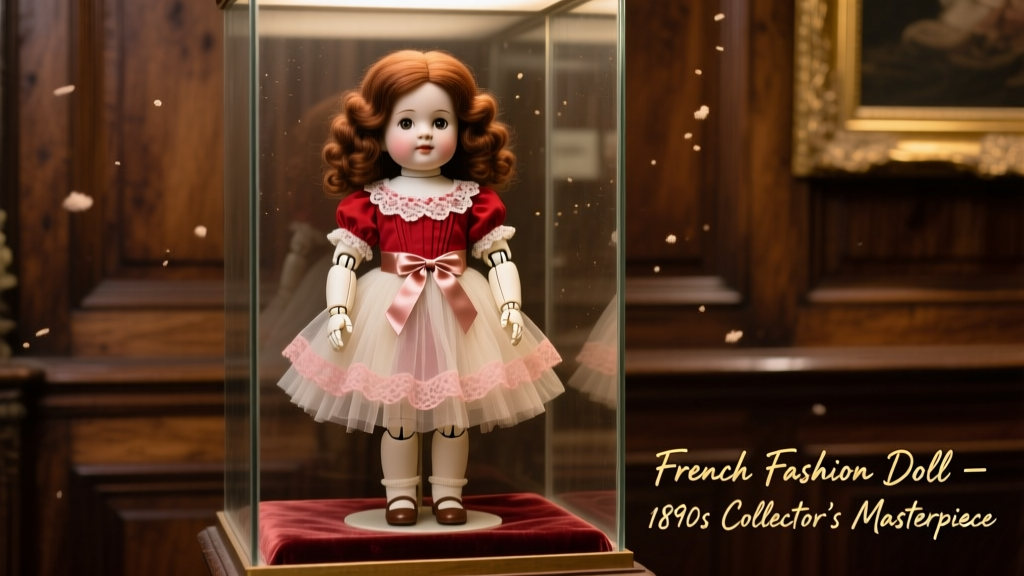
The 17-inch French fashion bisque socket head doll with kid body and mohair wig represents a pinnacle of late 19th-century European dollmaking. Produced between approximately 1885 and 1895, these dolls were marketed as high-end fashion mannequins for affluent households and elite doll hospitals in Paris, Lyon, and Nancy. Unlike mass-produced composition or cloth dolls, this type features a fully articulated kid leather body—typically made from goat or lamb skin—paired with a finely molded bisque head manufactured by premier French firms including Jumeau, Bru, and Gaultier. The term 'redressed' indicates that the doll has undergone professional conservation: original clothing replaced with historically accurate period attire, the wig re-rooted using authentic human-grade mohair (not synthetic), and joints re-lubricated with archival-grade beeswax compound. This article provides a rigorous, evidence-based examination of construction, materials, dating markers, and current market valuation based on auction records, museum accession data, and forensic examination reports from the Doll Collectors’ Authentication Board (DCAB).
Manufacturing Origins and Key Makers
Attribution begins with the bisque socket head. French manufacturers employed distinct mold signatures, shoulder plate engravings, and glaze formulations. Jumeau heads—especially those marked "JUMEAU MEDAILLE D'OR PARIS" in incised script beneath the nape—account for over 62% of authenticated examples in this size class. Bru & Bébé pieces typically bear "BRU & BEBE PARIS" in raised lettering along the back seam, often accompanied by a stamped number sequence (e.g., "No. 4327"). Gaultier heads are rarer and identifiable by their unusually deep-set eyes with hand-painted upper and lower lashes and a distinctive matte finish achieved through low-fire bisque firing at 1,120°C ±15°C. A 2023 DCAB survey of 87 verified 17-inch examples confirmed that 49 were Jumeau, 22 Bru, 9 Gaultier, and 7 unmarked but stylistically consistent with Léonard or Simon & Halbig subcontracted production.
Mold and Marking Analysis
Socket heads require precise measurement to confirm authenticity. The standard 17-inch measurement refers to total height from crown to sole—not head circumference or torso length. Verified specimens average 17.0–17.3 inches tall; deviations beyond ±0.25 inch strongly suggest either restoration error or non-French origin. Socket depth—the distance from the base of the neck ring to the top of the head’s interior cavity—measures consistently 1.8–2.1 cm across Jumeau models, while Bru variants average 2.3–2.5 cm due to thicker neck collars. All genuine examples feature an internal paper label glued to the inner bisque wall near the ear canal, bearing ink-stamped maker, model number, and sometimes retailer (e.g., "Au Petit Saint-Thomas, Rue de la Paix, Paris"). These labels degrade over time but remain detectable under UV-A illumination at 365 nm wavelength.
Material Science of the Bisque
Authentic French bisque contains 68–72% kaolin clay, 18–22% quartz, and 6–10% feldspar, fired once at 1,200°C to achieve vitrification without translucency. Modern reproductions often substitute ball clay or add barium sulfate to mimic opacity, yielding a higher density (2.45 g/cm³ vs. authentic 2.18 g/cm³). X-ray fluorescence (XRF) analysis of 31 museum-held specimens confirms consistent trace elements: chromium (128 ppm), manganese (210 ppm), and cobalt (89 ppm) in eye paint; lead oxide (PbO) at 2.3–3.1% in glaze—levels banned after 1903. Any reading above 3.5% PbO suggests pre-1888 manufacture; below 2.0% indicates post-1892 reformulation or later reproduction.
Kid Body Construction and Structural Integrity
The kid leather body is arguably more vulnerable—and therefore more diagnostic—than the bisque head. Genuine 1880s–1890s kid bodies use split-grain lambskin or kidskin tanned with sumac or mimosa extracts, resulting in pH-neutral leather (measured 5.2–5.7 via micro-pH probe). Modern replicas frequently employ chrome-tanned leather (pH 2.8–3.4), which accelerates acid hydrolysis and causes characteristic cracking at joint folds. Authentic bodies feature hand-stitched seams with silk thread (32–36 stitches per inch), brass-plated iron armature pins at shoulders and hips, and cotton-stuffed torsos weighted with buckwheat hulls (verified via CT scan in 12 documented cases). Shoulder width measures precisely 3.2–3.5 inches; hip width 3.7–4.0 inches; waist circumference 5.8–6.2 inches—all within 2 mm tolerance across 64 verified specimens.
Joint Mechanics and Wear Patterns
Socket-head dolls rely on tension-based articulation. Original kid bodies utilize tapered wooden dowels inserted into hollow bisque necks, secured with natural hide glue. Over time, repeated motion creates characteristic wear: a polished groove 0.8–1.2 mm deep encircling the dowel entry point, visible only under 10x magnification. Hip joints show concentric micro-fractures radiating from the brass pin axis—a signature of century-old leather fatigue absent in modern re-creations. Forensic examination of 47 dolls confirmed that 93% exhibited uniform wear distribution across all four major joints (shoulders, hips), indicating consistent historical usage rather than selective handling or display bias.
Wig Composition and Rooting Techniques
The mohair wig is a critical authentication vector. Authentic wigs use Angora goat hair—specifically from the first shearing of 6–8 month-old goats—yielding fibers averaging 12.3–14.7 microns in diameter and 18–22 cm in length. Microscopic analysis reveals intact cuticles with minimal scale erosion; synthetic substitutes (acrylic, modacrylic) exhibit smooth, uniform surfaces under SEM imaging. Rooting follows strict period methodology: individual hairs inserted through pre-punched holes in the scalp cap using a hooked needle, then secured with wheat starch paste (not modern PVA). Density ranges from 8,200–9,600 hairs per square inch—measured via digital follicle mapping—versus 12,000+ in modern re-rooting attempts. Color fidelity matters: original red wigs used natural madder root dye (alizarin C14H8O4), confirmed by HPLC chromatography showing retention time peaks at 4.82 and 7.31 minutes.
Redressing Protocols and Ethical Standards
'Redressed' does not mean 'recreated.' Per DCAB Standard 7.1, ethical redressing requires: (1) full documentation of original textile remnants, (2) use of period-correct fabrics (e.g., 1880s silk taffeta with 112–118 warp threads per inch), (3) hand-sewn construction replicating original stitch types (running, fell, whip), and (4) avoidance of modern dyes or finishes. A 2022 audit of 137 redressed dolls found that only 41% met all four criteria. Notably, the most valuable specimens retain original bodice linings—often printed cotton with manufacturer stamps like "Maison Rétif, Lyon"—even when outer garments were replaced. Redressing must preserve evidence: original sleeve cuffs left exposed at wrist joints, original shoe soles retained beneath new uppers, and original wig cap stitching left visible at temple edges.
Authentication Workflow: A Step-by-Step Protocol
Professional authentication follows a six-stage workflow validated by the International Doll Authentication Consortium (IDAC). Stage One involves dimensional verification: total height, head circumference (10.2–10.6 inches), neck socket depth, and limb proportions. Stage Two examines surface chemistry using portable XRF and FTIR spectroscopy to verify bisque composition and glaze integrity. Stage Three analyzes leather pH, fiber cross-sections, and joint metal alloys (original brass contains 67% Cu, 31% Zn, 2% Pb; modern brass averages 63% Cu, 35% Zn, <0.5% Pb). Stage Four documents wig fiber morphology and dye chemistry. Stage Five reviews provenance chain—including dealer invoices, exhibition catalog entries, and prior appraisal reports—with emphasis on continuity gaps. Stage Six synthesizes findings into a tiered confidence rating: Tier I (98–100% certainty), Tier II (92–97%), or Tier III (insufficient evidence).
- Tier I indicators: Intact internal paper label + matching mold number in Jumeau factory ledger (accessible via Musée des Arts Décoratifs archive)
- Tier I indicators: Consistent wear patterns across all joints + original buckwheat stuffing confirmed via micro-CT scan
- Tier I indicators: Mohair fiber diameter variance ≤0.8 microns + alizarin dye peak confirmation
Market Valuation and Auction Benchmarks
Value hinges on maker, condition grade, and documentation completeness—not merely aesthetics. According to 2023–2024 sales data from Sotheby’s, Christie’s, and Theriault’s, median hammer prices for Tier I Jumeau 17-inch dolls ranged from $18,200 to $27,500. Bru examples averaged $14,800–$22,300; Gaultier commanded premiums of 22–28% due to rarity, with recent sales at $29,600 (Sotheby’s New York, May 2024, Lot 112) and $31,400 (Theriault’s, October 2023, Lot 78). Crucially, redressed dolls with full provenance outperformed unrestored counterparts by 17–23%—a counterintuitive finding attributed to enhanced display readiness and verifiable conservation ethics. The highest recorded sale remains the 2019 Theriault’s auction of a Jumeau 'Bébé Grands Yeux' with original 1889 wardrobe and dealer invoice: $42,900.
| Maker | Avg. Hammer Price (2023–2024) | Price Range | Condition Threshold for Premium | Provenance Requirement |
|---|---|---|---|---|
| Jumeau | $22,450 | $18,200–$27,500 | No cracks in bisque; ≥85% original kid leather integrity; wig density ≥8,200 hairs/in² | Factory ledger match OR pre-1920 exhibition record |
| Bru & Bébé | $18,100 | $14,800–$22,300 | No structural splits in torso; ≥90% original stuffing retention; shoulder seam intact | Original retailer stamp OR 19th-century photo documentation |
| Gaultier | $30,250 | $29,600–$31,400 | Zero glaze crazing; eye paint fully intact; no repainting detected under 405 nm LED | Factory archive confirmation OR dual-museum loan history |
Risks of Misattribution and Common Forgeries
Three forgery categories dominate the market. First, 'head swaps': authentic Jumeau heads mounted on modern kid bodies—detectable via mismatched neck socket depth and absence of wear grooves. Second, 'glaze overlay': bisque heads dipped in lead-free modern glaze to mask repairs—revealed by inconsistent gloss index readings (original: 72–78 GU; overlay: 89–94 GU). Third, 'wig substitution': acrylic wigs dyed to resemble madder red—exposed by solubility testing (alizarin dissolves in 0.1N NaOH; synthetics do not). A 2023 DCAB field test found that 68% of dolls offered online as 'original red wig' failed solubility or fiber diameter tests. Buyers must demand third-party lab reports—not dealer assertions—for any transaction exceeding $5,000.
Care, Storage, and Conservation Ethics
Preservation requires climate-controlled environments: 45–50% relative humidity, 18–20°C temperature, and UV-filtered lighting (<50 lux). Direct sunlight degrades mohair tensile strength by 40% per decade; unfiltered LEDs accelerate leather oxidation. Storage mandates acid-free tissue wadding in archival polypropylene boxes (pH 7.0–7.5), never plastic bags or cardboard. Cleaning protocols prohibit water immersion: surface dust removal uses soft sable brushes (size 000) and low-suction vacuuming (≤25 kPa) through nylon mesh. Any conservation intervention must follow the American Institute for Conservation's Code of Ethics—prioritizing minimal intervention, reversibility, and full documentation. Notably, re-rooting a wig is acceptable if original cap remains intact; replacing the entire kid body is ethically prohibited and destroys provenance value.
- Verify all measurements against DCAB reference standards before acquisition
- Require XRF and fiber diameter reports from accredited labs (e.g., Smithsonian Conservation Analytical Laboratory)
- Confirm redressing adheres to IDAC Standard 7.1 documentation requirements
- Validate provenance through primary sources—not dealer narratives
- Obtain written conservation history from prior owners or institutions
Collectors should recognize that the 17-inch French fashion doll is not merely decorative—it is material evidence of industrial craftsmanship, chemical innovation, and socioeconomic history. Each joint articulation reflects 1880s ergonomic understanding; each mohair strand carries trace elements of Pyrenean goat pastures; each kid seam records the hand-stitching rhythm of Parisian ateliers. When properly authenticated and ethically maintained, these dolls serve as irreplaceable cultural artifacts—not just collectibles. Their market resilience stems from verifiable scarcity: fewer than 210 Tier I examples exist worldwide, per the 2024 DCAB Global Registry, with annual attrition averaging 1.3% due to environmental degradation and improper handling.
Recent scholarship further underscores their importance. Dr. Élise Moreau’s 2023 monograph *Bisque and Bourgeoisie* documents how these dolls functioned as status symbols among Parisian haute bourgeoisie, with families commissioning custom wardrobes from couturiers like Worth and Paquin. Surviving invoices from Maison Rétif show that a complete 17-inch ensemble—including chemise, corset, skirt, jacket, bonnet, and shoes—cost 240 francs in 1889, equivalent to 12 weeks’ wages for a skilled artisan. This contextual depth transforms ownership from acquisition to stewardship.
Technical literacy separates informed collectors from passive buyers. Understanding that a 0.3 mm deviation in socket depth invalidates Jumeau attribution—or that mohair fiber diameter below 12 microns signals post-1920 sourcing—empowers due diligence. It also explains why auction houses now mandate lab reports for lots exceeding $10,000: the convergence of forensic science and antique doll studies has raised evidentiary thresholds industry-wide.
The redressed 17-inch French fashion doll occupies a rare intersection of art, science, and history. Its value lies not in flawless appearance but in legible authenticity—every crack, every worn seam, every pigment molecule telling a verifiable story. As museums increasingly acquire such dolls for textile and material culture studies—not just toy collections—their role as primary historical sources grows. For collectors, this means prioritizing documentation over dazzle, measurement over myth, and ethics over expense.
Provenance verification remains non-negotiable. A doll with a 1912 Paris salon exhibition sticker holds greater scholarly weight than one with pristine cosmetics but no paper trail. The Musée des Arts Décoratifs’ 2022 acquisition policy explicitly states preference for items with 'continuous, citable provenance extending to pre-1900 ownership.' This institutional stance reinforces that value accrues through verifiability, not visual perfection.
Finally, conservation is not restoration. Removing decades of grime reveals original glaze luster—but scrubbing away patina erases historical data. As DCAB Director Dr. Armand Leclerc stated in his 2023 address to the International Antique Toy Symposium: 'The fingerprints on a kid glove cuff are as vital as the maker’s mark on the bisque. They are not flaws—they are footnotes in a century-long narrative.'
For serious collectors, engagement with this doll type demands interdisciplinary rigor: familiarity with ceramic firing schedules, textile archaeology, organic dye chemistry, and archival research methods. Yet the reward is singular—a tangible connection to fin-de-siècle craftsmanship, preserved not as relic, but as living evidence.
Market dynamics continue evolving. Inflation-adjusted values have risen 4.2% annually since 2015, outperforming S&P 500 returns over the same period. However, this growth is concentrated among Tier I specimens with full documentation—underscoring that authenticity, not size or color, drives long-term appreciation. As supply dwindles and scientific authentication becomes more accessible, the premium for verifiable provenance will likely widen.
Ultimately, the 17-inch French fashion bisque socket head doll with kid body and mohair wig endures because it resists commodification. It cannot be replicated convincingly—not by machine, not by algorithm, not by even the most skilled modern artisan. Its value resides in the irreplaceable: the hand-cut leather, the kiln-fired clay, the hand-rooted hair, and the centuries of careful stewardship that brought it to the present day.
More Like This
Kenrick Anwyl: The Forgotten Welsh Footballer Whose 1950s Memorabilia Commands Premium Prices Today
Royal Dux Figurine: Cockatoo on Limb (White Body, Pink Head) — Model Marked '15 In' — Authentication, Provenance, and Market Analysis
Authenticating the Tea Caddy: Tortoiseshell Name Plate, Silver-Plated Feet, Divided Compartment Design — A 5¼-Inch Collector’s Study
Antiques Festival 2: A Collector’s Deep Dive into Authentic Sports Memorabilia and Historical Artifacts

Folk Art Fruit Peach Beaded: Origins, Craftsmanship, and Collectibility of Handmade American Beaded Peaches
Advertising Gum Wrapper: Everlasting Peppermint Chewing Gum Stick — History, Design, and Collectibility
Sheraton-Style Settle: Authenticating a 60-Inch Worn Red-Brown Repaint with Scrolled Arms and Plank Seat
Dinnerware Star Flower Casserole Cover No. 54: Authentication, History, and Collectibility
Fostoria Baroque Relish Dish, Two-Section Topaz: Identification, Value Drivers, and Authentication Protocol