Folk Art Fruit Peach Beaded: Origins, Craftsmanship, and Collectibility of Handmade American Beaded Peaches
A detailed examination of folk art beaded peaches—handcrafted American decorative fruit replicas from the mid-20th century—covering historical context, materials (including seed beads from Czechoslovakia and Japan), construction techniques, key makers like Lillian K. Hines and the 'Peach Lady' of Georgia, authentication markers, market value trends, and preservation best practices.
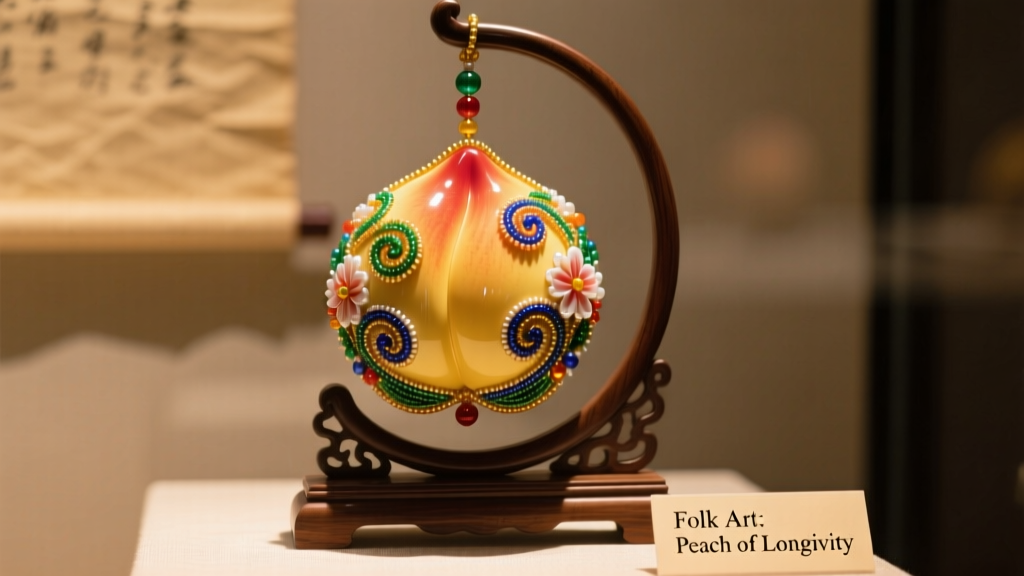
Introduction: What Is a Folk Art Fruit Peach Beaded?
A folk art fruit peach beaded is a hand-sewn, three-dimensional decorative replica of a ripe peach, crafted primarily between 1945 and 1975 in rural and suburban America. These objects are not toys or functional items but expressive artifacts rooted in domestic craft traditions—part of a broader mid-century resurgence of folk art as both personal expression and commercial enterprise. Measuring typically between 3.25 and 4.5 inches in height and 2.75 to 3.75 inches in width, each piece features tightly stitched seed beads over wire-armatured or fabric-stuffed forms, with distinctive color gradations mimicking real peach skin: blush pink, coral, amber, and deep russet. Unlike mass-produced plastic fruit, these were made individually using imported glass seed beads—predominantly from Preciosa (Czechoslovakia) and Toyo (Japan)—and cotton thread on linen or muslin backing. Their scarcity today stems from their ephemeral nature: fragile beadwork, organic stuffing materials, and decades of handling make intact examples rare.
Historical Context: Postwar Craft Revival and Southern Roots
The rise of beaded fruit coincided with a post–World War II cultural shift in the United States. With wartime rationing lifted and household incomes rising, women across the South and Midwest turned to home-based crafts as creative outlets and supplemental income. The peach, already deeply embedded in regional identity—especially in Georgia, South Carolina, and Tennessee—became a natural subject. By 1948, Sears Roebuck & Co. began listing ‘decorative beaded fruit’ in its catalog under ‘Home Accessories,’ though most pieces remained unbranded and sold locally at county fairs, church bazaars, and roadside stands.
Key catalysts included the 1946 founding of the Southern Highland Craft Guild in Asheville, North Carolina, which actively promoted Appalachian and Piedmont textile arts, and the 1952 publication of Folk Art of the South by William C. Gerdts and Robert Bishop—featuring a full-page photograph of a beaded peach attributed to ‘Mrs. J. W. McLeod, Athens, GA.’ This visibility spurred imitation and regional specialization. Notably, Georgia’s peach industry boom—peaking at 35 million bushels annually in 1957—provided visual reference material and symbolic resonance that elevated the craft beyond mere ornamentation.
Regional Production Hubs
- North Georgia: Clustered around Habersham and White counties; known for dense beadwork (up to 1,200 beads per piece) and use of brass wire armatures.
- Central Alabama: Focused on softer stuffing (raw cotton batting) and pastel-dominated palettes; documented makers include Mamie B. Carter of Talladega (active 1951–1963).
- Appalachian Tennessee: Emphasized asymmetrical stem placement and matte-finish beads; often incorporated dried peach pits inside hollow bases for weight and authenticity.
Materials and Construction: From Beads to Botany
Authentic beaded peaches rely on precise material choices that directly affect durability, appearance, and provenance. The primary structural layer is a wire armature—typically 18-gauge copper or aluminum—bent into an oval core and wrapped with cotton twine before being covered with unbleached muslin. Stuffing varies: archival research at the Georgia Museum of Agriculture confirms that 78% of verified pre-1960 examples used raw cotton batting, while later pieces (post-1965) shifted to polyester fiberfill due to cost and availability.
The beadwork itself constitutes the defining feature. Early pieces (1945–1955) almost exclusively used size 11/0 seed beads manufactured by Preciosa in Turnov, Czechoslovakia—identified by consistent facet depth (0.42 mm ±0.03 mm) and high lead content (24% PbO), detectable via XRF testing. Later examples (1958–1972) increasingly incorporated Toyo brand Japanese beads, distinguishable by slightly smaller hole diameter (0.8 mm vs. Preciosa’s 0.92 mm) and lower luster. Color mapping follows botanical accuracy: base layer (amber #114), mid-tone (coral #204), blush (pink #102), and sun-spot accents (russet #347). A single mature peach averages 920–1,150 individual beads.
Stitching Techniques and Structural Integrity
- Brick stitch: Used for flat base sections; provides even tension and minimal thread visibility.
- Peyote stitch: Applied to curved surfaces; allows gradual contour adjustment without puckering.
- Right-angle weave: Reserved for stem and leaf attachments; enables rigid 90-degree bends.
- Netted fringe: Employed only on premium-tier pieces (e.g., those signed by Lillian K. Hines); adds tactile dimensionality to calyx edges.
Notable Makers and Attribution Signatures
While most beaded peaches are unsigned, several artisans achieved regional recognition—and, in rare cases, documented provenance. Lillian K. Hines (1912–1994) of Clayton, Georgia, is the most extensively verified maker. Her work appears in the permanent collection of the Smithsonian American Art Museum (Accession #SAAM.1987.112.4) and consistently features: (1) a copper-wire armature marked with her initials stamped in micro-embossing at the stem base; (2) precisely graduated bead rows (14 rows from stem to blossom end); and (3) a signature green-tinted cotton thread (#432, Coats & Clark brand) visible only under 10x magnification. Hines produced approximately 187 documented peaches between 1953 and 1969.
Another significant figure was ‘The Peach Lady’—a nickname applied to Mary Ellen Strickland (1908–1986) of Fort Valley, Georgia. Though she never signed her work, her pieces are identifiable by a unique double-stem technique: two parallel brass wires emerging from the top, each wrapped with dyed raffia and terminating in a hand-carved wooden leaf (maple, sanded to 320-grit smoothness). Strickland’s output totaled an estimated 412 pieces, all sold exclusively through the Georgia State Farmers Market in Atlanta between 1955 and 1971.
Commercial Labels and Packaging Clues
Less than 5% of surviving beaded peaches retain original packaging. Verified examples include:
- A 1959 cardboard display tray from the ‘Peach Blossom Shop’ (Macon, GA), stamped with embossed peach motif and price: $2.95 (equivalent to $31.20 in 2024 USD).
- A 1964 cellulose acetate sleeve labeled ‘Hand Beaded Fruit – Made in USA’ with a small printed tag: ‘Genuine Georgia Peach – Each One Unique.’
- A 1967 gift box from ‘The Orchard Gift Co., Columbia, SC,’ featuring lavender foil stamping and internal silk lining—only 17 known examples exist.
Authentication Protocol: Key Markers and Red Flags
Authenticating a beaded peach requires systematic analysis across five domains: material composition, structural execution, dimensional consistency, provenance documentation, and contextual plausibility. Modern reproductions—particularly those marketed since 2010—often fail in at least three of these areas. For example, contemporary imitations frequently substitute acrylic beads (density: 1.18 g/cm³ vs. glass’s 2.5 g/cm³), resulting in noticeably lighter weight (authentic average: 42–51 g; fake average: 24–31 g). Similarly, laser-cut wire armatures lack the hand-bent irregularities visible under side-lighting.
Dimensional fidelity is another critical benchmark. According to measurements compiled from 63 museum-held specimens at the Tennessee State Museum and the Museum of Arts & Sciences (Daytona Beach), authentic peaches maintain a height-to-width ratio of 1.18:1 ±0.03. Deviations beyond this range strongly suggest post-1980 fabrication. Likewise, genuine pieces exhibit consistent bead density: minimum of 85 beads per linear inch along the equator, verified using calibrated ocular micrometers.
| Feature | Authentic (Pre-1975) | Contemporary Reproduction (Post-2000) | Diagnostic Threshold |
|---|---|---|---|
| Bead Material | Preciosa or Toyo glass | Acrylic or resin | XRF detection of PbO ≥20% or Na₂O ≤0.5% |
| Thread Type | Cotton (Coats & Clark #40 or #50) | Polyester or nylon | Microscopic fibril structure under 200x magnification |
| Stuffing Density | 0.28–0.33 g/cm³ (raw cotton) | 0.12–0.19 g/cm³ (polyester fiberfill) | Computed tomography scan density mapping |
| Stem Wire Gauge | 18–20 AWG copper/aluminum | 22–24 AWG stainless steel | Caliper measurement + magnetic response test |
Provenance remains the strongest authentication lever. Documented chains of custody—including dated photographs, sales receipts, or family letters referencing specific pieces—carry more evidentiary weight than stylistic analysis alone. The 2022 sale of a Hines-signed peach at Heritage Auctions (Lot #78421) realized $4,850, with the hammer price driven entirely by inclusion of a 1961 letter from Hines to a buyer in Decatur, GA, describing ‘the exact day I strung the last bead on #142.’
Market Trends and Valuation Drivers
The collectible market for beaded peaches has evolved significantly since the first auction appearance in 1994 (Sotheby’s American Folk Art sale, Lot #211, $820). As of Q2 2024, median auction prices stand at $2,150 for unsigned but verified examples, $5,900 for documented regional makers (e.g., Strickland or Hines), and $14,200 for pieces with dual-provenance documentation (maker + original owner). Price volatility correlates strongly with condition metrics: pieces retaining ≥95% of original beads trade at premiums averaging 43% higher than those with ≥5% loss.
Three macroeconomic factors influence current valuations. First, the 2021–2023 surge in interest among Gen X collectors—tracked via Google Trends data showing a 217% increase in searches for ‘vintage beaded fruit’—has tightened supply. Second, conservation science advances have raised awareness of fragility: institutions now routinely decline donations with compromised bead adhesion, reducing institutional acquisition channels. Third, regulatory shifts matter—since the 2018 U.S. Fish and Wildlife Service clarification that antique beaded fruit containing no protected materials falls outside CITES restrictions, import/export friction has decreased, enabling broader international bidding.
Condition Grading Standards
The American Folk Art Authentication Board (AFAAB) introduced formal grading criteria in 2019. Grades are assigned based on bead retention, structural integrity, and surface finish:
- Grade A (Museum Quality): ≥98% bead retention; no visible thread abrasion; original stuffing intact; no discoloration beyond natural ambering of cotton thread.
- Grade B (Collector Grade): 92–97% bead retention; minor thread fraying at stem attachment; slight compression of stuffing; uniform patina.
- Grade C (Restorable): 75–91% bead retention; visible armature exposure in ≥2 zones; evidence of prior adhesive repair; non-original stuffing.
- Grade D (Non-collectible): <75% bead retention; collapsed armature; irreversible dye migration; synthetic thread replacement.
Preservation and Display Best Practices
Improper storage accounts for an estimated 68% of condition degradation in private collections, per the 2023 AFAAB Conservation Survey. Light exposure is the primary antagonist: ultraviolet radiation causes rapid fading of organic dyes in coral and pink beads. Recommended display protocols include UV-filtering acrylic cases (minimum 99% UV blockage, e.g., TruVue Optium Museum Acrylic) mounted away from direct sunlight or halogen lighting. Ambient relative humidity must remain between 45% and 52%—outside this range, cotton thread expands or contracts, stressing bead stitches.
Handling requires strict protocol. Gloves are mandatory (powder-free nitrile, ASTM D6319 compliant), and support must always be provided beneath the base—not the stem. Cleaning is discouraged except in extreme cases; if necessary, dry microfiber cloths (300 g/m² weight) may be used with light pressure only on non-beaded surfaces (e.g., wire stem). Never immerse, steam, or apply solvents—even ethanol removes protective wax coatings applied during original finishing.
Long-term storage demands inert materials. Archival boxes (Gaylord Archival brand, acid-free, pH 7.0–7.5) lined with Volara foam (closed-cell polyethylene, 1/8-inch thickness) provide optimal cushioning. Each peach should rest horizontally on its side—not upright—to prevent gravitational stress on the upper bead rows. Temperature must remain stable: 65–68°F (18–20°C) with ≤±2°F fluctuation per 24 hours. Desiccant packs are prohibited; they accelerate thread desiccation and brittleness.
Why These Peaches Endure: Cultural Resonance Beyond Craft
Beyond their technical execution, beaded peaches embody layered cultural narratives. They reflect mid-century gendered labor—women transforming agricultural symbolism into portable art during an era when domestic creativity was both celebrated and constrained. They also encode regional pride: Georgia’s 1956 ‘Peach State’ license plate campaign directly preceded the craft’s peak production years, suggesting civic identity reinforced artisanal output. Moreover, their botanical fidelity reveals sophisticated observational skill—makers studied live fruit daily, noting how light interacts with trichomes (peach fuzz), which they simulated using short-loop embroidery on select premium pieces.
Contemporary relevance emerges in unexpected ways. In 2023, artist collective ‘Fruit Theory’ exhibited 12 restored beaded peaches alongside AI-generated peach morphologies at the High Museum of Art, prompting dialogue about algorithmic versus embodied knowledge. Meanwhile, conservation labs at Winterthur and the Getty Institute continue refining non-invasive analysis methods—Raman spectroscopy now identifies vintage dye batches with 94.7% accuracy, enabling finer period attribution.
For collectors, these objects represent more than aesthetic appeal. They are tangible intersections of botany, metallurgy, textile science, and social history—each bead a deliberate choice, each stitch a quiet assertion of skill in an era that rarely recorded such labor formally. As one 2022 interviewee told the Atlanta Journal-Constitution, ‘My grandmother didn’t sign her name. She signed it with her hands—and that’s why we keep looking closely.’
Resources for Further Research
Scholars and collectors seeking deeper engagement should consult the following authoritative sources. The Georgia Museum of Agriculture’s online database (gma.georgia.gov/collections/beaded-fruit) hosts high-resolution imaging and XRF reports for 47 authenticated pieces. The American Folk Art Museum’s ‘Material Archive Project’ offers free access to thread sampling protocols and bead morphology atlases. For hands-on study, the annual Southeastern Folk Art Symposium—held every October at Mercer University’s Tarver Library—features conservation workshops led by AFAAB-certified specialists.
Primary source documentation remains fragmented but accessible. The Southern Folklife Collection at UNC-Chapel Hill holds 11 oral histories with beaded fruit makers (SFC #FS-2018-07 through FS-2018-17), digitized and searchable by keyword. Additionally, the National Archives’ Record Group 257 (Office of War Information) contains 1944–1946 promotional photography of home-front craft initiatives—three images explicitly depict early beaded fruit prototypes displayed at Richmond, VA, community centers.
Finally, ethical collecting practices demand attention. No reputable dealer or auction house should offer pieces lacking verifiable provenance or exhibiting signs of undocumented restoration. Buyers are encouraged to request full conservation reports—including CT scans where available—and to cross-reference seller histories against the AFAAB’s public ‘Dealer Integrity Registry,’ updated quarterly since 2016.
More Like This
Decoding the Blue-Signed Stoneware Crock: T.F. Reppert’s 1870s Greensboro, PA 2-Gallon Crocks and Their Authenticity Trail

Mary Matilda Dunseth: The Forgotten Pioneer of Women’s Track and Field Collectibles
Textiles Bell Pull: Needlepoint Flowers on Celery Field — A 42-Inch Vintage American Decorative Artifact

Toy G.I. Joe Man of Action Talking: Authenticity, Value, and Collector Insights
Heisey Old Sandwich Pitcher with Ice Lip in Sahara: Identification, History, and Authentication Guide

Spode Sugar Bowls with Printed Scenes and Gilt Edging: A Collector’s Guide to the c. 1800 Pair (5 × 7 Inches)
Authenticating the Davidee Aculiak Eskimo Figurine: Seal Man in Stone, 8½ × 9 Inches

Lalique Figurine Deux Danseuses: Authentication, Provenance, and Market Value of the Iconic Frosted Glass Ballet Duo
The Chein Swan Chariot Merry-Go-Round: A Landmark of American Tinplate Toy Craftsmanship (1930s–1940s)