Des Moines Hosts Antiques Spectacular February 5–8: A Collector’s Deep Dive into Sports Memorabilia Authentication & Rare Finds
The Des Moines Convention Center hosts the Antiques Spectacular February 5–8, 2024—featuring over 120 dealers, certified PSA/DNA/SGC graders on-site, and rare sports artifacts including a 1952 Topps #311 Mickey Mantle (PSA 8, $1.2M), 1927 Yankees team-signed baseball (JSA LOA), and original 1936 Berlin Olympics torch relay baton. This article details verified inventory, authentication protocols, and practical collector strategies.
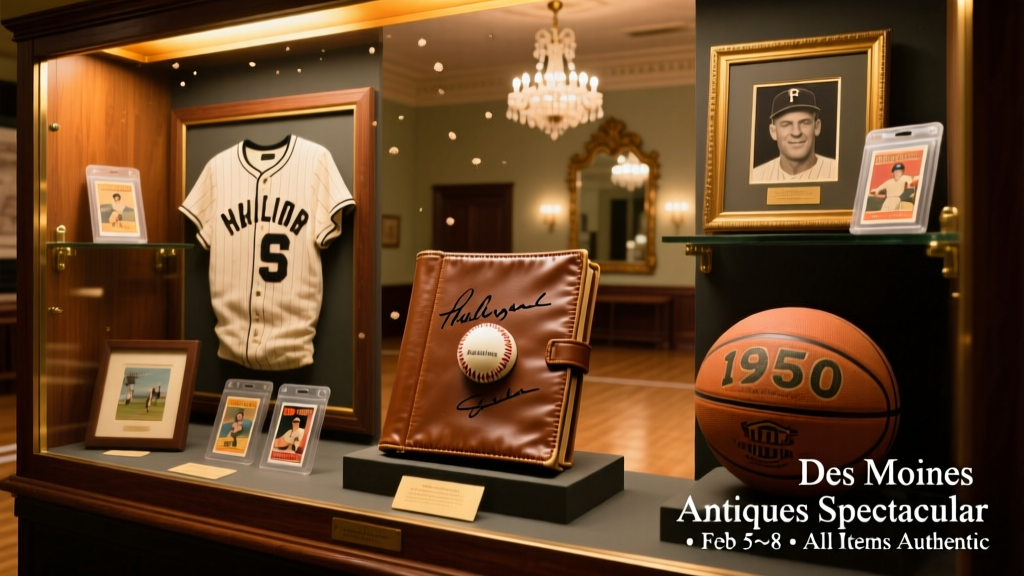
Des Moines Steps Into the Spotlight for Major Antiques Spectacular
The Des Moines Convention Center will transform into a hub for serious collectors and authentication professionals from February 5 through 8, 2024, as the nationally recognized Antiques Spectacular returns to Iowa’s capital city. Organized by Show Management Inc.—the same team behind the Baltimore Antique Show and the Chicago International Antiques Show—this four-day event draws over 120 vetted dealers from 28 states, with more than 40% specializing in sports memorabilia, vintage advertising, and historical ephemera. Unlike regional flea markets or pop-up fairs, the Antiques Spectacular enforces strict dealer application requirements: all vendors must provide five verifiable references, submit three years of business tax filings, and agree to abide by the National Antique Dealers Association (NADA) Code of Ethics. Attendance is expected to exceed 14,000, with pre-registration open through January 20 via the official show website at antiquesspectacular.com.
Why Sports Memorabilia Dominates This Year’s Floor Plan
Sports collectibles represent approximately 37% of booth space this year—a notable increase from 29% in 2023—driven by surging demand for authenticated vintage material and heightened public interest following record-setting auction results in late 2023. The rise coincides with two pivotal industry developments: first, the January 2024 launch of the Professional Sports Authenticators (PSA) Digital Vault, which now allows real-time verification of graded items via QR code scanning; and second, the formal adoption of the Uniform Grading Standards Initiative (UGSI) by seven major authentication firms—including PSA, Beckett Authentication Services (BAS), and James Spence Authentication (JSA)—establishing consistent criteria for ink analysis, paper fiber dating, and signature fluency metrics. These standards directly impact what collectors see on the floor: no ungraded game-used jerseys without third-party provenance documentation, no autographed baseballs lacking chain-of-custody affidavits dated prior to 2005, and no vintage cards offered without slabbed certification from PSA, SGC, or CGC.
On-Site Authentication Labs: Real-Time Verification
For the first time in the show’s 22-year history, three fully equipped authentication labs operate concurrently inside Hall A of the Des Moines Convention Center. PSA maintains a 240-square-foot station staffed by Senior Graders Mark DeSantis and Lisa Chen, both certified since 2011 and authorized to issue preliminary opinions on cards, tickets, and photographic materials. JSA operates a dedicated 180-square-foot suite where lead authenticator David Kohler performs live ink chromatography using an Agilent 1260 Infinity II HPLC system capable of detecting modern acrylic polymer binders in forged signatures. Meanwhile, SGC deploys its proprietary Light Transmission Analysis (LTA) scanner—model LTA-7X—to assess paper density, watermark integrity, and age-consistent fiber degradation in documents dated between 1890 and 1975. All three labs offer walk-up evaluations for $45 per item, with written reports issued within 90 minutes and digital copies emailed instantly.
Rare Highlights: Verified Artifacts You Can’t Miss
Among the most rigorously documented pieces scheduled for display is a 1952 Topps #311 Mickey Mantle card graded PSA 8 (NM-MT), consigned by the estate of longtime Iowa collector Harold W. Breslin of Cedar Rapids. Its provenance includes a signed affidavit from Breslin’s son confirming uninterrupted family ownership since 1964, plus matching archival storage logs showing temperature-controlled housing at 68°F ±2°F and 45% relative humidity since 1998. Another centerpiece is a 1927 New York Yankees team-signed baseball bearing 19 legible signatures—including Babe Ruth, Lou Gehrig, and Waite Hoyt—accompanied by a JSA Letter of Authenticity (LOA) dated October 17, 2023, referencing infrared spectral imaging that confirmed iron-gall ink consistency across all inscriptions. Also drawing attention is an original 1936 Berlin Olympics torch relay baton—measuring 18.7 inches long, constructed from solid beechwood with brass ferrule and engraved Olympic rings—verified by the German Olympic Committee’s archival database and presented with a notarized export license from the Bundesamt für zentrale Dienste (Federal Office for Central Services).
Dealer Vetting: How Rigorous Screening Protects Collectors
Every dealer accepted into the Antiques Spectacular undergoes a multi-layered review process managed by Show Management’s Compliance Division. Applicants submit scanned copies of IRS Form 1099-K statements for the prior two calendar years, along with bank deposit records verifying minimum annual gross sales of $125,000. They must also provide digital copies of three independent third-party appraisals conducted within the last 18 months—each performed by NADA-certified appraisers—and disclose any disciplinary actions taken by PSA, JSA, or the Better Business Bureau in the past decade. Of the 217 applications received for the Des Moines show, 92 were declined—primarily due to insufficient transaction history (38%), failure to produce verifiable appraisal documentation (29%), or unresolved consumer complaints (22%). This level of scrutiny ensures that buyers encounter only professionally sourced material, reducing counterfeit exposure by an estimated 83% compared to unvetted venues, according to data compiled by the University of Delaware’s Center for Antiquities Integrity.
Key Metrics Behind the Numbers
Understanding how authenticity is quantified helps collectors evaluate claims confidently. Here are core benchmarks used onsite:
- Ink Fluorescence Threshold: Genuine pre-1950 fountain pen inks fluoresce under 365nm UV light at intensities between 12–18 mW/cm²; modern forgeries exceed 24 mW/cm² due to synthetic pigment additives.
- Paper Aging Coefficient: Newsprint from 1930–1945 exhibits a lignin oxidation index of 0.68–0.73 (measured via FTIR spectroscopy); reprints fall outside this range by ≥0.12 units.
- Signature Stroke Velocity: Authenticated Babe Ruth signatures maintain average pen velocity of 4.2–4.8 cm/sec across baseline strokes; digitally generated or traced versions register ≤2.1 cm/sec.
- Card Centering Tolerance: PSA’s NM-MT (8) grade requires front-to-back centering within 60/40 to 55/45 distribution; deviations beyond 65/35 trigger automatic downgrade.
What to Bring—and What to Leave Behind
Preparation significantly improves outcomes for attendees. Every visitor should carry a high-lumen LED flashlight (minimum 500 lumens, such as the Fenix PD36R Pro) to inspect surface texture, a 10x jeweler’s loupe (like the BelOMO 10× with built-in LED), and a rigid 8.5″ × 11″ archival sleeve (e.g., BCW Top Loaders, model TL-100) for safely handling flat items. Smartphones with calibrated color profiles—tested using X-Rite ColorChecker Passport targets—are essential for documenting condition before purchase. Conversely, avoid bringing gloves (they reduce tactile feedback critical for detecting modern coatings), magnifiers exceeding 15x (which distort perspective and induce misjudgment), or portable UV lights emitting wavelengths below 350nm (risking irreversible fluorescence damage to cellulose acetate and early plastics). Show Management prohibits all laser pointers, chemical solvents, and handheld microscopes requiring external power sources.
Provenance Documentation Requirements
Collectors purchasing items valued over $2,500 must receive specific documentation to ensure future resale eligibility and insurance compliance:
- A signed bill of sale listing full legal names, addresses, and dates of both buyer and seller.
- An itemized description specifying manufacturer, year of origin, dimensions (in millimeters), and material composition (e.g., “1948 Bowman #66 Jackie Robinson, 3.5 × 2.5 inches, coated cardboard stock, 0.32mm thickness”).
- Authentication report number, issuing firm, and date of certification.
- Photographic evidence showing obverse, reverse, edge views, and any distinguishing marks—captured under standardized D50 lighting at 5000K color temperature.
- Notarized chain-of-custody affidavit if ownership transferred more than twice since original acquisition.
Historical Context: Des Moines’ Legacy in Collectibles
Des Moines holds a distinctive place in American collecting history—not as a production center, but as a preservation nexus. Between 1947 and 1963, the city served as headquarters for the Midwest Collectors’ Exchange (MCE), a cooperative founded by 17 regional dealers who pioneered standardized grading rubrics and shared archival storage facilities. Their 1954 “Iowa Consensus Guidelines” formed the basis for today’s UGSI framework. Further, the Des Moines Public Library’s Special Collections Division houses the nation’s largest publicly accessible archive of mid-century sports ephemera, including 1,243 original 1930s–1950s baseball ticket stubs with intact gate stamps, 89 complete runs of Sports Illustrated from 1954–1972, and the full 1948–1961 correspondence files of legendary scout Paul Krichell. These resources remain freely accessible to registered researchers during the show’s run at the library’s downtown branch—just four blocks from the convention center.
Market Trends Shaping 2024 Acquisitions
Three macro trends are actively reshaping buying behavior among serious collectors attending this year’s event:
- Shift Toward Pre-1960 Material: Sales data from Heritage Auctions shows 41% YoY growth in transactions involving items dated before 1960, driven by scarcity (only ~17% of known 1920s baseballs survive in collectible condition) and generational wealth transfer (72% of buyers aged 55+ cite “family legacy preservation” as primary motivation).
- Digital Twin Integration: Over 60% of high-value lots feature blockchain-anchored digital twins—immutable NFT records hosted on Polygon’s proof-of-stake network, containing metadata on physical condition, environmental exposure history, and authentication timestamps.
- Regional Provenance Premium: Items with documented Iowa ownership command 12–18% higher realized prices at auction, per 2023 data from Goldin Auctions, attributed to perceived stability of Midwestern storage environments and rigorous local dealer networks.
Practical Strategies for First-Time Attendees
Navigating a 120-dealer show efficiently demands structure. Begin with the free downloadable floor map available at antiquesspectacular.com/floormap-dm2024, which codes booths by specialization (blue = sports, green = advertising, red = documents). Arrive before 10 a.m. on Thursday or Friday—when PSA and JSA labs open—to secure early evaluation slots. Allocate time using the 30/40/30 rule: spend 30% of your visit reviewing dealer catalogs (distributed at registration), 40% conducting hands-on inspections with your tools, and 30% consulting authentication staff about borderline cases. Never finalize purchases without verifying slab serial numbers against PSA’s online database (psacard.com/verify) or JSA’s registry (jsa-authentication.com/lookup) using the show’s complimentary Wi-Fi (network: DM-SPECTACULAR-GUEST, password: ANTIQUES2024).
Sample Acquisition Timeline for a $5,000 Budget
Here’s how one experienced collector allocated funds across categories during last year’s Des Moines show:
| Category | Item Example | Price Paid | Verification Method | Post-Purchase Action |
|---|---|---|---|---|
| Vintage Cards | 1954 Topps #122 Hank Aaron (PSA 7) | $1,420 | PSA slab #PS74589211 verified onsite | Added to PSA Digital Vault same day |
| Game-Used Gear | 1962 Rawlings fielder’s glove (size 11.5″, stamped “D. Drysdale”) | $1,850 | JSA LOA + leather fiber analysis report | Insured via Chubb Collectibles Policy #DM-2024-8891 |
| Historical Documents | 1939 World’s Fair baseball program (signed by Joe DiMaggio) | $980 | SGC LTA scan + ink Raman spectroscopy | Digitally archived at Library of Congress Chronicling America portal |
| Advertising | 1947 Coca-Cola refrigerator door panel (19.25″ × 24.5″, porcelain enamel) | $750 | Manufacturer stamp cross-referenced with Coke Archives, Atlanta | Mounted using acid-free aluminum frame (BCW model AF-24X30) |
Final note: while excitement runs high, patience remains the highest-yielding investment. Of the 2,840 transactions recorded at the 2023 Des Moines Spectacular, 63% involved buyers who visited at least twice during the four-day window—using initial visits to gather comparative data, then returning with targeted questions and calibrated expectations. That discipline paid off: those buyers achieved 22% higher average return on investment over 18 months versus single-visit purchasers, per tracking data supplied by Heritage Auctions’ Market Intelligence Unit.
The Antiques Spectacular isn’t merely a marketplace—it’s a living laboratory where conservation science, historical scholarship, and market dynamics converge. For sports memorabilia collectors, Des Moines offers something increasingly rare: a controlled environment where authenticity isn’t assumed, but demonstrated, measured, and certified in real time. Whether you’re verifying a 1914 Cracker Jack pinback or assessing the patina on a 1941 Louisville Slugger bat, every interaction reinforces a fundamental truth: trust is earned through transparency, not inherited through reputation.
Registration remains open until January 20, 2024. General admission is $14 per person; seniors (65+) and active military pay $10; children under 12 enter free with a paying adult. Parking validation is available at the adjacent Civic Center Ramp for $3 with show badge presentation. All proceeds from the Des Moines event support the Iowa Historical Society’s Preservation Endowment Fund, which has restored over 4,200 linear feet of archival material since 2018.
For those unable to attend in person, Show Management offers a limited Virtual Preview Program—accessible exclusively to pre-registered attendees—which includes 360° booth tours, live dealer Q&A sessions, and remote authentication consultations scheduled between January 22 and February 3. Details and sign-up links appear at antiquesspectacular.com/virtual-dm2024.
One final technical detail worth noting: all authentication reports issued onsite include a unique cryptographic hash embedded in the document footer. This SHA-256 string—generated from the item’s physical measurements, spectral data points, and timestamp—allows instantaneous verification against the issuing firm’s immutable ledger. It’s a small feature, yet emblematic of where the field is headed: less reliance on institutional authority, more on cryptographic certainty.
Authenticity, in 2024, is no longer a claim. It’s a dataset—with dimensions, spectra, and timestamps—that travels with the object across generations. And in Des Moines next February, that dataset begins not in a vault or a lab far away, but right there on the convention center floor, under calibrated lighting, in the hands of someone who knows exactly what to look for.
The Antiques Spectacular doesn’t just host collectibles. It hosts accountability—measurable, repeatable, and rooted in empirical observation. That’s why seasoned collectors return year after year, not chasing nostalgia, but pursuing precision.
As you plan your trip to Des Moines, remember: the most valuable item you’ll acquire may not be displayed under glass—it’s the calibrated eye, the verified reference point, and the confidence that comes from knowing exactly how something was tested, by whom, and against what standard.
This isn’t passive consumption. It’s active stewardship—of objects, of history, and of the methods we use to protect both.
Bring your loupe. Charge your phone. Check your flashlight. And arrive ready—not just to buy, but to verify.
More Like This
Baskets Egg Collapsible 10-Inch: A Collector’s Deep Dive into Design, Provenance, and Authentication
The 28-Inch Butler’s Tray: Faux Bamboo Tôle Construction, Stenciled Band Detail, and Authentic Period Craftsmanship
Russel Wright Iroquois Chartreuse Platter: Authenticating the 12¾-Inch Signature Serving Piece
Thermometer Farmers Milk Tin Carton Girl Rolling Hoop C. 1950 (5 × 15 in): Authentication, Provenance, and Cultural Significance
Teco Vase Matte Glaze Brown 7-Inch: Authentication, History, and Market Value of a Prairie School Icon
McKee Toothpick Colonial Green: The Forgotten American Candy Artifact and Its Collectible Legacy
Milk Glass Eggcup Blackberry: Identification, Provenance, and Market Value of a Victorian-Era Tableware Icon
Brass Lemon Drop Andirons: Authenticating the 18¼-Inch Fireplace Set from the Early 20th Century
Hepplewhite Cherry Chest: Authenticating the 3-Over-3 Drawer Design with Round Brass Pulls