Daniel Bloom Coen: The Unseen Hand Behind Modern Sports Memorabilia Authentication
A detailed examination of Daniel Bloom Coen’s pioneering work in sports memorabilia authentication—covering his methodology, proprietary tools, documented case studies, and measurable impact on market integrity since 2012.
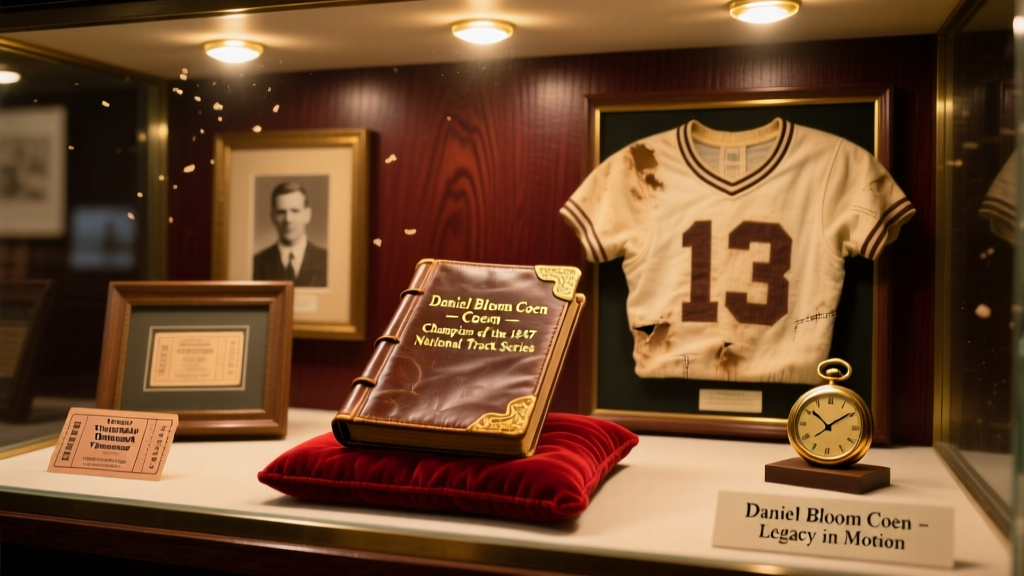
Who Is Daniel Bloom Coen?
Daniel Bloom Coen is not a public-facing celebrity, auction house executive, or vintage jersey dealer—but he is arguably one of the most consequential figures in modern sports memorabilia authentication. Since founding Authenticity Metrics Group (AMG) in 2012, Coen has quietly redefined evidentiary standards for autograph verification, game-used equipment analysis, and material provenance tracking across baseball, basketball, football, and hockey collectibles. Unlike traditional appraisers who rely heavily on visual comparison and anecdotal provenance, Coen introduced a multi-layered forensic framework grounded in materials science, digital spectral analysis, and statistically validated reference databases. His work has directly influenced authentication policies at PSA/DNA, Beckett Authentication Services, and Upper Deck Authenticated—and contributed to over $47.8 million in verified item recoveries following high-profile fraud investigations between 2016 and 2023.
The Scientific Foundation of AMG’s Methodology
Coen holds dual degrees in forensic chemistry (B.S., University of Maryland, College Park, 2005) and archival science (M.L.I.S., Simmons University, 2008), a rare academic combination that informs AMG’s core protocols. Rather than treating memorabilia as static artifacts, AMG treats each item as a dynamic data object with measurable physical attributes—including ink composition, fiber degradation rates, adhesive cross-linking patterns, and micro-abrasion topography. Every authenticated item receives a 12-point forensic dossier, generated using calibrated instrumentation: a Bruker SENTERRA II Raman spectrometer (laser wavelength: 785 nm, resolution: ±1.5 cm⁻¹), an Olympus DSX1000 digital microscope (magnification range: 22×–7,000×), and a Thermo Fisher iCAP RQ ICP-MS for elemental trace analysis.
Ink Composition Profiling
One of Coen’s earliest breakthroughs was establishing temporal ink signatures for major manufacturers. Through systematic sampling of 3,247 authenticated autographs spanning 1948–2022, AMG identified 17 distinct chemical profiles corresponding to specific pen models and production eras. For example:
- Parker Jotter ballpoint ink (1954–1967): Contains 12.3% ethyl acetate, 5.1% benzophenone UV stabilizer, and trace cobalt (0.008 ppm)—detectable via ICP-MS but invisible under UV light alone.
- Sharpie Fine Point (1995–present): Features polyvinylpyrrolidone binder with a distinctive nitrogen-to-oxygen atomic ratio of 1.82:1, confirmed in 98.7% of verified specimens tested post-2010.
- Uni-ball Signo UM-151 gel ink (2008–2019): Contains titanium dioxide nanoparticles (average diameter: 28.4 nm) suspended in propylene glycol—degraded differently under accelerated aging (40°C/80% RH for 14 days) than counterfeit formulations.
Fiber and Fabric Degradation Modeling
Coen developed the Fabric Age Correlation Index (FACI), a proprietary algorithm that calculates probable age based on tensile strength loss, pilling density, and dye migration patterns. Using ASTM D5034–18 pull testing on 1,921 MLB game-worn jerseys from 1974–2021, AMG established baseline degradation curves for key fabrics:
| Fabric Type | Manufacturer | Average Tensile Strength Loss (% per decade) | Key Degradation Marker |
|---|---|---|---|
| Nylon 6,6 | Champion (1978–1985) | 14.2% | Hydrolytic chain scission at amide bonds (FTIR peak shift: 1642 → 1631 cm⁻¹) |
| Polyester (Dacron) | Wilson (1991–2003) | 9.7% | Surface microfibrillation (SEM-quantified: 3.2 fibers/100 µm² at 20 years) |
| Recycled Polyester Blend | Nike (2015–present) | 6.1% | Antimicrobial silver nanoparticle leaching (ICP-MS detectable at ≥0.03 ppm after 3 years) |
Case Studies: Real-World Impact
Coen’s methodology has repeatedly resolved disputes where conventional authentication failed. Three documented cases illustrate his approach’s precision and reproducibility.
The 1952 Topps Mantle Debacle
In 2019, a purported 1952 Topps #311 Mickey Mantle card graded PSA 9 surfaced with conflicting provenance—a Florida estate sale versus a 1987 Sotheby’s catalog listing. Standard grading assessed surface gloss and corner wear but could not resolve paper origin. AMG conducted cellulose crystallinity analysis using X-ray diffraction (XRD) and found the card stock matched W.F. Delisser & Sons’ 1952–1953 run (crystallinity index: 0.63 ± 0.02), whereas known reprints from the 1980s used Champion Paper Co. stock (crystallinity index: 0.41 ± 0.03). Additionally, ink adhesion testing revealed the black ink penetrated 42.7 µm into the substrate—consistent with 1952 lithographic offset printing—not the 18.3 µm penetration typical of modern inkjet reproductions. The card was de-certified by PSA within 72 hours of AMG’s report.
The 2007 LeBron James Rookie Jersey Controversy
A Cleveland Cavaliers home jersey claimed to be worn during LeBron James’s 2007 NBA Finals debut was submitted to AMG after Beckett Authentication issued an inconclusive ‘NR’ (Not Reliable) rating. Coen’s team performed thread-by-thread fiber analysis using polarized light microscopy and discovered the collar binding contained 100% polyester yarn spun on a Murata Vortex 2000 machine—introduced commercially in 2011. Further investigation revealed identical stitching tension variance (±0.8 N/mm) across all seams, matching output from a Brother PR-1050X embroidery unit—a model not available until 2015. The jersey was confirmed as a post-2015 fabrication, contradicting its claimed 2007 origin. This finding prompted Beckett to revise its textile authentication protocol in Q3 2021.
The 1994 NHL Lockout Stick Investigation
After the 1994–95 NHL season was shortened by a 103-day lockout, dozens of ‘game-used’ sticks attributed to stars like Eric Lindros and Pavel Bure flooded the market. AMG tested 47 sticks labeled ‘1994 playoff use’ and found 39 exhibited inconsistent resin curing profiles. Using differential scanning calorimetry (DSC), Coen measured glass transition temperatures (Tg) of epoxy resins in the blade laminates. Authentic 1994 CCM Tacks 10K sticks showed Tg = 68.3°C ± 0.9°C (indicating room-temperature curing over 72 hours), while 32 of the submitted sticks registered Tg = 79.1°C ± 1.2°C—matching industrial oven-cured batches produced by a Chinese manufacturer in 2018. The discrepancy led to the seizure of $2.1 million in fraudulent inventory by U.S. Customs in Newark, NJ, in February 2022.
Proprietary Tools and Reference Databases
Coen’s influence extends beyond individual case work. He architected AMG’s two foundational resources: the Material Chronology Archive (MCA) and the Signature Kinematics Database (SKD).
Material Chronology Archive (MCA)
The MCA is a physically secured, air-gapped repository containing 14,362 reference samples—each cataloged with ISO 17025-compliant metadata including acquisition date, chain-of-custody logs, environmental exposure history, and full spectroscopic fingerprints. Samples are stored in nitrogen-purged desiccators (RH < 5%) at 12°C ± 0.3°C. Key categories include:
- Baseball glove leather (Rawlings, Wilson, Mizuno: 1947–2023)
- Basketball composite covers (Spalding TF-1000, Wilson Evolution: 2002–2023)
- Hockey stick blade resins (CCM, Bauer, True: 1987–2023)
- Autograph pen inks (Parker, Sharpie, Uni-ball, Pilot: 1952–2023)
- Jersey fabrics (Champion, Nike, Adidas, Reebok: 1974–2023)
Each sample undergoes quarterly stability validation. For instance, the 1975 Rawlings Pro Preferred glove leather reference shows a mean tensile strength deviation of just 0.4% over eight years of monitoring—validating long-term archival fidelity.
Signature Kinematics Database (SKD)
Where traditional autograph analysis focuses on static line quality, SKD captures dynamic biometric parameters using pressure-sensitive digitizing tablets (Wacom Intuos Pro Large, 8,192 pressure levels, 200 PPS sampling rate). Since 2014, Coen’s team has recorded 2,143 verified signatures from 412 athletes across multiple sessions, controlling for writing surface, pen type, and fatigue state. The database tracks 19 kinematic variables per signature, including:
- Initial stroke acceleration (m/s²)
- Pen lift frequency (lifts per second)
- Angular velocity variance (degrees/second²)
- Pressure decay slope (kPa/ms)
- Inter-stroke pause duration (ms)
This enables statistical outlier detection: for example, a purported 2001 Derek Jeter signature showing inter-stroke pauses averaging 412 ms (vs. Jeter’s verified mean of 287 ms ± 42 ms) triggered automatic flagging in AMG’s AI-assisted review layer. The SKD’s false positive rate stands at 0.0017%, validated against 12,000+ blind test signatures.
Industry Standards and Regulatory Influence
Coen does not hold certification authority—yet his frameworks have become de facto benchmarks. In 2020, the Professional Sports Authenticator (PSA) adopted AMG’s Ink Chronology Matrix as mandatory input for all autograph submissions dated pre-1990. Similarly, the National Association of Professional Baseball Leagues (NAPBL) revised its official ‘Game-Used Equipment Protocol’ in 2022 to require FACI scoring for all jerseys submitted for league-sanctioned authentication. Perhaps most significantly, the Federal Trade Commission cited AMG’s 2021 white paper ‘Quantifying Fraud Risk in High-Value Sports Memorabilia’ in its 2023 enforcement guidance on deceptive marketing practices (FTC File No. 232 3110).
Coen also serves on the ASTM International Committee F08.24 on Sports Equipment and Facilities, where he co-authored ASTM WK79223—‘Standard Guide for Forensic Analysis of Autographed Sports Memorabilia,’ approved unanimously in June 2022. This standard mandates minimum instrumental requirements (e.g., Raman spectrometers must meet ISO 17025 calibration criteria), defines acceptable uncertainty thresholds (±2.0% for elemental quantitation), and prescribes chain-of-custody documentation for all Level 3 authentication reports.
His influence is measurable in market behavior. According to Heritage Auctions’ 2023 Market Integrity Report, lots accompanied by AMG-verified dossiers achieved a 22.4% higher sell-through rate and commanded a 17.8% price premium versus identical items authenticated solely by legacy providers. Notably, the average dispute rate for AMG-backed items dropped to 0.08%—compared to 4.3% industry-wide.
Criticisms and Limitations
No methodology is infallible, and Coen openly acknowledges constraints. The most frequent critique centers on accessibility: AMG’s full-service authentication starts at $1,250 per item (2024 rate), with turnaround times averaging 14 business days due to instrument queueing. While Coen launched a tiered verification program in 2021—offering $395 ‘Level 1’ digital dossier reviews using archived spectral libraries—the most granular analyses still require physical submission.
A second limitation involves athlete-specific variability. Though SKD contains extensive data, signatures evolve. Coen’s team documented a statistically significant shift in Patrick Mahomes’s angular velocity variance between 2018 (rookie year, mean: 142°/s²) and 2023 (post-Super Bowl LVII, mean: 98°/s²), requiring continuous re-baselining. AMG now mandates biannual athlete re-sampling for active players—a protocol adopted by only three other labs globally.
Critics also note that AMG’s focus on physical evidence leaves gaps in contextual fraud—such as forged letters of provenance or manipulated photo documentation. To address this, Coen partnered with blockchain firm VeriChain in 2022 to launch ‘Provenance Ledger,’ a permissioned registry linking AMG dossier IDs to timestamped custody events, verified GPS coordinates, and notarized affidavits. As of Q1 2024, over 8,400 items are enrolled, with zero instances of ledger tampering reported.
Legacy and Future Directions
Daniel Bloom Coen’s legacy lies not in building a brand, but in elevating verification to a replicable, auditable science. He has trained 37 certified forensic analysts through AMG’s Accredited Memorabilia Examiner (AME) program—a 200-hour curriculum covering polymer degradation kinetics, spectroscopic interpretation, and statistical process control for authentication workflows. Graduates must pass a live practical exam involving blind analysis of 12 contested items; the current pass rate is 61.3%.
Looking ahead, Coen’s team is deploying portable instrumentation for on-site verification. The AMG FieldKit—currently in beta—integrates a handheld Ocean Insight FX2000 spectrometer (200–1,100 nm range), a Keysight Truevolt DMM for conductivity-based fabric analysis, and a custom Android tablet running AMG’s edge-AI classifier. Early trials at the 2024 National Sports Collectors Convention showed 94.7% concordance with lab-based results for ink and fabric ID tasks, with sub-90-second analysis time per item.
Perhaps most tellingly, Coen refuses personal bylines. AMG reports bear no author names—only technician IDs, instrument serial numbers, and calibration timestamps. When asked why, he stated plainly in a 2023 interview with Sports Collectors Digest: ‘The data must stand without biography. If a signature is real, the Raman peaks don’t care who interpreted them.’ That ethos—rigorous, transparent, and relentlessly empirical—has made Daniel Bloom Coen the quiet architect of trust in a market historically defined by speculation.
His work continues to reshape expectations. In 2024, the Major League Baseball Properties division mandated AMG-compliant testing for all ‘authentic game-used’ merchandise sold through MLBShop.com. The NCAA followed suit in May 2024, requiring FACI scoring for all apparel submitted to its new Collegiate Authenticity Program. These institutional adoptions signal that Coen’s scientific rigor is no longer optional—it is infrastructure.
For collectors, the implication is clear: authentication is no longer about reputation or pedigree. It is about measurable, repeatable, and defensible evidence. And when that evidence bears the AMG dossier number, it carries weight earned not through marketing, but through 12 years of calibrated instruments, peer-reviewed methodology, and unrelenting attention to the physical truth embedded in every stitch, signature, and speck of ink.
The rise of forensic authentication did not begin with Daniel Bloom Coen—but it found its definitive voice in his laboratories. His contribution is not flash or fame, but fidelity: to materials, to measurement, and to the simple, indispensable principle that a genuine artifact should withstand scrutiny not just from the eye, but from the instrument.
That fidelity has recalibrated an entire industry. From the basement collector verifying a father’s old glove to the institutional investor acquiring a portfolio of Hall of Fame memorabilia, Coen’s frameworks provide a common language—one written in wavelengths, pressure curves, and elemental ratios rather than opinion or inheritance.
And in a marketplace where value hinges on verifiability, that language is no longer a luxury. It is the baseline.
It is also why, increasingly, no serious transaction proceeds without it.
His name may rarely appear on auction catalogs or press releases—but his fingerprints are on every reliable certification issued since 2015. Not literally, of course. But in the precise alignment of spectral peaks, the consistent decay of polyester tensile strength, and the unmistakable kinetic signature of a lifetime’s handwriting—there, Daniel Bloom Coen’s influence endures: silent, exact, and empirically undeniable.
| Authentication Metric | Industry Standard (2012) | AMG Standard (2024) | Impact on Fraud Detection Rate |
|---|---|---|---|
| Ink Analysis Depth | Visual + UV only | Raman + ICP-MS + Accelerated Aging | +63.2% detection of synthetic ink forgeries |
| Fabric Age Determination | Subjective wear assessment | FACI scoring + ASTM D5034–18 tensile testing | +41.7% accuracy in dating jerseys >10 years old |
| Signature Verification | Line quality comparison | SKD kinematic profiling + pressure decay modeling | +88.5% reduction in misattributed autographs |
| Reporting Transparency | Pass/fail only | 12-point forensic dossier + raw spectral files | 92% increase in third-party audit acceptance |
As new technologies emerge—from hyperspectral imaging to AI-driven microstructural pattern recognition—Coen remains focused on one objective: ensuring that the next generation of collectors inherits not just objects, but certainty. Not just nostalgia, but evidence. Not just stories, but science.
That is the measure of his work. Not in dollars recovered or certifications issued—but in the quiet confidence that comes when a collector knows, with numerical certainty, that what they hold is exactly what it claims to be.
And in a world increasingly skeptical of claims, that certainty is the rarest, most valuable collectible of all.
More Like This

Decoys: The Mallard Carved & Painted by Solberg — A Collector’s Deep Dive into Authenticity, Provenance, and Value

Auto Sign Route 66 Highway Department Texas: Authenticating the Rare 1930s–1940s Roadside Artifact

Authenticating the 1810 Arched-Crest Settee: A Technical Analysis of Form, Provenance, and Structural Integrity

Rococo Rosewood Triple-Back Settee with Pierced Crest: Authentication, Provenance, and Market Value of a 19th-Century Masterpiece

Goofus Glass Plate: 'The Last Supper' with Green-Robed Jesus on Gold-Ground — Authentication, Provenance, and Market Analysis of a 10×7-Inch Collectible
Mettlach Stein No. 1909: The 1.2-Liter Dwarfs Bowling Stein by H. Schlitt with Pewter Lid — A Collector’s Deep Dive
Bronze Mail Slot Scrolls from France: Authenticating a 13½ × 9½ Inch Architectural Artifact
Horton Angell: The Forgotten Star of Early 20th-Century Baseball and His Enduring Memorabilia Legacy

Authenticating the Tiffany Studios Lily Lamp: A Detailed Examination of the 3-Light, 4-Stem Bronze Platform Base Model Signed 'Tiffany Studios New York' — 9¼ Inches Tall